• Older Is Wise Guy-er

    The good thing about older prison inmates is that they tend to be less violent than their younger peers. It helps keep down on the guard-staffing expenses when the warden doesn’t have to worry about convicts knifing one another in the exercise yard or sexually assaulting the beta males in the showers.

    The bad thing about older prison inmates is that they’re not as healthy. Now there are so many gaffers in the hoosegow that their medical bills are creating a financial problem for the corrections system. Not only has the number of inmates in Virginia age 50 or older increased nearly sevenfold over the past 20 years, reports the Washington Times, the average cost of providing them with specialized health care was nearly seven times the average expenses for younger prisoners in fiscal 2010.

    The cost per capita to house an inmate in the previous fiscal year was about $24,000, one corrections officials said. But at Deerfield Correctional Center, a special-needs facility in Capron with an average inmate age of 55, the cost was $29,600.

    Politicians are exploring the option of expediting geriatric releases. That’s a clever idea. Shift the health care burden to Medicare and Medicaid!

    — JAB


  • McDonnell’s Energy Pep Rally

    By Peter Galuszka

    One conceit of Gov. Robert F. McDonnell is that he magically wants to transform Virginia into “The Energy Capital of the East Coast.” The idea smacks of Alice in Wonderland.

    An example is “The Governor’s Conference on Energy,” that began in Richmond onย  Monday. I dropped by today and noted that the conference logo has a map with the state colored red as the aforementioned energy capital. There were the usual fossil fuels — coal, petroleum and natural gas — represented in exhibits along with a fair showing of nuclear power. Scattered here and there were cogeneration and wind turbine possibilities.

    A keynote speaker was by Christine Todd Whitman, a former New Jersey governor and head of the U.S. Environmental Protection Agency under George W. Bush from 2001 to 2003. During her tenure, she helped emasculate the agency. She now advocates nuclear power.ย Despite the Fukushima disaster and the fact that Dominion’s North Anna nuclear plant remains shut down after a 5.8-scale earthquake on Aug. 23, Whitman beat the drum for more nuclear plants.

    Coal companies also had a big role, likely because Dominion and American Electric Power, the state’s two largest utilities, have a large coal-fired capacity. And McDonnell is still pushing for oil drilling off the state’s coast despite the Deepwater Horizon disaster and the lack of evidence of any significant deposits.

    The favored mix did not sit well with the few environmentalists at the conference. “It’s nuclear, nuclear, coal, coal, gas,” Glen Besa, an official with the Sierra Club told me. In fact, the Sierra Club intends to give a counter
    speech favoring non fossil and alternative energy as McDonnell gives his
    keynote address Tuesday evening.

    There’s more odd about the conference. The “Energy Capital” moniker is a bit of a stretch for one thing. Take coa. The coalfields in far Southwestern
    Virginia produce between 30 to 40 million tons a year. Next door, West Virginia produces 144 million tons and Kentucky 96 million tons a year. Total U.S. production is about 1 billion tons, so Virginia’s 40 million tons is rather puny.

    Ditto oil. There’s isn’t much in Virginia although there are natural gas wells. Nuclear? In the state are four reactors, two of which are shut down due to the earthquake.

    Yet there’s lots of interest in wind, especially offshore where Google plans a big farm and on the Eastern Shore where a turbine test facility is planned. Plenty of wind blows in the mountains near the West Virginia border. McDonnell ought to emphasize wind a lot more than he does.

    Another curiosity is that the conference entrance fee was $245 ($50 for students).ย In ย other words, the conference was not intended as an informational session for the general public. Rather, it was a pep rally for well-heeled energy executives who might enjoy the governor’s nonsense about Virginia being the “Energy Capital of the East Coast.”


  • Women and Children First!

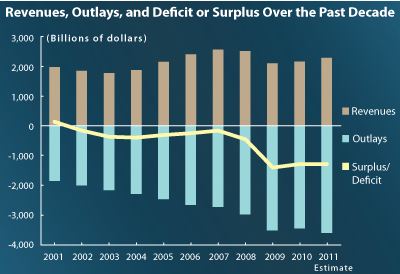
    Source: CBO. Click the chart to view more legible image.

    by James A. Bacon

    Boomergeddon is running right on schedule. The Congressional Budget Office released a report earlier this month disclosing that the federal budget deficit for Fiscal Year 2011, which closed September 31, was $1.3 trillion — equal to 8.6% of GDP. Two years into the economy recovery, the United States still racked up the third largest percentage deficit since the end of World War II. Meanwhile, economic recovery continues to drag. We’ll all consider it a triumph of economic policy simply to avoid a double-dip recession. One way or the other, the outlook is for chronic annual deficits above $1 trillion.

    The response of President Obama to the nation’s fiscal challenge is so inadequate as to be contemptuous. As if $1.3 trillion in deficits weren’t sufficient counter-cyclical spending, he proposes to roll out a $450 billion Son of Stimulus. His plan: Keep the economy running on Keynesian crack, fight cuts in government programs, beat Republicans with the class warfare stick and raise taxes on job creators. If Obama were the captain of the Titanic, he’d be manning the helm and shouting, “Damn the iceberg, full speed ahead!”

    But are the Republican candidates much better? To the extent that they don’t propose running up $450 billion in extra deficits, they would not accelerate the ruination of the country, as Obama would do. But to the extent to which their deficit cutting plans are weak-kneed and lily-livered, they won’t avert Boomergeddon. They will just put the economy on a slow glide path to catastrophe.

    Mitt Romney, who represents the technocratic wing of the Elephant Clan, has called for initial cuts to non-security discretionary spending of $20 billion, reports the Wall Street Journal. But he won’t cut defense and hasn’t proposed serious entitlement reform. He would roll back corporate taxes and eliminate capital gains, dividends and interest for taxpayers earning less than $200,000. But even with dynamic scoring (recognizing that lower tax rates stimulate growth), the tax plan is not likely to pay for itself. Bottom line: The GOP front runner is the proverbial guy who wants to rearrange the deck chairs on the Titanic.

    I have taken a liking to the plain-talking ways of Herman Cain, and conceptually I like his 9-9-9 tax plan, which calls for a flat 9% personal income tax, a 9% corporate tax and a 9% national sales tax. I do believe it would stimulate growth and create jobs — but it would be revenue neutral only if it delivered the promised growth and counted the tax revenue generated by that growth. So, even if it works as billed, Cain’s plan would create jobs but it wouldn’t cut the deficit. I have heard Cain say very little about how he would close that $1.3 trillion budget gap through spending cuts. If he were captain of the Titanic, he’d be saying, “Let’s poke around in the engine room and see what we can do.”

    Only one candidate gets it, and that is Ron Paul. He laid out a plan yesterday that would cut federal spending by $1 trillion during his first year in office, achieved partly by eliminating the departments of Education, Commerce, Interior, Energy and Housing and Urban Development, as well as halting foreign aid, “ending foreign wars” and throwing in some tax cuts. Credit Paul for recognizing the magnitude of change that needs to be made. (As it happens, closing the budget gap by $1 trillion was the goal I set in Boomergeddon.)

    Just two problems with Paul’s plan. First, it is an outlier. No one but a tiny fringe of the electorate will take it seriously. Most people will recoil at draconian nature of the cuts. Second, there is a legitimate economic criticism that can be leveled at the plan: Whacking $1 trillion in federal spending in a single year would cause massive economic dislocation and plunge the country back into a recession. Paul would save the Titanic from the iceberg by blasting a hole in the hull and preemptively sinking it.

    Our only hope for averting fiscal catastrophe is to enact spending cuts on the $1 trillion scale that Paul proposes but easing into them over several years so as to temper the economic pain and minimize the political backlash that could lead two years later to the plan’s undoing. It wouldn’t hurt to throw in a dose of Herman Cain-style tax reform to energize the economy. U.S. businesses are sitting on $2 trillion or more in cash. If we can create the conditions to get corporations and entrepreneurs investing and hiring again — sorry, but protecting the jobs of teachers and fire fighters, as our president proposes, won’t do the trick — perhaps we can grow our way out of the doldrums.

    But anyone who tells you can we achieve fiscal sustainability on the cheap and easy is a fool. And anyone who tells you we can kick the can down the road forever is a liar.


  • Live by the Sword, Die by the Sword

    by James A. Bacon

    Northern Virginia has long been a leading center of the defense industry, a fact of which I have been aware ever since my dad transitioned out of the Navyย  by working briefly for a consulting firm in Crystal City.ย  In the defense industry, like in any other, it is critical to maintain a close relationship with the customer. Defense contractors figured out decades ago they had to have a physical presence near the Pentagon.

    Defense manufacturing is famously scattered across the country, driven not by the conventional metrics of workforce skills, wage levels, cost of real estate and transportation access but by political patronage. But defense headquarters have clustered in the Washington metropolitan area, where executives can easily access the Pentagon, Congress and, increasingly importantly, other defense contractors as partners, vendors and customers. In sum, Northern Virginia has emerged as the dominant defense-industry cluster in the world, a fact of which I was reminded by reading this article in Forbes.

    With the exception of Martin Marietta headquartered in Maryland, every major defense contractor worth noting either has a corporate headquarters in Northern Virginia or a large corporate office. Big names include General Dynamics, SAIC, Computer Sciences Corporation, DynCorp, Booz Allen Hamilton, ITT Defense, and the U.S. arm of BAE Systems. Forbes notes that Boeing will move its senior defense executives to Arlington in two years, and it’s conceivable that the rest of the defense headquarters, now in St. Louis, will follow. Now that the defense cluster has achieved critical mass, every player or would-be player needs to move to Northern Virginia just to be where the action is.

    Back in the late 1990s when I was publisher of Virginia Business magazine and paid closer attention to such things, I followed with great interest the activities of the Northern Virginia Technology Council and other groups that labored tirelessly to build Northern Virginia into a world-class center of technology innovation. During the Internet boom, for instance, Northern Virginia seemed to be on the verge of developing a self-sustaining cluster of Internet and telecommunications firms. But the Internet bubble burst, MCI went spectacularly bust and AOL, whose dial-up subscription model proved obsolete, moved its headquarters to New York. The regionย  tried, and failed, to create a venture capital-driven model of growth comparable to Silicon Valley and Boston.

    Why, despite its awesomely educated and tech-savvy workforce and its entrepreneurial energy, has NoVa remained an innovation also-ran? What has held it back from making the leap to the big time?

    The dominance of the defense industry is the region’s greatest strength and greatest weakness. On the one hand, the military-intelligence-homeland security complex of industries is incredibly information intensive. Consequently, the players in this sector are savvy users of technology. That’s why the concentration of technology skills in Northern Virginia is one of the greatest in the world. On the other hand, the culture of defense procurement is extraordinarily rules driven, and its complexity has only gotten worse every time someone tries to reform it. The procurement process favors incremental innovation over the kind of disruptive innovation that emerges from Silicon Valley.

    Northern Virginia’s competitive advantage in defense contracting is difficult to transfer to other industries. Thus, what’s good for defense is not necessarily good for technology companies whose customer isn’t the federal government. The defense-fueled prosperity of Northern Virginia sends rents and other business costs higher, mires the region in traffic jams, and skews technology talent toward systems-integration rather than product development. In effect, I would argue, the defense sector is crowding out small, non-defense technology companies for whom it would be senseless to pay a premium to locate in Northern Virginia.

    It’s been invigorating for Virginia to ride the defense boom of the past decade, which has experienced extraordinary growth in spending on defense, intelligence and homeland security. But the nation has reached a tipping point. Defense spending, like all federal spending, will slow — if not go into reverse. The defense sector will experience hard times. The great question is whether, given the fact that the region’s competitive advantage lies in its mastery of the arcane federal procurement process, Northern Virginia can reinvent itself. Let us hope that it can.


  • Virginia’s Brain Drain

    by James A. Bacon

    California has a lot of problems, including a dysfunctional political system, structural budget deficits and a lousy business climate. But it’s still a magnet for some of the world’s most talented scientists and engineers. According to a new Milken Institute study, “What Brain Drain? California among the Best in the U.S. at Retaining Skilled Workers,” the Golden State had nearly the best record among the 50 states for retaining skilled workers. Between 2000 and 2009, roughly 35% of skilled (college educated), native-born Californians lived outside the state, compared to 50% for the average state.

    And how did Virginia fare? Not very well. Roughly 53% of skilled native-born Virginians lived outside the state during the same decade. Bottom line: Skilled Virginians are more likely to leave their home state in search of opportunity and a better life than other Americans are.

    California’s Achilles heel has been its ability to lure skilled, native-born Americans into the state. But it has more than compensated by its ability to attract skilled, foreign-born workers — and to retain them at a much higher rate than the national average. (It’s not clear from the numbers how many move back to their own countries, as opposed to other states in the U.S.) Virginia, conversely…. not so good. We retain skilled, foreign-born workers at a lower level than the national average.

    The Milken study warns that California must avoid complacency. Technology clusters are developing in other regions of the country — Texas, in particular, has an even better track record of attracting and retaining skilled workers.

    Californians also should be alarmed by the mounting dissatisfaction of many businesses, a problem highlighted in a Wall Street Journal op-ed published today by Steve Malanga. California perennially ranks near the bottom of “business climate” surveys, and nobody’s perceptions seem more negative than those of California businesses themselves. He writes:

    According to a poll by a California coalition of businesses and industries, 84% of executives and owners said that if they weren’t already in the state, they wouldn’t consider starting up there, while 64% said the main reason they stayed was the difficulty of relocating their particular kind of business. For several years in a row, California has ranked dead last in Chief Executive magazine’s poll about states’ business environments.

    Despite their unhappiness, most businesses stay. And the access to human capital is undoubtedly a major reason why.

    Meanwhile, Virginia may revel in its “best state for business” awards but outside of Northern Virginia, the state’s economic performance plods ahead roughly in line with the national averages. We may excel at traditional, ’70s-era corporate recruitment, which may account for 20% or so of new job creation, but Virginia still has no coherent policy to recruit and retain top scientific, technical and entrepreneurial talent — the so-called creative class so critical to economic growth.

    At least we can look forward to the completion of the Longitudinal Data System that will allow researchers to track the movement of Virginians of varying levels of educational achievement into the workforce and in/out of the state. One day we’ll be able to routinely conduct the same kind of analysis as the Milken Institute, though at a far greater level of detail.ย  Maybe we can start thinking seriously then about our own Brain Drain.


  • Budget Busters Thrown Again

    While the budget busters in Washington struggle to tame trillion-dollar deficits for years to come, they keep getting thrown. The Obama administration took a particularly nasty spill yesterday, announcing that the Community Living Assistance Services and Supports (CLASS) program, a long-term care initiative embedded in Obamacare, is beyond salvage. “Despite our best analytical efforts, I do not see a viable path forward for CLASS implementation at this time,” Kathleen Sebelius, secretary of health and human services, said in a letter to congressional leaders.

    As AP reports, CLASS was supposed to function as a voluntary and self-sustaining long-term care health plan. But the program was fatally flawed: Unless large numbers of healthy people willingly sign up during their working years, soaring premiums driven by the needs of disabled beneficiaries would destabilize it, eventually requiring a taxpayer bailout.

    Now the O Team has to write off $80 billion of the “deficit reduction” it expected from Obamacare over the next 10 years. During the early years, when far more people were paying into the program than taking benefits from it, CLASS would have run a positive cash flow. Those revenues were credited for purposes of calculating the fiscal impact of Obamacare. As enrollees aged and started availing themselves of the service, the program would have cost the government money. But the impact wouldn’t felt until after the 10-year budget scoring, so no one but anal-compulsive CPAs and Republicans cared.

    Now that the O Team has abandoned the fiction that the CLASS program is financially sustainable, it will have to delete the $80 billion net revenue from its 10-year budget forecasts.ย  That may not seem like much in comparison to the $7.2 billion in projected deficits, but it will make the job of closing the gap that much harder. Boomergeddon looms a little bit closer.

    — JAB


  • Can Japan Keep Pitching?

    By Peter Galuszka

    (Last of a series)

    TOKYO, Japan — “Technology is like water, it runs down hill.”

    My old Japanese friend and I are chowing down on delicious fried oysters and sashimi in a downtown Tokyo restaurant. We had just had drinks at the Foreign Correspondents Club Of Japan which offers a spectacular, 20th floor view ofย  the city, including parts of the Ginza shopping district.

    My journalist friend’s comment is at once wistful and annoyed. He’s sick and tired of hearing about the Chinese “miracle” when much of the technology that the Chinese have used isย  from Japan, the U.S., Germany or other more advanced nations.

    I agree with him. I have been skeptical hearing about the wonders of the Middle Kingdom since it became fashionable when I was a middle-ranking editor on the international desk of a business magazine in New York back in the late 1980s and early 1990s. Although I am not a China hand and know little about the country, I keep noting that for every high speed train, there’s a high speed train crash that the government wants to cover up. Many Chinese products have the taint of intellectual property or brand theft. The miracle of millions of skillful, hard-working laborers churning out products for export doesn’t shed light on one-sided currency exchange rates or the labor conditions in which those products were made.

    Not that long ago, Japan seemed to be where it was happening. Back in the 1980s, the buzz was that the Nipponese onslaught was moving from cars and consumer electronics to snapping up choice Manhattan real estate and buying big movie houses, controlling our media.

    Alas, the real estate bubble in Japan hit and a “lost decade” of deflation followed. Japan is still staggering from it. Economists faulted the country for not taking enough steps to reconfigure the old “keiretsu” structure of big banks, government organizations and trading agencies all working towards common industrial policy and trade goals. Too slow to change, Japan was trapped and paid the price.

    China faces the same pressures. It is, after all, a communist dictatorship that has ultimate say on all political, economic or civil rights issues. The plus is that it can make decisions quickly at least big decisions. It has the finances to build quickly and invest heavily in the U.S. This is an irony for conservative Americans who tout China because theyย  want to make money from it, but somehow forget that it stands for all of the things they loathe, such as big regulation, government oversight and spending.

    My friend and I would like to see a return to the old days when Japan led Asia with close cooperation from Washington. Despite the horrors of World War II, it seemed a natural fit.

    That idea, however, unravels the minute I step into a taxi. The drivers are invariably grandfatherly men in black suits and white shirts. They will take credit cards for the ridiculously expensive rides to the hotel. They must bow and hand you scrap after scrap of paper. Ditto trying to find an ATM that will issue a foreigner cash. Most ATMs work only with Japanese banks. And while the subway and train systems are fast and efficient with extremely courteous staff, they seem unnecessarily complex and old. At my mostly-Japanese hotel, when they serve a tasty breakfast buffet, they actually play elevator music from the 1960s, including (believe it or not), Mantovani. I sip my soup listening to “Born Free.”

    Indeed, Japan’s biggest problem is not spirit or smarts. It is age. Demographics are against it. Japan has the largest percentage of elderly of any advanced country. About 21 percent of the population is older than 65 years old. It has always been hard for foreign firms to crack the Japanese market, but some now shun it because the population is getting too old. Meanwhile, national champions such as Sony or Toyota seem as ancient as a Madonna CD. In the latter case, a shameful breakdown in quality tarred the once-popular car maker.

    Can Japan keep pitching? Can the U.S.? Both long-time allies face similar challenges. My guess is yes, but not until the current Asia set-up
    changes once more.


  • And the Band Played On

    By Peter Galuszka

    (Fourth of a series)

    FUKUSHIMA, Japan — About an hour and a half north of Tokyo by bullet train, ย the city of Fukushima is enjoying a fall festival. A brass band (see photo) belts out tunes while two young policewomen in sky blue uniforms have their pictures taken with children sitting atop their white Honda motorcycles. Jack-o-lanterns, Japanese-style, dot posters. Doting grandparents shoot pictures of their grandchildren riding a miniature steam train.

    There’s little evidence that one of the worst nuclear disasters ever occurred last March 11 not 36 miles away on a rocky stretch of Pacific coastline. The meltdown of three nuclear reactors at the Daiichi power plant was the worst accident since Chernobyl and caused the deaths of more than 45 people, the evacuations of 130,000 and may cause untold future cancer illnesses and fatalities.

    The only new information, as a friendly Fukushima resident shows me, is a newspaper article showing the radiation zones in a newspaper article. The most intense zone runs about 20 kilometers from the power station, including parts out to sea.

    It is the worst zone. Gamma rays, that can penetrate anything except lead, are prevalent. Theย zoneย includes all or part of eight local jurisdictions. Extending another 10 kilometers out in another zone, land and buildings are somewhat less irradiated but still cannot be occupied. There are roadblocks on all roads leading into these zones.

    The newspaper articles purports to outline just how many houses and other properties there are in these restricted zones and howย  much people can expect to be compensated for them. I haven’t done an exact count but they appear to be between 5,000 and 10,000. People from the houses are living in temporary shelters with with families or friends elsewhere.

    One would never know it from the pleasantries in the downtown of Fukushima city, but the nuclear disaster has serious implications on a global, as well as local, basis. Concerns about global warming had been pushing sentiment in favor of nuclear power as opposed to coal, but that’s shifted back again. The United Bank of Switzerland says that the Japanese mess may result in the closing of 30 other nuclear reactors around the world. In Germany, Chancellor Angela Markel said her country would shut down its reactors. German engineering conglomerate Siemens announced it was getting out of the nuclear business. China, on the other hand, intends to expand its nuclear generation capacity to offset its 70 perent reliance on coal.

    Back in Virginia,ย ย the region got a taste of Fukushima on Aug. 23 when a 5.8 Richter scale earthquake, much smaller thanย  the tsunami that touched off Fukushima’s nuke disaster but still unexpectedly strong, jarred the North Anna nuclear plant operated by Dominion Virginia Power. It forced a shutdown of two reactors while heavy casks of spent nuclear where shaken loose. A review by the Nuclear Regulatory Commission shows that perhaps 25 other nuclear reactors may need new earthquake safety upgrades.

    If you get a map of Virginia and plot the same evacuations zones as at Fukushima, you likely would see the evacuations for weeks, months or years of all or parts of Fredericksburg, Culpeper, Charlottesville and the far western Virginia suburbs of Richmond near Manakin Sabot. These would be roughly a 30 kilometer zone — not the very worst, but still requiring evacuation.

    Fukushima and North Anna also raise serious questions about another Old Dominion project realted to nuclear power. A small group of investors and Canadians called Virginia Uranium plans on mining reserves near Chatham. But if the mood is so against nuclear power, one wonders just how demanding the market for yellowcake is.

    It is anyone’s guess who would pay for the irradiated property in Japan although Munich Re, the reinsurer in the case of Fukushima, says that covering the disaster can be done successfully.

    Costs such as these, whoever, must be kept in mind should nuclear power still proceed. Financial discipline, naturally is the flavor of the times given the currentย  backlash against government spending. Yet that also dooms nukes. Dominion, for instance, requires federal loan guarantees if it wants to proceed with a third unit at North Anna which is likely to cost more than $10 billion. Fat chance of getting it, at least now.

    Meanwhile, on Oct. 15, the New York Times reportedย that about 20 “hot spots” of radioactivity, some withย Chernobyl-level amounts, had been found in Tokyo, 160 miles to the south of Fukushima. Government officials had stubbornly claimed that the contamination was limited to the zone near the stricken plant, but now it seems that the situation is much worse than thought.


  • VDOT Revisits Land Use

    Proposed new regulations would reform โ€“ or undermine, depending upon your point of view — a keystone 2007 law designed to limit the negative impact of local land use decisions upon state roads.

    Subdivision stub outs — sometimes they work better in theory than in practice.

    By James A. Bacon

    In 2007 members of the General Assembly were struck by a revelation: There were ways to address the problem of traffic congestion in Virginia that did not entail building expensive new roads and highways. Gridlock arises not only from a growing population and increasing traffic load but from poor planning and design. Accordingly, the legislature enacted a sweeping overhaul of state law regulating the interface of transportation and land use.

    Provisions of the law required traffic impact analysis for new development, greater street connectivity between new subdivisions and tighter regulation of public access to state highways. The bipartisan action was widely regarded one of the signature achievements of the Kaine administration.

    This year the General Assembly passed a law directing the Virginia Department of Transportation (VDOT) to review the legislation and enact new regulations as needed.ย  A VDOT advisory committee has recommended several changes, which await approval either by the Virginia Highway Commissioner or the Commonwealth Transportation Board.

    The revisions represent a victory for the real estate industry. Two measures โ€“ one that would reduce the size of rezoning projects required to conduct a Traffic Impact Analysis, and another that would modify regulations requiring new subdivisions to connect with one another โ€“ stand out as particularly important. The two provisions will relieve developers and home builders of significant regulatory costs while still preserving the intent of the original law, maintains Mike Toalson, executive vice president of the Home Builders Association of Virginia.

    But smart growth activists say the proposed new regulations will dilute the effectiveness of what had been one of the most progressive efforts in the country to coordinate transportation and land use. Stewart Schwartz, executive director of the Coalition for Smarter Growth, described the 2007 law as an effort to stem the growing and unaffordable list of transportation projects requested by local government and passed up to the General Assembly.

    โ€œWe will never have enough funds to build the quantity of infrastructure created by patterns of development that have been increasingly used since World War II,โ€ Schwartz wrote to Virginia Highway Commissioner Gregory Whirley. โ€œBy preserving the throughput of our highway network through better access management, by measuring traffic impact and applying creative solutions to reduce demand, and by increasing local street connectivity to reduce demand and traffic on our overburdened arterial roadways, we can save the tax payers of Virginia huge sums of money that would otherwise be required for new highways, the widening of dozens of arterials, and the addition of dozens of new interchanges.โ€

    The idea behind the regulations, says Trip Pollard, senior attorney with the Southern Environmental Law Center, is to look before you leap. โ€œYes, there is a cost, but itโ€™s a very reasonable cost.โ€ The proposed revisions โ€œare not the end of the world,โ€ he concedes, and Virginia still will be better off than five years ago. โ€œBut weโ€™re losing a lot here. โ€ฆ If you donโ€™t address transportation and land use, youโ€™ll end up with sprawl and congestion.โ€

    The revisions address three broad areas: traffic impact statements, secondary street acceptance requirements and access management regulations. (View VDOT’s video presentation of the regulatory changes here.)

    Continue reading.


  • The Wonk Salon, October 14, 2011

    Immigrant Demographic Trends in the 2000s
    Brookings Institution
    The foreign-born population in the United States grew by 8.8 million in the 2000s. Immigrants are somewhat more likely to live in the suburbs, to be educated, to reside here a decade or more, and to get naturalized.

    Immigrant Access to Social Services
    Urban Institute
    Even though immigrants are more likely than native-born Americans to be poor, they enrolls in social services programs at a lower rate. Eligibility requirements vary widely across the 50 states.

    The “Growth Model” of School Accountability
    Education Sector
    The Obama administration is pushing a new metric for rating schools: how well they improve student achievement. Growth models appear to be an idea whose time has come.


  • Low-Skilled Workers Take It on the Chin

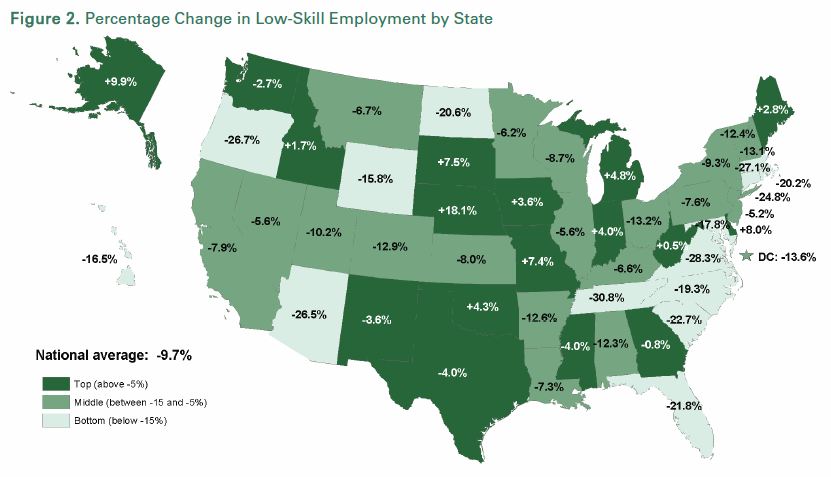
    Percentage change in low-skilled employment by state, 2007 to 2010/2011.

    OK, I was wrong (sort of). Now I’m fessing up. So, get over it.

    While the labor market has deteriorated markedly since the onset of the Great Recession, job losses for low-skilled workers have been especially devastating. And nowhere in the country (literally, nowhere, except in Tennessee) have low-skilled workers been more likely to lose jobs than in Virginia. According to the calculations of the Urban Institute’s Josh Mitchell in “Where It Really Hurts,” Virginia lost 2.7% of its jobs between 2007 and 2010/2011. But the number of low-skilled job declined 28.3%! That compares to a national average of a 9.7% decline in low-skilled jobs.

    Let me be the first to say (before anyone obnoxiously points it out to me) that this data is consistent with the claim made by the Commonwealth Institute, which I dissed a couple of days back in “Virginia’s Skewed Prosperity,” that the wage gap in Virginia has been getting worse. In “Unbalanced, Unequal and Undercut,” CI argued that highly educated workers have prospered while job losses in middle-wage industries have hurt employment opportunities for middle-class Virginians.

    The Urban Institute data supports CI’s assertion that employment in low wage occupations in Virginia has been clobbered and that the gap between high- and low-wage workers continues to grow. I still maintain, as I did in my review, that the statewide wage gap is exaggerated by the growth in population and incomes in Northern Virginia, thus obscuring economic dynamics within individual metropolitan areas. But I repent for saying that the CI study created “a terribly misleading impression.” Overall, CI got it right.

    — JAB


  • Yet Another Mongolian Crossroads

    By Peter Galuszka

    (Third in a series)

    ULAN BAATOUR, Mongolia — Flying into this capital city nestled among treeless, light brown mountains brought back memories of a grimy, industrial Soviet city from 30 years ago. Along the tarmac are rows of cannibalized Antonov 2 biplanes used as crop dusters after World War II along with ubiquitous MI-8 helicopter workhorses.

    The airport parking lot is also a blast from the past. As we struggle with our bags, Mongolian cab drivers scream at us for our business. My Russian-born wife springs into action. By turns playing one cabbie against the other and tough bargaining, besides touching off at least one fist-fight, she gets our fare down from 50,000 tegreg ($30)ย  to 15,000 tegreg (about $12)ย  in exactly 14 minutes — a masterful performance.

    Downtown is a mix of Soviet and new destiny. The sidewalks are cracked lumps of ankle-twisting concrete. Local pedestrians will shove you out of the way. Mongolian drivers are hyper-aggressive, challenging other drivers to showdowns that can be measured in millimeters. Yet against the gels, yurts and Stalinesque buildings are scores of construction gantries providing testimony to Mongolia’s newest crossroads.

    Freed abruptly from its decades’ long role as the Soviet Union’s 16th republica, Mongolia is struggling to position itself between a still-ambitious Russia and a fast-growing China’s with a ravenous appetite for raw materials. Mongolia needs foreign investment badly but has to shake off its bad reputation for lawlessness, corruption and a poor to non-existent infrastructure. As an attraction it has huge reserves of copper, gold and coal.

    The best-known Mongolian, of course, is Genghis Khan, who conquered most of the Eurasian landmass in the 12th century. On the bright side, he brought a sense of law and order to his new empire, introducing such inventions as the diplomatic passport. But G.K. & Sons were among history’s most vicious killers. Their 12th century body county, taken together and adjusted for world population, would be about double that of all the people Hitler, Stalin and Mao slaughtered in the mid 20th century.

    Mongolia has long been feared and abused by both China and Russia. It became a country in 1924 after the Manchus fell apart, but the Soviets were quick to force their influence. To makeย the point with his typical subtlety, Josef Stalin included Mongolia in his 1937 ย purges by accusing Mongolian Communist leader Gendel of collaborating withย  Chinese nationalists and the Japanese.

    The result was the arrest of 56,000 and the execution of 20,000 to 30,000 Mongolians, about 40 percent of the population. The horrible event is marked at the Victims of Political Persecution Memorial Museum tucked away in a hard-to-find part of downtown that is being torn up for new skyscrapers to house foreign consulting, banking, mining and construction firms.

    The museum is not for the squeamish. One exhibit shows the skulls (see
    photo)ย  of some of those executed. They were lined up precisely so one bullet would shatter the skulls of three or four victims. This particular batch of skulls shown in the photo was found in a mass grave in a remote part of Mongolian discovered in 2003.

    Not everything in Ulan Baatour is horrible.ย  Nearby is a museum of Buddhism with wildly creative art and there are plenty of monks around. Historically, Ulan Baatour (or “U.B.” in local parlance) rivals Tibet as a Buddhist religious hot spot.

    Meanwhile, Mongolians are trying to take corrective steps for a better future. At a conference on foreign investment that I attended, Bayaratsetsev Jigmiddash, a legal advisor to the Mongolian government, says that progressives are working on as many as seven separate laws to upgrade the country’s courts and judiciary systems. Key reforms include creating a conflict of interest code for judges to follow and to require them to list their assets and bank statements, she says.

    There’s more to be done on the infrastructure front. Despite its strategic location between two rich countries, Mongolia is stuck with ancient Soviet-style railroads and equipment. General Electric is said to be interested in building new locomotives capable of withstanding minus 50 degree temperatures and sandstorms. Likewise, the highway system is primitive or just doesn’t exist where needed. Many major highways have no repair shops or gas stations. About 40 percent of the truck fleet is obsolete.

    It’s a classic chicken-or-egg problem. Foreigners won’t invest without rule of law. Without investment, there won’t be rule of law. As one wag suggested, one place to start educating Mongolians about what being modern means is on the highways where no one seems to understand what a rule or a law is or how to brake for pedestrians.


  • How Did Virginia Do on the Latest Educational Report Card? You Don’t Want to Ask

    The results are out for the 16th edition of the American Legislative Exchange Council’s Report Card on American Education. Virginia fares reasonably well on academic achievement — 12th best in the nation. (Just remember that 12th best in the United States isn’t very high compared to international norms.) And that’s the highlight. Alas, the Old Dominion earns no more than a C- for its reform efforts.

    Among the very few pieces of good news, Virginia showed gains for low-income children in the federal National Assessment of Educational Progress (NAEP) test between 2003 and 2009. On the negative side, only 38% of all 4th graders met NAEP’s “proficiency” standards for reading.

    ALEC’s grade for reform reflects the organization’s policy priorities: enacting higher academic and proficiency standards, promoting charter schools and school choice, not over-regulating home schooling, encouraging online earning, and devising policies for retaining good teachers and removing bad ones.

    Why the low public policy score? Virginia’s academic standards rate a D+, there is very little school choice, and policies for improving the overall caliber of teachers is weak. About the best that could be said about educational reform in Virginia is that it rates a “c” for moderate levels of home school regulation and for retaining effective teachers.

    See Virginia’s profile here. — JAB


  • Everybody’s a Winna in the Federal Highway Sweepstakes!

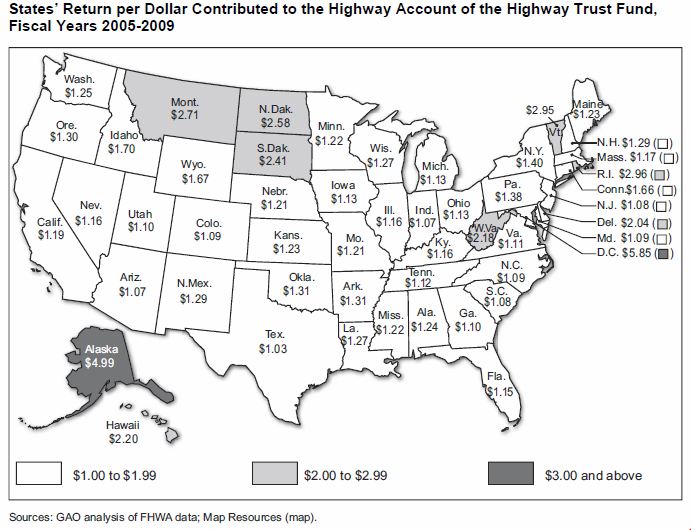
    Click on map for more legible image.

    There’s good news and bad news in a new Government Accountability Office (GAO) report on the Highway Trust Fund. Thanks to a $30 billion injection from the federal Fund since FY 2008, every state in the union has collected more from the federal Highway Trust Fund than its citizens contributed in motor fuels taxes. Yippee!

    Trouble is, sooner or later Congress will get its act together and start looking for places to cut the deficit and a good place to start whacking is the subsidy to the Highway Trust Fund. It’s looking increasingly likely that the feds will revert to its previous, long-held policy of dispensing no more money than they bring in from the motor fuels tax. When that happens, most states will go underwater. Virginians will dive so deep that we’ll have to slap on SCUBA tanks.

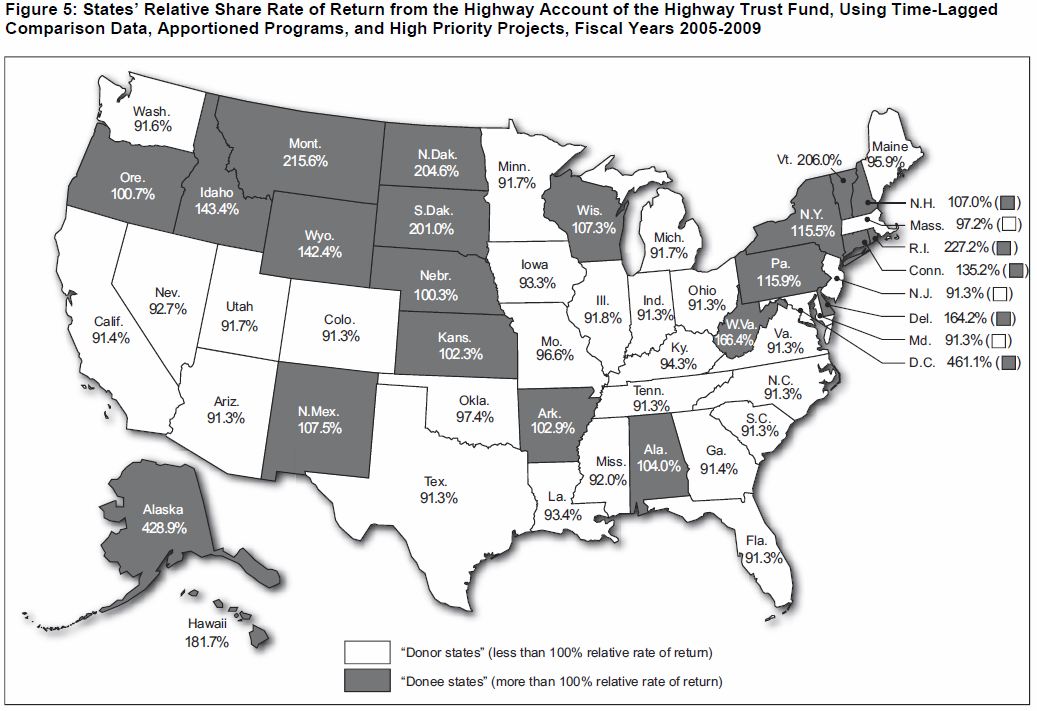
    As it happens, the Old Dominion is one of ten states that share the distinction of receiving only 91.3% of the national norm of federal highway dollars. Hey, Northern Virginia, you think you’re getting reamed by Richmond? Look across the Potomac! — JAB


  • The Wonk Salon, October 13, 2011

    How Government Stifles Innovation in Education
    American Enterprise Institute
    In areas from health care to green energy, government actively seeks to engage the private sector in fostering innovation. Not so in education.

    Diagnostic Math Testing Helps Boost Student Achievement
    Public Policy Institute of California
    The mandatory Mathematics Diagnostic Testing Project, which provides timely feedback on student progress that teachers can use, help boost standardized math test scores. The tests can be used to place students in appropriate math classes and spot those who need summer school.

    “No Excuses” Helps Close the Education Gap
    National Bureau of Economic Research
    “No Excuses” charter schools in Houston, which increase instructional time and create a culture of high expectations, have a significant impact on students’ math achievement and a measurable impact on reading.

    Power Flux
    Aspen Institute
    So much change, so many questions, for the electric power industry. Is consumer demand heading up or down? Are shale gas supplies here to stay? What’s the EPA up to? What does the Fukushima disaster mean for nuclear power? And what about China?