• Connecting the Dots on the 460 Connector

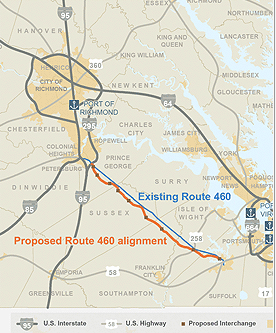
    Map credit: VDOT.

    So, I was digging into the economic and financial assumptions of the U.S. 460 Connector project, and I was reading the public-private partnership proposal put forth by 460 Partners, a consortium led by Richmond-based Moreland Property Group that includes infrastructure giants like Skanska USA and Lane Construction Corp…

    Like the proposals advanced by two competing groups, 460 Partners states that there is no way to charge enough tolls to pay for the estimated $1.8 billion project. But unlike the others, 460 Partners asks for no direct public subsidy (other than $52 million for pre-development expenses and right-of-way acquisition that would be repaid).

    Instead, the group proposed creating a regional economic development authority to coordinate marketing efforts under the brand of “Virginia’s Gateway Corridor,” which would carry with it a set of incentives “specifically targeted towards manufacturing, exports and warehouse and distribution type companies.” That marketing group would promote industrial and logistics development along the U.S. 460 corridor. And the expense of the highway project not covered by tolls would be recouped by “receiving a portion of the economic benefits created within the Virginia’s Gateway Corridor area,” based on metrics such as jobs created, sales tax revenue or capital investment.

    Where had I heard those ideas before? Oh, yes! The McDonnell administration attempted to craft legislation that would embody both ideas, or, at least, variants of both ideas — both of which I had already blogged about.

    Instead of creating “Virginia’s Gateway Corridor,” HB 1183 would create the Route 460 Corridor Interstate 86 Connector Economic Development Zone.” And, as originally submitted, it would have provided up to $50 million tax credits over two years to companies involved in maritime commerce or the import/export of manufacturing products. An amended version version of the bill has passed both the state Senate and the House of Delegates.

    The governor’s omnibus transportation bill also provided for the creation of Transportation Improvement Districts (TID) consisting of territory within a five-mile radius of a transportation infrastructure project. Twenty-five percent of any growth in state General Fund tax revenues would have been transferred to TID funds, and the Commonwealth Transportation Board could allocate the money to projects in its Six-Year Improvement Program — including, presumably, the project that accounted for the revenue growth. That’s pretty close to what 460 Partners had in mind. However, the provision did not make it into the final version of the bill passed by the House and Senate.

    Coincidence or not? I spoke to Brad Rodgers, president of 460 Partners, to find out. His consortium wasn’t involved with the drafting of the legislation, he said, but “I’d like to think [the legislation] was inspired by our proposal. The concept [for Virginia’s Gateway Corridor] was almost verbatim what we laid out.”

    Rodgers did not speculate how the defeat of the Transportation Improvement District idea would affect the chances that the 460 Partners proposal would be selected. Nor did he know when the McDonnell administration would make its decision. The project time line has been delayed, he said, due to the “hullabaloo” over the Midtown-Downtown Tunnel project in which Hampton Roads politicians are demanding the state contribute more to the project to buy down toll rates there. He suspects that administration officials are looking for “more clarity” before moving on to the U.S. 460 project.


  • Virginia at Greater Risk of Corruption than New Jersey? Really?

    Scene from "Boardwalk Empire"

    A couple of weeks ago I highlighted the State Integrity Investigation project, which graded Virginia “F” for transparency and accountability, and warned that poor ratings indicate a higher risk for corruption. (Read blog post.)

    I argued that Virginians should consider the report a wake-up call. But some people — and not just Virginians — find the study’s implications to be laughable. In a Wall Street Journal op-ed this morning, Paul Sherman, who litigates campaign finances cases for the Institute for Justice, and David M. Primo, a political science professor at the University of Rochester, take a critical look at the investigation. They find it curious that New Jersey and Virginia would stand at opposite extremes in the transparency-and-accountability rankings, especially considering that the Pew Center on the States judged Virginia as one of the best governed states in the nation.

    The State Integrity Investigation study never defines “corruption,” the authors note. Further, the project simply assumes that the presence or absence of its transparency/accountability indicators, like campaign finance limits and lobby disclosure, contribute to good government.

    “It isn’t asking too much of good-government groups to come forward with evidence that their preferred policies actually reduce corruption,” the authors write. “On that score, the State Integrity Investigation falls far short of the mark.

    — JAB


  • IG of the Day: Virginia’s Healthiest Counties

    The healthiest jurisdictions in Virginia (shown in white) are concentrated in Northern Virginia, the Shenandoah Valley, Roanoke/Blacksburg, Charlottesville and exurban counties surrounding Richmond… oh, and Virginia Beach. The least healthiest counties? Pretty much where you’d expect, in Southside and Southwest.

    Source: County Health Rankings & Roadmaps. Visit the website for details by county: premature death, poor physical health days, low birthweight, smoking, obesity, excessive drinking, STDs and a whole lot more.

    Hat tip: LarryG

    — JAB


  • What Do You Know, There Is Electoral Fraud in Virginia

    Commonwealth Attorney Michael Herring. Photo credit: Times-Dispatch.

    by James A. Bacon

    Not long ago, I dissed the need for a Voter ID law in Virginia on the grounds that it was a solution in search of a problem. Electoral fraud in the Old Dominion, I suggested, was such a rarity that there was no need to get people riled up. It just gave ammo to Democrats who charged Republicans with “voter suppression.” Just let sleeping dogs lie, I said.

    Well, the sleeping dog just got up and started biting people. Foolish me.

    Yesterday, a Richmond grand jury indicted 10 convicted felons on charges of electoral fraud for allegedly falsifying information on their voter registration forms during the 2008 presidential election, the Times-Dispatch reports today. The charges stem from an initiative in which the State Board of Elections had forwarded hundreds of referrals of possibly fraudulent registration forms to the state police. The state police forwarded 70 to the City of Richmond Commonwealth Attorney’s office.

    It appears that the Richmond registrar’s office handled more voter registration transactions in the three months preceding the 2008 presidential election than in the entire fiscal years of the previous two presidential elections. Commonwealth Attorney Michael Herring attributed the allegedly fraudulent registration to the activity of unnamed “solicitors” who urged the felons to indicate on the form that they had not been convicted of a crime.

    “The real criminal actors here are the solicitors, who are telling these people, ‘Don’t worry about it; sign up,” Herring said. “They kind of disappear like ghosts.”

    Herring said he did not know whom the felons voted for. But we can take an educated guess. In 2008, community action groups like ACORN were conducting massive voter registration drives, especially in the African-American community, to drum up support for Barack Obama. This is precisely the reason that Republicans distrust the integrity of the electoral process, and that distrust is the impetus behind the Voter ID laws. It is not immediately apparent to me how Voter ID laws would address the problem of false registrations, however. I repeat myself: It may be a solution in search of a problem.

    But voter fraud is obviously real. And fraud of this type apparently is hard to prevent. Herring suggested having undercover police posing as felons, but that sounds impractical. Would it not be possible to cross-reference the names of registered voters with the names of convicted felons? Perhaps that’s what the State Board of Elections did — the article is not clear on that point.

    But I do await the reaction of Democrats who harp on the topic of “voter suppression.” Do they acknowledge that a voter fraud problem does, in fact, exist? Are they really interested in protecting the integrity of the electoral process — or are they just trying to stack the deck in their favor?


  • Quote of the Day: John H. Cochrane

    John H. Cochrane

    PeterG. often belittles me for scabbing material from the Cato Institute, which, in fact, I almost never do. (Just search “Cato” on this blog to see for yourself — all “Cato” references originate with my old Wonk Salon squibs or PeterG, accusing me of something I don’t do!) Thus, it is with some trepidation that I reproduce a quote from John H. Cochrane, a University of Chicago finance professor who actually is an adjunct scholar at the Cato Institute.

    This column in today’s Wall Street Journal, “What to Do on the Day after Obamacare,” addresses an issue frequently discussed in the comments relating to health care (my bold face):

    Most pathologies in the current system are creatures of previous laws and regulations. Solicitor General Donald Verrilli explained as much in his opening statement to the Supreme Court: “The individual market does not provide affordable health insurance,” he noted, “because the multibillion dollar subsidies that are available” for the “employer market are not available in the individual market.”

    Start with the tax deduction employers can take for their contributions to group health-insurance policiesโ€”but which they cannot take for making contributions to employees for individual, portable insurance policies. This is why you have insurance only so long as you stay with one employer, and why you face pre-existing conditions exclusions if you change jobs.

    Continue with the endless mandates (both state and federal) on insurance companies to provide all sorts of benefits people would otherwise not choose to buy. It sounds great to “make insurance companies pay” for acupuncture. But that raises the premiums, and then people choose not to buy the insurance. Instead of these mandates, at least allow people to buy insurance that only covers the big expenses. …

    If we had a deregulated, competitive market in individual catastrophic insurance, that market would be so much cheaper than what’s offered today that we would likely not even need the mandate.

    — JAB


  • Expanding U.S. 460 and the Chinese Connection

    By Peter Galuszka

    In the past day or so, thereโ€™s been a bit of buzz about a decades-old plan to expand the northwest to southeast route U.S. 460 takes through Virginiaโ€™s peanut country on its way to Tidewater. This latest bit of boosterism posits that giant ships inbound to Virginia via the widened Panama Canal will make for a large opportunity in trade.

    Since existing Interstates linking Virginia Port Authority facilities in Norfolk, Portsmouth and Newport News are inadequate to handle the transshipment of cargo containers (and the role of railroads Norfolk Southern and CSXT is curiously left out of the equation),ย  the thinking seems to be that U.S. 460 is the only way to go. Or, we miss out on a big bonanza. Or so โ€œeconomic development officialsโ€ think.

    I, for one, have never been completely trusting of economic development people.ย  They are like Realtors trying to make sales. The last bargain they brought us involved Amazon sans state sales taxes. That idea was so wrong-headed that the public screamed and the General Assembly actually slapped on the countryโ€™s largest digital retailer to same tax a small Virginia business has to pay. So much for intelligence or egalitarianism.

    Yet thereโ€™s a much bigger issue out there that must be considered before Virginians start signing all those public-private deals to create superhighways through Planters-land. Most of the increase in imports that will enter the U.S. thanks to the Panama Canal project will be from China. Believe it or not, the U.S. has big and unresolved issues with the Peopleโ€™s Republic, which still is a Communist-controlled country that puts dissidents in jail or exiles them.

    For evidence, look no farther than the op-ed page of todayโ€™s New York Times. Richard A. Clarke, who was George W. Bushโ€™s special advisor for cybersecurity, warns that Chinese officials have long raided our Websites and data bases and emails to mine out advantageous bits of intelligence, mostly of an economic nature. Among victims of Chinaโ€™s data theft are such as firms as Sony, Citibank, Lockheed, Booz Allen, Google, EMC and Nasdaq. By hacking our files, the Chinese gain a leg up in research. They donโ€™t have to spend so much on R&D because they can easily steal ours.

    Meanwhile, a new report by the Brookings Institution is so worried about such thefts of intellectual property and cybersecurity that it urges a new round of negotiations between Washington and Beijing before things really get out of hand. โ€œU.S.-China strategic distrust is growing, is potentially very corrosive, is little understood on either side, and therefore should be addressed directly as a major issue,โ€ write authors Kenneth Lieberthal and Wang Jisi.

    The authors cite some other familiar issues, such as Beijingโ€™s one-sided currency trading and hard-edged trade policy negotiating as reason for wariness. Another issue is Chinaโ€™s acceleration of military strength. This may not involve the ability to strike globally with nuclear weapons as was the case with the former Soviet Union, but China is making big strides with regional weaponery that could ward off U.S. tactical moves or threaten Taiwan. A big component involves the ability to hack digital files and launch cyberattacks.

    President Obama is wary of the threats China is posing. As wars in South Asia wind down, he is proposing placing U.S. Marines in Australia. They would be a small force designed to be a tripwire and send a message to Beijing that the U.S. is nearby and might respond to aggression.

    As one who has covered the Soviet Union and Russia for many years, I have always been puzzled about why the U.S. was quick to slap the Russians with trade sanctions aโ€™ la Jackson Vanik while the Chinese got away with similar human rights violations not to mention very hardball economic and trade policies.

    From the sounds of it, Virginiaโ€™s economic development sector either doesnโ€™t know or doesnโ€™t want to know about the uncertainty of where Americaโ€™s future with China is going. If they donโ€™t start paying attention, however, we might end up with huge, empty ships at deserted docks with the rest of us paying for a huge, underused highway.


  • Virginia’s Next Economic Boom?

    Virginiaโ€™s economic developers expect a wave of manufacturing and logistical investment when the Panama Canal expansion is complete. Opportunities this big, they say, come along only once in a generation.

    by James A. Bacon

    From peanut fields….

    New mega-industrial parks and a proposed $1.8 billion highway could help create a world-class economic development asset in an unlikely corner of Virginia: the sparsely populated peanut country between Petersburg and Suffolk. Traversing farms, woodlands and hamlets, the 55-mile corridor has the potential to become one of the major sources of economic growth for Virginia in the decade ahead.

    That assessment comes from Liz Povar, director-business development for the Virginia Economic Development Partnership. โ€œWe see this as the future of Virginia,โ€ she says. โ€œThatโ€™s a big statement — and Iโ€™m serious about it.โ€

    The completion of the Panama Canal expansion by 2014 or 2015 represents a historic opportunity for Virginia, according to Povar, an economic development professional whose career spans a half-dozen or more Virginia governors. A third, wider lock in the canal will allow massive vessels holding 18,000 TEUs โ€“ four times the capacity of existing ships โ€“ to traverse Panama, diverting significant traffic from West Coast Ports. At present, Hampton Roads is the only East Coast port with channels deep enough to receive those deep-draft ships, giving Virginia a first-mover advantage in capturing the anticipated surge in traffic before other ports can make needed investments.

    …to Rolls Royce-scale OEMs?

    The growth in container shipments will be a boon to the Port of Virginia, of course. But the McDonnell administration hopes to leverage the traffic into massive new investment in logistics facilities and advanced-manufacturing complexes whose supply chains run through the ports. Economic developers are gunning for economic game-changers that bring a network of suppliers in their wake — like aerospace giant Rolls Royce, which in 2007 announced investments potentially reaching $500 million in Prince George County.

    The VEDP, the port and local industrial development authorities have seen this opportunity coming for some time. But not until the McDonnell administration have all the stakeholders coordinated efforts, plotted a cohesive strategy and backed it up with substantial state funding, says Povar. The state has committed $500 million in public dollars to build the new U.S. 460 connector, created tax incentives to stimulate port activity and, awaiting the governorโ€™s signature, enacted tens of millions in tax credits for companies investing in a new development zone. Meanwhile, state officials across agencies and secretariats are partnering to โ€œreach out to selected companies that can utilize the assets of a strong logistics network,โ€ she says.ย Sussex, Southampton and Isle of Wight counties are creating giant industrial parks that will provide enough acreage for the biggest facilities.

    This emerging vision for the future of downstate economic development has yet to spread beyond the stakeholders involved. The only piece of the plan to occasion much debate is the U.S. 460 connector, which is said to provide a critically needed alternative to the overloaded Interstate 64 out of Hampton Roads. Smart Growth advocates question the economics of a highway project that requires such a massive public investment, while some Hampton Roads officials would prefer to see the $500 million steered to transportation priorities closer to the urban core. But no no one has yet disputed the premise that an economic boom could be in the offing.

    If the mega-sites succeed in attracting OEM manufacturers, they potentially could account for $5.26 billion in direct, indirect and inducted economic output accounting for 8,300 jobs, according to a recent report by Chmura Economics & Analytics.

    Liz Povar

    And thatโ€™s just on the manufacturing side. Between Virginiaโ€™s ports, double-stacked CSX and Norfolk Southern rail service extending to the Midwest and Southeast, and connections to Interstates 95 and 85, Povar says that southeastern Virginia has what it takes to become a world-class logistical center. She sees the region growing into a warehouse-distribution node comparable to a half dozen clusters around the country like Alliance Park near Fort Worth, Tex., the FedEx complex in Memphis, Tenn., and the port and logistics activities around Long Beach, Calif.

    The economic boon will extend beyond the Petersburg-Suffolk corridor. Industrial sites on I-95, I-85 and U.S. 58 could come into play. โ€œWeโ€™ve got under public control more than 5,000 acres and 2.5 million square feet of existing buildings that could be used for advanced manufacturing and logistics/distribution,โ€ says Povar. โ€œWe have over 22 publicly controlled industrial parks with water, fiber, sewer and zoning. โ€ฆ All of those combined, once they are packaged and marketed in an aggressive and sustained way, can help make Virginia a world-class logistics headquarters.โ€ Read more.


  • Another Private-Sector Initiative to Salvage Health Care

    Back in 2006 an estimated 2.2 million Virginians were living with chronic diseases, running up $24.6 billion in health care costs. The numbers are far higher today. One reason costs are so high is that care is so fragmented. Patients often have multiple providers, treatment plans and prescriptions. Physicians, hospitals and other providers operate in silos, providing care without complete information about what others are doing. The lack of communication leads to unnecessary emergency room and hospitalย admissions.

    The au current idea for dealing with this mess is the Patient Centered Medical Home (PCMH), in which the “home” is not a physical place but a personal physician who leads a team of providers to plan and deliver ongoing care for the “whole person.” The idea is catching on, and a General Assembly report, “Chronic Health Care Homes,” describes what’s happening in Virginia.

    The Family Medicine Group in Vinton was the first practice in Virginia to be certified as a PCMH. Now, 18 Carillion physician practices in the Roanoke and New River Valley areas are recognized as NCQA Level-3 (highest) PCMHs.ย Additionally, an increasing number of practices in the Hampton Roads area are transforming themselves into PCMHs. Physicians and faculty of Eastern Virginia Medical School and several Sentara practices are in the application process for recognition as a medical home.

    In the meantime, aย Virginia Innovation Center, established as a nonprofit center hosted by the Virginia Chamber of Commerce, โ€œwill serve as a resource” in Virginia byย (1) researching and disseminating knowledge about innovative models of health promotion and health care; (2)ย ย developing demonstration projects to test innovative delivery models; and (3) helping Virginia employers, providers, purchasers, health plans, and communities accelerate their pace of innovation. (That information was based upon a 2010 communication to JCHC staff but I can find no indication from a Google search or a search of the Chamber website that this center exists yet.)

    Based on the study findings, the Joint Commission on Health Care resolved to continue monitoring the progress of the concept.

    — JAB


  • Five Ways Virginia Sucks

    By Peter Galuszka

    An alternative blogger is listing five ways Virginia may be the worst state in the union, a.k.a. โ€œBob Land.โ€

    Tara Lohan of AlterNet notes that generally, watching the news these days is like going through a time warp when it comes to debates about birth control or teaching science in the classroom. States such as Georgia and Missouri come to mind in this regard, but Virginia, she says, is the worst.

    Here are five reasons why:

    • Despite the horrific Virginia Tech shootings and public polling wishing otherwise, Gov. Robert F. McDonnell has successfully pushed through a measure to repeal the one handgun a month purchase limit in the state. He apparently doesnโ€™t care that New York Mayor Michael Bloomberg says that โ€œVirginia is the No. 1 out-of-state sourceโ€ of handguns in the country.
    • Virginia may have 1,600 children up for adoption. But not if you are gay or lesbian. Virginia allows adoption agencies to deny placementsโ€ to people who conflict with their religious beliefs.
    • Hard right Atty. Gen. Kenneth Cuccinelli has waged a vigorous and expensive campaign in his witch hunt against former University of Virginia climatologist Michael Mann.
    • ย Virginiaโ€™s powers have been backing a new coal-fired electricity plant just upwind of Colonial Williamsburg. According to The Virginian-Pilot, the plant would emit 2,000 pounds of arsenic, up to 7,000 pounds of benzene, 1,390 pounds of chromium and 118 points of mercury into the air every year.
    • McDonnell launched a โ€œWar on Womenโ€ with his backing of a law requiring women considering abortion to have an ultrasound test. He backed away from a more invasive way of doing the test which is not deemed a medical necessity.

    In general, Lohan hits the highlights, although she misses a little context. One is that since he is elected separately, Cuccinnelli doesnโ€™t report to McDonnell. The Old Dominion Electric Cooperative coal plant has been put on hold mostly because of financing issues. The flood of natural gas, much from hydraulic fracking, has put a serious dent in the viability of new coal-fired electricity.

    But she hits most of the notes. Interesting to read something other than what a dandy state Virginia is for business.


  • Even NAS Braniacs Have Unanswered Questions about Uranium Mining

    by James A. Bacon

    The National Academy of Sciences report on uranium mining in Virginia covers a lot of ground, as anyone who peruses the 290-page document can attest. But the panel of co-authors attending a public presentation of the report in downtown Richmond last night conceded that there was a lot that they didn’t know — often because their study mandate did not include evaluating specific mining sites.

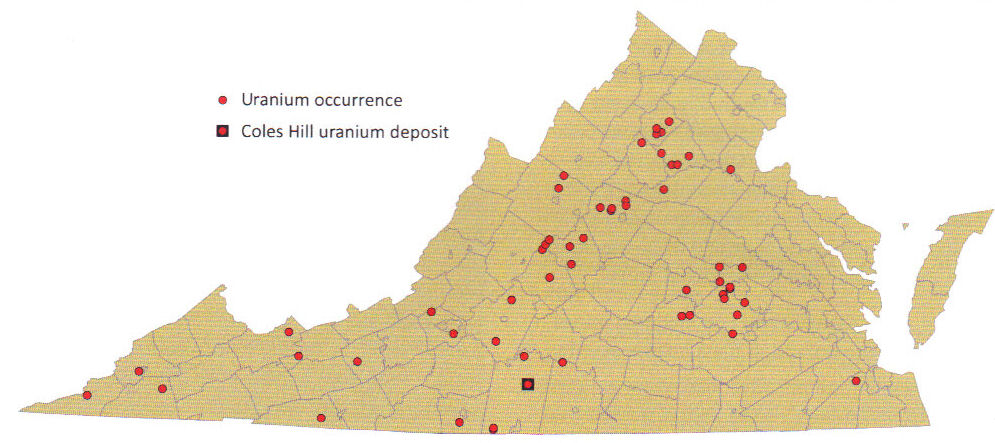
    Paul A. Locke, chairman of the NAS study committee

    As it happens, while uranium has been detected in some 55 spots around the state (as shown on the map above), only one site, the Coles Hill Farm in Pittsylvania County, has potential for commercial grade production, said Paul A. Locke, chairman of the committee and a Johns Hopkins University professor of public health. Members of the audience asked numerous questions about the feasibility of mining uranium at Coles Hill in a environmentally safe manner, but committee members could answer only with vague generalities, if at all.

    Lisa Guthrie, executive director, Virginia League of Conservation Voters

    Among the questions outside the scope of the NAS study:

    • Will there be a large up-front cost to establish a regulatory regime for uranium mining, considering that Virginia has no existing regulatory apparatus and no existing uranium-mining industry from which to generate licensing revenue?
    • Given the fact that uranium tailings remain radioactive for thousands of years, long after the mining company will cease to exist, what mechanisms exist to monitor and ensure environmental compliance of an impoundment site over the long term?
    • How much radiation is likely to leak in the event of an extreme event such as an earthquake or massive flood — an amount equivalent to the radiation from a radium watch… or a Chernobyl disaster?

    Further, neither Locke or other board members could point to specific Best Practices that should be implemented for uranium mining and processing at Coles Hill. Speaking generally, they said that technological and regulatory advances over the past two or three decades have vastly improved the safety and environmental health of uranium mining. No other uranium mine in the world exactly matches the Pittsylvania site in terms of geology, climate and surrounding population, but a mix-and-match approach, picking Best Practices on the basis of specific characteristics, should be feasible.

    Neither did the NAS board conduct a “probabilistic risk assessment,” an exercise that would be possible only for a specific site. But Locke did acknowledge that site-specific analysis and risk assessment of Coles Hill would be critical for the mining project to move forward.

    The Coles Hill ore deposit is the largest undeveloped uranium deposit in the United States and the seventh largest in the world, according to Virginia Uranium Inc., the company lobbying to lift the moratorium on uranium mining in the state. Gov. Bob McDonnell has assembled a Uranium Working Group staffed by state employees to examine risks associated with uranium mining and analyze how they could be addressed by regulation.

    The working group has scheduled four public hearings between June and November, launched a web portal and set up mechanisms to accept questions and comments from the public. Fearing that critical Working Group decisions might be made behind closed doors, environmental groups have expressed concerns about the transparency of the process.

    In a letter to legislators Martin L. Kent, McDonnell’s chief of staff, responded to those concerns: “This working group is solely focused on scientific, legal, regulatory, and factual questions that need to be further examined. If the General Assembly directs the agencies to promulgate appropriate regulations to govern uranium mining, that is a separate process.”

    (See PeterG’s coverage of a previous NAS meeting in Danville here.)


  • More Talk of a New Potomac Crossing

    Gov. Bob McDonnell and Gov. Martin O'Malley.Photo credit: Politico.

    Governor Bob McDonnell recently broached the idea of a new Potomac River crossing with Maryland Governor Martin O’Malley, reports Toll Road News.

    No other project in the Washington, D.C., metro area has comparable potential for improving mobility and taking unnecessary traffic off Beltway,ย the trade publication quotes Transportation Secretary Sean Connaughton as saying. “We are starting the process. Iโ€™ve already had some discussion with them about a joint effort.โ€

    It’s not clear where the crossing would be located, but Connaughton suggested it would be upriver from the Washington Beltway where it could serve asย direct link between the Rockville-Gaithersburg-Germantown area in Maryland and Reston-Sterling-Dulles-Chantilly in NoVa.

    The Commonwealth Transportation Board approved lastย year the development of a “Corridor of Statewide Significance” master plan that would cut through Prince William, Fairfax and Loudoun counties. Although the corridor would terminate at Rt. 7, Smart Growth lobbyists fear that the corridor could be easily extended to the Potomac and converted to an outer beltway.

    Hat tip: Larry Gross.

    — JAB


  • IG of the Day: Religiosity

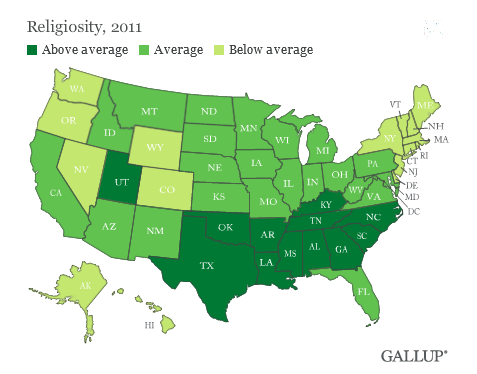
    Mississippi is the most religious state in the country, while Vermont and New Hampshire are tied for least religious. Virginia, where 42% of respondants to a recent Gallup pollย described themselves as “very religious,” ranked with the middling states.

    — JAB


  • What Baconauts Won’t Discuss

    By Peter Galuszka

    Reading the Baconโ€™s Rebellion Blog always displays breathtaking contradictions. Chief among them is the huge contradiction between pushing โ€œsmart growthโ€ and shunning any form of increasing gasoline taxation.

    The crux is that we have lots of horrendous sprawl in the state such as all of Northern Virginia, Route 3 in Fredericksburg and U.S. 29 in Charlottesville. We have underfunded and under-maintained roads. That all adds up to a death spiral of bad planning and a slavish adherence to el-cheapo ways of doing things โ€“ all in the name of the Cato Institute.

    In Virginia, for instance, the state gasoline tax is 17.5 cents a gallon. It hasnโ€™t been raised in 25 years. It hasnโ€™t even been made to adjust for inflation. By contrast, North Carolinaโ€™s gas tax is 38.9 cents per gallon.

    As politicians, especially Republicans such as Gov. Robert F. McDonnell stubbornly refuse to consider the obvious solution to their many road issues, they have the rest of us jumping through one convoluted hoop after the other trying complicated ways to get funds without taxation. Itโ€™s a bit like trying to breathe without air.

    That brings up another point โ€“ the insane accusations that Barack Obama is responsible for $4 a gallon gasoline. GOPers like Mitt Romney and Bobby Jindal (oil state guy) claim that gasoline prices have doubled under Obama and his energy policies are now creating havoc at the pump. The reality is that setting gasoline prices has a lot more to do with Asian demand the Iranian nuclear facilities than the policies of one U.S. president, who, by the way, has made big progress in weaning the country away from foreign oil.

    Yet the biggest irony is spelled out in the latest issue of The New Yorker and comes, surprise, from Romneyโ€™s own economics adviser, Greg Mankiw. The Harvard professor recently wrote: โ€œEconomists who have added up all the externalities associated with driving conclude that a tax exceeding $2 a gallon makes senseโ€ฆBy taxing bad things more, we could tax good things less.โ€

    Now, if you happen to read Baconโ€™s Rebellionโ€™s most prominent blogger, we get an education how smart growth could make our lives better. We need to build more housing in more densely-packed areas, go for green zones, reduce wasteful and polluting gasoline use and try mass transit (all dipped in a libertarian flavor of course!)

    The unspoken part is what Mankiw brings up. Federal gas tax is a puny 18.4 cents a gallon. If you raise ย it to $2 a gallon, as Mankiw suggests, youโ€™d suddenly have smart growth โ€“ presto! Youโ€™d have a lot of other things, too, such as much higher mileage cars, a fatter federal checkbook and less stupidity when it comes to highway and housing planning.

    Are we going to get this? Of course not. The status quo politicians are hardly going to pretend the gas hike issue exists while blaming Obama for something not of his making. Meanwhile, readers of Baconโ€™s Rebellion will be treated to the increasingly amusing acts of contortionists stretching and folding any way they can to avoid discussing tax hikes. As a former altar boy I can appreciate trying to keep the dogma pure.


  • Midtown Meltdown

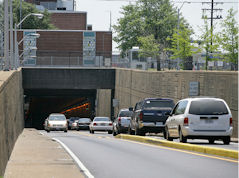
    Norfolk Midtown Tunnel. Photo credit: VDOT

    by James A. Bacon

    The controversy over tolls on the $2.1 billion Midtown Tunnel/Downtown Tunnel project in Hampton Roads is spreading statewide as transportation advocates in other parts of Virginia ponder the implications of what it means for them. Inย a missive distributed yesterday Robert Chase, president of the Northern Virginia Transportation Alliance, warned that one “rumored” scenario under consideration by House-Senate conferees would be to renege on the $2.1 billion public-private partnership agreement with Elizabeth River Crossings (ERC), even if it meant triggering multimillion-dollar penalties.

    Hampton Roads legislators are up in arms over the deal, which would slap tolls on users of the two tunnels and the Martin Luther King Expressway later this year in order to finance major improvements that aren’t scheduled to be complete for two years. Two weeks ago, the Virginian-Pilot reported, Del. Chris Jones, R-Suffolk, was researching how the contract could be terminated as an option of “last resort.”

    If Chase isย correct,ย Jones’ idea has morphed from a research project into an option under consideration by House and Senate budget conferees in Richmond. Jones, as it happens,ย is one of the six House conferees, as is Johnny Joannou, D-Portsmouth, whose district is at ground-zero of the controversy. Under the Jones scenario, writes Chase, the state “would legislatively scrap the $2.1 billion Hampton Roadsย Midtown-Downtown Tunnel PPTA contract and mandate that only a new Midtown Tunnel be built entirely with state funding through over $1 billion in federal GARVEE financing.”

    Needless to say, that idea won’t play well in Northern Virginia, or anywhere else for that matter. Conferees are weighing the idea of providing an additional $300 million, plus $150 million already agreed upon,ย to defray the cost of the Rail-to-Dulles METRO rail project in Northern Virginia, but half or more of that project financing still will be paid by commuters on the Dulles Toll Road. It’s an open question how NoVa lawmakers will cotton to an arrangement that extracts $4 tolls from Dulles Toll Road commuters for a rail service they aren’t even usingย while Norfolk commuters get a new tunnel for free.

    Notes Chase:

    Scrapping the PPTA deal would mean breaking aย legally binding contract with the consortium, incurring financial penaltiesย  and totally circumventing the Commonwealth Transportation Board/stateย and local planning and approval processes. Not a real private-sectorย confidence builder for a state with virtually no construction dollars desperateย to attract private sector investment. …

    Virginia has already committed $400 million to the Downtown/Midtown/MLK Extension project to buy down tolls. To provide the total $1 billion (and allow Hampton Road residents a toll-free trip) the Commonwealth would have to add another $600 million in GARVEE funds or essentially all of the $1.2 billion in authorized GARVEE bond funds for the next 10-12 years to a single Hampton Roads project. (GARVEE bonds are repaid from future federal revenues meaning that about $100 million/year in future federal revenues will go to a single Hampton Roads project as opposed to being leveraged across many throughout the state.)

    Transportation officials say that this would most likely kill Northern Virginia’s I-95 Express HOT Lanes project for which GARVEES are targeted and potentially several others including the Route 7/Belmont Ridge Road Interchange and the Leesburg Bypass/Sycolin Road interchange.

    In sum, scrapping the ERC contract would derail the McDonnell administration’s entire transportation grand strategy, which is based upon leveraging the borrowed dollars through public private partnerships. Accordingly, the chances of the governor going along with the Jones scenario are just about zero. I would conjecture that Jones doesn’t really want to un-do the ERC deal, he’s just using the prospect of disaster as leverage to extract enough money from the state to offset tolls until the tunnels are built.

    Two lines of argument would support such a bid. First, it is entirely unreasonable by any standard to ask people to pay tolls for transportation improvements they are not using. (Admittedly, that argument didn’t work for Dulles Toll Road commuters, so it may not be a strong one.) Second, if the state is forking out up to $450 million for the Rail-to-Dulles to provide toll road relief, it’s hard to argue that it can’t afford a measley $100 million or so for Hampton Roads.

    Whatever happens,ย Virginiaย has reached a sad state of affairs.ย Billions of dollars of bond proceeds are sloshing around uncommitted. The monies are not subject to the usual transportation formulas which, though flawed, at least ensure that funds are distributed around the state in a manner roughly approximating population and need.ย The criteria for allocating bond monies, it appears, will be he who screams the loudest gets the most money. Political considerations will supplant economic considerations, and the results will be sub-par.

    Welcome to the New Dominion.

    Update: Here’s another reason why the Jones scenario of cutting the cost by building just one tunnel won’t work: The improvements to the Midtown Tunnel, Downtown Tunnel and Martin Luther King Expressway are designed to work as a network. The MLK Expressway will funnel a lot of drivers off the Interstate to the two tunnels, according to my source. The plan is to provide up-to-date info about driving conditions at both tunnels to commuters on the MLK, by signs or other means, to steer them to the least congested facility. Building theย  components of the plan one by one won’t deliver the same congestion-mitigation benefits.


  • Veto Power for VDOT

    VDOT central office, Richmond

    The Virginia Departmentย of Transportationย would gain extensive powers over local transportation planning under a bill awaiting the governorโ€™s signature. That makes local governments and citizen groups very nervous.

    by James A. Bacon

    Gov. Bob McDonnellโ€™s omnibus transportation bill is less far-reaching than when first submitted to the General Assembly in January, but important elements have survived the legislative meat grinder. Among its many provisions, the bill would dramatically increase the stateโ€™s control over local transportation planning and, by extension, land use planning.

    Transportation Secretary Sean Connaughton describes the bill as an effort to address the fiscally ruinous practice of county boards making land use decisions and expecting the state to build the roads needed to serve the resulting growth. Counties and their sometime-allies in the Smart Growth movement view the bill as an momentous transfer of power over transportation and land use into the hands of an unresponsive Virginia Department of Transportation (VDOT) bureaucracy.

    In a deal hashed on the last day of the General Assembly session, Republican lawmakers stripped out many parts of the bill that the McDonnell administration had pushed for, most notably two controversial provisions for siphoning revenue from the General Fund to the Transportation Trust Fund. (The bill still provides for the transfer of a portion of General Fund surpluses to the transportation fund.) But they stuck with measures that (1) would require local transportation improvement plans to be consistent with the Commonwealth Transportation Boardโ€™s State Transportation Plan and Six Year Improvement Program and (2) require counties to pay back any state and federal funds spent on canceled projects at the countiesโ€™ request.

    Under the bill, local governments would have to submit their transportation plans to VDOT for review and comment. If VDOT determined that a plan was not consistent with the state plans, it would refer to plan to the Commonwealth Transportation Board, which approves all state-funded transportation projects, for appropriate action.

    โ€œThis basically gives the state veto power over transportation improvements in a locality,โ€ says Ted McCormack, director of government affairs for the Virginia Association of Counties. “Weโ€™re working on a plan of response. Weโ€™re very concerned about these land use provisions in the bill and would like to see some changes.”

    The bill goes โ€œcompletely against community vision,โ€ says Dan Holmes, director of state policy for the Piedmont Environmental Council. โ€œThe new law will make it impossible to deny projects put into place by VDOT.โ€

    The aim of the bill is to bring transportation and land use planning into closer alignment, an abstract goal that all parties agree is desirable. One way to accomplish that goal would be โ€œdevolutionโ€ โ€” shifting responsibility for building and maintaining secondary roads from VDOT to the counties. (Cities already have that responsibility.) But local governments reject that option on the grounds that the state would saddle them with major obligations without sufficient means to pay for them.

    The counties may not like devolution but the status quo is unacceptable, says Connaughton. Counties are making land use decisions and transportation plans that impact state finances. While proffers from developers might cover some of the cost of making road improvements, counties sometimes assume that the state will take up the slack. The state incurs additional, ongoing expense for maintaining the roads. Read more.