• Private Colleges and Educational Opportunity for African-Americans

    By James A. Bacon

    There is a tremendous thirst in Virginiaโ€™s African-American population for higher education that is not reflected in minority enrollment at Virginiaโ€™s public colleges and universities. Only 13.8% of the students attending public institutions in the fall of 2008 were African-American. But 47.4% of the students enrolled in private, proprietary colleges (often referred to as career colleges) were African-American.

    Whatโ€™s going on? Virginiaโ€™s public universities are all models of political correctness. They all champion โ€œdiversityโ€ on campus. Many recruit African-American students aggressively. Why donโ€™t they have more?

    Hereโ€™s what Chmura Economics & Analytics had to say in a 2010 study prepared for the Virginia Career College Association: โ€œVirginiaโ€™s community college and public 4-year colleges have capacity limitations, implying that they cannot accept all Virginians who want to pursue a post-secondary education. Without career colleges, many of those minority students may be shut out of the higher education system.โ€

    Normally, one thinks of government stepping in to remedy the failures of the free marketplace. In this case, it appears that the free market is stepping in to remedy the failure of the government-run marketplace. It is interesting that so-called progressives are hostile to career colleges. They say that career colleges experience higher rates of student loan defaults. But thatโ€™s just cover for a generalized hostility to privately delivered education.

    With student debt surpassing $1 trillion and default rates rising nationally, there is every reason to scrutinize lending practices. Overall, graduates of career colleges do default at higher rates than public and private not-for-profit institutions. โ€œAs a group,โ€ charges one critic on the Blue Virginia blog, for-profit higher ed โ€œsystematically scams the taxpayer, rips off the government, and harms the lives of veterans, minorities and poor people.โ€

    But such observations are dangerously superficial. One could note also that graduates of Historically Black Colleges and Universities, โ€œas a group,โ€ experience higher rates of default. Does that mean institutions like Virginia Union and Norfolk State are scamming the taxpayer and harming their students?

    Career colleges encompass a wide range of institutions that provide degrees with a wide range of marketability. Presumably, a degree in business, IT or health care provides superior career prospects to a certificate in cosmetology. All other things being equal, grads whose degrees give them superior career prospects do a better job of paying off their student loans than those whose degrees are less marketable. Why not focus on specific institutions and degree programs with high default rates rather than denounce career colleges generically?

    It is worth noting that career college students pay the full freight of what it costs to educate them, an average of $12,682 per year in the 2008-2009 academic year. The relevant point of comparison for public, four-year institutions is the $18,098 average tuition charged out-of-state students. The cost is lower for in-state students thanks mainly to state support equivalent to $2,487 yearly for community colleges and $5,027 per year for public four-year institutions. Career college grads likely would borrow less โ€“ and their default rates would be lower โ€“ if their tuition were subsidized to the tune of $20,000.

    Thereโ€™s one more consideration. Career colleges serve a population that comes from lower-income households. Many students growing up never learning the basics of budgeting and financial management. Arguably, students from households with similar socio-demographic characteristics default at comparable rates at public institutions.

    There are diploma mills that recruit students who are ill prepared for the rigors of higher education and have no business pursuing college degree, putting them deeply in hoc for worthless educational programs. In 2008 Virginia enacted legislation that makes it illegal to issue fraudulent academic credentials. Otherwise, the existence of diploma mills is an argument for the federal government to be more judicious in its lending practices. Rather than punishingย institutions based upon their profit/nonprofit status, the feds should focus on institutions, of whatever stripe, with the worst default rates. Stop lending to colleges that offer little educational value added. Stop lending money for fields of study that offer little payback in the marketplace. Curtail lending to students with a lousy credit scoreย and a demonstrated inability to pay their creditors.

    If federal and state officials crack down upon private career colleges for the sin of being privately owned, they could damage an important avenue of upward mobility for many Virginians, African-Americans in particular.

    Note: This commentary has been heavily edited from the original post.

  • CTB Authorizes $100 Million for Norfolk Toll Relief

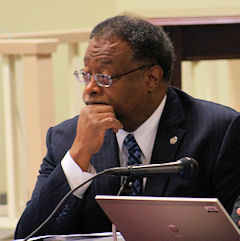
    Virginia Highway Commissioner Gregory Whirley

    by James A. Bacon

    The Commonwealth Transportation Board has allocated approximately $100 million in transportation funds to cover the cost of delaying tolls on the Midtown-Downtown tunnels for a year and half, but Norfolk-area commuters still will be stuck paying tolls for two or more years before the new tunnels and Martin Luther King Boulevard extension are complete in 2017.

    The $100 million does not come at the expense of other projects. The Virginia Department of Transportation had originally dedicated $395 million in state funds to the tunnels, the top transportation priority in Hampton Roads, but ended up needing only $305 million at deal closing, freeing up $87 million. The state also will tap up to $50 million in GARVEE bonds, backed by future federal transportation fund payments, to cover the balance, explained Virginia Highway Commissioner Greg Whirley. The state had set aside that GARVEE bonding capacity for the project but ended up not needing it.

    Whirley could not say exactly how much it will take to eliminate the tolls under the agreement with Elizabeth River Crossings (ERC), the tunnel project concessionaire, but he’s confident that it’s in the $100 million range. The final figure will have to be negotiated with ERC. The CTB action should provide more than enough to cover the cost.

    Transportation Secretary Sean Connaughton described the action as an effort to be “responsive to the requests and desires of the General Assembly.” Senator Louise Lucas, D-Portsmouth, had introduced legislation to delay the onset of tolling for a year and a half.

    However, foes of tunnel tolls are little mollified. As the Virginian-Pilot reports today:

    Del. Kenny Alexander, D-Norfolk, who has hired a lawyer and threatened a lawsuit, called the action “a $100 million giveaway.”

    “I’m not in favor of giving Elizabeth River Crossings any more money, not another dime,” Alexander said, adding that he still prefers to stop the project and work out a new deal. “$100 million doesn’t change the toll rate.”

    CTB members expressed disbelief that Hampton Roads legislators were taken by surprise by the tolls. “I’ve been on this board two years. I was shocked that there was an uproar over the tolls,” said Aubrey L. Layne, Jr., Hampton Roads district representative. “There were always going to be tolls. There were numerous meetings.”

    Shep Miller

    “I don’t see how anyone could view this as a surprise,” echoed W. Sheppard Miller III, an urban at-large representative from Norfolk. However, he conceded that Virginia is still new at rolling out public-private partnerships like the Midtown-Downtown project. “We’re learning.”

    Tony Kinn, director of the Office of Transportation Public Private Partnerships, defended VDOT’s outreach efforts, listing CTB discussions in Richmond and public hearings in Hampton Roads. (See presentation.) But, he conceded, “There are things we could do better.” In future projects, he said, “We’re planning to add a mass communication component to the process.”


  • ALEC, the Tea Party and the Feral GOP

    House Speaker William J. Howell

    By Peter Galuszka

    Virginiaโ€™s conservatives have gone through a spasm of controversy as they struggle to find their message. They desperately need to balance their ideas of fiscal discipline and limited government with a wide spectrum of unrelated hard-right social issues.

    The clearest evidence yet of the quandary for their soul involves the American Legislative Exchange Council (ALEC), which has just backed away from pushing โ€œStand Your Groundโ€ laws that were involved in the shooting of a young African-American from Florida, Trayvon Martin.

    ALEC had been a cozy, four-decades-old group of deep-pocketed corporations and lobbyists that ghostwrote template-style laws for state legislatures around the country to boost the conservative agenda of cutting taxes and government spending and cater to the business communityโ€™s desire for few regulations. For a long while, it seemed like a gigantic Chamber of Commerce funded by big corporate names such as Coca-Cola, Wal-Mart and Johnson & Johnson to push business-friendly laws.

    But as the Tea Party movement gained steam in 2010, its disparate elements pushed right-wing social issues that ended up alienating many and polarized legislatures, including Virginiaโ€™s General Assembly. That spilled over into ALEC, which ended up pushing voter ID laws designed to take voting power away from minorities when there was no real issue over identity fraud and suck up to the gun lobby by pushing the idea that if one feels under attack, he or she may whip out a firearm and blow away an assailant without much legal consequence.

    Incredibly, Virginia taxpayers have shelled out $231,000 over the past decade so legislators, mostly Republicans, can go to ALEC confabs and learn what the latest is in conservative designer legislation. A big player is House Speaker William J. Howell (R-Stafford), who, according to The Washington Post, made 60 percent of his publicly funded trips to ALEC meetings.

    The unexpected fury over the ย Trayvon Martin shooting involving a Stand Your Ground law blew everyoneโ€™s cover. It had the entire cossetted ALEC world tossed on its head. Firms such as Coca-Cola, Mars, Wendyโ€™s and Kraft, all of which are consumer products firms whose billions debate on a positive public image bailed on ALEC. The constant deluge of the Trayvon shooting was very bad for their business. Now ALEC says it is dumping social issues and sticking to economic ones.

    Howell didnโ€™t seem to know what to do. He attacked left-leaning critics such as โ€œProgressVaโ€ and had the bad taste and judgment to personally insult Anna Scholl, the head of ProgressVA at a press conference, demeaning her intelligence by saying he needed to speak to her only in monosyllables. Howell, usually more stately than that, soon issued a public apology to Scholl.

    Whatโ€™s revealing about Howellโ€™s tantrum, however, is how it shows that mainstream conservatives really donโ€™t know what to do with the social radicals in their movement. For years, theyโ€™ve enjoyed the upscale, closed-door demeanor of ALEC meetings until the Tea Party types shook everything up. It was fine, everyday work bashing unions and trying to cut taxes for companies and the rich. Yet they became spooked by what ended up being a weak, ephemeral and loosely organized group that they went freak-out if not totally feral.

    Big business interests figured it out faster and with the exceptions of firms such as Wal-Mart, they bailed on ALEC. This shows that a lot of the GOP stalwarts in Virginia and nationally have feet of clay. They are not sure of their agenda, as their unimpressive primary run so far has shown. Locally, they have let social right-wingers hijack this yearโ€™s General Assembly with issues that had been decided decades ago, such as womenโ€™s right to abortions and gay rights. Real work important to the Commonwealth didnโ€™t get done. Because of the distractions, it took four tries to get a (bad) $85 billion budget passed.

    It is time to put the Tea Party in its place and get past it. The Republicans are paying a huge price and will probably lose the presidential election if they continue. Meanwhile, the Democrats, who have stood on the sidelines snickering at the GOP melee, need to get engaged and shut down this social nonsense once and for all.


  • Richmond’s Creative Class and the Indie Music Scene

    Source: Wonkblog, Washington Post

    Richmond is no one’s idea of a cultural trend setter. I often joke that the last cultural innovation that originated in my fair city and spread beyond its borders was the festival flag (an adornment whose allure has long since peaked and faded). Perhaps I could add the Geico Gecko and Cave Man commercials that emanate from the creative geniuses at the Martin Agency.

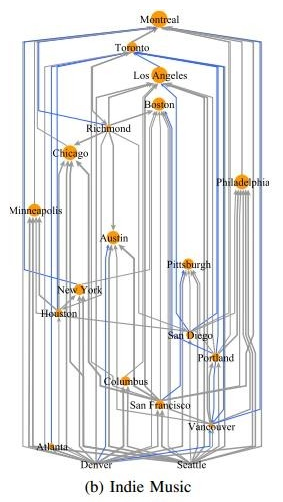
    But it turns out that Richmond registers on the map of independent music, a sign of its emergence as a regional center of artistic creativity. (See “Art as Richmond’s Future.“) A new paper, “The Geographic Flow of Music,” tracks which cities around the world have the most influence over musical trends by analyzing listening habits on Last.fm, a musical website that pinpoints users by geography. By this measure, as shown in the graphic above, Richmond ranks fifth — right below L.A. and Boston — in influencing the indie music world.

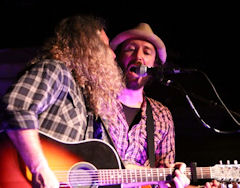
    Carbon Leaf, one of Richmond's best known indie bands.

    Sums up Brad Plumer at the Washington Post: ” The largest cities arenโ€™t always the most influential adopters of new music (or snubbers of stale music). New York and Los Angeles donโ€™t appear to have nearly as much influence over listening trends as, say, Montreal, even though those areas are presumably home to many more local bands and musical groups.”

    Too bad the Post didn’t take note of the awesomeness of Washington’s smaller, neighbor to the south. That’s OK, the people who live in Richmond know what we’ve got. And many welcome the transformation of this old southern town focused on the past into a vibrant creative center with an eye to the future.

    Meanwhile, notes the Times-Dispatch, the Chamber of Commerce is leading a delegation of 150 business, government and civic leaders to Boston to learn what they can from that city’s success. The message from Boston’s Mayor Thomas Menino:ย  It’s all about public-private partnerships.

    Dudes, it’s the 21st century. Top-down doesn’t work any more. Bottom-up does work. Forget copying other cities and see how you can stimulate the creativity that’s already here. There’s lots of it, if you know where to look.

    Hat tip to “FreeDem.”

    — JAB


  • Drive Down Dulles Tolls by Restructuring Bond Financing

    Sean Connaughton

    by James A. Bacon

    If the Metropolitan Washington Airports Authority (MWAA) restructured the way it plans to finance the Rail-to-Dulles project, it could reduce tolls on the Dulles Toll Road by $.90 per driver in the early stages, Transportation Secretary Sean Connaughton told the Commonwealth Transportation Board today.

    “We’ve been going through their finances. We can show them very easily how they can … dramatically reduce the toll rates by changing how they sell bonds and [utilize] fund balances,” Connaughton said.

    “These changes would be more beneficial than the $300 million being tossed around” in the General Assembly, added Virginia Highway Commissioner Gregory Whirley.

    Northern Virginia toll rates emerged as the deal-killer issue in the budget showdown between Republicans and Democrats this year. Senate Democrats blocked approval of the 2013-2014 budget on the grounds that it did not contain $300 million to help offset the fare increases that would be needed to finance Phase 2 of the Metro extension to Dulles airport.

    Connaughton expressed frustration that the VDOT analysis had gotten no traction in the Senate. “We are attempting to get them to understand. … This could have a dramatic impact.”

    Phase 2 of Rail-to-Dulles, currently estimated to cost about $2.8 billion, does not meet the cost-benefit prerequisites to qualify for federal funding. Therefore, Fairfax County, Loudoun County, MWAA and the state of Virginia must finance the entire cost themselves. Under the original financing agreement negotiated by the Kaine administration, the state’s share would come from revenues from the Dulles Toll Road. It has recently dawned upon Northern Virginia politicians that the financing requirements of the rail project could push tolls to $10.75 by 2028.

    Earlier this year the McDonnell administration said it could contribute an additional $150 million in undesignated transportation funds to help buy down the toll increases for the first twoย  years. But Senate Democrats, locked in a power struggle with Republicans, insisted upon $300 million more from unidentified sources.

    Connaughton said it’s not easy to come up with $300 million on the spot. Transportation funding is bound by rules and restrictions. Funds allocated for roads and highways, for instance, can’t be willy nilly transferred to mass transit. Moreover, most state construction funds are committed already as matching dollars on federal projects, and yanking the money could lead to the loss of the federal dollars. And there are practical limits to how much more the state can borrow.

    It would be easier to find the money next year. The irony, says Connaughton, is that the money for Rail-to-Dulles isn’t even needed until next year. He thinks the issue is a “power play.” First the Senate Dems, whose 20 votes are sufficient to block the budget, said they wanted more power sharing. Then they wanted money for K-12 schools in Northern Virginia. Now it’s money for Dulles rail. “Every time we address their concerns, it’s something else.”

    Even if the General Assembly coughed up the $300 million from some as-yet-unidentified source, there is no assurance that the CTB, whose approval is required by state law, would allocate it to Dulles rail. Several CTB members expressed reservations yesterday.

    Cord Sterling, representing the Fredericksburg district, will be a hard sell on extra money for Dulles Rail.

    Most outspoken was Cord Sterling, the Fredericksburg district representative. Giving an extra $300 million to Dulles rail, he said, would be “draining the rest of the commonwealth of resources.”

    “Somebody made an irrational decision to do a phase of the project that was not feasible,” Sterling said. The project could not be funded without sky-high tolls, and the prospect of high tolls raised an outcry. Now Northern Virginians want taxpayers from across the state to bail them out. “Northern Virginia is not hurting” in terms of transportation expenditures, he said referring to an earlier statement by Thelma Drake, director of the Department of Rail and Public Transit (DRPT) that Northern Virginia already consumes 89% of departmental funds allocated to transit capital spending and 72% allocated to transit operations.

    Whirley contended that there was no need for added funds, at least not right now. VDOT has not conducted an “exhaustive” review but he’s seen enough to suggest that MWAA should go back to the table. By his calculation, MWAA could avoid issuing $400 million in bonds by 2016, enough to eliminate the need for two planned toll increases.

    What makes VDOT, a highway agency, an expert in financing heavy rail projects? Said Connaughton: VDOT has developed considerable experience with mega-projects involving large fund balances.

    Update: This just in… Governor Bob McDonnell has issued a press release hailing Senate passage of the state budget. Apparently, the final budget version does not contain the earmark for Dulles rail. Regardless, the McDonnell administration should push MWAA to take another look at its bond financing plans to see if the savings postulated by Whirley are achievable.


  • Rail-to-Dulles Controversy Goes Statewide

    A house divided

    The debate over Rail-to-Dulles has taken a fascinating new twist. For years the controversy over the heavy rail project and its concomitant financing through Dulles Toll Road revenues has been a purely Northern Virginia issue. It received zero coverage in the Rest of Virginia (RoVa). Ninety-nine percent of downstate residents were ignorant of it, and the other one percent was indifferent (with the exception of your humble correspondent and a handful of others).

    Now Rail-to-Dulles financing has become the sole remaining object of dispute between Senate Republicans and Democrats in resolving the state budget impasse. The controversy has spilled over regional boundaries. Suddenly, what happens in NoVa matters to RoVa.

    So far, the proposal to borrow an additional $300 million — to be applied to reducing Dulles Toll Road fares incurred to help finance Phase 2 of the Rail-to-Dulles construction — has divided the General Assembly according to partisan, not regional, lines. Senate Democrats from RoVa have hung tough on the issue, even though their constituents will help shoulder the added debt burden. That raises the issue of whether Rail-to-Dulles is really a cause or pretext. Is it just a tool for getting Senate Dems what they really want, which is parity in committee and subcommittee representation in line with their 20 seats in the 40-member body?

    It will be interesting to see if regional tensions manifest themselves later today at the Commonwealth Transportation Board. The McDonnell administration will ask the board to allocate $100 million to help offset tolls for the Midtown-Downtown Tunnel project in Norfolk and Portsmouth. Sounds fair, considering that Governor Bob McDonnell has already promised $150 million in state funds for Rail-to-Dulles (possibly contingent upon resolution of a controversy over Project Labor Agreements in the bidding process). Is that enough to mollify CTB members from Northern Virginia? Will they express support for the additional $300 million in borrowed funds? Will rural representatives object to all the swag going to urban districts. Or will they simply rubber stamp administration requests?

    Stay tuned.

    — JAB


  • Skirting the Maelstrom

    by James A. Bacon

    It’s Business As Usual in Virginia as the political class grapples over budget issues seemingly oblivious to what’s happening in other parts of the world. Politicians of varied political stripes seem to think it’s a perfectly good idea to borrow another $300 million, over and above $150 million already set aside, to subsidize the Rail-to-Dulles project, an action that would push Virginia to the edge of its borrowing capacity consistent with a AAA bond rating.

    What could possibly go wrong?

    We’ll, let’s see. Despite the most massive peace-time monetary and fiscal stimulus in the modern history of the United States — near-zero interest rates and four years of $1 trillion+ deficits — the economic recovery remains the weakest since the Great Depression. Meanwhile, Hampton Roads and Richmond are under-performing in the current economic recovery, while slowdowns in the federal spending trajectory promises to slow future growth of the state’s only economic engine, Northern Virginia.

    There is nothing left in the economic arsenal to goose the national economy along. The United States is caught in the same kind of debt trap as Europe, in which cutting spending or raising taxes will damage short-term economic growth prospects and not cutting spending or raising taxes only postpones the final reckoning. That reckoning will come, whether it takes a year or a decade. The longer the delay, the greater the debt build-up and the more painful the ultimate confrontation with reality.

    Once again, we are reminded of how vulnerable some of the major European economies are, and by comparison we ourselves. Spain, a democratic welfare state with the world’s 12th largest economy, is back in the headlines.

    Madrid has committed to reducing a budget deficit of 8.5% of GDP lastย  year to a mere 5.3% this year, which is necessary to maintain credibility among the buyers of Spain’s debt. Trouble is, such austerity is shrinking the economy — not a good thing when unemployment is already running higher than 24%. And the cuts still may not be enough to restore investor confidence. The yields on 10-year Spanish Treasuries topped 6% Monday. As interest rates rise, so do debt payments. Higher debt payments mean bigger deficits, bigger deficits push up interest rates, and so on.

    The United States faces a similar challenge. The deficit this year is roughly 8% of GDP, comparable to Spain’s. But our debt as a percentage of GDP is way higher: 94% in 2010 compared to 60% for Spain. If Treasury bond yields reached 6% as in Spain, it would translate eventually (after long-term bonds matured) into additional debt payments of roughly $450 billion a year! There would be no way to cut spending or raise taxes enough to offset that burden. Of course, the U.S. is not Spain. We have our own currency, which means the Federal Reserve can buy as much Treasury debt as it wants. But that would lead to runaway inflation, which would substitute one form of economic chaos for another.

    I have seen absolutely nothing since writing “Boomergeddon” two years ago to suggest that the U.S. can avoid a fiscal meltdown. Locked in internecine political warfare, Democrats and Republicans have blown their chance to reduce the deficit and establish credibility with financial markets. We are fast approaching the point at which the fiscal slide becomes irreversible.

    Now, ask yourself. When federal finances melt down, with incalculable consequences, where would you rather be living? A state with strong enough finances to maintain core services through the ensuing chaos? Or a state that gets sucked into the maelstrom along with the federal government? Personally, I’d prefer to live in a solvent state and a solvent county. And that means making responsible financial decisions now.

    On the positive side, Moody’s Investment Services just noted that this year’s changes to the Virginia Retirement System will reduce state pension contributions by $3.6 billion over the next 21 years and “put it on a more sustainable path to fully [fund] its pension commitments, which is credit positive.”

    It will be interesting to see whether Moody’s will have anything to say if Virginia takes on an additional $300 million in transportation-related debt.

    Update: I have made a small edit to this post in response toย an exchange with DJ Rippert in the comments.


  • “Young Gun” Cantor Gets Tiresome

    By Peter Galuszka

    What a difference nine months makes. Last summer, Boy Wonder Eric Cantor, the U.S. house majority leader from Henrico County, was riding high politically.

    If he wasnโ€™t snubbing President Barack Obama in meetings over the need to raise the debt ceiling, he was racing to get ahead of the Tea Party parade despite his thoroughly Main Street credentials. With another even more luminous Boy Wonder, U.S. Rep. Paul Ryan, was giving himself into a makeover as a youthful leading light of the New Conservatism.

    To underscore that dynamism, cantering Cantor co-wrote, with Ryan and another young Republican congressman, the book โ€œYoung Guns,โ€ an ego-saturated tome that draws on 1960s cowboy shows to set him up as a brave gunslinger defending budget discipline righteousness in a saloonful of drunken hacks and slutty Miss Kittys.

    But today Boy Wonder has trouble on several fronts. According to Jeff Shapiro, the Times Dispatch columnist, Cantor is pissing off his fellow Republicans with his overweening self-centered nature and shameless attempts to replace Speaker of the House John Boehner.

    Cantor dipped into his own Super PAC (curiously named the Every Republican is Crucial Political Action Committee or ERIC-PAC) to buck up an unknown Illinois congressman against a GOP elder in a primary race. Trying, once again, to posture as a budget hawk, heโ€™s gone against the popular U.S. Export-Import Bank which helps fund exports of small and large corporations alike. And, his local allure has backfired so much that his guy lost in a Henrico County commonwealthโ€™s attorney race.

    If this werenโ€™t enough, the editorial page of The New York Times has taken apart one of Young Ericโ€™s pet legislative efforts โ€“ one that lets โ€œsmall businessโ€ owners deduct up to 20 percent of their business income.

    That sounds all well and good since small business is every polsโ€™ flavor of the month. But the Times points out a few little discrepancies โ€“ namely, what is a โ€œsmall businessโ€ exactly?

    According to Cantor, a small business is one with less than 500 employees. That can include โ€œmulti-million-dollar partnerships and corporations.โ€ Businesses this size, the Times says, ย arenโ€™t really the big job creators politicians claim they are.

    If you really want to get to jobs creation, you have to go down to businesses that have 50 employees or less. Endeavors this size have created one third of all new jobs in the past 20 years. So what does Cantorโ€™s bill mean? According to the Times, it is a thinly-veiled attempt to give the rich, whom Cantor loves to represent, yet another tax break.

    Many politicians might get away with such slick actions. The trouble with Cantor is that his persona comes off as that of Eddie Haskell, the cloying jerk of 1950s TV fame, according to New York magazine. Given the way his district runs through red zones, however, itโ€™s likely Eddie (or Eric) will be with us a while longer.


  • Fairfax County’s Incredible Shrinking Growth Forecast

    Click on graph for more legible image. Credit: Terry Maynard.

    More great analysis from Terry Maynard! In a memorandum to fellow members of the Reston Master Plan Special Study Task Force, he tracks the incredible deflating population growth projections for Fairfax County and explores what it means for transportation and land use planning.

    As recently as 2008, the sky was the limit. As the federal government had grown and prospered over the decades, so had Fairfax County. Northern Virginia, and Fairfax in particular, had boomed without let-up through the Reagan defense build-up, the S&L fiasco, the Internet boom and 9/11. The region even seemed resistant to the 2007-2008 recession.

    But economic recovery has been more sluggish than predicted, and the future for government spending — especially the defense, intelligence and homeland security spending that fueled Northern Virginia’s growth — is looking grim. While population and employment are still expected to expand, they will not do so at the torrid pace expected only a few years ago. The existing 17% vacant office space in Reston, suggests Maynard, could accommodate two-thirds of all forecast non-residential growth through the year 2030. He concludes: “We need to discuss what to do about adapting to the region’s new economic reality.”

    Sadly, that discussion is not taking place.

    Much of the massive infrastructure investment occurring in Northern Virginia was predicated on pre-2008 growth forecasts. I’m not as worried about the Capital Beltway HOT lanes project, in which private-sector investors will share the financial pain if forecast traffic does not materialize, as I am about the Rail-to-Dulles project, which has no private equity investment to cushion any shortfall in traffic and revenue.

    Rail-to-Dulles is essentially a bubble project. The economics of it worked only as long as Northern Virginia’s economy continued to boom. There are three levels of analysis that need scrutiny. The first and most obvious need is to re-examine the traffic and revenue forecasts for the Silver Line itself, which is already projected to lose money on an operational basis. If population and business growth forecasts fail to materialize, will revenue fall short? Will operational deficits increase? And what impact will that have on Fairfax and Loudoun budgets?

    A second set of questions arises about the Dulles Toll Road, the toll revenues of which will be siphoned to pay for roughly half of the up-front capital costs for Phase 2 of the heavy rail line. What will lower population growth mean for traffic and revenues? If toll fares fall short, who gets first dibs on the revenue– bond holders or the construction/maintenance needs of the toll road?

    Thirdly, what does this mean for the re-development of Tysons Corner? The Fairfax County Board of Supervisors approved massive increases in density around four Tysons station stops under the expectation that the resulting increase in property values would enable landowners to finance a transformation of the hodge-podge business district into a walkable, mixed-use urban center — Fairfax’s answer to Arlington’s Metro corridor. But if office vacancies remain stubbornly high and if population and employment projections are wilting, property owners will be in no hurry to re-develop their assets. If the higher densities and walkable streets take decades longer to materialize than originally thought, there could be a lot of half-empty trains rumbling through Tysons Metro stations.

    The Fairfax County board has done its best Hear No Evil imitation, voting to confirm its financial commitment to Phase 2. If the federal spending machine slows, if 2008 population and economic growth forecasts prove too optimistic, if Silver line revenues fall short of projections and operating deficits exceed them, and if Dulles Toll Road revenues fall short and if the Metropolitan Washington Airports Authority defaults on its bonds, the county — indeed, the whole region — will be in a world of hurt.

    Of course, I am looking at worst possible outcomes. But that’s what intelligent deal makers do — they examine worst-case scenarios to see if they can live with the results. They certainly don’t base multibillion-dollar investments on years-old economic and demographic forecasts that are known to be outdated.ย  Not one dime should be sunk into Phase 2 until the implications of slower growth for Silver Line and Dulles Toll Road revenues are fully understood. Failure to perform that fundamental analysis is not simple folly. It’s not mere blindness. As far as I’m concerned, it’s criminal negligence.


  • $100 Million in Mo’ Money for Hampton Roads Tunnels

    Step right up, there's plenty to go around!

    The Virginia Department of Transportation has reached financial close with Elizabeth River Crossings to begin construction of the new $2.1 billion Midtown/Downtown Tunnel project in Norfolk. Also, Governor Bob McDonnell announced today, he will ask the Commonwealth Transportation Board to allocate “up to $100 million” to cover the cost of delaying the tolls until January 2014.

    That extra $100 million comes on top of VDOT’s $300 million contribution under the terms of the deal. The good news is that VDOT had originally anticipated kicking in $362 million but was able to pare back its commitment thanks to lower interest rates. Thus, in effect, the state is plowing back $62 million into toll rate relief and contributing a net of only $38 million more.

    In a press release issued this morning, the McDonnell administration addressed the volatile reaction in south Hampton Roads to the imposition of tolls on facilities that had been paid off years ago and been enjoyed toll-free since. In an interim agreement negotiated before McDonnell took office, said the press release, the estimated toll was $2.89 for cars. That rate will be lower, $1.59 to $1.84 per car initially under the current plan depending on time of day, although rates will rise over time.

    Politically, it will be interesting to see how this plays out.

    Will Hampton Roads residents be mollified? McDonnell’s plan eliminates the paying of tolls before the new facilities are actually built, a gross injustice in anybody’s book, and he can claim to have brought down toll rates lower than they would have been. On the other hand, many Hampton Roads residents object to paying any toll. This may not satisfy them.

    Also, now that the governor has agreed to buy down tolls for Hampton Roads commuters, he has set a precedent for the Rail-to-Dulles project, for which Democrats have been pushing for an additional $300 million in relief over and above $150 million already promised. If Hampton Roads gets a total state contribution of $400 million, will $150 be enough to satiate Northern Virginia? Or will the governor cave and hand over the full $450 million?

    If he does, what’s to stop the Metropolitan Washington Airports Authority, which has been put in charge of the heavy rail project, from making more decisions that add to the cost of the project? Will MWAA back off its decision to stack the deck for Phase 2 bidding in favor of companies operating under union Project Labor Agreements at the risk of a higher winning bid?

    Finally, is there any rhyme or reason left to how state transportation dollars are allocated to mega-projects? All of they money we’re talking about here is borrowed, and it’s all exempt from traditional funding formulas which, for all their imperfections, do distribute money around the state according to criteria related to population and need. The calculus is purely political, divorced from any social and economic Return on Investment.

    — JAB


  • Art as Richmond’s Future


    by James A. Bacon

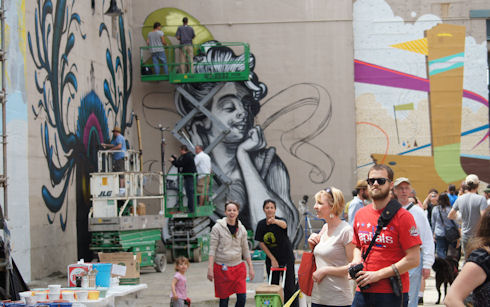
    Art in Richmond is busting out of the museums, universities and galleries and into the streets. The latest efflorescence occurred Saturday when a dozen nationally known street artists gathered to create an outdoor gallery along the James River Power Plant Building and Floodwall along the canal walk. Hundreds of people came on down to see the artists in action.

    Jon Baliles… with beer cup in hand

    The event was organized by Jon Baliles, who was inspired by seeing something similar in Venice, and Ed Trask, a musician and mural painter who recruited the other artists. Although Baliles works for the City of Richmond, he and Trask pulled off this event on their own initiative. It took about one year from conception to execution.

    Craft booth.

    Once upon at time, it’s fair to say, Richmond was a pretty stodgy place. It had some beautiful neighborhoods, most notably Church Hill and the Fan, and a fairly vibrant downtown. It had more than its share of Fortune 500 and other corporate headquarters, along with a good number of law firms, financiers and marketing/advertising professionals and a smatter of manufacturing. But the city was nobody’s idea of a center for innovation.

    Chilling out at the art festival on a Saturday afternoon.

    Richmond may never make it as a leading center of technological innovation. But it could become a respectable center for creative arts and the businesses that intersect with the arts. The Virginia Commonwealth University art program, rated the best of any public university in the country, lures a lot of artistic talent to the city. And many of those artists, like Trask, wind up staying.

    Artists don’t tend to launch the kind of fast-growth companies that turn metropolitan areas into growth dynamos. But they do create an ambiance that other educated and creative people like to share. They create the conditions for entrepreneurial vitality by making Richmond the kind of place where executives from Capital One, Philip Morris or other corporate behemoths like to live when they get tired of working for the Man and want to start their own businesses.

    Economically, Richmond is going through a difficult time right now. But it is reinventing itself from the ground up. Between the James River, the canal walk and the artistic community, the old Capital of the Confederacy is morphing into something very 21st century, something very exciting.


  • Fuel Economy Standards Will Price 200,000 Virginia Drivers out of the New Car Market

    Proposed fuel economy rules for the year 2025 will raise the average price of a vehicle by $3,000 and price seven million potential new car buyers out of the market nationally, according to a new study by the National Association of Automobile Dealers released today.

    A state-by-state breakdown indicated that 122,000 drivers in Virginia, or 1.9% of all licensed drivers in the state, would be affected.

    Mandated fuel efficiency standards may be necessary to wean the nation from dependence upon foreign oil but making automobiles more expensive will push millions of lower-income drivers into the used car market. If the price of used cars then rises, as elementary economics predicts, then people will be priced out of the used car market as well.

    Also, interest rates are bound to rise eventually from their rock-bottom lows. The Federal Reserve Board cannot sustain its stimulative, low-interest rate stance forever. Higher borrowing costs will price even more lower-income drivers out of the market.

    In the past, the number of licensed drivers increased as more lower-income Virginians could afford automobile ownership. As cars become more unaffordable, the number of drivers will stall or perhaps even go into reverse. It’s not a stretch to conclude that Vehicle Miles Traveled will not keep pace with historical increases over the next 10 years.

    What does this mean for public policy in Virginia? First, we won’t need a lot of roads and highways that planners think we will need. Projections of Vehicle Miles Driven made for the VTrans 2025 study were pure fantasy. Second, a lot of lower-income Virginians will need to find transportation alternatives — something we’re not preparing for. We need to be giving a lot more thought to making shared ridership services more ubiquitous and affordable so thousands of Virginians don’t find themselves stranded.

    — JAB


  • “Address the Transportation Crisis” — Code Words for Mo’ Money

    by James A. Bacon

    In a foreshadowing of a possible grand urban alliance, Hampton Roads mayors have reached out to counterparts in Northern Virginia and the Richmond region to unite in pursuit of a comprehensive transportation funding solution.

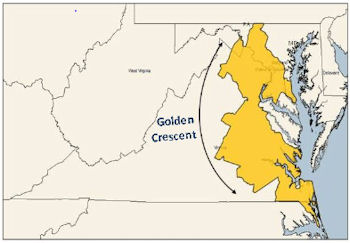
    “We all recognize the crisis Virginia faces as it relates to transportation, therefore, we strongly believe it is time for the Golden Crescent Region of Virginia to organize ourselves,” states a letter sent this week by the Hampton Roads Mayors and Chairs Caucus.

    The Virginian-Pilot described the initiative as the “brainchild” of Norfolk Mayor Paul Fraim and Virginia Beach Mayor Will Sessoms. The letter had support from leaders across Hampton Roads, the newspaper reports. Among south Hampton Roads municipalities, only Chesapeake declined to sign.

    The letter comes as the General Assembly prepares to return to the Capitol next week to vote on a state budget after Senate and House conferees nixed $300 million to pay down future toll rates on the Dulles Toll Road and an unspecified amount of additional toll-mitigation funds for the Midtown/Downtown Tunnel project.

    A number of years ago, the letter notes, there was an attempt to get the Golden Crescent to coalesce around transportation and education issues. It is time to revive that initiative. “Considering the transportation crisis we now face, we strongly feel it is time again for us to join together, perhaps with the assistance of the business community. We believe our regions working together can effectively influence the General Assembly to address the transportation crisis.” The letter also noted the need to address tax reform and the outcome of the Supreme Court ruling on Obamacare.

    The letter proposed convening a summit of the mayors and boards of supervisor chairs from Golden Crescent localities soon after the reconvened General Assembly session. “The purpose of this gathering would be to coalesce around some general ideas relating to transportation funding, developing a strategy, and discuss outreach to the business community. More specifically, we would agree to harness our respective political influence and initiate a campaign to influence our General Assembly to address our significant transportation challenges.”

    The letter provides no specific remedies. But it’s not difficult to imagine what the signatories have in mind. They’re not talking about changing they way they do business. They want mo’ money. Someone else’s money.

    That’s easier said than done. Here are some of the hard realities that Governor Bob McDonnell and state state confront while trying to find more money for transportation.

    • Gas tax. While elites favor an increase in the motor fuels tax, the general public does not. The reasons for the gulf in sentiment are twofold: (a) Higher-income households can absorb higher prices at the pump more easily than lower/middle households can, and (b) higher-income households place a higher premium on time spent stalled in traffic congestion than do lower/middle income families. For elected Republican officials, whose middle-class suburban and rural constituents drive more than average, the gas tax is politically toxic.
    • Borrowing. The McDonnell administration has already maxed out the state’s borrowing limits for transportation projects without endangering Virginia’s AAA bond rating. (See “Rail-to-Dulles and the Debt Dilemma“). Borrowing more is not an option.
    • General Fund. The General Assembly has just nixed two proposals to divert monies from the General Fund to the Transportation Trust Fund. Democrats, who led the charge for higher gas taxes, also led the charge to defeat proposals that would siphon off monies otherwise reserved for schools, colleges, health care, prisons and other non-transportation priorities.
    • Tolls. The McDonnell administration is aggressively pursuing public-private partnerships that would finance mega-projects by means of tolls. But the Hampton Roads mayors have made it very clear that they don’t like the idea of making their constituents pay the full cost of what it takes to build those projects. So, while tolls remain an option, it’s not one that the letter signatories like.

    There are alternatives to spending mo’ money. For the benefit of new readers, or those readers who failed to absorb the wisdom imparted by my previous columns, let me review some of them.

    • Zoning reform. Reform antiquated zoning codes and comprehensive plans that lock suburban growth counties into “suburban sprawl” mode — a development pattern marked by segregated land uses, low density and autocentric design — and make it easier for developers to build compact, walkable, mixed use communities when supported by consumer demand.
    • Prioritize by ROI. Prioritize transportation projects that deliver the greatest social Return on Investment as measured by safety, congestion relief, economic development (attracting primary employers, not retail and service employers) and environmental impact.
    • Devolution. Align transportation and land use by devolving responsibility of secondary roads, along with the means to pay for them, to local governments. If local mayors and chairs make poor decisions, they should pay for them — not the state.
    • User pays. Restructure transportation financing to a “user pays” system — gas tax and tolls are the most practical means at the moment — in which those who benefit from transportation projects are the ones who pay for them. When users pay for transportation improvements, they are more discriminating about what they ask for.
    • Deregulate transit. Revitalize shared ridership by shifting away from the failed model of government-owned transit monopolies to a model based on competition, private ownership and innovation.
    • Technological innovation. Pursue new technologies that drive down the cost of building and maintaining roads. Two examples: the use of LiDAR technology to achieve breakthrough gains in surveying and design efficiency, and the use of cold in-place recycling of asphalt in repaving projects.

    Will any of these alternatives to Mo’ Money be on the agenda of the Golden Crescent summit? I would be flabbergasted if they were.


  • Corey Stewart’s Racist Baggage

    By Peter Galuszka

    Corey A. Stewart, the scourge of โ€œillegalโ€ immigrants and standard-holder of good old fashioned American values, is now running for lieutenant governor on the Republican ticket in 2013.

    News reports of his recent announcement were predictably bland โ€“ comments in the right-wing blogosphere even more so โ€“ despite the fact that Stewart is one of the most divisive, if not downright racist, politicians in recent Virginia history.

    As a member of the Board of Supervisors of Prince William County since 2003, Stewart is famous for his movement to require county police to profile anyone they suspected of being illegal immigrants if they were stopped. This law was obviously aimed at brown-skinned Latinos. Similar legal requirements were later adopted statewide in Arizona and Alabama, bringing the U.S. global derision.

    One immediate effect of Stewartโ€™s 2007 initiative was that Hispanic immigrants started fleeing the county in droves regardless of whether their papers were entirely in order or not. Stewart claims that his move caused violent crime to drop 37 percent in the largely white and wealthy suburb of Washington, D.C. chock-a-block with federal jobs and cul-de-sac homes. More informed individuals, such as Steven Camarota, research director of Center for Immigration Studies, says the link between violent crime and illegal immigration is a lot more tenuous.

    Among the negative fallout from Stewartโ€™s xenophobic grandstanding was that it pit white-skinned against dark-skinned and haves against have nots. The lead-in to the law and the aftermath brought on some very ugly scenes that drew to the soul and conscience of what had been a rather quiet, growing county.

    For an idea of just how rancid Stewartโ€™s ideas were, check out the short, award-winning film 9500Liberty by Annabel Park and Eric Byler. The 2010 documentary runs less than five minutes or so, but shows Americana at its worst. In one famous scene, an elderly white man screams at Park and Byler to โ€œspeak Englishโ€ and get legal. In response, Park, who was born in South Korea, is a naturalized American citizen and studied at Boston University and Oxford, produces her U.S. passport and flashes it in his face.

    Even the chief of the county police has big trouble with Stewartโ€™s law, which Stewart later tried to expand to the rest of Virginia in his โ€œRule of Lawโ€ campaign. My memory of Stewart is in October 2010 at the โ€œVirginia TeaParty Patriots Conventionโ€ in Richmond manning a little booth trying to dish out anti-immigrant ideas. He seemed to be ignored amidst the hubbub of deficit hawks, Patrick Henry re-enactors in Colonial garb and gun fanatics packing Glocks and Colt 45s in Velcro holsters.

    In any event, bashing immigrants has gone out of style at least for now. The reason is the economy. Fewer undocumented foreigners are coming here because jobs are nil. Ironically, Hispanic construction workers had been flocking to Prince William about 10 years ago to help serve the demand for badly-planned cookie cutter houses, including McMansions.

    When the housing market tanked, some stayed, werenโ€™t quite legal and their brown skins became more evident to the white folks when they were shopping at the countyโ€™s many strip malls. In an odd way, itโ€™s a bit like Arizona which had been run by dark-skinned Native Americans and Spanish for centuries and was not even a state until 1912. Then, around the 1960s, flocks of retirees of more northern European ancestry showed up. Suddenly, Arizona became โ€œAmericanโ€ and had to be protected.

    For his lieutenant governorโ€™s campaign, Stewart seems to have dropped the immigrant bashing because it has gone out of style. Instead, he says, he weathered the recession by not raising taxes in Prince William but investing in roads and โ€œpublic safetyโ€™ (code word for immigrant bashing?) and cutting $143 million from the county budget.

    He says: ย โ€œPrince William County is a model for how to implement good conservative principles. Taxes are down, crime is down, and growth is up. I am going to bring to the Office of Lieutenant Governor the same conservative principles that I have led Prince William County with over the past 6 years.โ€

    Naturally, he fails to mention that many of those new jobs come out of the federal budget, but no matter. The bigger point is that Stewart is going to have to come to terms sooner or later with the impact of immigration on economic growth now that recovery seems in the air. That will raise the immigration issue yet again.

    Even the Wall Street Journal notes on its editorial pages today that too much visa protectionism is hurting the U.S. India is about to file a complaint with the World Trade Organization against a 2010 U.S. law that hikes fees for visas for highly skilled workers from India. Meanwhile, rejections of ย H-1B and L-IB visa applications for well-qualified foreign workers are considerably up.

    One wonders what Stewart, who is casting himself as ย yet another โ€œjobsโ€ Republican, thinks about this. One thing he might be sure of. Some darker-skinned foreigners with PhD.s in highly technical fields that many Americans lack may think twice about moving to Prince William County, or maybe even the Old Dominion if he wins his state race.


  • Dulles Rail: “Good Night, John Boy”

    By Peter Galuszka

    The convoluted schemes of Virginia state politicians to avoid paying for rail service to Dulles International Airport are as frustrating as they are self-defeating and unfair.

    Just a few days ago, it seemed that the General Assembly would consider adding $300 million to extend Metrorail to Dulles on the Silver Line when the legislature meets to approve an $85 billion budget April 18.

    Thanks in part to last minute opposition by Democratic deal-maker State Senator Charles J. Colgan of Prince William County, the $300 million went โ€œpuff.โ€ No deal. No money.

    The $300 million cut underscores what seems to be Richmondโ€™s ancient philosophy on expanding Dulles Rail: stick as much of the cost as possible on taxpayers and tollpayers in Northern Virginia.

    Days after the $300 million in state funds for Dulles Rail disappeared, the Board of Supervisors of Fairfax County confirmed its buy-in for Phase Two of the Dulles Rail project, whose ultimate costs will top $2.7 billion. The county says that while it is looking for alternate funding sources, it may pay up to $965 million for the project. About $730 million โ€“ or 80 percent โ€“ will be paid for by โ€œvoluntaryโ€ special tax districts created by landowners.

    Once again, Northern Virginia, which provides more state tax revenue than any other region of the Old Dominion, gets stuck with most of the bill for Dulles Rail. That is the criticism of the Coalition for Smarter Growth which was quick to note the bizarre budget cut. They point out that, at the same time, the administration of Gov. Robert F. McDonnell is proposing at least $750 million in state funding for a new superhighway near U.S. 460 in the rural peanut country of Southeast Virginia and diverting $200 million for a controversial bypass in Charlottesville.

    Itโ€™s hard to fathom why providing Dulles rail with state money is such anathema. The new U.S. 460 tollroad project, for instance, raises many questions. It is being billed as a necessity for Virginiaโ€™s economic future since the port of Hampton Roads needs better transportation access to handle bigger, deeper-draft cargo ships when the Panama Canal is expanded in 2014.

    Yet, Norfolk Southern railway which serves the port has already finished a $321 million public-private project to raise mountain tunnels to handle more double-stack rail shipments from Hampton Roads to the Midwest. The chief executive of the Panama Canal Authority says that thanks to rail improvements, Hampton Roads is already prepared to handle the expanded trade the canal project will bring. If heโ€™s right, then why is there urgency for the new road?

    There have been other peculiar impediments to the state paying for Dulles rail, such as Knee-jerk anti-unionism. Right-wing Atty. Gen. Kenneth Cuccinelli and others are crying foul at any attempt by the airports authority to use the a similar but somewhat tougher project labor agreement that helped move Phase One forward. A more deep-rooted issue is Virginiaโ€™s traditional philosophy, dating back to the one-party system of Harry F. Byrd 100 years ago, that public projects must be funded on a โ€œpay as you goโ€ basis.

    That might have worked for building a two-lane bridge in bucolic Virginia when TVโ€™s John Boy Walton, attired in bib overalls, might have been around. Today, the fact remains that Washington is the only capital in the advanced industrialized world not to have public rail service to its leading international airport.