• IG of the Day: Religiosity

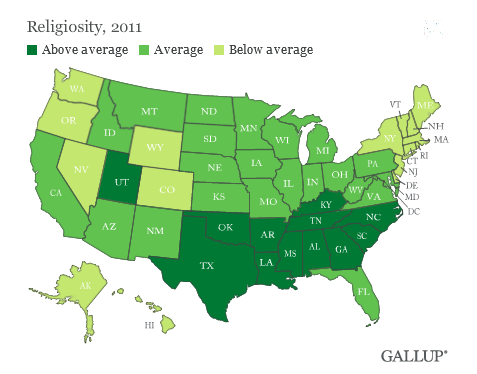
    Mississippi is the most religious state in the country, while Vermont and New Hampshire are tied for least religious. Virginia, where 42% of respondants to a recent Gallup pollย described themselves as “very religious,” ranked with the middling states.

    — JAB


  • What Baconauts Won’t Discuss

    By Peter Galuszka

    Reading the Baconโ€™s Rebellion Blog always displays breathtaking contradictions. Chief among them is the huge contradiction between pushing โ€œsmart growthโ€ and shunning any form of increasing gasoline taxation.

    The crux is that we have lots of horrendous sprawl in the state such as all of Northern Virginia, Route 3 in Fredericksburg and U.S. 29 in Charlottesville. We have underfunded and under-maintained roads. That all adds up to a death spiral of bad planning and a slavish adherence to el-cheapo ways of doing things โ€“ all in the name of the Cato Institute.

    In Virginia, for instance, the state gasoline tax is 17.5 cents a gallon. It hasnโ€™t been raised in 25 years. It hasnโ€™t even been made to adjust for inflation. By contrast, North Carolinaโ€™s gas tax is 38.9 cents per gallon.

    As politicians, especially Republicans such as Gov. Robert F. McDonnell stubbornly refuse to consider the obvious solution to their many road issues, they have the rest of us jumping through one convoluted hoop after the other trying complicated ways to get funds without taxation. Itโ€™s a bit like trying to breathe without air.

    That brings up another point โ€“ the insane accusations that Barack Obama is responsible for $4 a gallon gasoline. GOPers like Mitt Romney and Bobby Jindal (oil state guy) claim that gasoline prices have doubled under Obama and his energy policies are now creating havoc at the pump. The reality is that setting gasoline prices has a lot more to do with Asian demand the Iranian nuclear facilities than the policies of one U.S. president, who, by the way, has made big progress in weaning the country away from foreign oil.

    Yet the biggest irony is spelled out in the latest issue of The New Yorker and comes, surprise, from Romneyโ€™s own economics adviser, Greg Mankiw. The Harvard professor recently wrote: โ€œEconomists who have added up all the externalities associated with driving conclude that a tax exceeding $2 a gallon makes senseโ€ฆBy taxing bad things more, we could tax good things less.โ€

    Now, if you happen to read Baconโ€™s Rebellionโ€™s most prominent blogger, we get an education how smart growth could make our lives better. We need to build more housing in more densely-packed areas, go for green zones, reduce wasteful and polluting gasoline use and try mass transit (all dipped in a libertarian flavor of course!)

    The unspoken part is what Mankiw brings up. Federal gas tax is a puny 18.4 cents a gallon. If you raise ย it to $2 a gallon, as Mankiw suggests, youโ€™d suddenly have smart growth โ€“ presto! Youโ€™d have a lot of other things, too, such as much higher mileage cars, a fatter federal checkbook and less stupidity when it comes to highway and housing planning.

    Are we going to get this? Of course not. The status quo politicians are hardly going to pretend the gas hike issue exists while blaming Obama for something not of his making. Meanwhile, readers of Baconโ€™s Rebellion will be treated to the increasingly amusing acts of contortionists stretching and folding any way they can to avoid discussing tax hikes. As a former altar boy I can appreciate trying to keep the dogma pure.


  • Midtown Meltdown

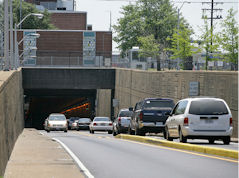
    Norfolk Midtown Tunnel. Photo credit: VDOT

    by James A. Bacon

    The controversy over tolls on the $2.1 billion Midtown Tunnel/Downtown Tunnel project in Hampton Roads is spreading statewide as transportation advocates in other parts of Virginia ponder the implications of what it means for them. Inย a missive distributed yesterday Robert Chase, president of the Northern Virginia Transportation Alliance, warned that one “rumored” scenario under consideration by House-Senate conferees would be to renege on the $2.1 billion public-private partnership agreement with Elizabeth River Crossings (ERC), even if it meant triggering multimillion-dollar penalties.

    Hampton Roads legislators are up in arms over the deal, which would slap tolls on users of the two tunnels and the Martin Luther King Expressway later this year in order to finance major improvements that aren’t scheduled to be complete for two years. Two weeks ago, the Virginian-Pilot reported, Del. Chris Jones, R-Suffolk, was researching how the contract could be terminated as an option of “last resort.”

    If Chase isย correct,ย Jones’ idea has morphed from a research project into an option under consideration by House and Senate budget conferees in Richmond. Jones, as it happens,ย is one of the six House conferees, as is Johnny Joannou, D-Portsmouth, whose district is at ground-zero of the controversy. Under the Jones scenario, writes Chase, the state “would legislatively scrap the $2.1 billion Hampton Roadsย Midtown-Downtown Tunnel PPTA contract and mandate that only a new Midtown Tunnel be built entirely with state funding through over $1 billion in federal GARVEE financing.”

    Needless to say, that idea won’t play well in Northern Virginia, or anywhere else for that matter. Conferees are weighing the idea of providing an additional $300 million, plus $150 million already agreed upon,ย to defray the cost of the Rail-to-Dulles METRO rail project in Northern Virginia, but half or more of that project financing still will be paid by commuters on the Dulles Toll Road. It’s an open question how NoVa lawmakers will cotton to an arrangement that extracts $4 tolls from Dulles Toll Road commuters for a rail service they aren’t even usingย while Norfolk commuters get a new tunnel for free.

    Notes Chase:

    Scrapping the PPTA deal would mean breaking aย legally binding contract with the consortium, incurring financial penaltiesย  and totally circumventing the Commonwealth Transportation Board/stateย and local planning and approval processes. Not a real private-sectorย confidence builder for a state with virtually no construction dollars desperateย to attract private sector investment. …

    Virginia has already committed $400 million to the Downtown/Midtown/MLK Extension project to buy down tolls. To provide the total $1 billion (and allow Hampton Road residents a toll-free trip) the Commonwealth would have to add another $600 million in GARVEE funds or essentially all of the $1.2 billion in authorized GARVEE bond funds for the next 10-12 years to a single Hampton Roads project. (GARVEE bonds are repaid from future federal revenues meaning that about $100 million/year in future federal revenues will go to a single Hampton Roads project as opposed to being leveraged across many throughout the state.)

    Transportation officials say that this would most likely kill Northern Virginia’s I-95 Express HOT Lanes project for which GARVEES are targeted and potentially several others including the Route 7/Belmont Ridge Road Interchange and the Leesburg Bypass/Sycolin Road interchange.

    In sum, scrapping the ERC contract would derail the McDonnell administration’s entire transportation grand strategy, which is based upon leveraging the borrowed dollars through public private partnerships. Accordingly, the chances of the governor going along with the Jones scenario are just about zero. I would conjecture that Jones doesn’t really want to un-do the ERC deal, he’s just using the prospect of disaster as leverage to extract enough money from the state to offset tolls until the tunnels are built.

    Two lines of argument would support such a bid. First, it is entirely unreasonable by any standard to ask people to pay tolls for transportation improvements they are not using. (Admittedly, that argument didn’t work for Dulles Toll Road commuters, so it may not be a strong one.) Second, if the state is forking out up to $450 million for the Rail-to-Dulles to provide toll road relief, it’s hard to argue that it can’t afford a measley $100 million or so for Hampton Roads.

    Whatever happens,ย Virginiaย has reached a sad state of affairs.ย Billions of dollars of bond proceeds are sloshing around uncommitted. The monies are not subject to the usual transportation formulas which, though flawed, at least ensure that funds are distributed around the state in a manner roughly approximating population and need.ย The criteria for allocating bond monies, it appears, will be he who screams the loudest gets the most money. Political considerations will supplant economic considerations, and the results will be sub-par.

    Welcome to the New Dominion.

    Update: Here’s another reason why the Jones scenario of cutting the cost by building just one tunnel won’t work: The improvements to the Midtown Tunnel, Downtown Tunnel and Martin Luther King Expressway are designed to work as a network. The MLK Expressway will funnel a lot of drivers off the Interstate to the two tunnels, according to my source. The plan is to provide up-to-date info about driving conditions at both tunnels to commuters on the MLK, by signs or other means, to steer them to the least congested facility. Building theย  components of the plan one by one won’t deliver the same congestion-mitigation benefits.


  • Veto Power for VDOT

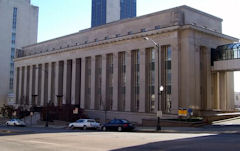
    VDOT central office, Richmond

    The Virginia Departmentย of Transportationย would gain extensive powers over local transportation planning under a bill awaiting the governorโ€™s signature. That makes local governments and citizen groups very nervous.

    by James A. Bacon

    Gov. Bob McDonnellโ€™s omnibus transportation bill is less far-reaching than when first submitted to the General Assembly in January, but important elements have survived the legislative meat grinder. Among its many provisions, the bill would dramatically increase the stateโ€™s control over local transportation planning and, by extension, land use planning.

    Transportation Secretary Sean Connaughton describes the bill as an effort to address the fiscally ruinous practice of county boards making land use decisions and expecting the state to build the roads needed to serve the resulting growth. Counties and their sometime-allies in the Smart Growth movement view the bill as an momentous transfer of power over transportation and land use into the hands of an unresponsive Virginia Department of Transportation (VDOT) bureaucracy.

    In a deal hashed on the last day of the General Assembly session, Republican lawmakers stripped out many parts of the bill that the McDonnell administration had pushed for, most notably two controversial provisions for siphoning revenue from the General Fund to the Transportation Trust Fund. (The bill still provides for the transfer of a portion of General Fund surpluses to the transportation fund.) But they stuck with measures that (1) would require local transportation improvement plans to be consistent with the Commonwealth Transportation Boardโ€™s State Transportation Plan and Six Year Improvement Program and (2) require counties to pay back any state and federal funds spent on canceled projects at the countiesโ€™ request.

    Under the bill, local governments would have to submit their transportation plans to VDOT for review and comment. If VDOT determined that a plan was not consistent with the state plans, it would refer to plan to the Commonwealth Transportation Board, which approves all state-funded transportation projects, for appropriate action.

    โ€œThis basically gives the state veto power over transportation improvements in a locality,โ€ says Ted McCormack, director of government affairs for the Virginia Association of Counties. “Weโ€™re working on a plan of response. Weโ€™re very concerned about these land use provisions in the bill and would like to see some changes.”

    The bill goes โ€œcompletely against community vision,โ€ says Dan Holmes, director of state policy for the Piedmont Environmental Council. โ€œThe new law will make it impossible to deny projects put into place by VDOT.โ€

    The aim of the bill is to bring transportation and land use planning into closer alignment, an abstract goal that all parties agree is desirable. One way to accomplish that goal would be โ€œdevolutionโ€ โ€” shifting responsibility for building and maintaining secondary roads from VDOT to the counties. (Cities already have that responsibility.) But local governments reject that option on the grounds that the state would saddle them with major obligations without sufficient means to pay for them.

    The counties may not like devolution but the status quo is unacceptable, says Connaughton. Counties are making land use decisions and transportation plans that impact state finances. While proffers from developers might cover some of the cost of making road improvements, counties sometimes assume that the state will take up the slack. The state incurs additional, ongoing expense for maintaining the roads. Read more.


  • Hate ObamaCare? Try Social Media

    By Peter Galuszka

    For all the chatter before the U.S. Supreme Court and pundits, ObamaCare has raised critical questions striking at the heart of individual rights and the Constitution. Yet thereโ€™s another, far more powerful and potentially more sinister force out there that is far more ominous along similar grounds: social media.

    True, โ€œsocial mediaโ€ is considered โ€œprivate industryโ€ since it is dominated by fast-growing companies such as Facebook and therefore is considered โ€œokโ€ by the libertarian crowd. They said the same thing back in the 1980s when Bill Gates cleverly forced more than 85 percent of the market to use his mediocre computer operating system, often by predatory tactics, or so critics say.

    Now we have Facebook, created by yet another brainy Harvard geek, everywhere, dominating everything and changing, for the worse, how people communicate, how they can protect their privacy, intellectual property, how they think and how they write. (Mind you, it is โ€œOKโ€ because it is โ€œprivate industry.โ€)

    If you want to check into newspaper stories, you are often forced to go to a Facebook page where you must wade through a swamp of irrelevant crap such as what someoneโ€™s latest cat looks like and what they thought of last nightโ€™s Fettuccini Alfredo. Grandmothers feel a little heartbroken when their grandchildren say they canโ€™t come over because they have to study, but then post their same-day trips to a theme park on their Facebook pages where Grandma can easily see them. Even common courtesy is being taken apart by this latest fad.

    The issues created by Facebook go far beyond ObamaCare requiring everyone to get health insurance. The Virginia State Police is now under fierce attack by civil libertarians for forcing applicant state troopers to hand over passwords so investigators can vet their Facebook pages. In ancient days, it would be like giving inquisitors every personal letter you ever wrote or your diary.

    True, vetting state employees especially cops is important. If Gov. Robert F. McDonnell had been a little more attentive about who his personal chef was, he wouldnโ€™t be getting front-page publicity. One wonders why he needs a chef to handle 100 events a year, but I guess itโ€™s better that way, since if he didnโ€™t have a chef, there are plenty of powerful corporations and lobbying firm all too happy to handle his canapรฉs for him. But there must be limits. Not only the State Police, but many companies, are stepping over the personal privacy lane because enormously public Facebook makes it easy.

    Another Facebook issue is who controls content. The company has gotten into trouble over this one before. The company line is that what you post is yours, but Facebook pretty much gets to do whatever it wants with it until you officially remove the item. Sometimes, it is hard to change anything with these faceless, computer-driven firms who often donโ€™t even bother to have phone trees, let along Customer Relationship Managers, to handle your problem.

    Intellectual property is another big issue. If you post your creative work, how do you know it isnโ€™t being ripped off? This question drills down to a generational divide. Some of the 20-somethings I work with part-time are so part of the Facebook culture, they judge their success by their number of hits, rather than the chances that their content is being ripped off. On the other hand, one of my daughters, a college senior studying art, told me than none of her colleagues will ever post any of their work on Facebook, not even photos of paintings, because they are too afraid of losing ownership control and there seem to be no safeguards.

    Lastly, since Facebook and Tweets and Twitters (whatever) are designed around quick, instant messages, they are as forgettable as they are extremely brief. The process puts enormous pressure on users not to do any deep thinking, develop an argument or share any more than the simplest of creative ideas.

    What you are seeing is the medium truly becoming the message (or, even better, the massage). ย Oops, that sounds so 1960s Marshall McLuhan. I am showing my age.


  • IG of the Day: Virginia’s Impaired Waters

    Click on map for larger image. Source: From the Virginia Department of Environmental Quality's 2012 Water Quality Assessment Annual Report.

    Virginia’s waters aren’t necessarily getting more polluted, but the Department of Environmental Quality is doing a better job of sampling Virginia’s rivers and streams, with the result that more dirty stretches of waterway are being found. This map shows the varying water quality across the state. Not much of it is pristine. Read the report.

    — JAB


  • The Lamentable Demise of the Daily Newspaper

    I, for one, will miss daily newspapers when they expire, as it seems they inevitably willย — and not just because I find it more convenient to scan headlines and read stories on newsprint than online. For all my complaints about the Mainstream Media, I will miss the ability of newspapers to cover important events and trends in a semi-objective manner.
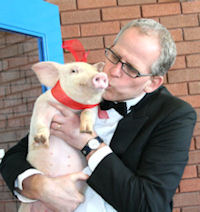
    Scott Lee and I chat about the future of newspapers and journalism in Virginia on The Score Radio Network.


  • Pencil Whipping Mass Transit

    In my previous post, I objected to the Virginia state Senate voting to pump an additional $300 million into the Rail-to-Dulles heavy rail project without demanding more accountability from the Metropolitan Washington Airports Authority (MWAA), theย entity in charge of overseeing design and construction.ย Now, let’s stop to think what happens when construction is complete and the Silver Line is handed over to the tender mercies of the Washington Metropolitan Area Transit Authority (WMATA) for day-to-day operation.

    What do we know about WMATA? Well, as pointed out yesterday, the authority has racked up $13.3 billion in capital replacement and maintenance backlogs, including $6.5 billion for which it has not identified a funding source. That should come as no surprise now that we read in the Washington Times about WMATA’s “culture of complacence, incompetence and lack of diversity.”

    WMATA is not only a union shop that resists efforts to increase productivity and efficiency, it has a clubby culture marked by rampant racial favoritism. People don’t talk about the favoritism because it doesn’t fit the dominant narrative of whites oppressing people of color. In WMATA’s case, blacks discriminate against whites and Hispanics, and men against women. As the Times leads its story:

    Ninety-seven percent of the bus and train operators at [WMATA]ย are black, with only six white women out of more than 3,000 drivers, according to Metro documents โ€” a lack of diversity at one of the regionโ€™s largest employers that has led to an acknowledgment of failure in affirmative-action documents and spawned a series of lawsuits.

    With Metroโ€™s budget chronically strained and reports of mismanagement coming more regularly than trains, interviews and internal records depict a likely root: an environment in which hardworking employees are actively excluded and those who rise are those willing to do the bare minimum โ€” never causing a stir by flagging rampant safety violations, reporting malfeasance or proposing improvements.

    Perhaps the most telling detail in the report is a description of the practice of “pencil whipping” — a practice so pervasive that there is a term for it. It refers to the fudging of inspections and other reports.

    The state of Virginia and local governments served by WMATA help cover the organization’s operating deficit. When Rail-to-Dulles project is handed over to WMATA, the state will sink even deeper into the Metro morass. Unfortunately, if the recent past is prelude, Virginia will dish out funds to WMATA as passively as it has forked over money to MWAA.

    Virginia will need more mass transit in the future as automobility becomes increasingly unaffordable. But the current model for mass transit in Virginiaย is badly broken, beyond hope of self-repair. Deficit-plagued bus and rail businesses will not survive a prolonged belt-tightening by state, local and federal government. What transportation options will Metro riders have if WMATA goes belly up?

    Where are the supporters of mass transit? Why are they silent? Are they scared of stigmatizing their favored transportation mode? That’s happening already. They must join the clamor for reform or risk seeing mass transit swept away in a tide of red ink.

    — JAB


  • Kissing the Pig — Wrapped up in a Bow

    by James A. Bacon

    When push comes to shove, are Virginia’s Republicans fiscal conservatives first or culture warriors first? We found out yesterday when the Senate Republicans and Democrats reached agreement to pass a state budget.

    Republicans succeeded in batting down a $3 million Democrat-inspired provision for the state to pay for ultrasounds required of women seeking abortions under a bill that Governor Bob McDonnell recently signed into law. But they let stand a measure authorizing the state to borrow another $300 million to offset the cost of the Rail-to-Dulles heavy rail project. (See “Kissing the Pig.”)

    Congratulations, guys, you clawed back an entire one percent of the dollars you approved to bail out the most expensive public works project in Virginia history. And you acceded to the giveaway without demanding any more transparency or accountability of the Metropolitan Washington Airports Authority (MWAA), the entity empowered with managing the project. Bottom line: You’ve abdicated your fundamental responsibilities as guardians of the public purse — all for what? A purely symbolic victory in the abortion wars.

    In the interest of balance, I could accuse Virginia’s Democrats of fiscal hit and run as well. After all, it’s at their insistence that the additional $300 million bail-out funds, over and above $150 million previously approved, were inserted in the budget. But, then, that’s just Democrats being Democrats. We all know they love spending other peoples’ money. Republicans profess not to.

    According to the Times-Dispatch, the Dems sought $3 million in state funding to cover the cost of the imaging procedures for low-income women. The Dems had a culture war issue that was playing well in the polls, and they weren’t about to let go. Moreover, given the fact that the state was now mandating the ultrasound, one could make a not unreasonable argument that the state should offset the cost for women who lacked insurance.ย  But for reasons that are unfathomable to me — it’s not as if state funds would be used for actual abortions — the Rs could not abide this fiscally negligible measure and voted it down in a party-line vote.

    Yet the ongoing drama over Phase 2 of the Rail-to-Dulles project elicited only a snore. The Senate measure would borrow $300 million to defray interest costs on the project debt, thus reducing pressure to raise tolls on the Dulles Toll Road, the source of more than half of the estimated $2. 8 billion roject’s funding.

    This is the same MWAA that has given preferential treatment to bidders using Project Labor Agreements, disadvantaging open-shop (non-union) enterprises… the same MWAA that backed off from an expensive underground station at Dulles airport only after setting off a political backlash in Northern Virginia… the same MWAA whose board is comprised of a majority of non-Virginians… the same MWAA that is exempt from Virginia’s Freedom of Information Act and is not subject to state audit. Rather than leverage that additional $300 million to make MWAA more accountable, the Senate is handing over the money with no conditions.

    The only hope for sanity to prevail is for House of Delegates representatives to axe the bail-out in the budget reconciliation process. Thankfully, the money-for-ultrasounds issue is off the table. Perhaps the House negotiators will be able to focus on where the real money is.


  • Kissing the Pig

    by James A. Bacon

    The good news for Virginians from late last week is that Republicans and Democrats in the Senate Finance Committee broke their deadlock over the state budget. The bad news is… Senate Republicans and Democrats broke their deadlock. The only way to paper over the divide between the two parties, of course, was to spread around more pork.

    Funding for transportation and schools lay at the heart of the budgetary disagreement between the Rs and Ds. On the transportation front, the Dems held out for a new deal that would delay implementation of tolls on the Midtown and Downtown tunnels linking Norfolk and Portsmouth, and and provide $300 million extra to finance the Rail-to-Dulles project. The GOP caved. Assuming the full Senate passes the agreement brokered in committee — it is scheduled to vote this afternoon — the budget then will be await reconciliation with the House of Delegates version, which includes none of those provisions.

    The first measure noted above would ask the state to re-open negotiations with Elizabeth River Crossings to “develop a strategy” to delay the imposition of tolls on Hampton Roadsters until 2014. That is entirely reasonable, as it is grotesquely unfair to ask commuters to pay for a facility that has notย  yet been built.

    The second measure would add $300 million more in state contributions for the Rail-to-Dulles project on top of $150 million already promised to help buy down toll increases on Dulles Roll Road users, the main piggy bank for Phase 2. Thus, the Senate would blindly dump nearly a half billion dollars into the project, no strings attached.

    Meanwhile, Gov. Bob McDonnell has yet to sign the Comstock bill, which would nix state funds for the heavy rail project if open-shop (non-union) companies are discriminated against in the Phase 2 construction. The governor’s inaction has prompted speculation that he has backed off from his insistence that the Metropolitan Washington Airports Authority (MWAA), which is managing the Rail-to-Dulles construction, reverse its preference treatment of union Project Labor Agreements.

    Adding to the jury-rigged nature of the Rail-to-Dulles bail-out, the Senate budget would borrow the extra $300 million and use the funds to defray the debt service on the Dulles Toll Road Revenue Bonds.

    But the worst of it is that so many questions about the Metro Silver Line project to Dulles airport still fester.

    • No one yet knows how much Phase 2 will cost. While Phase 1 is running close to budget, the Project Labor Agreement issue creates a huge uncertainty for Phase 2, which is estimated at $2.8 billion. MWAA’s preferential policy may discourage non-union companies from submitting bids, increasing the likelihood that the winning bid will exceed $2.8 billion.
    • No one has firm numbers on how much it will cost Loudoun and Fairfax counties to subsidize the operation of the Silver Line on a year-to-year basis. Official estimates suggest the deficits could run $40 million to $75 million annually, but that could be low if the Washington Metropolitan Area Transit Authority (WMATA), which will run the Silver line once it’s built, maintains its low-fare structure.
    • Long-term, ridership could be considerably lower than assumed. The recession and impending slowdown in federal government spending have reduced population growth projections for Loudoun and Fairfax, and Loudoun has downzoned much of its land, effectively capping population growth there in any case.
    • WMATA remains a financial cripple. The organization has projected 10-year capital replacement costs of $13.3 billion, including $6.5 billion for which no source has been identified. Will Fairfax, Loudoun and the state of Virginia end up assuming a portion of that liability? Or will MWATA simply let service deteriorate? No one knows.
    • Who will pay for the $3 billion in transportation improvements required to serve the anticipated traffic growth in Tysons Corner resulting from the increased density granted landowners there? The upzoning was justified on the grounds that, combined with heavy rail access, landowners would have the incentive to transform Tysons into a more walkable, mixed-use better functioning urban district.

    Virginia’s political class lurches from decision point to decision point, patching up the current crisis while failing to consider entirely foreseeable problems down the road. Taxpayers and toll road users are gouged while landowners, unions, project contractors and other private interests are enriched. Citizens know they are getting hosed but the process is so opaque, accountability so diffused and the Mainstream Media so neutered that they don’t understand how.

    Note: This post has been edited to reflect more up-to-date information provided by readers.


  • A Rare Civil Dialogue

    Robert Reich


    by James A. Bacon

    Conservative columnist Charles Krauthammer and liberal professor/author Robert Reich squared off in a civil and thoughtful debate at the Richmond Forum last night. Neither man changed my thinking but I enjoyed the dialogue immensely. I also walked away with one powerful conviction: The contentious, sound bite-driven format of cable television and the recentย Republican “debates” is poisoning this country.

    The beauty of the Richmond Forum format is that it provided ample enough time for Krauthammer and Reich to amplify their thoughts (although it did become a running gag during the event that Krauthammer always needed a little more than the time allotted). Further, they were given an opportunity to respond in a meaningful way to one another. There was no name calling. There were no cheap shots. There were no “gotcha” moments. There was no misrepresentation of the other guy’s position. None of the intellectual pollution that passes for thought in cable television was evident.

    Charles Krauthammer

    The theme was America’s social contract — can it be sustained? It would surprise no one that I sympathised most with the conservative Krauthammer. But Reich made his case eloquently and advanced a number of propositions that any thoughtful conservative would do well to address. By the end of the event, it also was clear that the two men actually agreed on a goodly amount.

    I rarely turn on the television at home butย one member of the householdย seems curiously addicted to MSNBC, with the result I spend a fair amount lot of time watching Rachel Maddow, Ed Schultz, al Sharpton and (anomalously) Joe Scarborough. Theย liberal hosts of the first three shows don’t haveย the faintest idea what conservatives think. Theyย erect straw men of conservative thought and then bash them with ridicule and personal demonization. The same technique describes the pseudo-news comedy routines of Jon Stewart and Stephen Colbert. I don’t watch Fox News butย ย based upon my radio exposure to the the likes of Sean Hannity and Glenn Beck (though Beck no longer works there), I would surmise that Fox is an ideologicalย photo negative of MSNBC.

    One does not come away from those shows enlightened. One is led to draw the conclusion that “the other guys” are frauds, charlatans, dupes, malevolent seekers of power or completeย ignoramuses. Not only are they wrong but they are willingly and deceitfully wrong — either that or they are mentally deficient. From my observation, CNN is somewhat more balanced in the views it presents but its talking-heads format still encourages dissemination of daily talking points rather than an enlighteningย exchange of ideas.

    Many others crave a new talk show format. Indeed, a former Virginia legislator of my acquaintance has been working on a business plan for an enterprise that, much like the Richmond Forum, would promote civil debate.ย I wish him the best of luck. We desperately need a change.


  • Murals on My Mind

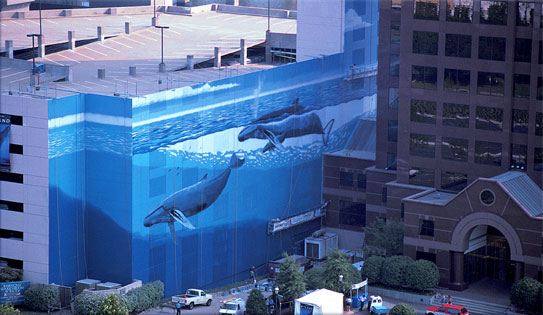
    I love giant murals painted on the vacant walls of buildings. They add so much life to the building — and the urban area all around. My favorite is the immense picture of two humpback whales on the side of the Dominion Towers parking deck in Norfolk. But the whales will have plenty of competition in downtown Richmond.

    Artists from around the world have begun painting murals on buildings in the Broad Street corridor for a month-long art show, G40 Art Summit-Richmond, reports the Times-Dispatch. The art exhibit coincides with a city proposal to convert the Broad Street corridor into an arts and culture district. (See “Richmond’s Wine and Brie Path to Economic Development.”)

    Photo credit: Times-Dispatch

    “We can help an artists district create a great identity,” said Shane Pomajambo, the G40 organizer. “If you drive by Broad Street after we’re done, you’re going to know it’s the arts district.”

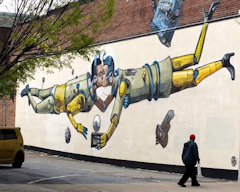
    Italian artist Pixel Pancho has already gotten to work, completing a mural of two weightless retro-astronauts kissing. Organizers expect to splash some 20 works of art on downtown buildings, including one that will be five-stories tall.

    I can hardly wait to move from the sterile ‘burbs back to downtown!

    — JAB


  • Selling Cars to a Generation that Venerates Apple more than Chevy

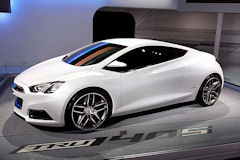
    Chevy's concept car, the Tru-140S, is designed to stimulate the interest of 20-something Millennials. But Millennials are diffident about owning cars at all.

    Back when the Baby Boomers were coming of age a zillion years ago, the Detroit automakers had a problem: Boomers rejected their parents’ favored American brands and embraced cars from Japan and Germany. Today, automakers of all nationalities have an even bigger problem. Members of the Millennial generation are rejecting their Boomer parents’ preference for automobiles in the first place.

    An article in today’s New York Times suggests the scope of the challenge:

    In 2008, 46.3 percent of potential drivers 19 years old and younger had driversโ€™ licenses, compared with 64.4 percent in 1998, according to the Federal Highway Administration, and drivers ages 21 to 30 drove 12 percent fewer miles in 2009 than they did in 1995.

    Forty-six percent of drivers aged 18 to 24 said they would choose Internet access over owning a car, according to the research firm Gartner.

    Cars are still essential to drivers of all ages, and car cultures still endure in swaths of suburban and rural areas. But automobiles have fallen in the public estimation of younger people. In a survey of 3,000 consumers born from 1981 to 2000 โ€” a generation marketers call โ€œmillennialsโ€โ€” [brand consultant] Scratch asked which of 31 brands they preferred. Not one car brand ranked in the top 10, lagging far behind companies like Google and Nike.

    Given how indispensable cars are to function in our society, those numbers are extraordinary.

    This isn’t a problem that affects only Detroit. Here in Virginia, developers, home builders and municipal planners need to anticipate Millennials’ preferences by designing the kinds of places where young people prefer to live. For many, that means building communities where it is possible to pursue a “car-free” lifestyle. Local officials and their planning staffs need to revisit comprehensive plans built around the preferences of Boomers like themselves. At the very least, they need to loosen the cosseted restrictions of their comprehensive plans and zoning codes to allow developers more leeway to innovate.

    Finally, state officials need to re-think their financial priorities for transportation funding. If young people are more likely than their parents to live in densely urbanized areas with greater access to mass transit, bike lanes and other transportation alternatives, should the commonwealth still be building roads into the suburban frontier? And if the younger generation prefers mass transit and other forms of shared ridership, should state officials not be straining to make commuter rail more economically viable rather than the expensive, money-losing fiscal disaster that it currently is?

    We can see the changes coming. Shame on us for continuing Business As Usual.

    — JAB


  • Tarheel Lawsuit Could Change VDOT Planning Practices

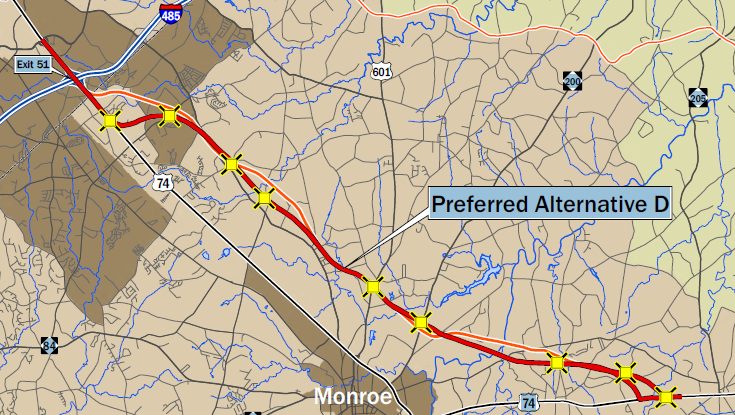
    The proposed Monroe Bypass south of Charlotte. (Click for more legible image.)

    A lawsuit filed against a proposed bypass near Charlotte, N.C., could have a big impact on how road and highway projects are decided in Virginia. If a coalition of conservation groups win their case in U.S. 4th Circuit Court of Appeals, it would apply to all states in the court’s jurisdiction, including Virginia.

    The Southern Environmental Law Center and three other conservation groups filed suit claiming that the North Carolina Department of Transportation and Federal Highway Administration turned federal law on its head by assuming in the environmental impact statement for the $700 million Monroe Bypass that the highway already existed when analyzing a “no build” option.

    “This flawed approach led to the improbable result that building the 20-mile, four-lane bypass with nine interchanges on the fringe of metro Charlotte would have practically no impact on development patterns, the Yadkin River watershed or air quality from increased commuting,” stated the SELC in a press release yesterday. The analysis also precluded from consideration anย option for upgrading the existing highway corridor that would have costย a mere $15 million.

    โ€œIf this flimsy, so-called โ€˜analysisโ€™ can stand,” said SELC senior attorney David Farren, “the concern is we could end up building tens of billions of dollars in massive highway projects across the region without any fiscal or environmental checks and balances.”

    A lower court acknowledged that the misrepresentation had occurred but ruled it “immaterial.” A ruling from the Court of Appeals is not expected for a few months.

    Trip Pollard, a senior attorney in SELC’s Richmond office, said a favorable ruling would impact transportation decision-making in Virginia. “The failure to analyze alternatives is a consistent problem in Virginia.”

    The $244 million Charlottesville Bypass is a case in point, Pollard said. The Virginia Department of Transportation did not study the alternative Places 29 plan for ameliorating congestion on U.S. 29 north of Charlottesville when resurrecting the project from mothballs after nearly 20 years. Another example is the proposed rebuilding of U.S. 460 between Petersburg and Suffolk as a limited access highway, a project to which the state has committed $500 million. VDOT never gave consideration to upgrading the existing four-lane highway.

    “We’re optimistic” about a favorable ruling, Pollard said. “The court asked a lot of good questions.”

    — JAB


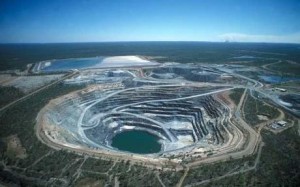
  • The Uranium Quagmire

    By Peter Galuszka

    For the 50 or so people sitting in the quaint Pepsi-Cola building Tuesday in Danvilleโ€™s tobacco warehouse district, the information seemed to spawn more frustration than clarity. They had gathered to hear two economic impact reports regarding controversial plans by Virginia Uranium to mine an ore deposit a dozen miles to the north in Chatham.

    โ€œThe bottom line is that we donโ€™t know what will happen in the future,โ€ said Katherine Heller, a senior economist at RTI International. The Research Triangle Park, N.C. consulting firm had been hired by regional agencies to estimate what happens if Virginia Uranium, owned by local and Canadian investors, proceeds with its plans for a uranium mining and milling complex.

    The RTI report, in addition to one prepared for the state by Chmura Economics and Analytics in Richmond, says that barring human error and adequate regulations, the uranium project could be a boon for the depressed, former textile and furniture region. RTI predicts it could bring in 724 jobs and $162 million in a year affecting an area 50 miles from the mine and milling operation. Chmuraโ€™s report says essentially the same thing.

    Those predictions, however, assume the state overcomes big hurdles, as yet another report by the National Academy of Sciences says it must face. Among those obstacles:

    • Virginia has no laws regulating uranium mining or milling ore into useable yellowcake. Gov. Robert F. McDonnell recommended delaying any decision on voiding a nearly three-decades-long ban on uranium mining in the state until more study is done. He has set up a group to study the issue.
    • According to RTI, the tailings from the uranium deposit that runs 1,500-foot deep will be stored permanently underground in an area near vital drinking water supplies. According to Heller, those dump sites will have to be monitored indefinitely, most likely for thousands of years. There are no plans yet to do such monitoring or how to pay for it.
    • There are no plans yet on requiring Virginia Uranium to set aside funds in escrow to help localities deal the costs and loss of businesses and taxes due a potential spill or accident. It also isnโ€™t clear who will pay for the necessary state regulators and inspectors especially when the upcoming budget is tight and has yet to be approved.
    • There are lingering questions and confusion over how transparent the McDonnell group will be as it studies uranium mining. At first, Cathie J. France, a deputy director of the Department of Mines, Minerals and Energy who heads the uranium committee, said that her group would not hold public hearings but would accept written comment and provide a Web page. After public criticism, Martin L. Kent, McDonnellโ€™s chief of staff, wrote legislators that due to โ€œmisunderstandingโ€ there had been a โ€œmischaracterizationโ€ of how public comment will be obtained. He says that the group will โ€œaccept public comment during four open meetings.โ€
    • The economic health of the uranium plans depends on highly volatile global uranium pricing. Heller said that RTI based its predictions on a โ€œmiddle highโ€ estimate that could be subject to big and unexpected swings.
    • So far, studies regarding uranium mining have cost various government entities more than $2.7 million. The RTI study cost $530,000. Yet they all confront the same problem, the impossibility of assessing risk or economic fallout if there are no state regulations or enforcement mechanisms in place to set a benchmark.

    The bottom line is that the uranium idea seems terribly premature. Virginia Uranium has already drawn negative attention for taking legislators on expenses-paid trips to places such as Paris. McDonnell wants his committee to make recommendations to the 2013 General Assembly. That may be way too soon.