• Back 2 Busing Basics

    Civic entrepreneur Jim Porter has discovered a new niche in the mass transit realm — free bus rides for students and other weekend revelers. Chalk up another victory for private-sector transit.
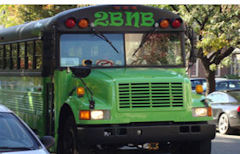
    by James A. Bacon

    When Jim Porter was looking into the practicality of operating a private bus service in Richmond, he was told he would have to get City Council approval for his routes. But if he didn’t charge a fare, he could run his bus where he wanted. He decided that charging passengers wasnโ€™t worth the trouble. His goal was simply to run a loop between Virginia Commonwealth University and Richmondโ€™s nightclub district in Shockoe Bottom so students would have an alternative to drinking and driving.

    Little did he imagine in 2009 when he launched To the Bottom and Back (2BNB) on capital of $6,500 that his free service would be transporting thousands of people monthly and generating $220,000 in revenue by 2011. As it turned out, Porter discovered that he could support the non-profit operation with tips, contributions and corporate sponsorships. With an entrepreneurโ€™s nose for business, he has added two circulator routes — one connecting the University of Richmond, another serving Richmondโ€™s museum district — and he has forged relationships with fraternities, sororities, festival organizers, food banks, athletic leagues and others.

    โ€œWe listen to our passengers, our drivers, our sponsors,โ€ says Porter. Word of mouth has led to numerous opportunities. It turns out that there was a vast market not served by the Greater Richmond Transit Company (GRTC) or commercial bus companies. Established competitors would gladly provide the service but they cannot match Porterโ€™s fares โ€“ free โ€“ or his cost structure. He has purchased his fleet of four buses from county school systems, never paying more than $3,500 for a bus, and he hires school bus drivers for part-time work. Maintenance costs are minimal. โ€œWhen I have maintenance on the bus,โ€ he says, โ€œI can go to the nearest junkyard and get what I need.โ€

    Oh, yeah, all that, plus he doesn’t pay himself a salary.

    2BNB has a unique business model; there is nothing else like it in the country. It is a classic example of what a civic entrepreneur can accomplish with creativity and a shoe-string budget. And it shows the kind of innovation in transportation services that that could be unleashed by the private sector if only it were given more lattitude in an industry dominated by government-funded monopolies.

    The dominant player in the Richmond market, the GRTC, is regarded as one of the better-run transit companies in the country, but it pays 10 times what Porter does for new buses, pays its bus drivers 50% more, plus benefits, and must convince affected municipalities to pass an ordinance every time it wants to add or drop a route. GRTC management has had a plethora of good ideas for expanding the service across the region but local politics and federal regulations make it impossible to respond nimbly to market opportunities.

    To Porter, running the bus service is more than a job, itโ€™s a passion. He tells stories about how he grew up in the bus business. His grandmother ran a tour company for senior citizens, and as a youngster he would help out by hauling luggage and handing out BINGO tickets. โ€œI was raised with the idea of customer service,โ€ he says. Later, crossing the picket line during a Greyhound strike, he drove the route between Richmond and New York. The gregarious Porter says he loved that job, which allowed him to interact with riders.

    For 15 years Porter, now 45, had nursed the idea of running a bus to serve Richmond restaurant patrons but he couldnโ€™t get any interest. He talked to Mothers Against Drunk Driving but drew a blank. He investigated taking his idea down to Nags Head during the tourist season but couldnโ€™t pull it off. It wasnโ€™t until he was in a West Virginia traffic accident โ€“ he was hit by a drunken driver and his car tumbled down a hill โ€“ that he raised the money he needed. He drew upon his settlement to finance the start-up of To the Bottom and Back.

    Porter bought his first bus, painted it lime-green and black, and started carrying VCU students. The free service was a huge hit and drew hundreds of riders. It wasnโ€™t long before he began attracting restaurant and corporate sponsors like Sticky Rice, the Hat Factory, Loveland Distributing and the Emroch and Kilduff law firm. Riders didnโ€™t pay fares, but they did leave tips. Says Porter: โ€œI would meet parents, and they would write me checks and say, โ€˜Thank you for looking after my daughter.โ€™โ€

    As revenues rolled in, Porter added new buses. Although the routes are fixed, drivers aren’t required to abide by strict schedules. Porter likes his buses to dally in Shockoe Bottom so they can pick up more riders, and he would rather have a bus run behind schedule than go faster and risk an accident. The lack of minute-by-minute precision doesnโ€™t hurt, he says: Riders can keep track of the busesโ€™ locations on free, smart-phone so they know when their ride will arrive.

    Porter may have to stick to tighter schedules to pull off his next big idea. He sees another under-served market โ€“ West Broad Street, a commercial corridor flanked by hundreds of restaurants and retailers that supports thousands of entry-level jobs. When people need to get to work on time, keeping schedules is important, he concedes, but it would cost GRTC a lot more to serve the route than it would cost 2BNB. โ€œFor a few thousand dollars, I can drive a bus anywhere.โ€

    Porter doesn’t have toย conduct expensive marketing studies to determine if demand for the service exists. He’ll just buy a bus, paint it and put it on the street. If theย riders materialize, so will the sponsorships. Ifย the demand isn’t there, he’ll move the bus to another route — exactly how mass transit needs to operate in the future if it’s going to gain market share from automobiles.


  • The “Agenda 21” Nutbars

    By Peter Galuszka

    A half a century ago in rural places like the tobacco and corn fields of Eastern North Carolina, there used to be billboards with strong and aggressive messages. One said: โ€œThis Is Klan Country.โ€ Another advocated: โ€œU.S. Out of the United Nations.โ€

    Both represented frightening, hard-right elements. The source of the first sign was obvious. Another, slightly more presentable group had put up the second sign. That was the John Birch Society, an ultra-conservative organization founded in 1958 that hated communists, pushed U.S. unilateralism, and purported to uphold so-called โ€œAmericanโ€ values, which, at the time, were codes words for Anglo Saxon โ€œChristiansโ€ upset about everything from growing globalism to integrating the races at home.

    Now, people of the same ilk, Tea Partiers and other hard-right types, are extending decades-old U.N. paranoia to down-in-the-weeds smart growth policies that set up limits such as lot size, where growth should go and how services can be matched to growth.

    In an intriguing article in this Sundayโ€™s Richmond Times Dispatch, reporter Rex Springston outlines how this cabal apparently based in the Richmond area and in the watery Middle Neck has targeted the smart growth campaign. They have helped delay comprehensive plans in Henrico and Chesterfield Counties, oppose the use of electricity meters, bike paths, and cleaning up the Chesapeake Bay.

    Their rallying cry is the so-called โ€œAgenda 21โ€ which is a policy established by the U.N. back in the early 1990s promoting the then-fashionable ideals of โ€œsustainable development.โ€ Given that the document came from an international group representing countries of all income and development levels, it pushes such guidelines as grouping housing for the sake of efficient resource use.

    The anti-Agenda 21 crowd claims that the plan would strip away home ownership. It would end private farming and would apparently push people into Stalin-style collective farms or somesuch. Erecting smart electric meters in individualsโ€™ houses for more efficient use of electricity is part of a plot for mass surveillance by Big Government. Naturally, George Soros, the billionaire, left-leaning financier, is behind this. Yet the Republican National Committee and Next Gingrich have embraced getting rid of Agenda 21.

    Close to my home in Chesterfield County, anti- Agenda 21 types have helped delay adoption of a new comprehensive plan which had been designed more or less around smart growth policies. Growth would be concentrated around existing highway and commercial areas and not allowed to hopscotch hither and yon. A โ€œgreen zoneโ€ in southwestern Chesterfield where I live would be kept green. Tea Party types threw wrench into that one, saying it would take property rights away from owners.

    One wonders where these clowns were back 20 years ago when Chesterfieldโ€™s growth-happy board of supervisors gave into every idea any developer had. That is why schools are overcrowded and police and fire services are short-changed. My small subdivision has shifted school districts three times in 10 years to help the county rectify its disastrous planning.

    The Tea Party people like bad planning because it represents โ€œfreedom,โ€ I would guess. It seems extremely odd that they would drag in a sleepy, two-decades-old UN proposal as their whipping boy. Their claims that it is fostering global socialism is as nutty as the John Birch Society itself.

    One wonders, with the global economy deciding where jobs go more and more, how these people deal with the 21st century world. Their solution seems to be to dress up like Patrick Henry in colonial garb, wave their rattlesnake flags and tell the rest of the world where to go. The rest of us will be paying for the consequences.


  • Virginia Government Scores an “F” for Transparency, Accountability

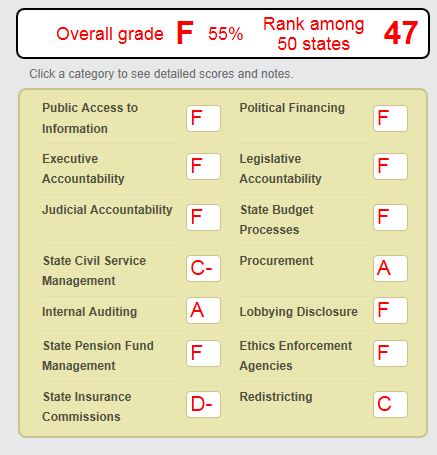
    Virginia transparency and accountability report card. (Click for more legible image.)

    by James A. Bacon

    Virginia scores 47th out of 50 states in a ranking of transparency and accountability conducted by the State Integrity Investigation project. In case you were wondering, a score of 50 is the absolute worst. In other words, 46 other states have greater transparency and accountability than we do.

    Among the major flaws in Virginia: The state is one of only nine with no ethics commission, one of four with no campaign finance limits,ย and one of only two in which part-time legislators select the judges before whom many practice law. The State Corporation Commission and constitutional officers (including sheriffs) are exempt from the state Freedom of Information Act. Lobbyists are required to register, but the definition of “lobbying” applies only to direct contact with legislators and the governor, not to the influence over the drafting of regulations or contacts with other lobbyists. And that’s just the short list. (See the Virginia state profile.)

    By contrast, Virginia receives superior scores only for procurement and internal auditing. (Let’s have a cheer for the Joint Legislative Audit and Review Commission!)

    The project stems from a collaboration of the Center for Public Integrity, Global Integrity and Public Radio International. Predictably, defenders of the status quo will shoot the messenger — this is a liberal organization, therefore, it’s biased. As a libertarian/conservative, I tend to be highly suspicious of liberals. I never take anything they say at face value. But I don’t start with the supposition that they are always wrong. Sometimes, they make valid points and do valuable work. And this is one of those cases. There is no evident partisan slant to the state rankings. This is a study that everyone should take seriously.

    Defenders of the status quo make one other point: How bad can the problem be? Virginia has a low level of corruption. As House Speaker William Howell said after the conviction of former Del. Phil Hamilton, R-Newport News, for bribery and corruption, โ€œNeither ethical lapses nor public corruption are commonplace, let alone tolerated in Virginia.โ€ Howell added that the state has a longstanding โ€œreputation for good government.โ€

    I have the highest regard for Howell’s personal integrity, but in this instance I believe he is being naive. As Laura Lafay, the Virginia researcher for this project, quotes John McGlennon, a professor of government at the College of William & Mary, as saying, “How they can take the case of the one guy who got caught and say it proves that no one does anything wrong is beyond me. Part of the reason we identify those states like Illinois and New Jersey as more corrupt is because they have more rules identifying corrupt behavior.”

    Aย case in point: A month ago, I blogged about special state tax breaks worth millions of dollarsย carved out for the Orion Air Group. There was nothing illegal about the legislation and lobbying surrounding that deal — but there should have been. Virginians can preen themselves aboutย how clean their government is. Just because a practice is legal, however, doesn’t make it right.

    Another worrisome area is transparency and accountability for a wave of multibillion-dollar public-private transportation projects in the process of being negotiated around the commonwealth. Virginia’s executive branch has the power to dispense massive sums of money with minimal outside oversight and, due to the inherent tension between transparency and privacy during the negotiation process, with public involvement limited to the early phases of a project. As for handing off the Rail-to-Dulles project to the Metropolitan Washington Airports Authority, which is exempt from Virginia FOIA laws and auditing oversight, don’t get me started!

    This is not a McDonnell administration issue, and it would be a mistake to turn it into one. This is not an Elephant Clan/Donkey Clan issue. This is a matter of the rules of governance we set to constrain the behavior of whomever is in office. Bloggers of all philosophical stripes should pick up this banner and fight for more open government.


  • Who Will Report the News? 2012 Update

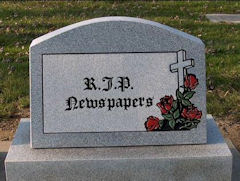
    More bad news for news junkies: The press is the fastest shrinking industry in the United States. Advertising sales have halved since 2005. For every digital ad dollar earned, newspapers have lost $7 in print ads. Digital advertising is expected to surpass the combined advertising of newspapers and magazines combined. “There’s no doubt we’re going out of business now,” one executive was quoted as saying in this Financial Times article.

    More newspapers are talking about charging subscriptions for access to their content., but so far the Wall Street Journal appears to be the only U.S. newspaper capable of generating meaningful revenue. In any case, charging for subscriptions would be a double-edged sword. Cutting off Web readers would reduce page impressions and Internet advertising revenue.

    Here in Virginia, Landmark Communications has expressed an openness to selling its newspapers, which include the Virginian-Pilot and Roanoke Times (where I worked five years). Media General, which owns the Richmond Times-Dispatch as well as newspapers in Charlottesville, Lynchburg, Danville, Bristol and Manassas, is considering a divestiture of its newspaper properties. (See Peter G.’s article in Style Magazine.) Even the mighty Washington Post is suffering from eroding revenue and falling profit.

    For the most part, newspapers are still profitable. But they are maintaining margins only by cutting expenses, including reporting staff. Even with aย  resumption in economic growth, there is no sign that the slide in revenue has bottomed out. Meanwhile, digital alternatives continue to proliferate.

    I would not lament the passing of newspapers if I thought digital media were creating new business models for reporting and sifting the news. There is no lack of opinion and commentary, which Americans appear to be willing to publish in great quantities for free. But few digital outlooks are doing much real reporting, as opposed to repackaging news created by others. Politico and Huffington Post are exceptions, but it’s not clear to me that they have financially sustainable business models.

    Our media future will provide more opinion, more commentary, more content creation by interested parties, more aggregators uncritically packaging that content, and possibly more reporting by enthusiastic amateurs untrained in the basics of journalism…. but less news reporting. It is frightening to think that in a world awash in information there will be less reporting by credible and financially disinterested entities than before.

    — JAB


  • Virginia Toll Projects and “Loss Aversion”

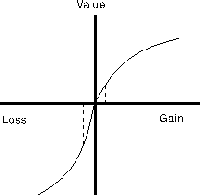
    Kahneman's "loss aversion" schematic: The value of the loss is greater than the value of a comparable gain.

    — James A. Bacon

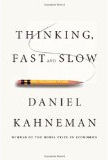
    In his book, “Thinking, Fast and Slow,” psychologist and Nobel Prize winner in economics Daniel Kahneman describes the phenomena of “loss aversion” and “reference points.” These deeply embedded cognitive quirks, which had survival value for hunter-gatherers, pose dilemmas for politicians in complex modern societies who try to change the status quo. The McDonnell administration’s plan to ameliorate traffic congestion in Hampton Roads is a case in point.

    Loss aversion is the phenomenon in which people experience the loss of a thing with greater intensity than they experience the gain of a comparable thing. Thus, people will experience more anguish from the loss of $100 than pleasure in the gain of $100. Gains and losses are judged in relation to a reference point, which often is the status quo (but sometimes can be a goal to be achieved in the future). When there is a departure from the status quo, losers feel their pain more intensely than the winners.

    These principles are well established through numerous psychological experiments conducted over several decades. There is nothing controversial about them. Now, let’s apply them to the McDonnell administration decision to pay for roughly $2 billion to make improvements to the Midtown Tunnel, Downtownย  and Martin Luther King Boulevard in Norfolk and Portsmouth.

    The tunnels were paid for originally by tolls, but the tolls came down a couple of decades ago, and the citizens of Hampton Roads have enjoyed the status quo of using them for free. Within half a year, Elizabeth River Crossings, the public-private partner in charge of expanding the tunnel capacity and collecting the tolls, will start charging tolls — more than $3 per day for a two-way trip — before the improvements are even made.

    Not surprisingly, this has caused an outcry among Hampton Roads commuters. (I’ll defer for a later discussion the issue of whether or not people had ample warning that the tolls were coming and had sufficient opportunity to let their opinions be known.) The McDonnell administration response is that, yes, people will have to pay tolls, but the project will eliminate the half-hour congestion they experience each time they cross the Elizabeth River, and that by any rational calculation, saving an hour in stop-and-go traffic is well worth $3 or $4 in tolls.ย  (See Transportation Secretary Sean Connaughton’s remarks in “E-Z as Pie? Not Really?“).

    From the perspective ofย  purely economic calculation, Connaughton’s argument is impeccable. But, as Kahneman points out, humans are not always economically rational creatures. The anticipation of paying that toll causes greater grief for many than the anticipation of spending less time stuck in traffic promises relief. As a result, the citizenry is up in arms and Gov. Bob McDonnell has a big problem on his hands.

    Now, let’s compare the public reaction in Norfolk to the reaction in Northern Virginia, where people soon will begin paying HOT lane tolls on the Capital Beltway. Northern Virginians are far less upset. Why? Because the tolls are being used to add new lanes. People who place a premium on their time can pay to use the new lanes and avoid congestion. They have an option they did not have before. Those who don’t wish to pay the money can continue using the same old, congested lanes. While they devoutly may wish that money would fall out of the sky and pay for the new lanes so everyone could use them for free, their situation remains the same. They do not perceive themselves as losing anything. They do not get agitated. McDonnell does not have a problem on his hands.

    There is a very important political lesson to be learned here as the McDonnell administration forges ahead with a series of high-profile public-private partnerships and other toll projects. Toll projects like the Interstate 95 HOT lane, which creates new capacity and new options for drivers without imposing tolls on roads that now are used for free, will meet relatively little political resistance. By contrast, the prospect of paying higher tolls on the Dulles Toll Road to pay for the Rail-to-Dulles project is causing an uproar. Predictably, the administration’s proposal to toll I-95 in order to raise money to pay for improvements in the corridor likely will raise a clamor as well.

    You can argue economic logic all you want, but people who perceive themselves as losing something will gripe and bellyache. The politically astute path is to select toll projects that pay for themselves by creating new choices for drivers, not imposing tolls where there were none before. To put it more simply, toll projects must be structured as win-win arrangements to gain popular favor.


  • Factoid of the Day: Virginia’s Biggest Agricultural Customer

    Morocco? Really?

    Virginia agricultural exports are on a roll, having increased 6% in value in 2011. And our biggest export customer was… Morocco. Yes, that small African country purchased $360 million in Virginia farm and wood products, more than China ($304 million), Canada ($220 million), Switzerland, Egypt, Tunisia, Cuba, Venezuela, Indonesia, or any other country.

    Top export products in 2011 included soybeans, poultry, wheat, pork, lumber and wood products, corn, animal feed, un-manufactured leaf tobacco, fats and oils, cotton, marine and aquaculture products, fresh vegetables, raw peanuts, hides and skins, processed foods, and beverages, including wine. So says this press release from the Guv’s office.

    — JAB


  • E-Z as Pie? Not Really.

    Brace yourself for a slew of new toll roads in Virginia. E-ZPass will make it a breeze to pay the tolls, but it won’t ease the suspicion that people in “other parts of the state” are getting a sweeter deal.

    by James A. Bacon

    Between the 495 Express Lanes project and the Downtown/Midtown Tunnel, Virginians will be paying a lot more in tolls by the end of the year. The Virginia Department of Transportation estimates that 400,000 new drivers will enroll in the E-ZPass electronic-payment system, compared to 900,000 presently, and Transportation Secretary Sean Connaughton wants to make sure that VDOT can accommodate the surge.

    Virginia already allows motorists to set up E-ZPass accounts and order the transponders online. But VDOT hopes to supplement that distribution with a retail distribution network that includes the Division of Motor Vehicles, big-box stores and other outlets.

    Hampton Roads drivers are expected to start paying tolls on the Midtown Tunnel, Downtown Tunnel and Martin Luther King Boulevard by the third quarter this year, while Northern Virginians will require the transponders to use the tolled HOT lanes on the Capital Beltway by the end of the year. Never before has VDOT had to distribute so many transponders in such a short time frame. “It will be a significant challenge to get that many transponders to the public,” said Virginia Highway Commissioner Gregory A. Whirley at a meeting of the Commonwealth Transportation Board today.

    Connaughton expressed concern that VDOT does not yet have vendor contracts in place to deliver 400,000 transponders nor the retail network to distribute them. Having the electronic payment system in place is critical for a smooth launch of the multibillion-dollar public-private partnerships in Hampton Roads and Northern Virginia, he said. “If we don’t get this right, it will be a black mark.” He told VDOT officials that he expects monthly updates on E-ZPass at future meetings.

    “It’s all underway,” John Lawson, VDOT’s chief financial officer, assured him.

    VDOT will get help from its private-sector partners, Transurban-Fluor in Northern Virginia and Elizabeth River Crossings in Hampton Roads. Both public-private partnership (P3) operators would prefer to collect their tolls electronically rather than resort to other means such as tracking down motorists on the basis of license-plate images captured by video cameras. The administration costs for E-ZPass are far lower than the alternatives, which means lower costs for drivers and less hassle for the franchise operators.

    Transburban-Fluor plans a major roll-out when the HOT/HOV lanes open for business in December, said Jennifer Aument, vice president-corporate relations for Transurban USA. 495 Express Lanes will have to educate drivers about new traffic patterns, who gets to use the express lane for free (buses, vans, carpools), who has to pay, and how to sign up for the transponders. The partnership expects to unleash a promotional campaign that includes ads in the Washington Post, 100 delivery trucks acting as mobile billboards, festival promotions and meetings with targeted stakeholders.ย  The company has developed the graphics for fliers and other collateral material and has developed a core message, “It’s time to change lanes.” Of course, she added, the roll-out will be Tweeted.

    495 Express Lanes hopes to generate 400,000 customer interactions by March 2013 and to convert them into 100,000 transponder sign-ups.

    Likewise, Elizabeth River Crossing (ERC) has created a tolling strategy and marketing plan, which it has submitted to VDOT for review, said Greg Woodsmall, interim CEO of the partnership. ERC has a tougher job than Transurban and Fluor, however. No one will be forced to pay the HOT lane tolls on the Beltway; drivers can continue using the old Beltway lanes at no cost. By contrast, commuters using the Norfolk-to-Portsmouth tunnels will start paying tolls for tunnels that they are accustomed to using for free — before the improvements are even completed. Hundreds of citizens gathered in Portsmouth recently to protest the tolls, and scores offered to join as plaintiffs in a lawsuit expected to be filed by next week.

    Some 10% to 15% of Hampton Roads drivers already have E-ZPass. ERC’s goal is to get that number to 50% when the tolls are put in place, and eventually to 90%, said Woodsmall. Reaching the 50% goal will require distributing 80,000 transponders. Toll payers will be required to pay VDOT $35 up-front, which includes the cost of the transponder and a credit toward use of the tolled facilities. When the credit is used up, VDOT will draw from the driver’s bank account and/or credit card. “It’s a tough sell to charge for an advance payment,” acknowledged Woodsmall. ERC will offer an alternative — paying for each use of the facilities in a “pay by plate” arrangement. But that entails a lot more administrative work, and the charge can be three times the transponder fee, or nearly $5.

    Discussion of the tolling technology stimulated a variety of comments. Dana Martin, the Salem transportation district representative, said that the “photo enforcement” of the Hampton Roads tolls would unfairly punish drivers from outside the region — in Charlottesville or Lynchburg, say — who have no tolls and no reason to acquire a transponder. Why should they have to pay three times as much as locals do?

    That inspired a response from Shep Miller, an urban at-large representative from Norfolk, who said, “At least you don’t have to pay every day just to get to work!” Miller elaborated in later remarks, saying that paying $900 a year in tolls to get to work represents a genuine hardship for someone making $15,000 a year.

    Connaughton leaped into the fray, asking, “What’s the situation you have today?” Commuters spend a half an hour daily stuck in traffic at the two Norfolk-to-Portsmouth tunnels, he said. His implication was that paying the tolls was preferable to sitting idle in traffic.

    Miller retorted that when the state fixes “other peoples’ problems” in other parts of the state, it doesn’t slap tolls on the projects. Other CTB members joined in, decrying how different regions of the state are treated differently when it comes to paying tolls. Then Jim Rich, Culpeper district representative, quipped that the state was welcome to take back the $244 million committed to the Charlottesville Bypass — which he opposed — to buy down tolls in Northern Virginia and Norfolk.

    In the end, Miller agreed that the McDonnell administration has no choice but to create toll-driven projects in a political environment in which Virginia legislators are unwilling to raise the motor fuels tax, or even to adjust it for inflation. Said he: “The problem is that previous administrations did nothing for so long, there is no alternative.”

    Update: Here is Debbie Messina’s story in the Virginian-Pilot.


  • Who Gets Credit for Virginia’s Recovery?

    By Peter Galuszka

    As with fruit tree blossoms, economic recovery is in the springtime air in the Old Dominion. Virginiaโ€™s unemployment rate dropped to 5.8 percent in January, a three-year low. The question now is who gets credit for it.

    Leading the โ€œcredit meโ€ pack is Gov. Robert F. McDonnell who insists that his job creation policies are responsible for the uptick.ย  โ€œNow the good news that weโ€™re beginning to come out of this economic downturn stronger and better than most other states,โ€ he says.

    Setting himself him as a โ€œjobsโ€ creator is especially important to McDonnell now that his ambitions to be considered as a vice presidential candidate have taken major hits with his handling of the extremely divisive moves by hard-right legislators to promote their anti-abortion agenda. McDonnellโ€™s positions have been mocked on televisions shows such as Saturday Night Live. Doonesbury is running cartoon strips this week lambasting conservative white males in Texas (read โ€œVirginia,โ€ too) for their extreme ham-handedness in how they regard women considering their legal right to abortion.

    To be sure, McDonnell has worked hard to get more jobs in Virginia. One notable example is Amazon.com which will open distribution centers in Dinwiddie and Chesterfield Counties that will create hundreds of new jobs. Problem is: McDonnell let Amazon get away with paying a state sales tax as an incentive until the General Assembly shot down that idea.

    Another problem with McDonnellโ€™s claims is that some of the jobs he may be creating are just in the pipeline. He did win a $3 billion transportation bond package, but the bulk of those jobs are a bit down the road.

    Whatโ€™s unsettling about McDonnellโ€™s claims, however, is that he leaves out the role that federal jobs and government spending played in the recovery. As a former Army officer, he ought to know that Virginia is chock-a-block with defense jobs. President Barack Obama gets no credit, either. Virginia benefited from Obamaโ€™s stimulus package in 2009 and 2010, while Republicans such as McDonnell whined away about โ€œsocialismโ€ and runaway deficit spending. Yet those very policies have finally borne fruit.

    James Koch, an economics professor at Old Dominion University, says that McDonnellโ€™s job creation program was helpful. โ€œBut the truth is governors donโ€™t have very many tools to influence whatโ€™s happening nationally, and whatโ€™s happening in Virginia reflects the national recovery in many respects,โ€ he adds.

    Predictably, Democratic Party had stronger criticism of McDonnell for ignoring Obamaโ€™s contribution. The bottom line is that McDonnell does have the right idea on creating jobs. But really should give credit where it is due.


  • Complacency Check: Virginia’s Employment Picture

    We can all take some comfort in the fact that Virginia’s unemployment rate has fallen to 5.8%, a three-year low. Only a year ago, unemployment was 6.4%, and it had been as high as 7.2%. Clearly, the economy is strengthening. It would be beastly not to savor the gains for a least a moment. So, let’s all bow our heads for a moment of silent thanks. … There. Now, what do we make the the numbers?

    Just as the Obama administration is taking credit for the improving employment picture nationally, the McDonnell administration is taking credit for the improving employment picture in the Old Dominion. As I have blogged previously, I am little impressed with the Obama track record, which is based upon fiscal and monetary stimulus that is unprecedented for a peace-time economy and will wither as soon as that stimulus is withdrawn. I also remain unimpressed with the McDonnell administration’s track record, which has been sub-par compared to national numbers over the past year.

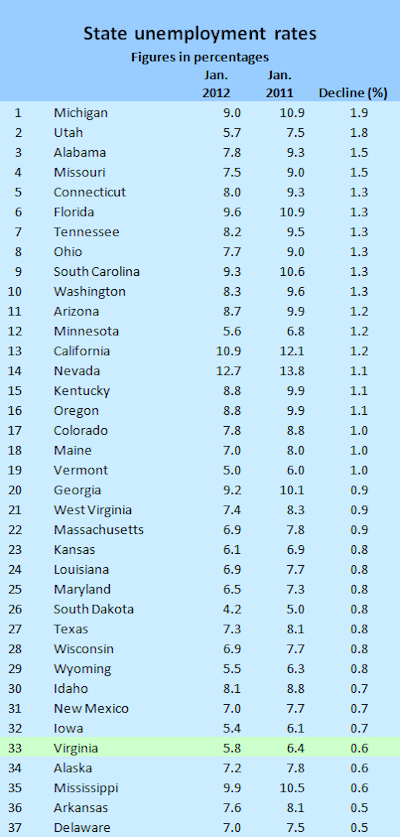
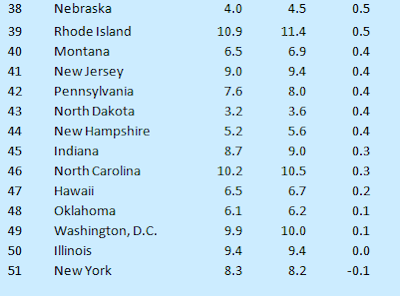
    The following numbers from the Associated Press show that although unemployment declined in Virginia between January 2011 and January 2012, it dropped more in 32 other states.


    McDonnell and his jobs czar, Lieutenant Governor Bill Bolling, do deserve kudos for one thing. Unlike their executive counterpart in Washington, D.C., who utilized the economic crisis in order to engineer an unsustainable expansion in the size and scope of government, they have cobbled together an economic strategy that functions within tight fiscal constraints: no tax increases, no unsupportable increases in debt and little increase in inflation-adjusted spending. Also, they have done a competent job of utilizing the tools that have been available to all Virginia governors for time immemorial — promoting inward corporate investment, tourism, agricultural exports and the like. What they have failed to do — and they reflect the blinkered thinking of Virginia’s political class and civic leadership in this regard — is think about economic development in creative and imaginative ways.

    In truth, there is little to celebrate. Virginia’s economy recovery is as fragile — and reversible — as the nation’s economic recovery. We should not take this brief revival in our fortunes as a reason to get complacent. Rather, we should redouble our efforts, while we have the resources to do so, to bring about fundamental and lasting change to the underpinnings of a strong economy: education, health care, transportation, land use and efficient government services.

    Update: Virginia had a good year by traditional economic development standards — the state ranked No. 5 in Site Selection magazine’s top states by number of corporate facilities and expansions, snagging 273 new projects, up from 190 the year before. (See press release.) This is what Virginia is good at, but clearly it’s not enough to move the jobs meter very far.

    — JAB


  • Race and Virginia’s Emerging Democratic Majority

    by James A. Bacon

    Virginia is fast reaching a demographic tipping point at which “residents of color” will account for a majority of the state’s population, states a policy brief by the left-leaning Center for American Progress. Since 2000, residents of color have accounted for 76.1% of the state’s population growth. In 2008, 40% of all children born in the state were children of color.

    This is great news for Democrats, gloats the report. In 2008, then-Sen. Barack Obama won the state by 230,000 votes, snagging 92% of the African-American vote and 65% of the Hispanic vote. (No numbers for the Asian-American vote.)

    The General Assembly has considered or passed legislation that will “adversely affect communities of color,” including stricter voter ID laws and an “Arizona- and Alabama-styled immigration law.” The CAP report also highlights Prince William County’s ordinance instructing police officers to obtain the legal status of people who are arrested.

    Democrats couldn’t be any more explicit about their strategy of achieving a race-based electoral majority based on identity politics. They are convinced that, in the long run, the politics of racial grievance mongering is a winning electoral strategy. And, as long as Republicans play into their hands by enacting legislation that can be construed, fairly or unfairly, as targeting minorities, the Democrats will succeed.

    It’s time to pivot. Illegal immigration into the United States has peaked. Illegal immigration created real social and fiscal problems, but the wave is receding. Recent research has shown that more illegals are going home than entering the country. The tepid American economy is only one factor at work. Birth rates in Hispanic countries like Mexico that account for most illegal immigrants are falling. At the same time, the Mexican economy is growing considerably faster than that of the U.S. Meanwhile, the federal e-Verify system is cutting down on the hiring of illegal immigrants, while theย cost and risk of entering the country illegally is increasing.

    Aย lot of Republicans haven’t gotten the message. They persist in fixing a problem that shows every sign of fixing itself, and they’re ticking off a lot of Hispanics in the process. Frankly, in the current political environment, I’m amazed that even one-third of Hispanics vote Republican. Continuing to sponsor legislation that alienates this fast-growing voter bloc is electoral suicide.

    Meanwhile, what’s with the voter ID law? Is there really a problem of widespread voter fraud in Virginia? No, there isn’t.ย The GOP can argue that voter ID does not pose a meaningful barrier to voting, and it probably doesn’t. But why give the Dems an issue to demagogue? Politically, it’s a no-win issue.

    Republicans need to spend more time thinking about how to create prosperity for all Virginians and showing how Democratic policies trap “people of color” in a culture of dependency and poverty. The Dems are wrong about a lot, but they’re right about one thing: In a few more decades, whites will become a minority in Virginia. If the GOP can’t articulate a vision that blacks, Hispanics and Asians can buy into, Republicans will become a minority, too.


  • IG of the Day: Exports in Virginia’s Economy

    Virginia may boast one of the premier ports on the East Coast and one of the premier international airports in the country, but Virginia’s metropolitan regions are not very plugged into the global economy. According toย the Brookings Institution’s “Metropolitan Exports Dashboard,” the percentage of GDP accounted for by exports in the Washington, Hampton Roads and Richmond economies is less than 10%. That’s too bad because export-related jobs tend to be better paid than non-export jobs.

    I’m old enough to remember when Jerry Baliles was governor. He saw exports and Foreign Direct Investment as the key to economic development for Virginia. He led numerous overseas trade missions and he emphasized the teaching of geography in Virginia schools. He helped launch other initiatives to make Virginians more cosmopolitan in their thinking, suchย the Japan-Virginia society, which at one time was a very active organization. Since the late 1980s, Virginians have become more insular. Governors lead fewer missions overseas. Virginia’s eonomy has suffered the downside of globalization — our apparel, textile and furniture industries have been obliterated — but my sense is that Virginia businesses have not taken full advantage of the opportunities that globalization offers. Our loss.

    Update: The Governor’s office issued this press release noting that Virginia agricultural exports increased 6% in 2011, reaching record levels. The exports totaled $2.35 billion in value. Presumably, agricultural exports are not captured in the metropolitan statistics cited by Brookings: Urban areas don’t have a lot of farms and woodlands.

    — JAB


  • Collapse of the Blue State Governance Model: New York Update

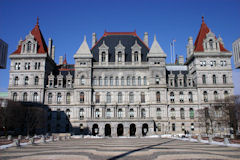
    The Empire State capital building

    Yeah, Virginia legislators do a lot of stupid stuff, I can’t deny that. Without question, the commonwealth’s governance model is critically flawed. But, to tweak Winston Churchill’s immortal words about democracy, Virginia’s government is the worst in the world — except most of the others.

    The situation is worse in New York — a lot worse. States a recent article entitled, “Deficits Push N.Y. Cities and Counties to Desperation“:

    Even as there are glimmers of a national economic recovery, cities and counties increasingly find themselves in the middle of a financial crisis. The problems are spreading as municipalities face a toxic mix of stresses that has been brewing for years, including soaring pension, Medicaid and retiree health care costs. And many have exhausted creative accounting maneuvers and one-time spending cuts or revenue-raisers to bail themselves out.

    No, that’s not right-wing spin from FOX News, National Review or the Cato Institute. That comes straight from the New York Times.

    A state oversight board seized control of Nassau County’s finances last year, while neighboring Suffolk County has declared a financial emergency. Buffalo is approaching financial failure and Rochester may not be far behind. Moody’s downgraded the debt of Yonkers and Long Beach last year and the debt of Rockland County and Utica last month.

    Public pensions are a big part of the problem. Three percent of New York property tax collections were used to pay pension costs in 2001; by 2015, pension costs are expected to eat up 35 percent of property tax collections. You thought Virginia’s General Assembly was reckless? Syracuse Mayor Stephanie A. Miner blamed state government for passing unreasonable costs such as pensions on to municipal governments. “Unless Albany changes its policies,” she said, “we will be dead.”

    Remember all those wonderful government services that were supposed to contribute to a higher quality of life, attract human capital and support a stronger, more vigorous economy? They may not last. Said a Rockland County executive: ” โ€œI think youโ€™ll see a dropping off of the programs that many counties now view as important โ€” law enforcement, economic development, parks and recreation. Those kinds of programs will disappear. Counties will become welfare and Medicaid managers.โ€

    Collapse of the Blue State Governance Model: California Update. Michael J. Boskin and John F.ย Coogan write in the Wall Street Journal: “California’s economy, which used to outperform the rest of the country, now
    substantially underperforms. The unemployment rate, at 10.9%, is higher than
    every other state except Nevada and Rhode Island. With 12% of America’s
    population, California has one third of the nation’s welfare recipients.”

    — JAB


  • Richmond’s Arab Spring


    By Peter Galuszka

    What seems one of the wildest General Assembly sessions that ended on Saturday was actually a healthy display of democracy in action. It could presage a fundamental way that things are done in Richmond.

    True, a new Republican and conservative majority in the House of Delegates pushed odious wedge issues at the General Assembly that made Virginia the laughingstock of national late night television. These include attempts to force women to have transvaginal ultrasound exams before they have abortions. In a slap at gay and transgender citizens, it made it harder for them to adopt children.

    It pushed back needed health exchanges to get insurance as the Obamacare deadline approaches. Keeping our priorities skewed, public school kids still will have their start-date dictated by huge, profitable theme parts like Kingโ€™s Dominion and Busch Gardens. Legislators came up with an empty tank when it came to funding transportation projects. And the legislature set up the repeal of the one-handgun-a-month law that could revive Virginiaโ€™s key role in pistol trading by East Coast criminals.

    That said, a lot of other mayhem was thankfully put to rest. Racist immigration-based citizen checks got nowhere as did a law to burden public school teachers with extra and unneeded reviews. Amazon will be forced to pay sales taxes like everyone else, torpedoing a sweet-heart deal used to attract the digital retailer by Gov. Robert F. McDonnell and the Virginia Economic Development Partnership. The Senate killed a bill that would have singled out poor women by forbidding them from having abortions if the fetus has gross abnormalities.

    With all this social agenda nonsense, the General Assembly didnโ€™t get on with its most important task p-p- passing a budget –, but it will meet again to do so. Not to first time this has happened.

    What has happened, and is very encouraging, is that this is the first time in years that the average public actually gave a damn about their rights to be heard in the legislative process. The State Capitolโ€™s bucolic lawns saw thousands of protestors, including the arrests of 30 or more by state police SWAT teams armed with nightsticks and machine pistols and dressed in protective armor that made them look like fearsome Michelin Men.

    What made the scenes so unusual was that most of the participants were middle aged women outraged that McDonnell and the hard-right Republicans would suddenly start dictating some extremely private parts of a womanโ€™s life and deny her what the U.S. Supreme Court says she can do. Weโ€™re not talking the long-haired types of my Vietnam generation or more recent Occupy Richmond (or Wall Street or Seattle) people.

    For far too long, state politics has been a good old boysโ€™ club run by big corporations who bankroll think tanks and legislators led by the hand by lobbyists. Bill wording can be cut and paste jobs from national right wing outfits. People with opposite points of view are usually sliced out of the loop.

    When McDonnell appointed a subcommittee within a state mining department to study the highly controversial notion of uranium mining in Southside, he picked as its head a former natural gas lobbyist with no experience with radioactive issues. She announced there will be no public hearings before her group sends its recommendations about whether or not lift a near 30-year-old ban on uranium mining. This is typical of the way Bob McDonnell and people like him see the world and regard their voters. They are not to be seen. Not to be heard.

    While it is doubtful that McDonnell and his ilk will get the message, the outrage over the behavior of the General Assembly by everyday people shows that the old, behind-closed-door way of doing business is over. McDonnell and his spokesman Tucker Martin, can blame the news media. The State Capitol Police, with McDonnellโ€™s acquiescence, can call out the SWAT teams all they want.

    One thing they canโ€™t do is kill the spirit of the man who actually designed the State Capitol building that was the locus of so much outrage. That spirit will outlive them all.


  • The “Planning Fallacy” and Virginia Transportation

    by James A. Bacon

    Daniel Kahneman, an eminentย psychologist,ย won the 2002 Nobel Prize in economics for his work showing how a key underlying assumption of classical economics — that people behave in an economically rational manner — is demonstrably false. The human brain has evolved cognitive short cuts that served homo sapiens well when survival required rapid decision making but now bias thinking in unproductive ways in the vastly more complex environment of contemporary society. Among these traits, which he explores in his book, “Thinking, Fast and Slow,” are an irrational aversion to risk in some circumstances and a proclivity for excessive optimism in others.

    Little did I suspect when I embarked upon reading the book during vacation that passages would bear upon my work at Bacon’s Rebellion. But one section entitled, “The Planning Fallacy,” which describes the tendency to baseย plans and forecasts upon unrealistic, best-case scenarios, applied directly to a wave of transportation mega-projects, from Rail-to-Dulles to the U.S. 460 upgrade, at various stages in the approval process in Virginia. This optimism bias is a fundamental human affliction, affecting consumers, businesses and government alike. No one is immune. But the most egregious examples come from government.

    Kahneman cites a fiasco in which the cost of the new Scottish Parliament building escalated from a ยฃ40 million estimate in 1997 to ยฃ431 million upon completion in 2004. He also notes a tendency for the cost of rail projects around the world to… well, to run off the rails. In a worldwide survey of projects undertaken over 30 years, the average cost overrun was 45% and passenger forecasts exceeded actual performance by 106%.

    Writes Kahneman:

    Errors in the initial budget are not always innocent. The authors of unrealistic plans are often driven by the desire to get the plan approved — whether by their superiors or by a client — supported by the knowledge that projects are rarely abandoned unfinished merely because of overruns in costs or completion times. In such cases, the greatest responsibility for avoiding the planning fallacy lies with the decision makers who approve the plan. If they do not recognize the need for an outside view, they commit a planning fallacy.

    What decision makers should do, Kahneman writes, is to engage in what he calls “reference class forecasting,” a practice that has been implemented for transportation projects in several countries. “The outside view is implemented by using a large database, which provides information on both plans and outcomes for hundreds of projects all over the world, and can be used to provide statistical information about the likely overruns of cost and time, and about the likely underperformance of projects of different types.”

    Reference class forecasting protects decision makers from excessiveย optimism before approving a project and may help them structure projects in ways that will help prevent cost overruns. The problem with most forecasts is that they are based upon known factors and known “unknowns” but, in the immortal words of former Defense Secretary Donald Rumsfeld, do not incorporateย “unknown unknowns.” Whileย any particular unknown may be unlikely to occur, there are so many unknowns that the oddsย are very high that one of them will occur, often with cascading effects. A well-run organization, says Kahneman, will reward planners for precise execution and punish them for ailing to anticipate difficulties.

    That’s all very fine but how does it apply to Virginia? Hopefully, decision makers will learn something from recent experiences in administering rail projects like The Tide in Norfolk and Rail-to-Dulles in Northern Virginia. In both projects, costs outran early cost estimates but public authorities continued pursuing them because once a public project picks up momentum and costs have been sunk into it, politically there is no going back.

    Now the McDonnell administration is pushing a slew of expensive bridge and highway mega-projects. Aside from the critical question of whether all of these projects are economically justified — the case for the Charlottesville Bypass is particularly weak — we now get to worry whether the projects will run over budget. The Virginia Department of Transportation is shifting from a project-management methodology in which VDOT designed the projects, bid them out to private contractors and ate the cost overruns, to a new methodology that shifts far more of the responsibility and riskย  to the private contractors. The theory is impeccable. How the theory will be executed is another matter entirely. It will depend largely upon how tightly the contracts are written.

    Unfortunately, Gov. Bob McDonnell will be long gone when the projects he sets into motion are completed and the costs are tallied. By the time we know how well his team did in managing the mega-projects, it will be impossible to hold him accountable — just as his predecessor Tim Kaine has eluded the fallout from the Rail-to-Dulles project that he set into motion. Accountability is the key. Private corporations have evolved mechanisms, however imperfect, for holding their decision makers accountable for successsful management of massive projects. Virginia has yet to do so.


  • The GERM That Is Destroying Public Education

    By Peter Galuszka

    Sarah Wyscoki seemed to be doing well as a fledgling fifth grade teacher in the District of Columbia public system. Last spring her appraisal praised her โ€œsound teachingโ€ along with her ability to motivate students and keep things positive, according to The Washington Post.

    She was fired two months later. Why? The D.C. school system had adopted an Obama-instigated program that puts a much higher emphasis on studentsโ€™ test scores and their โ€œvalue addedโ€ computer consensus as a way to retain or get rid of teachers. Because of the shift in appraisal methods, Wyoscki went from being a highly regarded teacher to one with a stigma of being fired for poor performance.

    Her predicament shows just how efforts to โ€œreformโ€ public school education are so wanting. Barack Obama shares plenty of blame with his โ€œRace to the Topโ€ program. So does George W. Bush with his โ€œNo Child Left Behindโ€ program.

    Both are known among educators as part of the โ€œGlobal Education Reform Movementโ€ (or โ€œGERM,โ€) that is pushing tougher testing and productivity as yardsticks for academic success. But according to The New York Review of Books, the approach teaches children to learn the test and for teachers to teach it. Obama has said that teaching the test is not the way to go, but his program directly c contradicts that motive.

    Iโ€™ve been fascinated by some of the bloggers on this blog, notably Jim Bacon, who suddenly have taken up the mantle for some type of GERM. Jim, who apparently has very little real life experience in K-12 public education either as a student or parent, writes predictably that education must be made โ€œefficientโ€ and โ€œcost-effective.โ€ I was always puzzled by Baconโ€™s sudden interest in public school education because it dovetailed with a national offense on the topic by conservatives.

    There may be a few little problems with that idea. Writer Diane Ravitch in the Review notes:

    โ€œThe GERM model seeks to emulate the free market, by treating parents as consumers and students as products, with teachers as compliant workers who are expected to follow scripts. Advocates of GERM often are hostile to teachersโ€™ unions, which are considered obstacles to the managerial ethos necessary to control the daily life of a school. Unions make it hard, if not impossible, to carry out cost savings, such as removing the highest-paid teachers, and replacing them with low-wage, entry-level teachers.โ€

    I wish I could have said it so well. Ravitch is spot on. The problem with the bean-counting efficiency types get hold of social programs, they start treating them as if they were General Electric making a jet engine blade to the best and cheapest tolerance. Fact is, kids arenโ€™t widgets. The same ethos translates into health care, but thatโ€™s something else. Another problem with the GERM system is that it always punishes teachers and never the administrators who make much more in salary and decide the issues with the biggest impact, such as budgets.

    In her article, Ravitch reviews a book about Finlandโ€™s highly successful public school program. Most Finnish teachers and principals belong to one union. The teachers are motivated by a love of teaching, not fear of some arbitrary test and โ€œvalue-addedโ€ methodology that mysteriously massages the results.

    I havenโ€™t read the book about Finnish school, but I have been to Finland a bunch of times. It was our major source of resupply when I ran a news bureau in Moscow during the Cold War. I always found the Finns smart, efficient and friendly. I may still have an account at Stockmanโ€™s, downtown Helsinkiโ€™s largest department store.