Proposed fuel economy rules for the year 2025 will raise the average price of a vehicle by $3,000 and price seven million potential new car buyers out of the market nationally, according to a new study by the National Association of Automobile Dealers released today.
A state-by-state breakdown indicated that 122,000 drivers in Virginia, or 1.9% of all licensed drivers in the state, would be affected.
Mandated fuel efficiency standards may be necessary to wean the nation from dependence upon foreign oil but making automobiles more expensive will push millions of lower-income drivers into the used car market. If the price of used cars then rises, as elementary economics predicts, then people will be priced out of the used car market as well.
Also, interest rates are bound to rise eventually from their rock-bottom lows. The Federal Reserve Board cannot sustain its stimulative, low-interest rate stance forever. Higher borrowing costs will price even more lower-income drivers out of the market.
In the past, the number of licensed drivers increased as more lower-income Virginians could afford automobile ownership. As cars become more unaffordable, the number of drivers will stall or perhaps even go into reverse. It’s not a stretch to conclude that Vehicle Miles Traveled will not keep pace with historical increases over the next 10 years.
What does this mean for public policy in Virginia? First, we won’t need a lot of roads and highways that planners think we will need. Projections of Vehicle Miles Driven made for the VTrans 2025 study were pure fantasy. Second, a lot of lower-income Virginians will need to find transportation alternatives — something we’re not preparing for. We need to be giving a lot more thought to making shared ridership services more ubiquitous and affordable so thousands of Virginians don’t find themselves stranded.
In a foreshadowing of a possible grand urban alliance, Hampton Roads mayors have reached out to counterparts in Northern Virginia and the Richmond region to unite in pursuit of a comprehensive transportation funding solution.
“We all recognize the crisis Virginia faces as it relates to transportation, therefore, we strongly believe it is time for the Golden Crescent Region of Virginia to organize ourselves,” states a letter sent this week by the Hampton Roads Mayors and Chairs Caucus.
The Virginian-Pilot described the initiative as the “brainchild” of Norfolk Mayor Paul Fraim and Virginia Beach Mayor Will Sessoms. The letter had support from leaders across Hampton Roads, the newspaper reports. Among south Hampton Roads municipalities, only Chesapeake declined to sign.
The letter comes as the General Assembly prepares to return to the Capitol next week to vote on a state budget after Senate and House conferees nixed $300 million to pay down future toll rates on the Dulles Toll Road and an unspecified amount of additional toll-mitigation funds for the Midtown/Downtown Tunnel project.
A number of years ago, the letter notes, there was an attempt to get the Golden Crescent to coalesce around transportation and education issues. It is time to revive that initiative. “Considering the transportation crisis we now face, we strongly feel it is time again for us to join together, perhaps with the assistance of the business community. We believe our regions working together can effectively influence the General Assembly to address the transportation crisis.” The letter also noted the need to address tax reform and the outcome of the Supreme Court ruling on Obamacare.
The letter proposed convening a summit of the mayors and boards of supervisor chairs from Golden Crescent localities soon after the reconvened General Assembly session. “The purpose of this gathering would be to coalesce around some general ideas relating to transportation funding, developing a strategy, and discuss outreach to the business community. More specifically, we would agree to harness our respective political influence and initiate a campaign to influence our General Assembly to address our significant transportation challenges.”
The letter provides no specific remedies. But it’s not difficult to imagine what the signatories have in mind. They’re not talking about changing they way they do business. They want mo’ money. Someone else’s money.
That’s easier said than done. Here are some of the hard realities that Governor Bob McDonnell and state state confront while trying to find more money for transportation.
Gas tax. While elites favor an increase in the motor fuels tax, the general public does not. The reasons for the gulf in sentiment are twofold: (a) Higher-income households can absorb higher prices at the pump more easily than lower/middle households can, and (b) higher-income households place a higher premium on time spent stalled in traffic congestion than do lower/middle income families. For elected Republican officials, whose middle-class suburban and rural constituents drive more than average, the gas tax is politically toxic.
Borrowing. The McDonnell administration has already maxed out the state’s borrowing limits for transportation projects without endangering Virginia’s AAA bond rating. (See “Rail-to-Dulles and the Debt Dilemma“). Borrowing more is not an option.
General Fund. The General Assembly has just nixed two proposals to divert monies from the General Fund to the Transportation Trust Fund. Democrats, who led the charge for higher gas taxes, also led the charge to defeat proposals that would siphon off monies otherwise reserved for schools, colleges, health care, prisons and other non-transportation priorities.
Tolls. The McDonnell administration is aggressively pursuing public-private partnerships that would finance mega-projects by means of tolls. But the Hampton Roads mayors have made it very clear that they don’t like the idea of making their constituents pay the full cost of what it takes to build those projects. So, while tolls remain an option, it’s not one that the letter signatories like.
There are alternatives to spending mo’ money. For the benefit of new readers, or those readers who failed to absorb the wisdom imparted by my previous columns, let me review some of them.
Zoning reform. Reform antiquated zoning codes and comprehensive plans that lock suburban growth counties into “suburban sprawl” mode — a development pattern marked by segregated land uses, low density and autocentric design — and make it easier for developers to build compact, walkable, mixed use communities when supported by consumer demand.
Prioritize by ROI. Prioritize transportation projects that deliver the greatest social Return on Investment as measured by safety, congestion relief, economic development (attracting primary employers, not retail and service employers) and environmental impact.
Devolution. Align transportation and land use by devolving responsibility of secondary roads, along with the means to pay for them, to local governments. If local mayors and chairs make poor decisions, they should pay for them — not the state.
User pays. Restructure transportation financing to a “user pays” system — gas tax and tolls are the most practical means at the moment — in which those who benefit from transportation projects are the ones who pay for them. When users pay for transportation improvements, they are more discriminating about what they ask for.
Deregulate transit. Revitalize shared ridership by shifting away from the failed model of government-owned transit monopolies to a model based on competition, private ownership and innovation.
Technological innovation. Pursue new technologies that drive down the cost of building and maintaining roads. Two examples: the use of LiDAR technology to achieve breakthrough gains in surveying and design efficiency, and the use of cold in-place recycling of asphalt in repaving projects.
Will any of these alternatives to Mo’ Money be on the agenda of the Golden Crescent summit? I would be flabbergasted if they were.
Corey A. Stewart, the scourge of “illegal” immigrants and standard-holder of good old fashioned American values, is now running for lieutenant governor on the Republican ticket in 2013.
News reports of his recent announcement were predictably bland – comments in the right-wing blogosphere even more so – despite the fact that Stewart is one of the most divisive, if not downright racist, politicians in recent Virginia history.
As a member of the Board of Supervisors of Prince William County since 2003, Stewart is famous for his movement to require county police to profile anyone they suspected of being illegal immigrants if they were stopped. This law was obviously aimed at brown-skinned Latinos. Similar legal requirements were later adopted statewide in Arizona and Alabama, bringing the U.S. global derision.
One immediate effect of Stewart’s 2007 initiative was that Hispanic immigrants started fleeing the county in droves regardless of whether their papers were entirely in order or not. Stewart claims that his move caused violent crime to drop 37 percent in the largely white and wealthy suburb of Washington, D.C. chock-a-block with federal jobs and cul-de-sac homes. More informed individuals, such as Steven Camarota, research director of Center for Immigration Studies, says the link between violent crime and illegal immigration is a lot more tenuous.
Among the negative fallout from Stewart’s xenophobic grandstanding was that it pit white-skinned against dark-skinned and haves against have nots. The lead-in to the law and the aftermath brought on some very ugly scenes that drew to the soul and conscience of what had been a rather quiet, growing county.
For an idea of just how rancid Stewart’s ideas were, check out the short, award-winning film 9500Liberty by Annabel Park and Eric Byler. The 2010 documentary runs less than five minutes or so, but shows Americana at its worst. In one famous scene, an elderly white man screams at Park and Byler to “speak English” and get legal. In response, Park, who was born in South Korea, is a naturalized American citizen and studied at Boston University and Oxford, produces her U.S. passport and flashes it in his face.
Even the chief of the county police has big trouble with Stewart’s law, which Stewart later tried to expand to the rest of Virginia in his “Rule of Law” campaign. My memory of Stewart is in October 2010 at the “Virginia TeaParty Patriots Convention” in Richmond manning a little booth trying to dish out anti-immigrant ideas. He seemed to be ignored amidst the hubbub of deficit hawks, Patrick Henry re-enactors in Colonial garb and gun fanatics packing Glocks and Colt 45s in Velcro holsters.
In any event, bashing immigrants has gone out of style at least for now. The reason is the economy. Fewer undocumented foreigners are coming here because jobs are nil. Ironically, Hispanic construction workers had been flocking to Prince William about 10 years ago to help serve the demand for badly-planned cookie cutter houses, including McMansions.
When the housing market tanked, some stayed, weren’t quite legal and their brown skins became more evident to the white folks when they were shopping at the county’s many strip malls. In an odd way, it’s a bit like Arizona which had been run by dark-skinned Native Americans and Spanish for centuries and was not even a state until 1912. Then, around the 1960s, flocks of retirees of more northern European ancestry showed up. Suddenly, Arizona became “American” and had to be protected.
For his lieutenant governor’s campaign, Stewart seems to have dropped the immigrant bashing because it has gone out of style. Instead, he says, he weathered the recession by not raising taxes in Prince William but investing in roads and “public safety’ (code word for immigrant bashing?) and cutting $143 million from the county budget.
He says: “Prince William County is a model for how to implement good conservative principles. Taxes are down, crime is down, and growth is up. I am going to bring to the Office of Lieutenant Governor the same conservative principles that I have led Prince William County with over the past 6 years.”
Naturally, he fails to mention that many of those new jobs come out of the federal budget, but no matter. The bigger point is that Stewart is going to have to come to terms sooner or later with the impact of immigration on economic growth now that recovery seems in the air. That will raise the immigration issue yet again.
Even the Wall Street Journal notes on its editorial pages today that too much visa protectionism is hurting the U.S. India is about to file a complaint with the World Trade Organization against a 2010 U.S. law that hikes fees for visas for highly skilled workers from India. Meanwhile, rejections of H-1B and L-IB visa applications for well-qualified foreign workers are considerably up.
One wonders what Stewart, who is casting himself as yet another “jobs” Republican, thinks about this. One thing he might be sure of. Some darker-skinned foreigners with PhD.s in highly technical fields that many Americans lack may think twice about moving to Prince William County, or maybe even the Old Dominion if he wins his state race.
The convoluted schemes of Virginia state politicians to avoid paying for rail service to Dulles International Airport are as frustrating as they are self-defeating and unfair.
Just a few days ago, it seemed that the General Assembly would consider adding $300 million to extend Metrorail to Dulles on the Silver Line when the legislature meets to approve an $85 billion budget April 18.
Thanks in part to last minute opposition by Democratic deal-maker State Senator Charles J. Colgan of Prince William County, the $300 million went “puff.” No deal. No money.
The $300 million cut underscores what seems to be Richmond’s ancient philosophy on expanding Dulles Rail: stick as much of the cost as possible on taxpayers and tollpayers in Northern Virginia.
Days after the $300 million in state funds for Dulles Rail disappeared, the Board of Supervisors of Fairfax County confirmed its buy-in for Phase Two of the Dulles Rail project, whose ultimate costs will top $2.7 billion. The county says that while it is looking for alternate funding sources, it may pay up to $965 million for the project. About $730 million – or 80 percent – will be paid for by “voluntary” special tax districts created by landowners.
Once again, Northern Virginia, which provides more state tax revenue than any other region of the Old Dominion, gets stuck with most of the bill for Dulles Rail. That is the criticism of the Coalition for Smarter Growth which was quick to note the bizarre budget cut. They point out that, at the same time, the administration of Gov. Robert F. McDonnell is proposing at least $750 million in state funding for a new superhighway near U.S. 460 in the rural peanut country of Southeast Virginia and diverting $200 million for a controversial bypass in Charlottesville.
It’s hard to fathom why providing Dulles rail with state money is such anathema. The new U.S. 460 tollroad project, for instance, raises many questions. It is being billed as a necessity for Virginia’s economic future since the port of Hampton Roads needs better transportation access to handle bigger, deeper-draft cargo ships when the Panama Canal is expanded in 2014.
Yet, Norfolk Southern railway which serves the port has already finished a $321 million public-private project to raise mountain tunnels to handle more double-stack rail shipments from Hampton Roads to the Midwest. The chief executive of the Panama Canal Authority says that thanks to rail improvements, Hampton Roads is already prepared to handle the expanded trade the canal project will bring. If he’s right, then why is there urgency for the new road?
There have been other peculiar impediments to the state paying for Dulles rail, such as Knee-jerk anti-unionism. Right-wing Atty. Gen. Kenneth Cuccinelli and others are crying foul at any attempt by the airports authority to use the a similar but somewhat tougher project labor agreement that helped move Phase One forward. A more deep-rooted issue is Virginia’s traditional philosophy, dating back to the one-party system of Harry F. Byrd 100 years ago, that public projects must be funded on a “pay as you go” basis.
That might have worked for building a two-lane bridge in bucolic Virginia when TV’s John Boy Walton, attired in bib overalls, might have been around. Today, the fact remains that Washington is the only capital in the advanced industrialized world not to have public rail service to its leading international airport.
Up, up and away… Outstanding state-supported debt. Source: Debt Capacity Advisory Commitee 2011 report
by James A. Bacon
General Assembly Democrats fought McDonnell administration proposals in the 2012 session to divert funds from the General Fund to transportation programs on the grounds that the transfer would short-change education, health care and other core programs. They don’t appear to be applying the same principle, however, to the issuance of state debt.
A 5% debt service/revenue ratio for state finances (primarily the General Fund plus the transportation fund) is deemed desirable to preserve the state’s coveted AAA bond rating. According to the Debt Capacity Advisory Committee’s December 2011 report, debt service on the Transportation Trust Fund (TTF) already exceeds 5% of TTF revenues. States the report:
To the extent the 5% measure is exceeded, capacity derived from the general fund is being utilized. This does not mean that general fund dollars are needed to supplement debt service payments on TTF debt. However, it does mean that some debt capacity derived from the general fund is being used to keep overall capacity for all tax-supported debt under the target of 5%.
Thus, borrowing more for transportation means borrowing less for schools, higher ed, prisons, parks, government buildings and other capital improvement projects.
Yet, while criticizing McDonnell for raiding General Fund revenues to pay for transportation projects, Senate Dems have pushed furiously for the state to borrow an additional $300 million to help offset the sky-high tolls on the Dulles Toll Road. Toll revenues will be diverted to help pay for construction of Phase 2 of the Rail-to-Dulles project.
With 20 members in the 40-member Senate, Dems forced Senate Republicans to adopt many of their budget priorities, including the $300 million for Rail-to-Dulles. In the budget reconciliation process, however, Republican-dominated Senate and House conferees stripped out the borrowed funds. Then late last week, Sen. Charles J. Colgan, D-Manassas, signed off on the conferee version, holding out the possibility that he might join with Republicans in giving the reconciled budget the Senate’s final approval, but he refused to commit.
Tax-supported debt issued over the past 10 years. Source: Debt Capacity Advisory Committee.
The state debt issue could prove crucial as the parliamentary maneuvering plays out. The Debt Capacity Advisory Committee has maintained since 1991 that the state’s debt service should not exceed 5% of blended revenues. The purpose, as the 2011 reports explains, “is intended to ensure that annual debt service payments do not consume so much of the state’s annual operating budget as to hinder the Commonwealth’s ability to provide core government services.”
In 2010, the Debt Capacity Advisory Committee refined its guidelines to “smooth the effect of dramatic revenue fluctuations, and to facilitate long-term capital planning.” The 5% target measure remained unchanged.
Maintaining a AAA bond rating has been a long-standing bipartisan objective in Virginia. Although the 5% limit is not a formal requirement of municipal bond rating agencies, the debt service/revenue ratio is considered in the rating of the state’s debt. All three bond-rating agencies reaffirmed Virginia’s AAA status in October, but Moody’s gave the commonwealth a “negative” outlook, suggesting that a future downgrade was possible.
In 2011 the General Assembly approved a McDonnell administration plan to accelerate previously authorized transportation bond issues and to issue additional GARVEE bonds, which are backed by future federal transportation funding receipts. Still, thanks to robust increases in tax receipts this year and the lack of other debt issues, the state still has unused debt capacity of roughly $460 million.
Allocation of state long-term debt 2002 to 2011. Source: Debt Capacity Advisory Committee.
It is unclear exactly what kind of debt the Democrats have in mind. Emails Jeff Caldwell, the governor’s press secretary: “We won’t know what type of financing is proposed or the details of these budget proposals until a budget bill passes the GA and is sent to the governor for review.”
Whatever the Democrats are thinking, they have to deal with two issues. First, a practical problem: There aren’t sufficient transportation funds to cover the expected debt service, which means under state code the bonds cannot be issued.
Anne Oman, legislative fiscal analyst for the House Appropriations Committee, explained the problem in an email to Del. James L. LeMunyon, R-Chantilly:
As [the revenue] stream currently stands, there is not room beyond the current fiscal year to continue at the $300.0 million annual issuance level, thus increasing the overall authorization from $3.0 to $3.3 billion as proposed by the Senate would not help projects in the foreseeable future because there is not enough repayment capacity in the [Priority Transportation Fund] revenue stream to support additional issuances at this time.
Then there’s a policy dilemma: While the state can issue another $460 million before hitting the 5% debt service/revenue benchmark, it already exceeds 5% for the transportation component of the budget. The Dems are on the record against under-funding schools, health care and other General Fund programs. Are they willing to under-fund capital spending projects for those very same programs? I can’t help but wonder if they’ve thought it through.
The Fairfax County Board of Supervisors has just voted to confirm the county’s participation in Phase 2 of the $2.7 billion Rail-to-Dulles project. (See press release.)
The county’s share of Phase 2 will be $330 million raised through a tax on Phase 2 District property owners equal to 25 cents per $100. Additionally, under the revised financial deal worked out under the auspices of U.S. Transportation Secretary Ray LaHood, the county also will make its “best efforts” to find additional funds to pay for the Route 28 station and two station parking garages.
The prepared statement did not make it clear where those funds might come from. If the county fails in its “best efforts” to locate the money — I believe but need to confirm — the burden would fall back upon drivers on the Dulles Toll Road. But a recent analysis by the Reston 2020 Committee demonstrated that higher tolls on the Dulles Toll Road would chase drivers onto other county roads, aggravating traffic congestion.
In a statement posted on her Facebook page, Bulova acknowledged the problem with toll rates. “This is something that I am working hard to address and am hopeful that funding from the General Assembly for this purpose will be forthcoming.”
However, there is considerable resistance in the General Assembly to the proposal, advanced mainly by Senate Democrats, to having the commonwealth borrow an additional $300 million (over and above $150 million in funds already allocated) to buy down the cost of the tolls.
The problem is simple: The state has tapped out its extra borrowing capacity when the General Assembly agreed to Governor Bob McDonnell’s plan to accelerate and expand the commonwealth’s transportation bond issues. The state will issue $3.4 billion in transportation-related bonds during McDonnell’s four-year term. If it issues any more debt, it threatens the state’s AAA bond rating.
Del. James L. LeMunyon, R-Chantilly, put it this way in an April 3 email he wrote to a Loudoun County official (which I was copied on later in later transmissions):
I am informed by the House Appropriations Committee (HAC) staff that the Commonwealth is already at its bonding capacity limit based on capping principal and interest payments for all state debt at 5% of general fund revenue and certain other revenue. If the $3 billion bond limit were to be increased to $3.3 billion as is proposed by the Senate, the additional bonds could not be issued without exceeding the 5% cap, unless other existing bonds were paid off. I am informed by the HAC staff that it will take at least three years for this to occur.
LeMunyon also argued that if the state had $300 million to spare, the funds would be better spent on priorities other than Dulles Rail, although he did not specify which ones.
Two major hurdles remain before Phase 2 is officially back on track. First, the new financial arrangement must be approved by the Loudoun County Board of Supervisors. And second, to release $150 million promised by the state, the McDonnell administration must set aside its objections to the Metropolitan Washington Airports Authority board’s decision to favor union Project Labor Agreements in the bidding process.
Update: Some of the information conveyed in LeMunyon’s email was inaccurate. Authorizing the $300 million for Rail-to-Dulles would not push Virginia over its 5% debt service/revenue ratio. The state currently has some $460 million in unused debt capacity, according to Anne Oman a member of the House Appropriations Committee staff. The problem is that there are insufficient transportation revenues to coved the added debt in a manner commensurate with state code.
Michele Claibourn with the Weldon Cooper Demographics & Workforce Blog took a look at the same data that I did in my previous post and made a very interesting comparison, as seen in the image at left.
The top graphic compares the four- and six-year graduation rates of Virginia’s public colleges, private colleges and for-profit colleges. By this measure, the performance of the for-profit colleges — oft criticized for their high tuitions and high default rates on student loans — is abysmal. Of course, different types of students attend different institutions. As Claibourn writes, “Increasingly, students go to college part time, transfer between institutions, or return to college as adults – this is particularly true for students at for-profit colleges. Folks in these college trajectories aren’t captured by the official graduation rate (defined by the Department of Education).”
By a different metric — spending per degree awarded — the for-profit colleges kick butt, as seen in the lower graphic. According to Claibourn’s numbers (which she extracted from the searchable “College Completion” database), for-profit institutions spend only half as much per graduate as traditional institutions of higher learning in Virginia.
By the way, if you are a policy wonk as opposed to a political junky, you should check out the Demographics & Workforce blog. It’s new, but it’s off to a very good start.
A few weeks ago, I was making another trip to the area near Matewan, W.Va., a small, historic town of red brick buildings a stone’s throw across the Tug Fork River from Kentucky. Matewan is noted for its coalfield labor strife caught dramatically in John Sayles superb 1987 movie of the same name and is the locus for part of a book I’ve been researching for the past 18 months.
There isn’t much hotel space available in the Tug Fork Valley. At times, I’ve had to stay dozens of miles away in Eastern Kentucky. When available, I prefer a bed and breakfast right in the middle of Matewan and just steps from where Sid Hatfield, the town police chief, shot it out with rent-a-thugs from the Baldwin-Felts Detective Agency in 1920 (yes, Big Money was into privatization even then).
Aside from seasonal all-terrain vehicle enthusiasts, the only big noise in Matewan is the Norfolk Southern. The original mainline of the old Norfolk & Western runs just behind the bed and breakfast. First you hear an odd whir, then a diesel horn blast and then your world shakes. Trains run anytime, day and night. It was the route of the fancy red and black Powhatan Arrow passenger train from Norfolk to Cincinnati. Now what you see are endless coal trains and hot shot containers racing their East Coast to Midwest route. Most recently, I have seen jumbo-sized, extra-tall coal hoppers whip past.
What’s the point of this travelogue? The extra-sized cars are the point. Nearly two years ago, Norfolk Southern completed a $321 million project using private and public money to raise tunnels in West Virginia and southwestern Virginia. The low ceilings had forced east-west,double-stack trains to spend an extra day going through Pennsylvania or Tennessee. Not anymore.
In fact, the so-called Heartland Corridor project means that Hampton Roads is uniquely qualified to take advantage of the larger, deeper-drawing container ships that are expected to boost trade when the Panama Canal expansion is completed in a couple of years.
That, at least, is the opinion of Alberto Aleman Zubieta, chief executive officer of the Panama Canal Authority. Zubieta worries, as many do, that U.S.East and Gulf Coast ports just aren’t ready for the new Panama Canal trade, except for Hampton Roads. “Norfolk is ready,” he was quoted as saying. “Rail has been modernized between Norfolk and Chicago; they understand the benefit of getting cargo to its destination.”
So, if Hampton Roads is already the beneficiary of a major rail improvement project that is now ready to handle Panamax cargo, then why all the hullabaloo over a $1.8 billion public-private project to expand U.S. 460? The expansion from Suffolk to Petersburg would relieve clogged Interstate 64 on the other side of the James River and would offer an extra emergency escape route should a major hurricane show up.
But the big reason for the project, enthusiastically backed by Gov. Robert F. McDonnell and his Transportation Secretary Sean Connaughton, is that Hampton Roads desperately needs transportation access to handle all the new trade coming with the Panama Canal is expanded.
Yet if you listen to Zubieta, the project is in place. Finito. Even if you wanted to expand distribution and manufacturing centers in Southeastern Virginia, why couldn’t you do it with rail spur lines coming from the NS mainland that neatly parallels the existing U.S. 460? A number of distribution centers already use the rail line, including a Food Lion warehouse near Petersburg.
The road project has lots of problems. Its backers admit that tolls won’t pay for it. Some kind of industrial authority would have to be created with new factory or warehouse owners kicking in payments to make it work.
What about the already existing rail line? Why doesn’t someone bring that up? Doesn’t it make the expensive road project unnecessary? Or is there some under-the-table log-rolling going on that we don’t know about?
Q: What Virginia college had the highest four-year graduation rate of any four-year private institution nationally?
A: Washington & Lee University, with a 92.8% graduation rate.
That compared to an 84.5% rate for the University of Virginia, a 49.1% rate for all Virginia public universities and a 31.3% rate for all four-year colleges nationally. Virginia public institutions actually have the third highest four-year graduation rate in the country.
Find those statistics and more at the Chronicle of Higher Education‘s “College Completion” website in a project funded by the Bill & Melinda Gates Foundation.
Should public university faculty email be exempt from the Freedom of Information Act? So asks the Roanoke Times in dueling op-eds from David W. Schnare with the American Tradition Institute (ATI) and Kate Westcott with the American Association of University Professors.
ATI sued the University of Virginia to gain access to the emails of a climatologist Michael Mann, a former professor who devised the controversial “hockey stick” graph so well known in the Global Warming debate. Westcott argued that professors’ scholarly work should be protected from FOIA on the grounds of academic freedom. Most people would agree that academic freedom is a value worth protecting.
While Schnare acknowledges the value of academic freedom, he also contends that the tax-paying public has the right to know how university faculties at public institutions “spend the peoples’ money.” The Climategate emails recovered from an English university exposed how a professorial clique (of which Mann was a member) manipulated scholarly institutions to suppress opposing points of view. Another FOIA request showed how a North Carolina professor used grant funds for projects other than those intended.
And then, writes Schnare, there was this: “A recent Virginia FOIA request found that at one university, of 15 professors conducting research, not one kept a research log. In one case, a professor could not duplicate his findings for lack of such research discipline. Without FOIA, this execrable faculty misbehavior would never have been uncovered.”
Does the public have a right to know if publicly funded scientists at Virginia universities are following basic protocols so their research findings can be examined and replicated? Isn’t that central to scientific inquiry? Or should university professors be entitled to “academic freedom” without “academic accountability”?
There is an interesting back story to the General Assembly deliberations over subsidies to the Rail-to-Dulles project (see previous post). Engaging in a form of informational guerilla warfare, a hardy band of skeptics in Northern Virginia has managed to inject a critical new issue into the debate: How much traffic will higher tolls on the Dulles Toll Road divert to other streets and roads?
Here’s the problem: Rates for the Dulles Toll Road are not being set by a determination of what it costs to maintain and upgrade the toll road. Rates are not set by a calculation of what drivers are willing to pay. Rates are driven by how much money it takes to build Phase 2 of the Rail-to-Dulles heavy rail project.
That project is estimated to cost $2.7 billion. Under the current funding agreement, 75% of the sum will be extracted from drivers on the toll road. Unless the General Assembly coughs up new subsidies, tolls for traveling the full length of the toll road will reach $4.50 by 2013 and escalate steadily to $10.75 by 2028.
“That’s going to drive a large portion of toll-road traffic to local roads, and the local roads are already crowded. The congestion will be that much worse, Terry Maynard, a board member of the Reston 2020 Committee and co-author of “The Dulles Corridor Transportation Planning Fail,” said last week.
Metrorail has been touted as a way to relieve overloaded Northern Virginia roads. In an irony of ironies, Maynard and his buddies contend, more drivers will be diverted to local roads than will be added to the Metrorail ridership! If it’s any consolation, the toll road itself will be a lot less crowded.
Think of that. If Maynard & company are right, Virginia will have spent $5-6 billion on a rail project that will make traffic congestion worse than it was before!
Let me repeat that in capital letters so you don’t miss the point: VIRGINIA WILL HAVE SPENT $5-6 BILLION ON A RAIL PROJECT THAT WILL MAKE TRAFFIC CONGESTION WORSE THAN IT WAS BEFORE!
That’s a truly breathtaking level of incompetence.
The Reston 2020 Committee findings are based in part upon numbers provided by a CDM Smith March 2012 forecast and the Federal Transit Administration’s (FTA’s) annual progress report on the construction of Phase 1 of the Silver Line. Thirty-five thousand fewer vehicles will use the toll road daily in 2013 if the tolls are doubled as forecast; 46,000 fewer vehicles will use the toll road daily by 2028.
As Northern Virginians were absorbing the prospect of worse traffic congestion, people drew two different types of conclusions. One group argued that Phase 2 was a boondoggle and that Fairfax and Loudoun counties, both junior funding partners, should scuttle it altogether. The other group argued that the General Assembly should step in, contributing up to $450 million ($150 million already agreed upon, plus $300 million in dispute) to help pay down the interest on the project debt in order to reduce the impact on Dulles Toll Road users.
Either way, the project is a disaster. Either Metro never gets extended to Dulles airport, as was the idea all along, or Virginia’s taxpayers will get dunned for hundreds of millions of dollars for a project that was structured to enrich well-connected property owners in Tysons Corner. But, hey, what else is new? Virginia used General Funds to pay off an unfunded portion of the Rt. 288 boondoggle outside Richmond several years back (which wasn’t even tolled), and Hampton Roads politicians are clamoring for special consideration for the Midtown-Downtown tunnel.
The old firewalls of fiscal constraint have broken down. This is what we get from abandoning user-pays logic for transportation funding. It’s all about politics and perception now. Taxpayers beware. You will be fleeced.
Sen. Charles J. Colgan. Photo credit: Times-Dispatch.
Sen. Charles J. Colgan, D-Manassas, signed off Friday on a state budget compromise that omits $300 million for the Rail-to-Dulles project, reports the Washington Post. Colgan said that his agreement in Senate-House budget conferee deliberations does not commit him to actually voting for the compromise budget when the Senate must ratify it. But his decision does appear to be the first break in the stand-off.
Colgan’s decision took place against a backdrop of furious negotiations between the McDonnell administration and Senate Democrats. According to another Washington Post article, Transportation Secretary Sean Connaughton had agreed to provide as much as $200 million of the $300 million demanded by the Dems, then backed off. (The article made no mention of $100 million or more demanded to buy down tolls for the Midtown/Downtown tunnels in Norfolk and Portsmouth.)
“What is particularly galling is, the administration has been giving mixed signals,” said Sen. Janet Howell, D-Fairfax. “Two weeks ago, they indicated that they had $200 million available. Two days ago, they said they had $175 million available. And yesterday, they had zero.”
Connaughton and his boss, Governor Bob McDonnell, had a difficult juggling act. Many Republicans balked at the idea of borrowing $300 million to help defray the interest expense on the Metropolitan Washington Airports Authority (MWAA) bonds that would be used to finance Phase 2 of the estimated $2.8 Metrorail project.
“I understand they want to secure that [$300 million], but to sell bonds to mitigate tolls, that really is kind of a stretch,” said Sen. John C. Watkins, R-Midlothian. “I’d be willing to put cash into it. But to sell bonds to mitigate tolls and have to run around and have to pay interest on them, fiscally, that’s not being responsible.”
The McDonnell administration had already agreed to funnel $150 million into the project. Still lurking is the issue of the Rail-to-Dulles Project Labor Agreement (PLA). Some Republicans wanted to make that $150 million contingent upon the MWAA board reversing a decision to give preferential treatment during the bidding process to companies that signed a PLA, in effect guaranteeing that all worker would be hired through labor union hiring halls. Critics say that provision could knock open-shop contractors out of the bidding, decrease competition and result in a higher price for the project.
It appears that ultrasounds, handgun purchases and helping groups ban gays from becoming adoptive parents are costing Gov. Robert F. McDonnell his dreams of being a Republican vice presidential candidate.
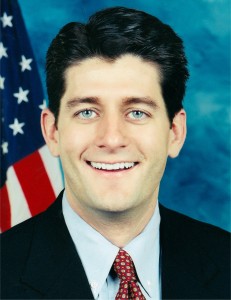
Now that Mitt Romney has 655 electoral votes tied up and looks like a sure thing as far as the GOP nominee, McDonnell has fallen to the wayside. Pundits still opine about who the VP contender could be, such as Florida Sen. Marco Rubio or Buckeye politician Bob Portman. A clear favorite of the moment is Wisconsin Congressman Paul Ryan who is seen as the Dr. Spock of the right-wing’s intellectual set.
But where, oh where, is Bob McDonnell? He’s either off the pundits’ lists or is being increasingly dissed as being potentially too “social conservative.” In that regard, he has his fellow Republicans to thank.
In the last elections, hard right elements took over the House of Delegates and cheered on by such ultra-conservatives as Del. Bob Marshall, launched their attacks on women’s rights, gay rights and immigrant rights as well as handgun safety.
In doing do, they made Virginia a national laughing stock on programs such as Saturday Night Live that did utterly devastating skits in 2008 about Sarah Palin, the completely unprepared and nearly clueless Alaska governor who ran as John McCain’s running mate.
The sad part is that McDonnell had no direct role in this political meltdown, rather his former positions such as his notorious graduate school thesis that he tried so hard to suppress resurfaced again.
Ironically, the politician who has usurped McDonnell is Wisconsin’s Paul Ryan, who is cast as a young, dynamic and brainy “Young Gun” who was the mastermind behind the attention-getting 2011 debt ceiling debacle with Virginia’s own Eric Cantor. Such stuffy GOP kingmakers as George Will regard Ryan as a bright young thing: “Admirably, Romney has embraced Ryan’s approach to altering the ruinous trajectory of the entitlement state and forestalling that trajectory presages, a “government-centered society” (Romney’s phrase in his fine Milwaukee speech Tuesday night).
Reading the tea leaves reveals that Ryan is seen as the thought-leader who can push forward the GOP’s more serious agenda of cutting deficits and debt and changing the decade’s old role of the federal. McDonnell, who had tried so hard to remake himself as a moderate and a “jobs” government is now being seen as another pathetic nutbar, who, fairly or not, wants to humiliate women before they have a legal abortion. And, fairly or not, he’s seen, thanks to buddy Marshall, as an anti-immigrant fanatic without the multi-racial appeal of Rubio, another VP contender.
In any event, Bob’s VP days are over. And Barack Obama may actually push ahead with Virginia anyway. Real Clear Politics has him ahead of Romney 48 to 43.1, as incredible as that sounds.
New technology is taking cost, time and uncertainty out of highway design. For Virginians, this quiet revolution means less traffic disruption, lower costs and faster turn-around times on big projects.
by James A. Bacon
Last fall Fluor Transurban was negotiating a contract with the Virginia Department of Transportation (VDOT) to build or upgrade 29 miles of express lanes on Interstate 95 in Northern Virginia. It was critical to get a better handle on how much the roughly $1 billion project would cost. To help out, the consortium hired HNTB, a Kansas City-based engineering firm, and Dayton-based Woolpert, a geospatial firm, to conduct a preliminary design.
Normally, a job like this would require a sub-contractor to assign dozens of surveyors to develop a detailed topographical map of the route. The job would take months as survey teams worked down miles of highway, making tedious measurements every step of the way. Traffic would have to be diverted, and the safety of the surveyors would be an ever-present concern. Frequently, the engineers would have to dispatch surveyors back into the field to take more measurements, creating delays. It wasn’t a pretty process.
But Fluor Transurban got a much faster turn-around because HNTB and Woolpert embraced a fast-evolving technology known as LiDAR (Light Detection and Ranging). Invisible, pulsed laser beams emanating from rotating mirrors can acquire up to 1 million precise distance measurements per second of the roadway and surroundings. The resulting data, a “point cloud,” provides precise 3D digital images of the scene. Cameras mounted next to the LiDAR scanners acquire thousands of high-resolution 2D color images of the same terrain.
“LiDAR is faster and safer, and it’s better quality,” says Paul DiGiacobbe, director of strategic technology-incubation for HNTB. “We’re able to respond much more quickly. We’ve got our finger on the pulse much better than in the past.”
First and foremost the LiDAR revolution offers a productivity jump in surveying efficiency. But it also may help VDOT manage routine operations more effectively by making it easier to inventory road conditions. And in the long run, it could have a profound impact by supporting a strategic shift from conventional highway contracting methods to a design-build paradigm.
Traditionally, VDOT designed projects in-house and then put the jobs up for bid. Taking place in sequential steps, work took a long time and was subject to cost overruns. Under design-build, the contractor can perform design and construction work simultaneously, which cuts time and costs. The ability to compress construction schedules potentially could save Virginia taxpayers tens, even hundreds, of millions of dollars in the years ahead.
For Fluor Transurban, estimating the cost of the upgraded Interstate was a complex task. Plans call for reversible High Occupancy Toll (HOT) lanes running 29 miles along I-95 south of the Capital Beltway. Under a preliminary agreement negotiated with the commonwealth of Virginia, Fluor Transurban will convert existing High Occupancy Vehicle (HOV) lanes to HOT lanes, extend the express lanes down the Interstate median, widen some lanes and make a variety of other improvements.
Gathering the data was made significantly more efficient by the use of mobile data-collection techniques. The Woolpert team set up “tie points,” or registration points, at intervals along I-95 so the LiDAR data could be properly aligned. After that, a single van with an Optech LYNX Mobile Mapper mounted in the back bed drove up and down I-95 at highway speeds. The disruption to traffic was minimal. Surveyors minimized their exposure to speeding cars and trucks. Working within existing HOV lanes access patterns and other construction activities, Woolpert took only four days to finish.
Woolpert’s eight-person technical team used its TopoDOT™ software to extract critical information and develop 3D models for downstream engineering and design operations. TopoDOT™ is an application for MicroStation™ software, which is used by a majority of roadway design engineers.
“TopoDOT™’s function is delivering value from LiDAR system data,” says Certainty 3D President Ted Knaak, whose company created the software. “The problem with point cloud and pictures is that there really isn’t much intelligence associated with the data. Think about a digital image. Step back and look at the entire image, and you know what is exactly in the picture. Look at just a few pixels up close and, absent the context of the entire picture, you don’t know what they are. TopoDOT™ thus provides the tools for the technician to recognize and extract the intelligent 3D CAD model from the data.” Read more.
Food activists proved wrong about fat are now setting their sights on sugar.
Image credit: Washington Times
by James A. Bacon
Once upon a time, there was a medical “consensus” that fat and cholesterol in the diet were major causes of heart disease. Armed with this “settled science,” the public health establishment moved in the 1970s to expunge the offending substances, beyond a basic minimum deemed to be necessary, from Americans’ diets. Food bureaucrats established dietary guidelines. Physicians ordered billions of dollars of blood tests. Pharmaceutical companies made tens of billions of dollars on drugs that suppressed cholesterol levels. Food companies, castigated in some quarters as soulless merchants of dietary corruption, were compelled to report the nutritional breakdown of their packaged products. Badgered by public officialdom and the media over the decades, Americans slowly, grudgingly changed their eating habits.
What good did it do them? Americans are more overweight, more prone to diabetes and more at risk of heart disease than ever before. Now, it transpires, the public health consensus and settled science might not have gotten it right. A new wave of scientific research finds that the worst culprit of all is sugar. CBS‘ “60 Minutes” hit the highlights of that research in a show broadcast April 1, “Is Sugar Toxic?”
In that segment, Dr. Sanjay Gupta interviewed Dr. Robert Lustig, a pediatric endocrinologist who was for years the proverbial voice in the wilderness.
Gupta: “What are all these diseases that you say are linked to sugar?”
Lustig: “Obesity, Type 2 diabetes, hypertension and heart disease itself.”
Gupta: “So, with the best of intentions, they said, it’s time to reduce fat in the American diet.”
Lustig: “And we did. And guess what? Heart disease, metabolic syndrome, diabetes and death are skyrocketing.”
Gupta: “Dr. Lustig believes that’s primarily because we replaced a lot of that fat with added sugars.”
Lustig: “When you take the fat out of the food, it tastes like cardboard. The food industry knew that. So they replaced it with sugar.”
Prediction 1: Often wrong but never in doubt, the progressives and do-gooders will develop amnesia about the past 40 years of regulatory activism. The old “settled science” will go down the memory hole, to be replaced with a new “settled science.” With new demons to castigate and a new cause to justify meddling in peoples’ lives on the grounds that they are too ignorant, slothful or obstinate to do what’s good for them, progressives will embark joyfully upon a new crusade. Soon we’ll be hearing how sugar is as addictive as cocaine. (Oh, wait, Dr. Gupta quoted a different scientist saying exactly that.) Sugar companies will replace the fat peddlers at McDonald’s as the new villains du jour. (Dr. Gupta also interviewed a sugar-industry lobbyist.)
Prediction 2: Progressives will not engage in the slightest bit of introspection. It will never occur to them to think, “Gee, if the science wasn’t really settled about heart disease, could the science really be settled about, say, global warming?”
Prediction 3: The American public will grow ever more distrustful of the way science is presented to them by the do-gooders and media, which in turn will lead do-gooders and the media to demean the intelligence of the American public.
Glenn Reynolds recently pointed out in the New York Post that conservatives are no more distrustful of science than liberals and progressives, despite the conceit of liberals and progressives that they represent the “evidence-based” school of thought in contrast to creationists, global-warming deniers and other assorted Neanderthals. Conservative distrust, Mr. Reynolds suggests, stems from “the increasing use of science as ammunition for big-government schemes.”
I concur. In my experience, conservatives do not quibble with the scientific method as a way to advance knowledge. But they distrust the intermediaries between the scientists and the public – the journalists and good-government activists who purport to interpret the findings of the “scientific community” – who frequently minimize the uncertainties in the science and extrapolate to policy conclusions not supported by science.
Prediction 4: It’s just a matter of time before we start hearing, “Hey, we knew a sugar tax was a good idea!”
As for me, I’m stockpiling KitKats, Oreos and Eskimo bars. If the goo-goos want to take my confections away from me, they’ll have to pry them from my warm, sticky fingers.
This column was originally published in the Washington Times.
The year: 2075. The American colonies on the Moon are getting restless under Washington’s tyrannical rule….
This second edition of “Dust Mites” has a snazzy new cover, includes helpful lunar maps, and is 5,000 words tighter than the original. The sequel, “Trogs,” is scheduled for publication this summer.
Advertisement
Advertisement
Advertisement
Advertisement
About
Bacon’s Rebellion is Virginia’s leading politically non-aligned portal for news, opinions and analysis about state, regional and local public policy. Read more about us here.
Fund the Rebellion
Shake up the status quo! Your contributions will be used to pay for faster download speeds and grow readership. Make a one-time donation by credit card or contribute a small sum monthly.
Can’t wait until tomorrow
For your Bacon’s Rebellion fix?
Enter your email address to receive immediate notifications of new posts by email.
SUBSCRIBE
Search Bacon’s Rebellion
Categories
Archives
The Jefferson Council
Protecting Thomas Jefferson’s Legacy at the University of Virginia
Forgot Your Password?
Shoot me an email and I’ll generate a new password for you.

 Proposed fuel economy rules for the year 2025 will raise the average price of a vehicle by $3,000 and price seven million potential new car buyers out of the market nationally, according to a new study by the National Association of Automobile Dealers released today.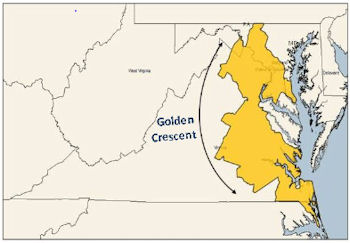
 By Peter Galuszka


 by James A. Bacon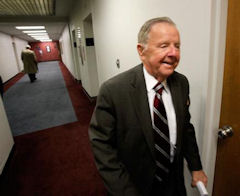
 New technology is taking cost, time and uncertainty out of highway design. For Virginians, this quiet revolution means less traffic disruption, lower costs and faster turn-around times on big projects.