New: Virginia House Democrats announce their first priorities during the 2026 session.
They include protecting abortion and LGBTQ rights, redistricting, raising the minimum wage, paid sick leave, and more. @8NEWSpic.twitter.com/Ikaby5v2D7
The Miami Independent blog reports on the inquiries of a Virginia citizen affiliated with the Virginia Voter Roll Maintenance Movementinto possible voting-registration irregularities in Arlington County. — JAB
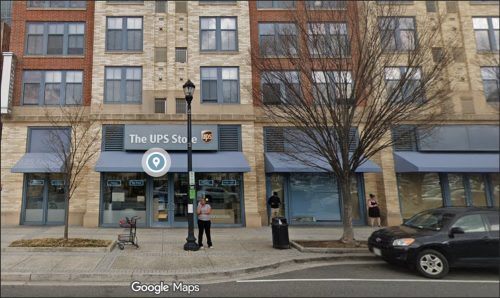
Google Maps view of 1405 South Fern Street
Voter Registration At UPS Store In Arlington, Virginia by Eduardo Vidal
A Virginia resident reports that he has been stonewalled by Arlington County election officials after raising questions about dozens of voter registrations allegedly linked to a UPS Store address on 1405 South Fern Street.
The resident first contacted Arlington County General Registrar Gretchen Reinemeyer to flag what appeared to be potential irregularities with registrations listing 1405 South Fern Street, which is a UPS Store providing private mailboxes—not a residential building. Thus far, the resident says, the registrar’s response has been “woefully inadequate.” …
The poll pad listed multiple pages of voters registered at 1405 South Fern Street—one page with 39 active voters and another with 30. Some entries had unit numbers, others did not. One record listed no address at all. At least 12 names appeared more than once, suggesting possible duplicates or record-keeping errors. Unit designations varied from three digits to five, without a clear pattern.
🚨Mary Baldwin U is cutting 17 minors & multiple faculty positions. The president resigned August 2025.
Students protested at the private Staunton, VA campus, which has about 700 residential undergrads plus online & commuter programs, and a female Corps of Cadets. Tuition:… pic.twitter.com/yCScepHhSB
Jim Bacon chats with Matt Thornhill, founder of Cozy Homes Community.
Millions of aging Americans have too much money to get government assistance but not enough to move to an upscale independent-living community. In any case, most would like to age in place in their own home. If Thornhill’s middle-market housing solution gets off the ground, it could revolutionize where and how older Americans live.
James Bacon: Hello, everyone! I’m Jim Bacon, and this is the Oinkonomics Podcast.
About 15 years ago, I worked for the Boomer Project, a research marketing firm that specialized in studying the baby boomer generation. A major preoccupation at that time was what happened at Woodstock, but what would happen when tens of millions of boomers got old and had trouble living on their own? Aside from the question of who was going to pay for their Social Security and Medicare, who is going to care for all those octogenarians and nonagenarians? What kind of quality of life would they enjoy as they became increasingly dependent upon caretakers?
Well, here I am, a boomer who reached senior citizen status several years ago. Once upon a time, anyone over 65 was considered old. But guess who’s older? My 96-year-old mother and 89-year-old mother-in-law. They require a lot of assistance. Elder care is not an abstract, sometime in the future concern like it seemed 15 years ago. My wife and I worry about our aging parents every day, and we spend a lot of time thinking about where the best place is for them to live.
That’s all prelude to me bumping into my old Boomer Project boss, Matt Thornhill, recently at a social event. Turns out, while I was scratching out a living as a journalist and blogger. Matt was converting the insights he’d gained from his market research into a real estate venture aimed mainly at aging boomers. Although, it probably won’t be too long before it appeals to Gen Xers, too. As founder and CEO of Cozy Home Community. Matt is developing a very specialized type of housing for communities of aging middle-income boomers.
Welcome to the Oinkonomics Podcast, Matt. Or should I just say, OK, Boomer!
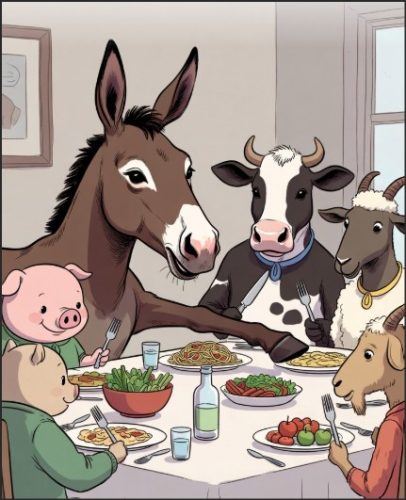
Fork in the road. Image credit: Bing Image Creator
by Andrew Rotherham
A lot of people are asking: What’s going to happen on education in Virginia? It’s a good question. And it matters beyond Virgina’s borders. The commonwealth took several big steps forward on schools over the past few years — some initiated by the legislature (science of reading and assessment reform), and some by Governor Glenn Youngkin (innovative public lab schools across the commonwealth, more ambitious standards, transparency, and a real accountability system).
Enter Abigail Spanberger. A moderate Democrat, perhaps more by temperament than politics. She worked for the CIA before winning one of Virginia’s vanishingly few swing districts to serve in Congress (she was my member of Congress for a time before retiring to run for governor).
She enters office with the wind at her back. Virginia’s countercyclical off-year election cycle, Trump’s abysmal numbers in the state, a non-Trump on the ballot electorate, and the government shutdown all handed Spanberger a legit landslide. Even seasoned observers and Democratic leaders were surprised by how well the party did — picking up 13 House seats and giving the incoming governor a commanding 64–36 majority. The state senate, not on the ballot, remains closely divided, though Democrats now hold a tiebreaker with the lieutenant governor’s seat.
Twenty-four years ago, when I entered the Assembly as an unlikely Democratic challenger, the Republicans controlled 66 seats in the House of Delegates, as well as the State Senate — and 8 of 11 Congressional seats.
A mansion tax? That will go over big in Northern Virginia.
As a new Democratic Party trifecta looms in Virginia, a progressive policy group has floated a long list of old and new ways to soak Virginia’s upper income residents through taxes in order to fund additional state spending.
The Commonwealth Institute for Fiscal Analysis doesn’t use the word “spending,” of course, but speaks of “investments” in “quality public education, health care, affordable housing, access to food.”
According to the most recent report on state government spending trends, from the Joint Legislative Audit and Review Commission, the state’s payments to localities for school operations have grown 7% annually, about double the rate of inflation, and the cost of the Medicaid program has grown 12% annually, more than three times the rate of inflation. Those two by themselves have added $22 billion to the state budget in ten years.
But the appetite for more is on full display following the election. Later this week the money committees for both the House of Delegates and Senate will hold retreats away from the capital to hear likely warnings that the projected revenues are inadequate for a host of “unmet needs,” what a Republican Finance Committee chairman used to call “bills in the drawer.”
The Commonwealth Institute has the path to financial salvation:
On November 16, the author revised previous articles on the nursing homes in the Eastern, Central, and Southwest regions to provide better data and explain it better in a much-revised spreadsheet.
The format the author chose previously wasn’t getting the job done, so he changed it.
The new one should provide more clarity. The spreadsheet is designed to be self-explanatory. The sums and averages line at the bottom of each shows regional results.
Changes in the text were made only to reflect the updated spreadsheet.
Increased enrollment of economically disadvantaged students seems to have had only a minor impact on academic performance.
by John Butcher
Responding to discussions (here, here, here, and here) of a new admissions policy and a decline in the US News ranking of TJ (aka Fairfax County’s Thomas Jefferson School for Science and Technology), I posted an analysis of the end-of-year test (“SOL”) data through 2025. Since then, I’ve had a chance to try to think more clearly (says he), with the following results.
But first: VDOE reports pass rate averages for “economically disadvantaged” students (“ED” here)(mostly those who qualify for free/reduced price meals, i.e., this is the bureaucratic euphemism for “poorer”), their more affluent peers (“Not ED”), and all students. ED students generally perform less well than the Not ED, see, e.g., this. Most of the VDOE reports and, it appears, the new Accreditation system (and, also, the US News rankings, see below) look at the all students averages. That serves to unfairly penalize the schools and divisions with large ED populations (and to benefit those, such as TJ, with a small ED group). A fair system would look at both groups and probably would emphasize the performance of the group that needs more attention, the ED. This post looks at the recent ED and Not ED data for TJ, in addition to the all students results.
VDOE scores SOL tests on a 600 point scale. Passing is 400. As well, there are two “pass” classifications. Scores above 500 are counted as Pass/Advanced; those from 400 to 500, Pass/Proficient. The sum of those two rates in the overall pass rate.
The 2021 testing was voluntary so that year’s data surely are not reliable measures. I’ve omitted them here.
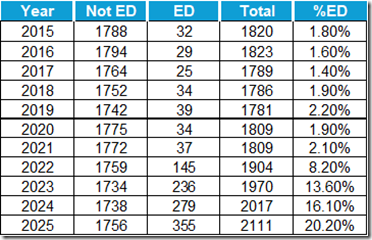
To start, a helpful VDOE database gives us the “Fall Membership.” Here is the dataset for TJ:
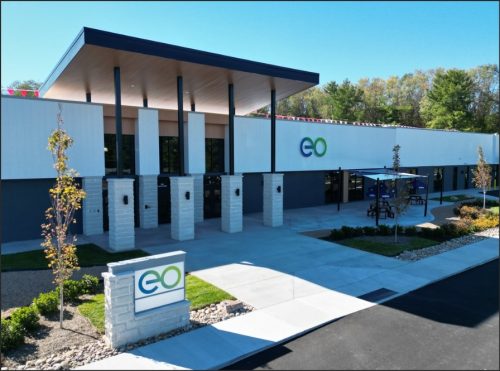
The EO Regional Workforce + Child Development Hub in Abingdon.
by Alex Dadok
With Virginia’s election behind us, there’s a sense among some of wanting to find common ground. Those from all political persuasions share an interest in creating additional jobs and economic development for Virginia’s communities.
Community development — such as quality childcare, housing, healthcare, education, parks and amenities, transportation, and more — can support these economic development efforts in real and concrete ways. When a community is functioning at a high level to provide services and make itself an attractive place to live, work, and play, it’s easier to attract businesses. Community development partnerships, including the coalitions and dedicated public-interested leaders working in these areas, often make that quality of life possible.
Yet, for when many regional leaders think about economic development, community development is an afterthought. That’s a counterproductive posture.
Let’s look at a few examples of how community development partnerships affect economic development and will continue to affect economic development in Virginia. Then, we will turn to discuss the interplay between community development partnerships and economic development efforts and consider how these two dynamics might best reinforce each other.
New Jersey Democrats do a better job with election integrity than Virginia Democrats, who take their cues from California.
by Jacob Grandstaff
The Nov. 4 elections were disappointing for Republicans in that they weren’t surprising for Democrats. New Jersey is a reliably blue state that sometimes swings purple, and Virginia is a reliably purple state that usually swings against whichever party occupies the White House. For those who believe in secure elections, however, Virginia offers more cause for concern.
The state’s ridiculous election laws make blue New Jersey look like a bastion of election integrity, showing just how far off the deep end Old Dominion Democrats have sunk.
Ken Cuccinelli
In an exclusive interview with Restoration News, Election Transparency Initiative chairman Ken Cuccinelli noted, “There have been over 60 changes to Virginia election law since Democrats had their 3-way sweep in 2017.”
Born in New Jersey and raised in Virginia, Cuccinelli served as Virginia Attorney General from 2010 to 2014, before Democrats’ election “reforms” turned a once-secure election day into a 45-day marathon and a potential fraud magnet.
It’s like Marc Elias rewrote our laws,” he said, referring to the Democrat operative who bankrolled the Steele Dossier against President Donald Trump in 2016.
Despite nearly two million foreign-born residents now calling Virginia home — representing more than one in five voters in Northern Virginia alone — the party completely squandered the chance to engage these communities under the state’s new outreach and voter engagement provisions.
This is not a minor oversight. It’s a monumental strategic failure. While neighboring states are building durable pipelines with first- and second-generation voters, the RPV has treated immigrant engagement as an afterthought.
Demographic Reality: According to the American Community Survey, Virginia’s immigrant population has surged by over 35% in the last decade, with immigrants now comprising 16% of the total population and 20% of the state’s workforce.
Voter Power: Roughly 1.2 million naturalized citizens are already eligible voters, with another 400,000 legal permanent residents on track for naturalization by 2030. These are potential swing voters — not abstractions.
Missed Legislative Tools: Recent state-level reforms have expanded funding and legal pathways for civic engagement, language access, and small business outreach — all of which could have been used to cultivate trust and visibility within immigrant communities. The party has done absolutely nothing with these openings.
Community Disengagement: There are zero recurring outreach programs, zero coalition-building efforts, and zero partnerships with cultural or faith-based organizations that are already mobilizing these voters.
The result? Silence. Total vacuum. While Democrats and community groups run weekly engagement events, party can’t point to even one sustained initiative. The political math is brutal — losing even 5% of persuadable immigrant voters could determine outcomes in close Northern Virginia districts.
Someone needs to remind Abigail Spanberger that Virginia has just one governor. And until January 17th it ain’t her.
Spanberger may have had an impressive win on November 4th, but Gov. Glenn Youngkin gets to carry out the duties of the office HE was elected free from her meddling for another two months.
Earlier this week Spanberger decided to poke her nose into affairs at the University of Virginia. She’s worried the Board of Visitors is about to appoint a president who will insist on merit-based admissions for students and color-blind promotions in the administration, so she wrote a letter urging them to hold off on selecting a new university president until she’s in office.
Spanberger’s WAY out of line. I hope the board ignores her and finds a replacement for Jim Ryan quickly.
Spanberger, as we all know, is a fan of DEI. She supports advancing less-qualified candidates over qualified ones provided they check the proper boxes: female, racial minorities, extra points for being gay. Transgendered? Furry? Chef’s kiss!
Remember, in a June 2023 decision, the U.S. Supreme Court ruled that the use of race as a factor in college admissions, also known as affirmative action, is unconstitutional. Clever disciples of DEI have found ways of getting around the ruling. It would be refreshing if the president of Virginia’s flagship university actually followed the Constitution.
In his first week in office, President Trump issued a series of executive orders targeting diversity, equity, and inclusion programs in the public and private sectors. UVa had to be dragged kicking a screaming into compliance, which resulted in the departure of ultra-woke president Ryan a few months ago.
The year: 2075. The American colonies on the Moon are getting restless under Washington’s tyrannical rule….
This second edition of “Dust Mites” has a snazzy new cover, includes helpful lunar maps, and is 5,000 words tighter than the original. The sequel, “Trogs,” is scheduled for publication this summer.
Advertisement
Advertisement
Advertisement
Advertisement
About
Bacon’s Rebellion is Virginia’s leading politically non-aligned portal for news, opinions and analysis about state, regional and local public policy. Read more about us here.
Fund the Rebellion
Shake up the status quo! Your contributions will be used to pay for faster download speeds and grow readership. Make a one-time donation by credit card or contribute a small sum monthly.
Can’t wait until tomorrow
For your Bacon’s Rebellion fix?
Enter your email address to receive immediate notifications of new posts by email.
SUBSCRIBE
Search Bacon’s Rebellion
Categories
Archives
The Jefferson Council
Protecting Thomas Jefferson’s Legacy at the University of Virginia
Forgot Your Password?
Shoot me an email and I’ll generate a new password for you.