
by Jeff Reynolds
You’ve heard the stories. Data centers are loud, water-guzzling monsters chewing up rural landscapes. They promise jobs but deliver none. They’ll suck the grid dry, jack up everyone’s electric bill, overload the power grid, and leave abandoned warehouses when the AI bubble bursts. Opponents paint them as the latest corporate scam, with Chinese Communist Party–backed accounts flooding social media to amplify every complaint from low information voters.
Meanwhile, the Big Tech acolytes tell us these monstrosities will unlock human flourishing to a degree never before seen in history. The AI revolution will free humanity to create instead of having to punch a clock as a slave to the grind. It will transform industries, contribute trillions to the global economy, and even heal the planet by slowing global warming. All at a relatively low low strain on resources, unlike the claims to the contrary by those opposed to data centers in their back yard.
So who’s right?
The social media furor has gotten so loud that local governments are hesitating, even while the technology reshapes the economy.
The sheer volume of misinformation surrounding the issue has marred any sort of thoughtful debate about the pros and cons of data centers.
To be fair, this is not to advocate for one side of the debate or the other. The purpose of this exercise is to examine the BS and offer actual facts so the debate can proceed with true understanding, not hype and fearmongering.
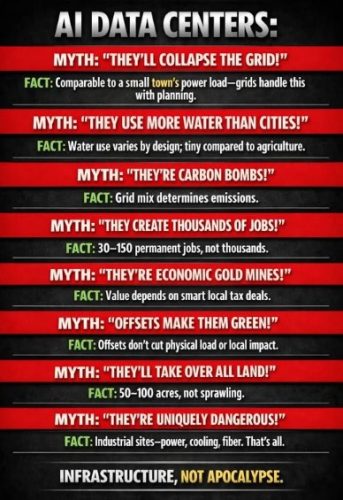
This graphic made the rounds recently on social media. Regardless of verifying whether the claims hold any statistical significance, it indicates the sheer volume of misinformation and disinformation emanating from both sides of the data center divide:
Luckily, we have an energy expert who can address these myths and give us the facts we need to make informed decisions about where to site the inevitable expansion of data centers.
One thing is certain: the race for global AI dominance will continue, as will the need domestic solutions.
Why all the myths?
Glenn Davis has spent years speaking in Delaware, Maryland, Pennsylvania, West Virginia, and Virginia, cutting through the fog. A former Virginia Beach city councilman, state assemblyman, and director of the Virginia Department of Energy, he doesn’t defend data centers or attack them. He simply insists on facts over recycled talking points.
In an interview with Restoration News, Davis said, “The people that are opposed to data centers have never seen a data center. They’ve never lived near a data center.” He believes most of the hype in Virginia—the state with the most data centers—comes from a deep blue Democrat stronghold, Loudoun County.
Davis has years of experience in dismantling the hype. As he points out, we’ve had server farms and data centers for years—in fact, 70 percent of all current data centers in the U.S. sit in northern Virginia, getting their start with government contracts and at the headquarters for America Online (AOL).
“Start with the noise,” Davis said. “Older facilities from the late ’90s sit cheek-by-jowl with homes in Loudoun because the county never updated zoning in time. Those plants hum from servers and cooling systems built before sound attenuation became standard.”
“I had a friend that did Bitcoin mining,” Davis recalled, “and it was pretty loud because they didn’t have the sound attenuation that they have today.” Modern centers are different. To prove this, Davis took a West Virginia delegation to Loudoun County with decibel meters to prove the point. “The difference between yesterday’s tech and today’s is night and day. Most neighbors wouldn’t know a new facility was there unless someone pointed it out.”
The myth that every data center makes for a noisy neighbor comes straight from a handful of outdated Loudoun County sites that no one would build the same way today. The water myth follows the same pattern. Critics claim data centers guzzle precious water resources. But as Davis points out, the complaints stem from those same old late-90s facilities that used open-loop systems.
Today’s centers rely on closed-loop cooling that recycles water and dramatically cuts consumption. The technology has moved on, but the talking points haven’t.
Then comes the tax panic. Critics claim data centers starve local budgets or shift burdens onto homeowners. The opposite is true. In Mecklenburg County, a single Microsoft facility delivered enough property-tax revenue to fund $134 million in immediate school renovations—middle and high schools first, elementary now. Davis noted that data centers now account for roughly 40 percent of property taxes in some Virginia localities.
Loudoun County itself enjoys one of the lowest property-tax rates in the state precisely because of revenue from data centers. “If people understood what their property taxes in Loudoun County would be if they didn’t have data centers, they’d all move away,” he said flatly.
That broadened tax base doesn’t just patch potholes; it rebuilds entire school systems and funds community projects without the usual trade-offs. Rural counties that land even one or two facilities suddenly have the money to improve roads, parks, and public services that used to depend on raising taxes on existing homeowners. It’s the rare economic development win that pays its own way and then some.
The jobs argument gets twisted, too. Yes, direct employment matters—maintenance crews, construction booms when clusters form—but the real payoff is subtler. Data centers don’t import thousands of new families demanding new roads, schools, and traffic lights the way a factory or housing development does. They deliver massive annual tax revenue with almost zero additional service burden. That money then improves schools, builds amenities, and creates the very culture that attracts advanced manufacturing and the skilled workforce Virginia has struggled to keep.
The source of the myths
Kevin O’Leary—Mr. Wonderful from the reality TV show Shark Tank—has started sounding the alarm about foreign influence in the online debate about data centers. After a large Utah facility he was invested in was beset by delays and downsizing, he began investigating.
He pointed to a sudden surge in negative comments on social media platforms starting in early May 2026 — “tens of thousands” of messages on Instagram and X — with patterns suggesting coordination: shared IP addresses, bot activity, and “nefarious accounts from out of the country.” He says the organizations pushing anti-data center propaganda have ties to Arabella Network and Neville Roy Singham, both of which act as proxies for the Chinese Communist Party.
O’Leary notes that China has a clear and vital interest in seeing the U.S. fall behind in data center development, even as President Trump has declared winning the AI race a vital national interest.
Watching jobs disappear — and a possible solution
Davis lived this reality on Virginia Beach city council. He watched steel plants and other manufacturers beg for better schools and downtown vibrancy before they’d relocate talent from Germany or elsewhere. “Data centers break that chain of chicken and egg because they’ll come to your area without you having to have a huge workforce there,” he explained. “They’ll dump an enormous amount of annual tax revenue into the locality that generally you use to invest in your schools, invest in the area, and now you’re going to bring in advanced manufacturing and other types of jobs.
Davis continued to tick off the economic benefits he’s watched develop:
Community colleges are already responding with new HVAC, electrician, and trades programs, retooling workers mid-career. In Hampton Roads, Navy retirees bring precision skills that fit perfectly. The clustering effect multiplies this: one center draws others, turning three-year construction cycles into sustained local work without overwhelming small-town infrastructure.
Virginia doesn’t have to wait years to build a manufacturing base; the data centers create the revenue stream that funds the training pipeline today. Localities can finally invest in the education and amenities that draw the very people manufacturers need.
The loudest myth of all is the power grab. Data centers will devour the grid, the story goes, and ratepayers will foot the bill while the tech giants laugh. Davis has negotiated these deals at the state Department of Energy level. The reality is the opposite. “The industry’s price elasticity is unlike anything else. Reliability matters more than cost,” he said. “That is why Microsoft is building a 1. 4-gigawatt facility in West Virginia entirely behind the meter on natural gas—no grid connection, no utility middleman. Virginia law already allows data centers to bring their own power.”
The most exciting development revolves around the revival of America’s nuclear power industry. West Virginia passed a data-center microgrid statute giving them retail choice. Even more striking, data centers are bankrolling the nuclear renaissance that politicians have talked about for decades. Small modular reactors (SMRs) and advanced designs like the AP1000 are moving forward because hyperscalers are writing billion-dollar checks upfront and signing long-term power purchase agreements. “The first set of these new technologies will be for data centers. It won’t be for you and I,” Davis explained.
The economics are sound, though. The high first-of-a-kind costs get absorbed by companies that can pass them on to their customers. Once the nth-of-a-kind price drops—roughly 20 percent per unit after the first few—the technology becomes viable for utilities and residential ratepayers. In the last PJM capacity auction, the regional grid was short 6.2 gigawatts; 5.1 gigawatts of that shortfall came solely from new data-center demand. Far from draining the system, they are forcing the build-out of reliable generation that eventually benefits everyone.
The data centers are paying to solve the very capacity crunch the rest of us have been complaining about for years. Virginia already routes 70 percent of global data-center traffic. That didn’t happen by accident; it began with early internet backbone points like MAE-East and the original AOL campus. The facilities of the future—gigawatt-scale campuses, some already announced in Canada—will be larger still.
The industry’s own capital expenditures fund the very power solutions the rest of the grid needs. A 5-gigawatt data center campus is on the drawing board right now. That’s one-fifth of Virginia’s entire current statewide energy usage, all in a single project. And the hyperscalers aren’t waiting around for someone else to solve the power problem—they’re writing the checks themselves.
This isn’t a bubble
Davis invokes Jevons paradox: efficiency breeds more consumption. The first computers filled multiple rooms. Today an Apple Watch packs more power. We didn’t use fewer chips—we invented new uses for them. The same logic applies here. AI, autonomous vehicles, medical diagnostics, robotics—every leap demands more secure, always-on computing. “We’re definitely not in the bubble and I don’t think we’re going to see a curve going down in our lifetime and probably not our children’s lifetime,” he said.
Some smaller developers may fail and get gobbled up—the normal course of events in the emergence of new technology. But the next player will snap up the physical infrastructure.
China is experimenting with submerged coastal data centers for built-in cooling. Innovation keeps moving forward. The dot-com bubble was about stock prices and failing companies, not the underlying technology. The servers and fiber are here to stay. Every time we make computing more efficient, we find new ways to use it.
That’s not hype; that’s history repeating itself in real time.
None of this erases legitimate local concerns. Zoning still matters. Older plants need upgrades. Rural counties must avoid becoming Loudoun 2.0.
The Utah controversy illustrates a wider tension. Data centers are strategically vital for U.S. technological leadership, economic growth, and applications ranging from medical research to education and productivity. At the same time, communities have every right to demand rigorous environmental reviews, transparent water and power planning, and genuine local benefits.
O’Leary’s allegations of CCP-linked disinformation add a geopolitical dimension. We know the CCP has engaged for decades in influence operations in U.S. discourse, what they call fifth-generation warfare.
The blanket opposition peddled online ignores the measurable economic lift, the quieting of modern facilities, and the self-funding power strategy already underway. The genie is not going back in the bottle. The choice is whether Virginia shapes the future with facts or lets recycled myths from Loudoun County dictate policy.
Jeff Reynolds is Senior Editor for Restoration News, specializing in energy and science policy, as well as dark money. This column has been republished in Bacon’s Rebellion with permission from Restoration News.
Leave a Reply
You must be logged in to post a comment.