• The Most Aggressive Gerrymander of Any State

    A colorful collection of cartoon-style fantasy creatures, including a dragon, a blue monster, various playful beasts, and a dinosaur. Each creature is numbered and features vibrant colors like green, pink, purple, and yellow.
    Virginia’s fantastical congressional creatures. Image credit: Chat GPT

    by Scott Dreyer

    In what Cardinal News columnist Dwayne Yancey labels โ€œsheer ugliness,โ€ Virginia Democrats on Feb. 5 finally released their proposed new maps to carve up the Old Dominion into 11 new Congressional districts. According to the US Constitution, House seats are apportioned by population, so since Virginia has somewhat over 8 million residents, we have 11 members in the House of Representatives.

    Of those current 11 seats, six are occupied by Democrats and five by Republicans. Many see this as reasonable since the Old Dominion is largely a โ€œpurpleโ€ state. For example, just one month ago, all three statewide offices were held by Republicans. Trump lost Virginia in 2024, but still carried 46.6% of the vote to Harrisโ€™ 51.8%.

    However, the Democratsโ€™ new map is projected to possibly give Democrats a 10-to-1 advantage in Congressional seats from Virginia. This was largely achieved by lumping in most GOP voters in the western third of the state into an oddly-shaped and solidly-Republican 9th District, and then most of the other ten districts were heavily gerrymandered to link Democrat-heavy areas in ways to outweigh GOP voters.

    States usually draw new lines for congressional districts every ten years, after the latest census.

    This year, however, Democrats are angered by the Texas legislature drawing new lines to favor Republicans in the Lone Star State. Thus, Virginia Democrats reason they must now โ€œfight fire with fireโ€ and redraw lines here too to offset possible Republican gains in Texas.

    (more…)

  • Taxing Everything That Moves

    Leaf blowers, guns, dog walking, dry cleaningโ€”full government control means everything gets taxed in Democratsโ€™ Virginia.

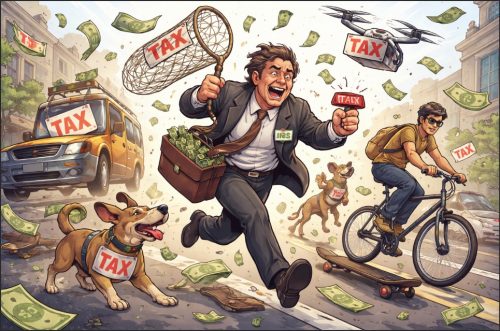
    A frantic businessman in a suit with an IRS badge is running down a street, chasing after floating dollar bills labeled 'TAX' with a net. He carries a briefcase filled with money. A dog runs alongside him, and a young man on a bicycle weaves through the scene, also in pursuit of the money.
    Taxing everything that moves. Image credit; Chat GPT

    by Jacob Grandstaff

    It’s a truism that when Democrats gain a trifectaโ€”full control of a stateโ€™s executive and legislative branchesโ€”they tend to tax every human activity. Virginia Democrats are aiming to exceed the stereotype by taxing animal activity, too.

    Fresh off Gov. Abigail Spanberger’s January inauguration, Democratic lawmakers have flooded Richmond with over 50 new tax proposals. This barrage includes everything from vehicle repairs and gym memberships to dog walking and pet grooming.

    Democrats seldom tell voters exactly how much they intend to tax them while campaigning for their votes. Instead, they launch an full-scale assault on the wallets of unsuspecting residents after getting elected. In Virginia, this is now possible because there’s no Republican governor left to veto any of these proposals.

    Under Gov. Glenn Youngkin (R), Virginia enjoyed four years of genuine fiscal restraint. He pulled the commonwealth out of the costly Regional Greenhouse Gas Initiative (RGGI), saving families hundreds of millions in electricity bills. He eliminated the grocery tax and doubled the standard deduction, among other tax relief policies. Despite foregoing all that revenue, he still left the commonwealth with a $2.7 billion surplus, negating any need for future tax hikes if the government spends responsibly. These policies strengthened Virginia as a good place to start or relocate a business and raise families.

    With Democrats holding the governorship and majorities in both chambers, however, the guardrails are now gone. Spanberger’s administration has already moved to rejoin RGGI, effectively imposing a backdoor carbon tax that will cost Virginians an extra $500 million per yearโ€”that’s $1,100 per household.

    (more…)

  • Redefining Time

    by Dick Hall-Sizemore

    Most people to understand a โ€œdayโ€ to constitute a 24-hour period of time.ย They understand that the term โ€œwork daysโ€ generally exclude weekends and holidays.ย Furthermore, for those that follow government and politics, โ€œlegislative daysโ€ is understood to mean those days in which the legislature is in session.ย Notwithstanding those commonly accepted definitions, Virginiaโ€™s Republican members of the U.S. House of Representatives recently voted to consider the period between Feb. 10 and July 31 as one day.

    Last year, President Trump invoked International Emergency Economic Powers Act to impose some of his tariffs last year under the National Emergencies Act. As reported by the New York Times, โ€œthat law allows any member of the House to challenge an emergency by introducing a resolution that must receive a vote after 15 days.โ€ A Democrat introduced such a resolution, but the Republican leadership in the House has delayed consideration of it several times by redefining what constitutes a day.

    The last such delay expired on Jan. 31.ย This week, the leadership included a provision on a rule regarding unrelated legislation, that would count the period between Feb. 10 and July 31 as one legislative day, thereby extending the delay further.ย Three Republican lawmakers joined Democrats in defeating the measure. No Virginian Republican was included in that dissenting group.

    As a result, Republican Reps. Kiggans, Wittman, McGuire, Cline, and Griffith soon will have to vote on a resolution to end Trumpโ€™s tariffs on goods from Canada, Mexico, and Brazil. Some of the Virginians most affected by these tariffs are farmers and small manufacturers in the rural areas represented by these legislators who are highly dependent on fertilizer and other raw materials from Canada.


  • Assembly, Dominion Seek to Bill Data Centers for Rising Energy Costs

    by Steve Haner

    Virginiaโ€™s major data centers could pay more for electricity and other customers less under a surprise legislative substitute that appeared in email inboxes Sunday and was rapidly approved Monday by a major Virginia Senate committee.

    Senator Louise Lucas

    The proposal is politically attractive, already being touted a major consumer rate cut, but the detailed accounting analysis of whether it is fair will be punted to the Commissionโ€™s judges later this year. If the Commission decides not to agree with the politicians’ suggested allocation rules, it will take the heat, and the politicians will say they tried. ย 

    At issue is the marginal electricity price increase caused by the skyrocketing cost of future generation capacity within the PJM Interconnection regional marketplace, and the cost of large substations and power lines needed by the data centers. Under basic accounting rules for cost allocation, all the various customer classes pay a share of those.ย 

    As introduced, Senate Bill 253 from Senator Louise Lucas, D-Portsmouth, had nothing to do with either. Sunday, she began to circulate to fellow members of the Senate Commerce and Labor Committee a drastic substitute version that was apparently drafted by Dominion Energy Virginia lawyers.ย 

    The last minute โ€œgotchaโ€ move had obviously been well planned, because she also distributed a letter from the State Corporation Commission staff on the way it would impact various customer classes. The data centers would see their future bills jump almost 16%, while residential customers would see about a 3% reduction, perhaps $60-65 per year if they use 1,000 kilowatt hours monthly.

    (more…)


  • Administrative Bloat in Fairfax County Schools

    A chubby man wearing a dark suit and red tie stands confidently in front of a brick building with columns and green trees.
    Image credit: Grok

    by Stephanie Lundquist-Arora
    Republished with permission fromย IWFeatures

    Julie Perry, a high school history teacher in Fairfax County Public Schools (FCPS), told IW Features that she spends thousands of dollars each year on her studentsโ€™ school supplies, classroom essentials, and decorations.ย Perry, who is running for the U.S. House of Representatives in Virginiaโ€™s 10th Congressional District, argues, โ€œEducation leaders across this nation are not spending the money properly that they receive in federal, state, and local tax dollars.โ€ย 

    โ€œThey are spending the money on administrative bloat, DEI curricula that do not enhance student learning, and expensive lawyers from white shoe law firms,โ€ Perry continued. โ€œThey are constantly having to defend themselves against lawsuits because they continue to knowingly break the law.โ€ 

    Perry is right on all counts. Fairfax County, in particular, has spent more than $52 million on legal costs since 2020, according to a Freedom of Information Act (FOIA) request obtained by IW Features.

    Fiscal YearLegal Fees
    FY 2020$6,401,077.94
    FY 2021$5,066,049.47
    FY 2022$6,312,989.17
    FY 2023$6,925,475.29
    FY 2024$11,619,332.03
    FY 2025$7,656,968.09
    FY 2026 (Julyโ€“Dec 2025)$8,047,874.69
    Total$52,029,766.68
    (more…)

  • Spanberger Has Declared War on the Second Amendment

    The Democrat governor is preparing to trample the gun rights of law-abiding Virginians, confirming exactly what critics warned all along.

    A serious woman with long hair stands beside a chained handgun and a partially visible document referencing the Second Amendment, with a dark red background.
    Image credit: Restoration News

    by Bronson Winslow

    Newly sworn-in Virginia Gov. Abigail Spanberger (D) is hellbent on turning Virginia into California, keeping her campaign promise to completely gut Virginians’ constitutional right to bear arms.

    Spanberger, a longtime supporter of the radical gun abolitionist group Everytown for Gun Safetypromised on the campaign trail to push through every gun law former Republican Gov. Glenn Youngkin vetoedโ€”and it’s safe to say now she was not lying. Now, more than 10 bills are moving through the Virginia legislature targeting nearly every form of gun ownershipโ€”from how many bullets you can fire, to where you can carry, to what firearms you are allowed to own.

    “I will sign legislation into law to make progress on these issues to keep Virginia families safe,” she said while campaigning at an Everytown rally in 2025. “I will not veto common-sense proposals like our current governor has done.”

    Over the last four years, former Gov. Youngkin served as a shield for gun ownersโ€”vetoing 54 gun control bills sent to his desk by radical Democrats.

    (more…)

  • If The World Is Getting Hotter…

    Why On Day 14 After Paralyzing Ice Storm Does SWVA Still Look Like Frozen Tundra With Wind Chills Of 0 Degrees?

    by Scott Dreyer

    A white dog standing beside a snow structure made of stacked ice blocks, with trees and plants in the background.
    Ice chunks stacked up by a Roanoke County driveway one week after the Jan. 24 winter storm.

    Full disclosure: One, I am not a climatologist. Two, I understand the difference between weather (short-term conditions) vs. climate (long-term trends).

    But just as an observer, itโ€™s been really cold here around Roanoke for a long time. On Saturday, January 24, it began to snow, and during the night it turned to sleet.

    (That was actually a huge blessing for us, since sleet bounces off, so most of us kept our power on. Many areas south of us, even in the Deep South of Mississippi and Alabama, had freezing rain which accumulates, gets heavy, and thus brings down trees and power lines with it.)

    Then, on Sunday and Monday, bitter coldย came in,ย turning thatย top layer of sleet into solid sheets of ice someย four to five inches thick.ย In our area, we can usuallyย justย shovel off the snow or, better yet, wait a day or two for the sun to come out and the temperatures toย getย above freezingย to doย the snowย removal for us.

    (more…)

  • We Have to Destroy Democracy in Order to Save It!

    by Chap Petersen

    A vintage-style propaganda poster featuring the text 'WE MUST DESTROY DEMOCRACY IN ORDER TO SAVE IT!' with an illustration of the U.S. Capitol building engulfed in flames, surrounded by soldiers and aircraft.
    Image credit: Chat GPT

    About fifty years ago the United States was involved in a military conflict in Vietnam which lasted many years and did not end well.

    There was a phrase from that era โ€“ โ€œWe had to destroy the village in order to save itโ€ โ€“ which encapsulated its own self-defeating logic. We know better than the natives. We must force them to appreciate our values.

    Fast forward to 2026.

    Powered by the latest surge in the TDS virus, Democrats in the General Assembly are on the verge of passing a redistricting bill which will turn the stateโ€™s Congressional map into a Jackson Pollock painting โ€“ with the sole purpose of creating four new โ€œDemocraticโ€ Congressional seats so as to โ€ฆ (wait for it) โ€ฆ SAVE DEMOCRACY!

    The putative losers in all this are rural white voters, who are already the subject of disdain if not actual bigotry in large swaths of American culture. In a geography-based map, these voters would form a natural majority in three Congressional districts and significant share in at least three others.

    In the Democratic map, most the โ€œdeplorablesโ€ will be โ€œpackedโ€ into one District โ€“ the remainder will be divided up and thus outnumbered by suburban liberals in all others.

    If this were done to urban black voters, it would be a blatant Voting Rights Act violation. But since it only applies to Trump-friendly white voters, then itโ€™s ok!

    (more…)

  • The Surreptitious Disappearance of the Capitol Square Preservation Council

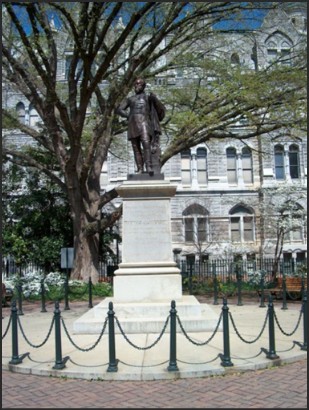
    A bronze statue of a historical figure on a stone pedestal, surrounded by a circular chain fence and large trees, with a historic building in the background.
    Source: The Virginia State Capitol History Project (www.vacapitol.org

    by Don Smith

    Breathtaking. Unsettling. Healing. Those meant-to-catch-your-attention words come from an article by the British newspaper The Guardian on the โ€œreimaginedโ€ statue of Stonewall Jackson, currently on display at a contemporary โ€œartโ€ museum in Los Angeles.

    Now, as members of The Guardianโ€™s target audience — progressives — take full control of Virginiaโ€™s state government, is another prominent Stonewall Jackson statue in peril of being sent to the chopping block? (Literally, as weโ€™ve seen in Los Angeles).

    At the beginning of 2026, legally, the answer appeared to be: not immediately. But that has changed. Quietly, but drastically, changed.

    Virginia Democrats and progressives complain constantly about the Stonewall Jackson statue that stands on the grounds of the Virginia Capitol.ย 

    Those of us who follow Virginia heritage news, or use Google regularly, took comfort in the fact that Jacksonโ€™s statue, and all the other monuments in Capitol Square, had a legally-established, extra level of protection from activists: the Capitol Square Preservation Council.

    All of the statues on Capitol Square came under the authority of the Capitol Square Preservation Council.Title 30, Chapter 28 of the Virginia Code lists in detail the roles and responsibilities of the council.ย This is an excerpt from the Virginia Code (eEmphasis added):

    With regard to the architectural, historical, archeological, and landscape features of Capitol Square and antiquities contained therein, the Council shallโ€ฆ[r]eview all plans or proposals for alterations, improvements, additions, renovations, or other disposition that is structural or architectural in nature. No implementation of such plans or proposals shall take place prior to review by the Council.

    (more…)

  • It’s Not Just an Act

    Loudoun School officials really do think unhappy parents are potential terrorists.

    Don’t go — there’s more!

    (more…)

  • Dominion Opposes Battery Mandate on Fire Safety Concerns

    by Steve Haner

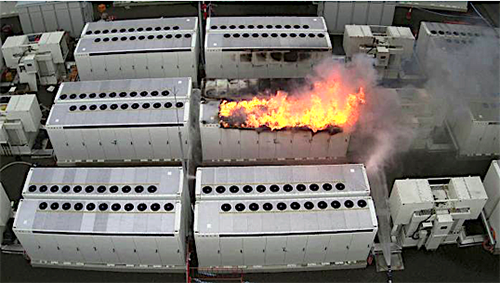
    Utility scale battery on fire in Australia

    Today a Senate committee is scheduled to take up the billย directing Virginiaโ€™s two investor-owned utilities to proposeย hugeย battery installationsย whichย will cover square miles of ground,ย cost ratepayers billions of dollarsย andย whichย will produce zero energy to power our homes and businesses.ย ย The bill has Governor Abigail Spanbergerโ€™s endorsement.ย ย 

    So far, legislators have been in a โ€œsee, hear and speak no evilโ€ posture on the issue, almost disinterested in the proposalโ€™s overall cost, impact on ratepayer bills, or any challenges to the batteriesโ€™ safety or energy benefits.ย ย 

    If the Senate discussion mirrors the brief presentation (there was no debate) on the House version of the bill last week,ย which was approved by a subcommittee with a newย substitute,ย it will shed no real light.ย ย ย 

    During the House subcommittee discussion Thursday, a lobbyist for Dominion Energy Virginia made it clear the company does not support the substitute as it stands and cited safety concerns. They want to use tougher fire protection rules thanย now in the bill, but the language explicitly prevents that. She stood at the podium waving the red flag ofย fire safetyย and not one legislator asked her whyย Dominionย isย nervous.ย ย 

    (more…)


  • Jeanine’s Memes

    A satirical tweet from The Babylon Bee commenting on journalists being laid off from The Washington Post, set against a background of the newspaper's nameplate.

    See more memes at The Bull Elephant


  • Bacon Meme of the Week

    A stack of eight bacon grilled cheese sandwiches on a plate, with a humorous quote about trying to solve problems.

  • Bill & Ed’s Excellent Richmond Adventure, Part 2

    by Jon Baliles

    A middle-aged man with glasses and short brown hair, wearing a suit and tie, smiling at the camera.
    Bill Martin

    As mentioned in Part 1, Richmond lost two giants of history and change at the end of 2025 when Ed Slipek died after a brief illness and soon after, Bill Martin was struck by a car in the crosswalk on Broad Street, only two blocks from The Valentine Museum, which he had led for more than 30 years. The opening third of Part 1 (which you can read here) highlighted how both Bill and Ed embraced this cityโ€™s history and saw using it as an adventure to start conversations, open peopleโ€™s eyes, and change their minds by learning more about the city around them. They were human time machines of Richmond history and could instantly transport anyone back to a specific neighborhood, year, or historical event and almost instantly convey what happened and what it meant in context of that time and where we are today. Where we are today, sadly, is that we have lost two men who possibly did more than any other two to expand the knowledge of this cityโ€™s history and never stop searching for more stories about it.

    Perhaps what is so astonishing about Billโ€™s legendary career and life in Richmond is that his tenure at The Valentine almost ended before it really began. Bill, who had been serving as Petersburgโ€™s Director of Tourism, was hired in 1994 to be the museumโ€™s marketing director just as it launched the ambitious and very expensive project called Valentine Riverside. The $23 million project (centered around Tredegar Iron Works and where the American Civil War Museum is today) was an interactive history park with live re-enactors and used what was, at that time, pretty cutting-edge sound and light shows as well as offering bike and river tours, and shuttles to Hollywood Cemetery and Shockoe.

    The project failed spectacularly within 16 months as the crowds never materialized and suddenly the ship was in a storm. As the failure of Riverside became evident, so did the magnitude of the trouble. Debt mounted to $10 million, most of the staff were laid off (out of 85 staff, only 12 remained), the Director was ousted, and the endowment slid from $4 million down to just $500,000.

    (more…)

  • Say Socialized Cost, Not That Other S Word

    by Steve Haner

    The PIPP Acorn Now an Entitlement Oak?

    A House of Delegates committee has approved expanding a state-managed program to subsidize electric bills for some lower-income Virginians, hoping to reach more people and offer them more assistance. It also approved a new plan to grant lower-income homes lower water rates.

    The utility companies involved will not absorb the cost of giving these customers discounts. They will instead be allowed to collect the subsidy money from all their other customers.

    As advocates lined up to praise the two bills in testimony last week, the word โ€œaffordabilityโ€ escaped their lips too many times to count. A member of the State Corporation Commission staff used the term โ€œsocialized cost.โ€ Economists refer to โ€œtransfer paymentsโ€ that move money from one person to another. Just call it energy welfare, Virginia.

    The electricity program involved is the Percentage of Income Payment Program, or PIPP, which was first created by the 2020 Virginia Clean Economy Act. The House Labor and Commerce Committee approved House Bill 884, with the amended version expanding the program to Dominion Energy or Appalachian Power customers with a household income of up to 200 percent of the federal poverty level (FPL).ย 

    (more…)