
by Steve Haner
A House of Delegates committee has approved expanding a state-managed program to subsidize electric bills for some lower-income Virginians, hoping to reach more people and offer them more assistance. It also approved a new plan to grant lower-income homes lower water rates.
The utility companies involved will not absorb the cost of giving these customers discounts. They will instead be allowed to collect the subsidy money from all their other customers.
As advocates lined up to praise the two bills in testimony last week, the word “affordability” escaped their lips too many times to count. A member of the State Corporation Commission staff used the term “socialized cost.” Economists refer to “transfer payments” that move money from one person to another. Just call it energy welfare, Virginia.
The electricity program involved is the Percentage of Income Payment Program, or PIPP, which was first created by the 2020 Virginia Clean Economy Act. The House Labor and Commerce Committee approved House Bill 884, with the amended version expanding the program to Dominion Energy or Appalachian Power customers with a household income of up to 200 percent of the federal poverty level (FPL).
The current program grants eligibility at up to 150 percent of the FPL. Bumping that up expands the 2026 income ceiling to $43,300 for a two-person household and $66,000 for a four-person household. Before the amendments, it would have covered up to 400 percent of the FPL.
The new version will also allow the subsidy to kick in if the electric bill exceeds 3 percent of the household’s monthly income, a big change from the current 6 percent trigger. So, if the monthly cash income is $2,000, their maximum electric bill will be $60 under the amendments rather than $120 now. If their usage is higher, the PIPP fund pays the utility the balance.
Bigger subsidies for more people. No legislator asked how much the program is costing ineligible customers of Appalachian or Dominion now, let alone what the cost is likely to become if the new rules take effect next January. There is no fiscal impact statement on the legislation (which is common this year). After the 15-7 vote to approve it in that committee, it was referred to the House Appropriations Committee for review.
A lobbyist for the Virginia Poverty Law Center did tell the committee that PIPP participants are not exempt from paying for the PIPP program. Any rate adjustment clause increase needed will also be on their bills (but their bills are of course capped and thus no, ma’am, not really). She completely ignored that the PIPP recipients are also exempt by law from paying for the Dominion offshore wind project. (The rest of us are already picking up their share of that.)
So far (this session is far from over) it is just customers of those two large utilities who can apply for PIPP assistance. The rural electric cooperatives with all their customers have no such “socialized” program, just the other directly-tax funded assistance programs or private charities.
The legislation covering water and sewer bills from public utilities is not specific to any company but may apply only to those regulated by the State Corporation Commission (SCC). House Bill 770 as currently written is permissive, granting utilities an opportunity to propose and the SCC to approve rates which are not uniform.
The same 200 percent of federal poverty threshold is used in this statute for the lower, subsidized rates. The introduced version forced the utilities to make up the difference with higher charges on commercial and industrial customers only, preventing any transfer payment from other residential customers. The substitute spreads the cost over all classes of customers.
That bill was not sent to another committee but will be voted on by the full House of Delegates now. It was given the same 15-7 vote of approval, so it will not be on the uncontested calendar, should any of the other members wish to ask a question or raise some debating points.
The best question would be, if this passes, how long will it be before the same is done for electric and natural gas rates? PIPP is not heavily used so far probably because it is so bureaucratic and cumbersome. Moving to means-tested electric rates will be so much simpler that far more households likely will take advantage of it.
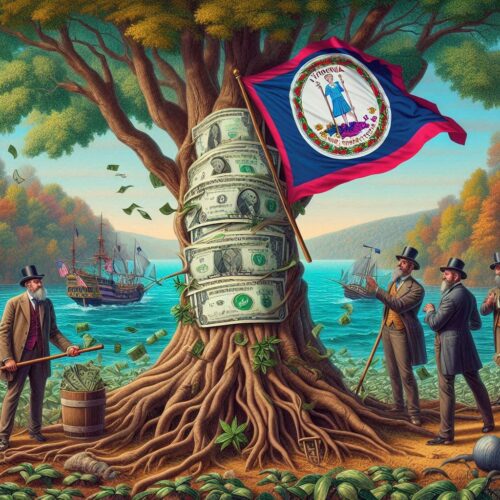
The PIPP acorn planted six years ago has sprouted into a nice sapling, on its way to becoming a full entitlement oak. A new subsidy seed is planted for another set of basic costs all households must deal with. In both cases, only one or two polite questions were raised, no real fiscal impact statements provided, and how much everybody else’s bills might rise remains to be seen.
The last word from the last report on PIPP for the savvy readers of Bacon’s Rebellion:
Another interesting tidbit in the report is that a fair chunk of the money being transferred from non-PIPP participants to PIPP participants (after the healthy overhead cut) is going to pay off their overdue bills. One way or another, the money all flows into Dominion’s coffers — for current billing, for overdue billing or for the administrative task of paying itself. The house always wins.
Leave a Reply
You must be logged in to post a comment.