
by Steve Haner
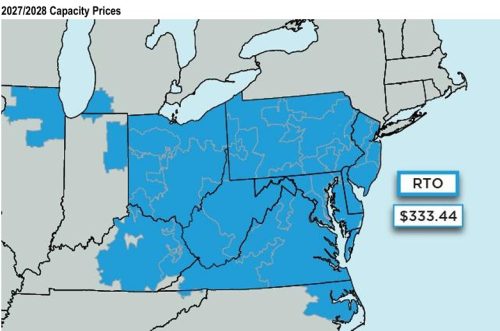
The regional electric grid operator that serves Virginia held another of its periodic auctions to secure sufficient supply for the future last week and the price went up again, slightly higher than in last summer’s auction. Even worse news, PJM Interconnection fell short of securing its target amount needed to guarantee reliability.
PJM has been holding auctions for future supply on an accelerated basis, and the one last week secured energy contracts for late 2027 through early 2028. With the new contract period 18 months away, there is time for some adjustments by accelerating new supply or recalculating the forecasts. The shortfall still set off alarm bells at a meeting of the Federal Energy Regulatory Commission (FERC).
The price paid was $333 per megawatt-day, up slightly from the $329 per megawatt-day price in the July 2025 auction (for the 2026-27 rate period). Those prices are for the entire PJM region, so will apply to Dominion Energy, Appalachian Power Company, and the various regional electric cooperatives in Virginia. The cooperatives are the most sensitive to capacity pricing due to their reliance on purchased power.
Dominion’s need for purchased power is likely to spike substantially if President Trump’s Administration succeeds in cancelling the Dominion offshore wind project. A pause in construction of the 2.6-gigawatt facility was announced yesterday. The other four projects paused are outside the PJM territory, but if they do fully die it will change all the electricity math on the East Coast.
What types of future generation were in demand and were put under contract by PJM? From the PJM news release:
The cleared resource mix in this auction includes: 43% natural gas, 21% nuclear, 20% coal, 5% demand response, 4% hydro, 2% wind, 2% oil and 1% solar. These results were impacted by changes in Effective Load Carrying Capability (ELCC) ratings that assess the reliability value of each resource class. The amount of capacity that offered as DR resources, for instance, did not change significantly between auctions, but an increase in ELCC for DR resulted in an increase of cleared megawatts from 5,531 MW in the last auction to 7,299 MW in the 2027/2028 auction.
The $333 per megawatt-day price would have been higher but for an artificial cap imposed by the PJM leadership in response to political pressure from anti-hydrocarbon elected officials. Basic Economics 101 would lead one to suspect the price cap and the failure to secure sufficient supply had something to do with each other.
The assets in most demand were those based on hydrocarbon (65%) and nuclear (21%) generation. The people who run power companies recognize that wind and solar, especially solar, do not provide the reliability needed on the hottest and coldest days, or when weather badly disrupts the grid. Only 1% of the capacity purchases were from solar facilities, presumably solar backed by battery. Remember this is looking ahead 18 months, by which time many more solar facilities will probably be connected within PJM.
Unfortunately, too few of the members of our Virginia General Assembly understand the limited value of solar. It will probably be fewer legislators in January than it has ever been who understand that. New Governor Abigail Spanberger (D) also spends most of her time and political capital chasing energy sunbeams.
PJM manages the flow of electricity through all or parts of 13 states and the District of Columbia, serving an estimated 67 million Americans. It continues to be a scapegoat for the way energy supply is falling behind demand, producing these record capacity prices, and there are many projects pending in its approvals queue. But many of those are the wind, solar and battery projects just rejected again as unreliable by this auction, and too often projects cleared by PJM then fail for other reasons and do not connect. Much of the news release linked above defends PJM’s performance:
Approximately 57 GW of projects have completed PJM’s study process and have either signed or been offered generation interconnection agreements and are free to proceed to construction. Many of these projects, however, continue to be slowed or stopped by factors unrelated to PJM, including local opposition, state/local permitting delays, supply chain challenges or financing.
Add to that list of approved but delayed reliability projects the Dominion natural gas plant in Chesterfield, approved by the State Corporation Commission a few weeks ago, just granted its air permit, but now put on hold as the anti-hydrocarbon forces filed a motion for reconsideration.
Such motions are common on controversial applications and that may not delay the project’s scheduled 2029 completion. A full-scale appeal to the Virginia Supreme Court is another matter. As of January 17 Virginia’s new Attorney General could enter the case against Dominion and oppose the SCC’s decision. If he also joins the complaints about PJM failing to secure enough energy for the future, the irony will go unnoted.
Leave a Reply
You must be logged in to post a comment.