• Stifling Discussion in Hanover

    A story in todayโ€™s Richmond Times-Dispatch caught my eye. It revealed what seems to be an outrageous action by the Hanover County School Board.

    The story deals with the controversy over the recent resignation of the school superintendent.ย One school board member, in an e-mail exchange with a county resident, blamed the other school board members for the resignation and lamented that it was a โ€œgreat loss for Hanover.โ€

    I do not intend to get into the merits of the controversy.ย What I find outrageous is the statement that โ€œboard members were asked to sign a nondisclosure agreement regarding the separation.โ€ย 

    Who asked them to sign an NDA? Arenโ€™t Hanover County residents entitled to know what their school board members think about major developments affecting the schools, such as the resignation of a superintendent?

    It is common for elected officials and chief administrators to decline to discuss โ€œpersonnel matters.โ€ย However, that is a discretionary decision.ย An NDA is another dimension.ย Members of governing bodies should be free to discuss publicly any aspect of the business of the public body.

    RWH


  • Riding to Richmond

    by James A. Bacon

    In Northern Virginia, a common battle cry around the turn of the century was, “Don’t Fairfax Loudoun.” After much of Loudoun became Fairfaxed, the admonition moved on to, “Don’t Fairfax Fauquier.”

    Soon it will be “Don’t Fairfax Richmond.”

    Fairfax County’s dysfunctional pattern of land use — low density subdivisions of detached single-family dwellings, separated land uses, hopscotch development — was cemented in place by zoning codes and the high cost of redeveloping property into higher-density development. Traffic congestion and supply-demand imbalance for housing are baked into the cake. The resulting quality of life may be acceptable to the immigrants who replenish the population outflow, but the middle class wants out.

    According to the leading expert in Virginia demographics, thousands of Northern Virginians are moving to Richmond. (Listen to our cool AI-generated song, “Riding to Richmond,” by clicking on the audio link above.)

    The main reason more people are leaving Virginia than are moving in — and moving from Northern Virginia to Richmond — is the high cost of housing, said Hamilton Lombard, manager of the Demographics Research Group at the University of Virginia’s Weldon Cooper Center on Tuesday at an online seminar organized by Virginia FREE.

    (more…)


  • Brainwashing and Politicization at GMU

    by James A. Bacon

    Bryan Caplan

    Last week I highlighted an article in the Chronicle of Higher Education that gave voice to fears by lefty George Mason University professors about the newly constituted Board of Visitors. Six board members appointed by Governor Glenn Youngkin, the profs fretted, had ties to the conservative Heritage Foundation and might do all sorts of awful things, such as interfere with the tenure-granting process and dismantle the Diversity, Equity & Inclusion apparatus.

    One of the professors interviewed, Bryan Caplan, was not quoted in the article. Caplan, whose work is informed by public choice theory, describes himself as an economic libertarian.

    In his Bet on It Substack account, Caplan has republished the written Q&A he engaged in with the Chronicle reporter. Anyone interested in GMU should read the post.

    Some excerpts:

    Q: Do you think faculty should be worried by a Heritage presence on the board?

    A: The correct story, in my view, is that far-left faculty feel “threatened” by anything short of 100% control of the university. And all of the allegedly horrible views you list are, at minimum, worthy of calm discussion.

    (more…)


  • Maps of the Day: Revenue Capacity, Revenue Effort


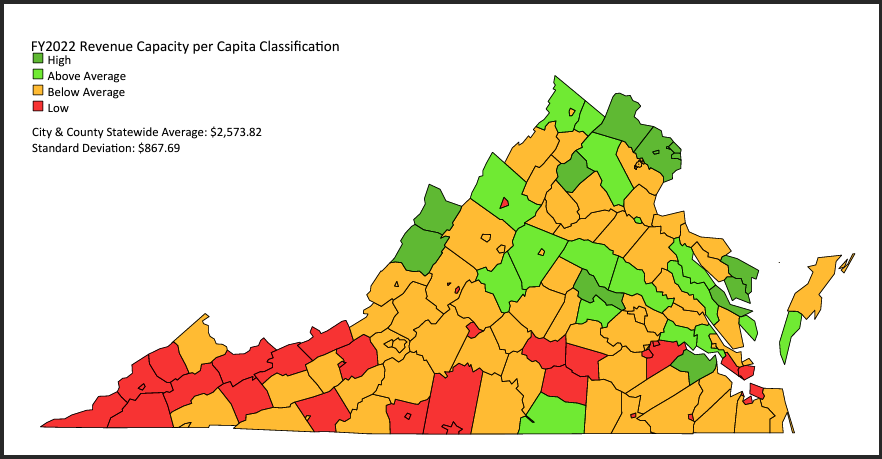
    A concept related to “fiscal stress” (see previous post) is “revenue capacity.” The Commonwealth of Virginia defines “revenue capacity” as the amount of revenue a local government would generate if it set its tax rates at statewide averages. The calculation takes into account five main revenue sources: true value of real estate, true value of public service corporation real estate, registered vehicles, local option sales tax receipts, and adjusted gross income. The state Commission on Local Government expresses the resulting number on a per capita basis.

    The index compiled by the Commission, based on the most recently available numbers from FY 2022, ranges from a high of $5,886.10 in Bath County and a low of $1,272.16 in Radford City. The average revenue capacity per capita in the Commonwealth is $2,960.72.

    The Commission then calculates what it calls “revenue effort” — how much revenue a locality raises expressed as a ratio of its revenue capacity, as seen in the map below:

    (more…)


  • Map of the Day: Fiscal Stress

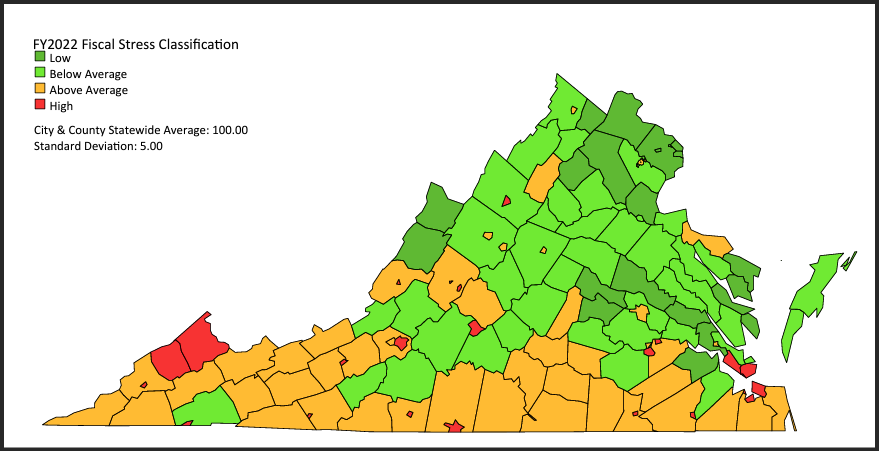
    ย The Commission on Local Government has released its report ranking the “fiscal stress” of Virginia’s local governments. Fiscal stress measuresย a localityโ€™s ability to generate additional local revenues from its current tax base. As shown in the map above, the most severely stressed localities in Virginia fall into two buckets: cities and chronically depressed coalfield counties.

    The most fiscally stressed localities of all are small cities — Emporia (the #1 most stressed), Petersburg (#2), Covington (#3), Bristol (#4), Galax, (#5), and Martinsville (#6). The most fiscally robust (or least stressed) localities are suburban counties and cities — Goochland County (#133), Loudoun County (#132), Falls Church (#131), and Fairfax County (#130).

    A fascinating anomaly is Bath County (at #129), which is about as rural as you can get. The largest community, Hot Springs, has a population of less than 1,000. But the county is home to The Homestead resort and has numerous vacation homes. Also high on the list of fiscally robust counties are Lancaster (#118), Middlesex (#115) and Mathews (#114) counties on the Chesapeake Bay. Lancaster is home to The Tides resort. All three are blessed with an abundance of vacation and retirement homes.

    — JAB

    Update: I have updated the post to give a more precise definition of “fiscal stress.”


  • The Risk of Offshore Turbine Blade Failure

    Image: Idaho National Laboratory Creative Commons

    by David Wojick

    On July 26, CFACTโ€™s President Craig Rucker sent Virginia Governor Glenn Youngkin a letter warning him about the serious risk of blade failure in the giant offshore wind facility being built off Virginia. The warning builds on the recent blade failure off of Nantucket, which has littered the beaches with fiberglass fragments. Virginia is also at risk.

    In this article, I present some technical background on that risk. The Virginia offshore wind facility will be one of the worldโ€™s biggest, with 176 enormous turbines. It is just getting started with pile driving, so no turbine blades have been installed to date. This is an opportune time to undertake caution.

    The Nantucket turbines are made by GE, and they are the worldโ€™s largest in operation today at 13 MW, each driven by three huge 107-meter-long blades. That is 351 feet for those of us who do not speak metric. The Virginia turbines will be even bigger at 14 MW with blades 108 meters (154+ feet) long. They are made by Siemens Gamesa, or SG for short.

    The GE turbines and blades have been in production for going on two years, so have some operational experience. The SG turbines and blades just came into production so there is no experience with them. One could say they are being beta tested off Virginia.

    (more…)


  • What Would You Have Done in 1861?

    by Donald Smith

    โ€œThe past is a foreign country. They do things differently there.โ€ — British writer L.P. Hartley

    โ€œBeing woke is like a magic moral time machine, where you judge everyone [who lived in the past] against what you would have done in 1066, and you always win. Presentism is just a way to congratulate yourself about being better than George Washington because you have a gay friend and he didnโ€™t. But if he were alive today, he would too. And if you were alive then, you wouldnโ€™t.โ€ –Bill Maher, TV talk show host.

    Magic moral time machine

    I am the proud descendant of Confederate cavalrymen — and I am glad the Confederacy lost. Abraham Lincoln, shortly after his famous debates with Stephen Douglas, described slavery as a cancer. The Civil War cut that cancer out of the South and started in on a long path to healing. The war was a blessing, in that it ended slavery quickly. Iโ€™ve read that the Founding Fathers hoped to put slavery on the path to eventual extinction. Well, that was great for the Fathers, but not the slaves. No one asked THEM if they were willing to wait, in chains, for slavery to die off gradually, eventually, some dayโ€ฆ.

    But, I am confident that, if I had lived in a Southern state in early 1861, I would have fought for the Confederacy. Even if I loved the Union and loathed slavery. Here are some reasons why.

    (more…)


  • Will AI Obliterate Virginia Jobs?

    Virginia is in a two-way tie with Colorado as the state whose workforce will be most impacted by artificial intelligence, concludes Journoresearch.org.

    โ€œProfessional, scientific, and technical servicesโ€ was found to be the industry most affected by AI in both states. Fifty-two percent of the industry’s workforce in each state (217,829 in Colorado and 322,493 in Virginia) are estimated to be affected,” states an email communication from Journoresearch, a journalistic research company, that entered my inbox today

    The analysis drew from Pew Research, the Bureau of Labor, and localization-management platform Centus, but the email does not explain its methodology. Still, it stands to reason that “professional, scientific and technical services” would be at greater risk of being disintermediated by AI than industries that require lots of hands-on work, such as health care, construction, or hospitality.

    I cannot evaluate an analysis I cannot access. But I can say this: Journoresearch asks an interesting question.

    (more…)


  • The New Virginia Way

    Figures in billions of dollars. Note: FY 2025 is an estimate.

    by James A. Bacon

    Governor Glenn Youngkin announced Friday that Virginia closed out FY 2024 with $1.2 billion more revenues than forecast. Needless to say, every dollar of surplus is spoken for, and none of it is going to taxpayers. The money will fund a list of “contingent” spending priorities — clean water projects, college tuition for military survivors and dependents, and improvements to Interstate 81.

    Lost in the headlines of what is happening in the here and now is how much state government spending has ballooned over the past two decades. Between fiscal 2007 and 2025 (our current year) total state spending (General Fund and Non General Fund) has increased 139 percent. That compares to 50 percent inflation over the same period.

    More money for Medicaid. More money for K-12 schools. More higher-ed tuition dollars. More taxes for transportation. What do we get for all that money?

    Look at us. Our society is a mess. K-12 student achievement is a wreck. Health outcomes are deteriorating. Traffic congestion is as bad as ever. Universities have become engines of social revolution, not learning. Virginia’s economic performance, once stellar compared to other states, is mediocre. Housing is unaffordable, suicides are up, drug-overdose deaths are probing new highs. And the list of “unmet needs” is as long as it’s ever been.

    (more…)


  • T.J. Loves Bacon

    In his weekly email missive, Derrick Max, president of the Thomas Jefferson Institute for Public Policy, led with the following quote from Thomas Jefferson to Alexander Donald in 1788:

    I had rather be shut up in a very modest cottage with my books, my family and a few old friends, dining on simple bacon, and letting the world roll on as it liked, than to occupy the most splendid post, which any human power can give.

    My esteem for Jefferson knows no bounds. — JAB


  • Jeanine’s Memes

    From The Bull Elephant


  • Bacon Meme of the Day


  • Fight the Culture Wars — Get Married!

    The institution of marriage is under attack in popular culture. Celebrating the single life, childlessness, and the pursuit of individual self-fulfillment, many journalists, academics, and Hollywood script writers view marriage and parenthood as barriers to happiness. But Brad Wilcox, a sociology professor at the University of Virginia, says they’ve got it all wrong. The sociological data show that married people live longer, healthier, wealthier, happier lives on average than their unmarried peers.

    Wilcox makes a powerful case in his new book, Get Married: Why Americans Must Defy the Elites, Forge Strong Families, and Save Civilization. I was privileged to interview him in a Jefferson Council webinar earlier this week. Bacon’s Rebellion readers will especially enjoy Wilcox’s explanation of why conservatives, religious people, Asian-Americans, and “strivers” (which admittedly includes college-educated liberals) have stronger marriages on average than other Americans.

    Watch the half-hour video, buy Wilcox’s book, check out the Jefferson Council website, and donate to the Council so it can bring cool interviews to your attention. — JAB


  • A Project 2025 Revolution at GMU?

    by James A. Bacon

    Lefty professors are fearful that a new Board of Visitors, now comprised of a majority of Youngkin appointees, is about to unleash a right-wing revolution at George Mason University, Virginia’s largest public university.

    Six of the 12 Youngkin-appointed board members are, or have been, affiliated with the conservative Heritage Foundation think tank, which recently produced a detailed document, Project 2025, laying out policy options for the next Republican president. Many on the left have decried Project 2025 as a dystopian blueprint for ending democracy and imposing a right-wing autocracy if Donald Trump is elected.

    Bethany Letiecq

    An article in The Chronicle of Higher Education catalogs concerns articulated by Bethany Letiecq, a professor in GMU’s College of Education and Human Development and chair of the state American Association of University Professors (AAUP) conference.

    Letiecq avoids the apocalyptic rhetoric typical of “progressive” media voices, but she warns that GMU is โ€œincredibly vulnerable as a test case for what Project 2025 could look like on campus…. My feeling is, we’ve been captured.”

    Letiecq is worried that the new board will bring a new governing philosophy to GMU. โ€œAll the ingredientsโ€ appear to be in place for “real change,” she said. “Weโ€™ve had a strong sense as faculty that once the board shifted to 12-4, the gloves would come off.โ€

    She might be right about that. I hope she is.

    (more…)


  • Give Charter Schools a Chance in Virginia

    by Chris Braunlich

    The Youngkin Administration is trying to jumpstart the creation of independent public charter schools in Virginia, in order to provide students additional high-quality options for their education.

    This effort is long overdue. But the road to quality choices in Virginia is a steep climb.

    Public charter schools were first established in Minnesota 32 years ago. Now, more than 7,800 public charter schools serve 3.7 million students โ€“ eight percent of all public schools in the United States. Charter schools also attract diverse student populations (29 percent white, 24 percent black, 36 percent Hispanic) and because they are not bound by public school boundaries, each school often attracts a more diverse population both geographically and racially. Public charter schools also better deliver the goal of quality education.

    Stanford Universityโ€™s Center for the Study of Educational Outcomes (CREDO) has studied charter school performance for 15 years. In a study published last year comparing two million charter students with two million comparable traditional public school students, the center noted that in reading and math charter schools provide stronger learning for students, with reading advancing by an additional 16 days and math an additional six days each year.

    Those are badly needed outcomes for educationally at-risk children. But here in Virginia, only seven such schools exist today.

    (more…)