by James A. Bacon

The United States has spent trillions of dollars on poverty programs, yet hard-core inter-generational poverty and its attendant social ills remain endemic. Federal and state benefits are not lavish, and they are contingent to some degree upon recipients finding work, or at least looking for work. But anti-poverty programs are doing a terrible job of lifting people out of poverty. While individual programs might make sense, the system of programs is dysfunctional. Ameliorating poverty will require addressing the system.
That’s my takeaway from a recent report by the Joint Legislative Audit and Review Commission (JLARC), “Virginia’s Self-Sufficiency Programs and the Availability and Affordability of Childcare.”
A mother and child living in the Richmond area and “on welfare” can reap about $1,900 a month ($22,800 a year) in benefits, as seen in this JLARC graphic:
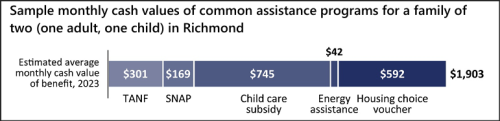
I cannot imagine trying to support a child on $22,800 a year, which is only a tad above Federal Poverty Level of $20,400. It must be noted, however, that JLARC’s list does not include Medicaid (average spending per enrollee in Virginia of $7,000) or the Earned Income Tax Credit (worth up to $4,000 for a family with one child). Nor does it take into account private charity such as food banks or the vast underground economy, estimated at more than $1 trillion, in which many people (including the poor) take money under the table.