• Release the Report, President Ryan

    by James A. Bacon

    Christopher Darnell Jones, Jr., has plead guilty to three counts of first-degree murder, two counts of aggravated malicious wounding, and five counts of use of a firearm in the commission of a felony in connection with the mass shooting at the University of Virginia two years ago.

    Now UVA officials should release the Attorney General’s report on the university actions leading up to the shooting, which resulted in the deaths of three UVA football players.

    That’s what UVA leadership promised. Now it’s time to make good on that promise.

    Initially, UVA officialdom declared that it would release the report to the public shortly after receiving it on Oct. 30, 2023. UVA Spokesperson Brian Coy was quoted by media as saying โ€œThe University will share the report publicly, with a goal of doing so by early November.โ€

    But President Jim Ryan and Rector Robert Hardie sang a different tune after having had time to digest the findings.


    (more…)


  • RGGI is Back. Prepare to Pay.

    By Steve Haner

    The states that belong to RGGI? Or the states that voted for Kamala Harris? Works both ways.

    Grapevines sequester carbon dioxide, so Virginiaโ€™s climate alarmism activists are pulling corks without guilt today, after learning that a Virginia circuit court judge will order Virginia to rejoin the Regional Greenhouse Gas Initiative (RGGI).

    During the three years Virginia was part of the multi-state cap and tax compact, Virginia collected $827 million from electric power producers seeking permits to emit CO2.ย The largest of the payers in the state, Dominion Energy Virginia, simply passed its cost along to consumers dollar for dollar right on monthly bills.ย 

    The final order from the judge has not been produced, so the details of any relief he will order are not settled. But on Monday Floyd County Judge C. Randall Lowe circulated a letter stating he agreed with RGGIโ€™s boosters that only the Virginia General Assembly could pull the state out of the compact, based on his reading of 2020 legislation.

    It was the position of Republican Governor Glenn Youngkin and Republican Attorney General Jason Miyares that the statute was permissive but not mandatory.ย Both issued brief statements today disagreeing with the judgeโ€™s order and promising to pursue an appeal to the Supreme Court of Virginia. Presumably they will also ask the upper court to stay the order, but that motion could be denied.

    (more…)


  • More “Food Insecurity” Blather

    Photo credit: Virginia Roadmap to End Hunger, 2024 Update

    by James A. Bacon

    We learn today courtesy of Radio IQ that Virginia’s Commission to End Hunger, which began meeting this year, has identified measures for legislators to consider in the 2025 General Assembly session. The one tangible initiative mentioned in the article was doing something to address food insecurity on college campuses.

    โ€œThere are a lot of college students going under the radar, who are food insecure, canโ€™t access food and are probably embarrassed to say so,โ€ Del. Rae Cousins, D-Richmond, told Radio IQ.

    Apparently, we’ll learn more about food insecurity in the Commonwealth when the Commission releases results of a survey, which is expected any time now. I’m not holding my breath in the expectation that we’ll learn anything useful.

    It is hardly original to observe that Americans’ problem with food is that they have too much of it, not too little. Obesity is a major social issue; malnutrition is not. Frankly, I’m struggling to understand the nature of the problem. Consider the multibillion-dollar programs we already have:

    (more…)


  • End Federal Control of Our Schools

    by Derrick Max

    While the U.S. Department of Education is only a small fraction of total education spending โ€“ accounting for less than 10 percent of education spending in the United States (9 percent in Virginia) โ€“ it has a huge impact on how states and localities spend their own money on schools, on how teachers are educated and certified, and on the curriculum used in classrooms. Through regulation, accreditation, grant language, testing, and the force of law, the U.S. Department of Education literally steers how most education funds are spent in this country.ย 

    The Department of Educationโ€™s one size fits all, Washington-centered approach reduces efficiency, penalizes innovation, limits the ability of schools to respond to changes in student needs, pushes progressive cultural beliefs, and generally funds bloat and bureaucracy over teachers and classrooms.ย 

    While working for the Oversight and Investigationโ€™s Subcommittee of the Education and the Workforce Committee in the U.S. House of Representatives, I was part of a team of Congressional staff that worked on Chairman Pete Hoekstraโ€™s โ€œEducation at a Crossroadsโ€ report (cited generously in the much-maligned Project 2025 education chapter by my friend, Dr. Lindsey Burke).ย Notably, our report found that only 65 to 70 cents of every dollar sent to local schools ever made it to the classroom.ย ย 

    (more…)


  • Standing Up for T.J. … at UVA

    Want to learn about the whole Thomas Jefferson, not the slave-holding-rapist Jefferson taught at UVA? Go to Colonial Williamsburg and meet Jefferson reenactor Kurt Smith, urges Sidney Sebold, undergraduate winner of this year’s UVA Student Oratory Competition.

    Memorable quote: “My professors and fellow students taught me to hate founding fathers like Thomas Jefferson. ‘He was a good writer, but we must reject him and his ideals from this university as a misogynistic slave owner,’ my first-year English writing professor told my class on a required historical tour. Any attempts I witnessed to put Jefferson on a pedestal garnered social media hate, social exclusion, and hard-to-shake labels like bigot and white supremacist.”

    Many thanks to Think Again @ UVA and the Karsh Institute for hosting the event in partnership with Heterodox Academy at UVA and others. View The Jefferson Council’s full tweet here. — JAB


  • Something Smells at the UVA Medical Center

    by James A. Bacon

    A half-dozen vendors have put the University of Virginia Health System on credit hold, interrupting supplies of important medical supplies and equipment, alleges a group calling itself the Concerned UVA Health Physicians & UVA School of Medicine Faculty.

    The vendors include Boston Scientific, a supplier of catheterization and electrophysiology supplies, which in June 2024 was owed $2 million with $700,000 overdue, states the group in a public letter published on the TheTruthAboutUVAHealth.com website.

    Also, Phillips, a supplier of intracardiac echocardiography supplies and lead extraction supplies, has placed at least two credit holds on UVA Health. The most recent was November 2024 with over $400,000 not paid, according to the doctors’ group.

    Meanwhile, Parrhesiastes, an allied website, says it knows of three “life-threatening incidents” in the past two months when dangerous situations unfolded after “suspicious odors” disrupted surgeries in Operating Rooms 25 and OR 33 at the UVA University Hospital.

    (more…)


  • Did School Battles Hurt Dems in Liberal Strongholds?

    Did local school-board issues in Loudoun County boost turnout for Republicans and discourage Democratic Party turnout in the 2024 presidential election? A New York Times article explores that possibility. Money quote from Austin Levine, a Republican-leaning independent who voted for Hillary Clinton in 2016:

    Mr. Levine said he remains disappointed by what he sees as a lack of accountability for Democratic-majority institutions, like the school system, that failed his family during the pandemic. He said his two sons learned โ€œnothingโ€ while Loudoun schools were largely shut down for more than a year, and the academic effects were still being felt by his younger child, now a high school junior.

    Normally, we hear about the issues in presidential races affecting down-ballot contests. This year, we may have seen the reverse: local issues affecting a national race. — JAB


  • The Great and the Awful per the Newย Framework

    by John Butcher

    The estimableย Dick Hall-Sizemoreย hasย commentedย on some results of the new accountability Framework. Through the magic of Excel, we can excavate a much larger trove of information.

    Some background: the new system will take effect with the 2025 school year. There is a summary of the system here.ย  As a warmup, VDOE hasย postedย the Frameworkโ€™s analysis of the 2024 data.

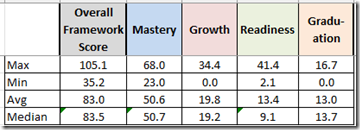
    The byzantine process produces four sub-scores: Mastery, Growth, Readiness, and Graduation. These are multiplied by weighting factors and summed to produce an Overall Framework Score. The ranges of those scores look like this (here and below on the 2024 data):

    In terms of the Overall scores, the top 36 schools (all that fit on my monitor) are these:

    (more…)


  • The Changes, They Are Here

    by Dick Hall-Sizemore

    Now that the Presidential election is over, Virginians can do what we always do at this timeโ€”start seriously considering the next election.

    Jason Miyares has taken care of one big unknown; he has announced that he will run for reelection as Attorney General.

    For those of us who have been around Virginia government and politics for 40 or 50 years, the line-ups for the elections for statewide offices next year are astounding. They are graphic evidence of how much the population and politics of the Commonwealth have changed in those years. Here are the potential pairings:

    Governorโ€”a Republican Black woman vs. a Democratic white woman

    Lt. Governorโ€”for the Republicans, no formal announcement yet, but an openly gay man is seriously โ€œexploringโ€ a possible candidacy. For the Democrats, the candidates announced so far include a Muslim female state senator born in India, a male Pakistani-American, and two Black men.

    Attorney Generalโ€”a Republican son of Cuban immigrants versus either a Black male or white female.

    (more…)

  • Richmondโ€™s โ€˜Strong Mayorโ€™ Charter Reaches 20 Years

    But More Clarity Needed to Improve Mayor-Council Relations

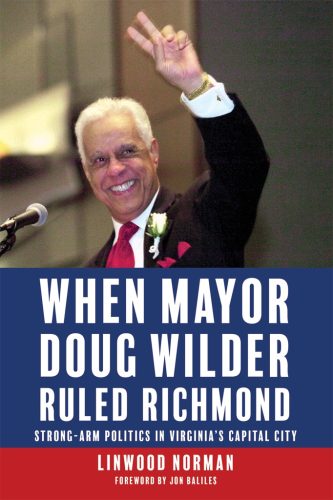
    by Linwood Norman

    City charters, which provide rules of governance for local government, may be revised with the best of intentions, but once those changes take effect, the cracks and crevices may begin to appear.

    Such was the case for Richmond, Virginia.

    In 2005, Richmond became the first city in Virginia to have a โ€œstrong mayorโ€ form of government. Some viewed the cityโ€™s transition to this model of local government as a โ€œpolitical experiment in progress.โ€ The goal was to promote greater efficiency, effectiveness and transparency in running the city. Now, on the eve of the 20th anniversary of its charter, Richmond remains the only city in Virginia with a strong mayor system.ย ย 

    Though Richmondโ€™s charter was revised to establish the mayorโ€™s role as the cityโ€™s chief executive officer and the city council as the legislative branch, the task fell short in clearly outlining all of the aspects of how the strong mayor system would operate.

    Richmondโ€™s new form of government brought fundamental changes that transferred additional power to the mayor, who served as theย official elected citywide who directly reported to โ€“ and was held accountable by — the people.

    In many respects, Richmondโ€™s revised charter strengthened the mayorโ€™s position in overseeing the operation of local government. He obtained line-item veto authority for the cityโ€™s annual budget (subject to a two-thirds override by city council), the ability to hire and fire top city officials through the chief administrative officer, and also had the authority to allocate funding to the school system within specific budget categoriesโ€”such as instruction, administration, and facilitiesโ€”for greater emphasis on academic performance and operational efficiency.

    (more…)


  • Globalism, Wokeness and the Great Political Realignment

    Image credit: ChatGPT

    by James A. Bacon

    Phillip and Tanja Thompson aren’t ready to join the Republican Party, but their patience with Democrats is wearing thin. Once upon a time, they write, the Democratic Party stood up for working people. “Today, we’re left wondering if there’s room for the values we cherish,” they write in a Richmond Times-Dispatch op-ed.

    It’s not that they disagree with Democrats about such issues as restoring voting rights for felons, say the African-American husband and wife, but they believe the Ds have lost interest in the issues that matter most to them — like economic opportunity, public safety and quality of life. “The party leans heavily on highly visible social issues that cater to select groups, often sidelining the bread-and-butter concerns that used to drive working families to the polls. Special interests seem to have taken center stage over expanding opportunity for all.”

    Adopting a new worldview is not something that people do easily. Most people change their political loyalties by only a few degrees at a time. But a massive political realignment is occurring, and the Thompsons seem to be a part of it, even if they haven’t yet made the partisan jump from one party to the other.

    Anyone who wants to understand modern politics needs to understand that realignment. The Democratic Party is no longer the party of FDR. It is a coalition led by educated elites, and its preoccupations are those of educated elites. Likewise, the Republican Party is becoming the party of working people. The transition is not complete, as both parties retain muscle memories of who they once were, but the process is far along, and it is driven by underlying changes in America’s class structure.

    Comprehending the new class struggle has been a priority of mine, and I recommend several books to Bacon’s Rebellion readers who strive to understand the deeper forces at work in society.

    (more…)


  • The Words of George Will

    George Will is one of my favorite columnists. Although I donโ€™t always agree with him, his arguments are well-constructed and laid out. And the man has a way with words that few others have. Combined with a dry wit, his mastery of the language can be devastating (and hilarious) when he targets someone. Hence, his characterization in todayโ€™s column of Matt Gaetz, Donald Trumpโ€™s nominee to be Attorney General: โ€œan arrested-development adolescent with the swagger of a sequined guitarist in a low-rent casino.โ€


  • Surprising Results

    by Dick Hall-Sizemore

    As explained by Todd Truitt in his well-argued article regarding the new school accountability system developed by the Virginia Dept. of Education, the state has posted a listing of how each school would currently score under that system if it were in effect today. (It does not go into effect until next school year.) An analysis of the scores yields fascinating results.

    Before going into the details, a summary of the criteria used would be useful. High schools are rated in four areas: mastery, progress, readiness, and graduation. Following is a summary of the components of each category:

    โ€ข Mastery (50 percent)โ€”various test scores and progress of English learners;
    โ€ข Readiness (35 percent)โ€”number of students taking college prep courses, weighted based on grades earned in those courses; number of students earning industry credentials in high-demand areas; scores on exams for armed forces enlistment. Chronic absenteeism is another component;
    โ€ข Graduation (15 percent)โ€”percentage of students in four years.

    It is no surprise that the Thomas Jefferson High School for Science and Technology in Fairfax County obtained the highest rating with an โ€œoverall framework scoreโ€ (the sum of the mastery, readiness, and graduation index scores) of 105.1. The remaining schools in the top ten were surprising:

    โ€ข Tunstall High, Pittsylvania County–102
    โ€ข John S. Battle High, Washington County–100.2
    โ€ข Western Albemarle High, Albemarle County–100.1
    โ€ข Richmond Community High, Richmond city–100.1
    โ€ข Franklin Military Academy, Richmond City–99.9
    โ€ข Grundy High, Buchanan County–99.1
    โ€ข James River High, Botetourt Countyโ€”98.0
    โ€ข Hanover High, Hanover Countyโ€”97.4
    โ€ข Eastside High, Wise Countyโ€”96.2
    โ€ข Rural Retreat High, Wythe Countyโ€”96.2

    To state the obvious, with the exception of the TJ School for Science and Technology, none of the top ten-scoring high schools were in Northern Virginia. Furthermore, the much-criticized Richmond public school system had two schools in the top ten, while the neighboring counties of Henrico and Chesterfield had none.

    (more…)


  • Jeanine’s Memes

    From The Bull Elephant

    My sentiments exactly. — JAB


  • Dominion Models More Future Scenarios and Still Needs Gas

    By Steve Haner

    Dominion’s Warren County, Va., natural gas plant.

    Dominion Energy Virginia has run additional projections on its future energy demand and how to meet it, and the answer keeps coming back that Virginians will need more โ€“ not less โ€“ natural gas-fired electricity in the next 15 years.ย The supplemental data was filed with the State Corporation Commission Friday and added to the case file. ย 

    Just before the State Corporation Commission received Dominion Energy Virginiaโ€™s new integrated resource plan back in October, it issued an order for the company to provide more information.ย Some opponents of the utilityโ€™s plans to add to its natural gas generation expected the additional data to bolster their case it could be done without gas.

    Yet gas power continues to turn up in the companyโ€™s model runs (we all know how environmental activists trust models) even when Dominion removes the growth in its demand coming from the explosion of data centers in its region. More gas turns up even when the model is set to fully comply with the anti-gas Virginia Clean Economy Act and even when the model is told to comply with the Environmental Protection Agencyโ€™s new power plant emission rules.ย Dominion wrote:

    The results of the modeling sensitivity analysis show that even with updated capacity pricing and removing the data center load growth:

    • There is still an incremental capacity need.
    • The model does not choose to retire any existing generation.
    • Renewable and dispatchable generation is needed to meet demand in all sensitivities.

    (more…)