
by James A. Bacon
We learn today courtesy of Radio IQ that Virginia’s Commission to End Hunger, which began meeting this year, has identified measures for legislators to consider in the 2025 General Assembly session. The one tangible initiative mentioned in the article was doing something to address food insecurity on college campuses.
“There are a lot of college students going under the radar, who are food insecure, can’t access food and are probably embarrassed to say so,” Del. Rae Cousins, D-Richmond, told Radio IQ.
Apparently, we’ll learn more about food insecurity in the Commonwealth when the Commission releases results of a survey, which is expected any time now. I’m not holding my breath in the expectation that we’ll learn anything useful.
It is hardly original to observe that Americans’ problem with food is that they have too much of it, not too little. Obesity is a major social issue; malnutrition is not. Frankly, I’m struggling to understand the nature of the problem. Consider the multibillion-dollar programs we already have:
The Supplemental Nutrition Assistance Program (SNAP), administered by the Virginia Department of Social Services, provides financial assistance to lower-income households to purchase food.
We also have Women, Infants, and Children (WIC), a federally funded program managed by the Virginia Department of Health, which provides nutritional support to pregnant women, new mothers and young children.
Then there’s the National School Lunch Program, a federal program that provides free and reduced-price lunches to lower-income children across Virginia.
Apparently, people fall between the cracks of these government programs, so the nonprofit sector has stepped in with food banks and soup kitchens. The Federation of Virginia Food Banks is a well-oiled machine for soliciting foodstuffs, maintaining food pantries, and delivering prepared meals through such programs as Meals on Wheels.
Major challenges, according to the Virginia Roadmap to End Hunger, have been the increase in grocery store prices — admittedly a very real problem, one that helped elect Donald Trump — and an increase in demand for food pantries even as donations to food banks have declined. The Roadmap cites a 2002 USDA study as saying there was a 5% increase in “food insecurity” in households with children compared to the previous year.
What does that even mean?
Reportedly 17% of American households with children experience food insecurity. Please note, however, food insecurity is not the same as chronic malnutrition. The USDA provides these details about what the term entails.
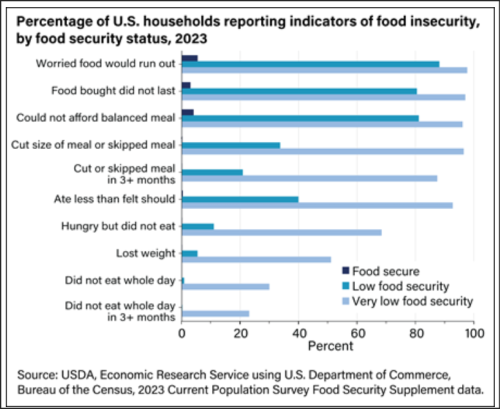
Lower-income Americans are missing some meals, it appears — something we don’t like to see — but no one is starving.
Here’s the thing: we don’t know why, given all the programs that exist, anyone is missing meals. We also don’t know from this data what the health effects are.
To what extent does the problem reflect social dysfunction — drug users feeding their addictions, say? To what extent does the problem reflect poor nutritional choices — spending money on sodas and junk food instead of nutritional food? We hear a lot about “food deserts.” But if you handed out healthy broccoli, kale, and quinoa for free to “food insecure” families, would people even eat it?
And what is the impact on public health? How many people are actually losing weight due to missing meals? Not many. In reality, people are gaining weight and suffering from diabetes and hypertension as a result. Are they stretching food budgets by eating more cheap but carb-heavy rice, pasta and potatoes? Or are they binging on Coca-Colas and Cheetos? How many people are converting their food stamps into cash to spend on something else? I’m sorry, but if politicians want to spend more of my tax dollars on another food program, I’d like to know the answers.
For the American political class, every social problem demands a government solution. And another. And another. It is always “society’s” obligation to fix, never the responsibility of the “victims” to alter their behavior. Many of these problems never get better. We squander billions so we can tell ourselves we are “doing something.” We rarely consider if the programs are doing what they’re supposed to do; we just enact another program.
Finally, a word to conservatives and Republicans: You mocked Michelle Obama when she tried to get school menus to offer more salads and less pizza. But maybe she had a point. If we want to change America’s nutritional culture, which costs all of us untold billions in healthcare expenditures treating obesity, diabetes and heart disease, maybe government should stop subsidizing junk food. Maybe we should also insist that poor people take responsibility for their own health and eat healthy, even if it means eating less.
Of one thing I’m certain: the last thing we need to do is expand food entitlements to college students.


Leave a Reply
You must be logged in to post a comment.