
by James A. Bacon
Phillip and Tanja Thompson aren’t ready to join the Republican Party, but their patience with Democrats is wearing thin. Once upon a time, they write, the Democratic Party stood up for working people. “Today, we’re left wondering if there’s room for the values we cherish,” they write in a Richmond Times-Dispatch op-ed.
It’s not that they disagree with Democrats about such issues as restoring voting rights for felons, say the African-American husband and wife, but they believe the Ds have lost interest in the issues that matter most to them — like economic opportunity, public safety and quality of life. “The party leans heavily on highly visible social issues that cater to select groups, often sidelining the bread-and-butter concerns that used to drive working families to the polls. Special interests seem to have taken center stage over expanding opportunity for all.”
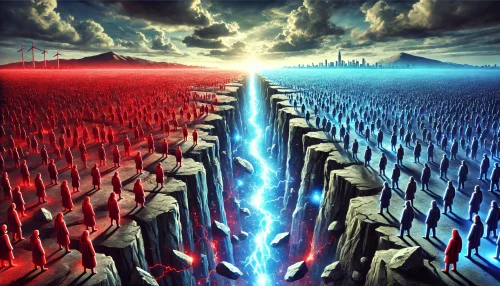
Adopting a new worldview is not something that people do easily. Most people change their political loyalties by only a few degrees at a time. But a massive political realignment is occurring, and the Thompsons seem to be a part of it, even if they haven’t yet made the partisan jump from one party to the other.
Anyone who wants to understand modern politics needs to understand that realignment. The Democratic Party is no longer the party of FDR. It is a coalition led by educated elites, and its preoccupations are those of educated elites. Likewise, the Republican Party is becoming the party of working people. The transition is not complete, as both parties retain muscle memories of who they once were, but the process is far along, and it is driven by underlying changes in America’s class structure.
Comprehending the new class struggle has been a priority of mine, and I recommend several books to Bacon’s Rebellion readers who strive to understand the deeper forces at work in society.
We Have Never Been Woke: The Cultural Contradictions of a New Elite
In We Have Never Been Woke, Musa Al-Gharbi, a Stony Brook University sociologist, offers the most incisive critique I have yet seen. He argues that a new elite class, referred to as “symbolic capitalists,” has acquired enormous power to dictate the cultural discourse. These elites work in fields that deal with words, ideas, images, and data, such as academia, media, and nonprofits. They overlap to some degree with economic elites — they tend to be highly compensated compared to other Americans — but are envious of the wealth, power and status of the super-rich.
Symbolic capitalists, Al-Gharbi says, are notable for their quest for status, which they achieve through virtue signaling: posing as allies of progressive causes such as antiracism, feminism and LGBQT rights. They see working people as holding “wrong” views of race, gender and sexuality. They view those who do not conform to their views, especially working class Whites, as not merely misguided or wrong but morally deficient. Notably, they frame social justice issues in a way that allows them to gain power and status, often at the expense of the marginalized and disadvantaged.
This overwhelmingly White cultural elite now dominates the Democratic Party and sets its agenda. Thus, the preoccupations of mostly White symbolic capitalists preoccupy the Democratic Party.
Second Class: How the Elites Betrayed America’s Working Men and Women
Journalist Batya Ungar-Sargon tells the story of America’s new class divide from the perspective of the working people. American elites in media, academia and politics, she argues, have betrayed the working class, shifting their focus from economic issues to cultural and identity issues that concern the elites themselves. She is most scornful of the media, which has abandoned its role as champion of the underdog in favor of acting as mouthpiece for the power elites.
Second Class is not an academic treatise like We Have Never Been Woke. Ungar-Sargon interviewed dozens (if not hundreds) of working people, and she is attentive to different gradations with the working class: those who have achieved a middle-class lifestyle, those who live paycheck to paycheck, and those whose lives are a daily struggle for survival. Giving a voice to the voiceless, she finds the thinking of working people to be far more nuanced and tolerant than portrayed by the cultural elites, indeed more nuanced and tolerant than the orthodoxies of the cultural elites themselves.
Troubled: A Memoir of Foster Case, Family, and Social Class
Rob Henderson, whose birth father was Hispanic and birth mother was Korean, entered the foster care system at an early age, bounced around in the system, and was adopted as a boy by a working-class family. In a memoir evocative of J.D. Vance’s Hillbilly Elegy, he vividly describes the challenges he faced and the self-defeating behavior he adopted due to the absence of a stable family. As with Vance, a stint in the military turned his life around, and he ended up at Yale.
Henderson coined the phrase, “luxury beliefs” to describe ideas that confer status on members of the upper class but which in practice inflict enormous costs on the lower classes. In particular, he refers to cultural elites’ expressed views toward non-traditional family structures in which single parenthood or polyamorous relationships are just as valid as intact nuclear families. While such views signal virtue and open-mindedness, the spread of non-traditional households has been disastrous for children, who crave the stability and support provided by stable two-parent families.
Regime Change: Toward a Postliberal Future
Patrick Deneen, a political science professor at Yale University, argues that classical liberalism, an ideology designed to protect and expand individual liberties, is crumbling under the weight of its own contradictions. America’s “managerial elites” have prospered under the regime of market liberalism, but free trade and globalism have hollowed out regional economies, devastated communities, and undermined social cohesion.
Deneen also has sharp words for liberal cultural elites in academia, media, and politics, whose policies work to maintain the status quo and suppress challenges to their authority. Wokeness, he contends, is a form of virtue signaling used to maintain status that distracts from more pressing economic and social problems.
The Age of Entitlement: America Since the Sixties
Journalist Christopher Caldwell argues that the Civil Rights Act of 1964, designed to end segregation and racial discrimination, was structured in such a way constitutionally as to create far-reaching, unintended consequences. It created a new regime of social engineering and a new set of rights and obligations organized around group identities. The new elite, concentrated in academia, media, and politics, has used the language of civil rights to maintain its power and status. The new order has undermined traditional social structures such as family and community, and the dissolution of those structures has been disastrous for working people.
The Dying Citizen: How Progressive Elites, Tribalism, and Globalism Are Destroying the Idea of America
Victor Davis Hanson, whose conservative critique of American society is rooted in his background as a professor of classical history, argues that the concept of citizenship is under threat in America. Citizenship is not just a legal status but a set of responsibilities and privileges that binds individuals to their community and nation. He sees two main threats: globalization and tribalism.
Globalism, in the form of outsourced jobs and an influx of cheap, often-illegal foreign labor, has undermined the economic security of the American middle class, weakened the social fabric, and made it difficult for citizens to fulfill their civic responsibilities. Meanwhile, America’s elites are fragmenting society by promoting divisions based on race, gender and ethnicity rather than uniting citizens under a common national identity. Dividing the lower orders by race, gender, and ethnicity rather than income and wealth allows the elites to maintain their privileged economic position.
According to Hanson, no society can long maintain stability and democracy without a strong middle class. As America’s middle class erodes, so does the foundation of the republic.
I am still digesting these critiques of American society, but they are largely in accord with what I have observed. It is through this lens that I interpret what I see occurring in Virginia, which is a microcosm of the forces at work nationally and even globally.


Leave a Reply
You must be logged in to post a comment.