It’s going to be a wild ride, baby!
It’s going to be a wild ride, baby!
by James A. Bacon
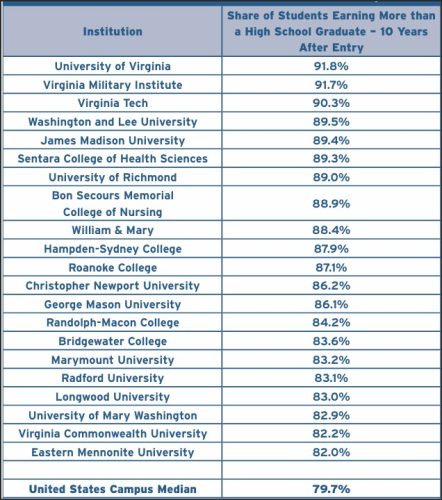
Wonder why young Americans are souring on the higher-ed value proposition? The Old Dominion University Strome College of Business’s “2024 State of the Commonwealth Report” supplies data that provides the answer.
Ten years after leaving high school, one in five bachelor’s degree recipients earned less than the median income of high school graduates here in Virginia.
The aggregate numbers hide a lot of variability between institutions, degree programs, and students’ socioeconomic background, the report cautions. But the bottom line is clear.
“Substantial proportions of college graduates end up earning less than the members of their high school graduating classes who did not attend college,” states the report in its chapter entitled, “Does It Still Pay to Attend College in Virginia?”
Even at the University of Virginia, the state’s flagship university with arguably the most selective admissions standards, nearly one in twelve graduates earned less than the median income for Virginia high school grads.
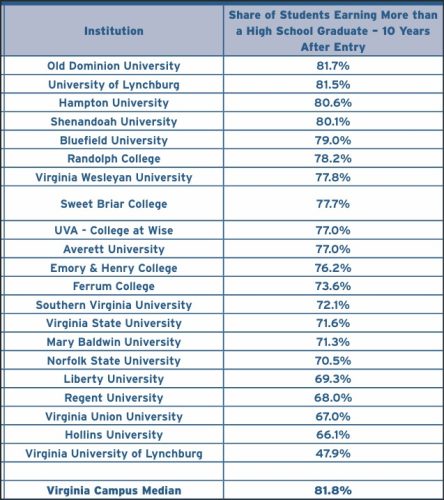
Worse yet at the opposite end of the spectrum, at the Virginia University of Lynchburg only 47.9% of graduates earned the high school average. By that measure, a majority of VUL grads were worse off than if they’d just entered the workforce after graduating high school! (The report did not examine for-profit colleges where the comparative earnings numbers for most institutions are even worse.)
Correction: In the paragraph above, I had mistakenly referred to the University of Lynchburg, a different institution than the Virginia University of Lynchburg.
(more…)by Dick Hall-Sizemore

One of the top selling points made for approval of the establishment of the Virginia Lottery was that lottery profits would be dedicated to public education in Virginia.
That is still the message that the Virginia Lottery peddles. Scroll to the bottom of its website home page, past all the current offerings, and you will see, in large font, the “total Virginia Lottery profits generated for Virginia’s K-12 public schools since 1999.” The message: “Buy a lottery ticket. If you don’t win, your money goes to Virginia schools.”
Anyone familiar with the Virginia budget knows this is specious. The lottery profits are used to supplant general fund support for K-12. If there were not the lottery profits, the amount of state money for K-12 would likely be the same but would come entirely from the general fund. The explanatory bullets in Governor Youngkin’s budget document provides clear proof of that relationship. The estimate of lottery profits increases by $73.3 million for the biennium. However, that does not mean that the amount of state funding for K-12 increases by that amount. Instead, the existing general fund appropriation for K-12 is reduced, almost dollar for dollar, by the amount of the increase in lottery profits. The result is a $3.00 net increase in funding for K-12 due to the increase in lottery profits.
by Charles B. Pyle
On December 18, the governing board of the National Assessment of Educational Progress (NEAP) -– the battery of fourth- and eighth-grade exams in reading and math known as the Nation’s Report Card -– announced that the results of the 2024 tests will be released January 29, 2025.
State-by-state NAEP results are typically published in the fall, but during presidential election years the governing board delays reporting to keep the assessment program from becoming ensnared in national politics.
But state politics don’t factor into the NAEP governing board’s timetable. And in Virginia, the results of the national tests students took at the beginning of 2024 will land in the middle of a contentious General Assembly session and in what promises to be a bruising election year as Republicans seek to retain the top three statewide offices and Democrats battle to hold their narrow majority in the House of Delegates.
The 2024 NAEP results will be as much of a report card on the educational policies and initiatives of Governor Glenn Youngkin as a measure of the reading and math skills of Virginia elementary and middle school students.
As discussed in an earlier column on this site, Youngkin seized on the disastrous performance of Virginia students on the 2019 NAEP during his 2021 campaign for governor. The former Carlyle Group executive tied the sharp declines in the performance of Virginia students on the national reading and math tests with the low bars set for corresponding state Standards of Learning tests during the Northam administration.
(more…)by Kerry Dougherty
Question of the day: Will you fall for it again?
This is directed only at those who dutifully wore face diapers, who cancelled family get togethers or who left sick children alone in their rooms as ordered by public health authorities during the covid pandemic. Oh, and those who took vaccine after vaccine, thanking Pfizer that they didn’t die every time they caught the virus.
Will you stay home if ordered? Cover your face in public? Let them close your kids’ schools? Roll up your sleeves for another experimental shot?
And guess who reappeared just in time to fan the flames: Deborah Birx, the scarf-wearing vampiress who admitted that 14 days to slow the spread was a lie intended to shutdown the country indefinitely.
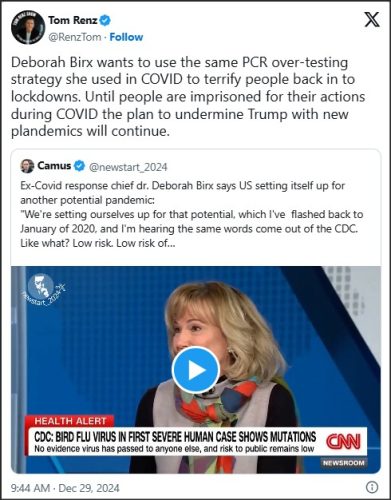
She ought to be under indictment, not making appearances on cable news.
According to hysterics in the media, a strain of the bird flu virus – detected in a single patient in Louisiana – shows signs of “concerning” mutations. An outbreak in chickens and cows has caused California (of course) to declare a state of emergency.
Could other blue states be far behind? Continue reading.
by James A. Bacon
When credit card companies, hospitals and other debt collectors try to collect the money they’re owed, they often target the bank accounts “of people who are already in crisis,” Radio IQ informs us.
“When a creditor garnishes a bank account, it can really be devastating,” Jay Speer at the Virginia Poverty Law Center tells public radio. “The account holder is notified that their funds are frozen, and then you can’t pay your rent and you can’t pay your utilities. And so for some people it becomes a downward spiral.”

That’s why Delegate Phil Hernandez, D-Norfolk, is introducing a bill that would preserve the last $5,000 in a bank account.
Why does Hernandez hate poor people?
Forgive my hyperbole. Hernandez doesn’t really hate poor people. He just seems ignorant of economics and heedless of unintended consequences. The predictable result of his bill, should it pass: Lenders will curtail credit to the lower-income people he wants to help.
(more…)by Dick Hall-Sizemore
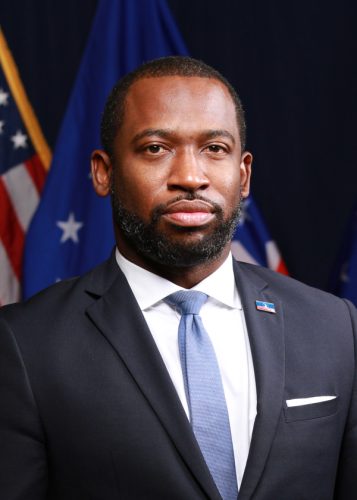
The editorial page of the Richmond Times-Dispatch today has a blistering critique of outgoing Mayor Levar Stoney. Stoney has spent the last few weeks in office in a “Faring Well” tour touting “the remarkable strides Richmond has made over the past 8 years” under his leadership. There is little doubt that this idea will occupy a prominent place in his campaign for the Democratic nomination for lieutenant governor. At this point, according to the Virginia Public Access Project, Stoney has a significant lead in fundraising over his opponents in the Democratic primary election.
The headline of the editorial neatly summarizes its thesis: “Yes, Richmond is faring well. But not because of Stoney.” Since 2016, when Stoney took office, real estate tax revenues have doubled, from $230 million to $460 million. That is thanks to an influx of new residents, mostly young professionals, all of whom have led “to a stronger retail base and overall economy, fueled RVA’s growing rep as foodie town, an arts and cultural destination on the East Coast.”
Like his predecessors, instead of trying to deal with the “dysfunction and incompetence” that Richmond city government has come to be known for, he got distracted by the “shiny object.” First, he “carried water for the business community” for the proposed $1.4 billion Navy Hill project that would have diverted city tax revenues. As the RTD put it, before the city council killed the project, “Navy Hill angered just about everyone who didn’t stand to profit from it.” Then it was a casino. Unwilling to let it go after being narrowly defeated in a referendum, Stoney succeeded in getting a “do-over.” It was defeated by a larger margin in a second referendum.
In the meantime, Stoney’s finance department was screwing restaurants, one of the bright points in the recent economic recovery of the city, over the collection of meals tax revenue. (That is a long, complicated story that Jon Baliles has documented on this blog. See, here, for example.) His staff was running up large, questionable credit card charges. Hiring in the top echelons of the city administration reeked of cronyism.
So, Richmond is a significantly different city than it was eight years ago. From July 1, 2016 to July 1, 2023, its population increased by almost 12 percent. There is a lot of construction underway. Whole commercial areas, such as Scott’s Addition, have undergone a significant transformation. In Manchester, south of the river, high-rise apartment buildings and condominiums have taken the place of warehouses. There are lots of high-end restaurants that are busy. But, most of this is in spite of Stoney and his administration, not because of it.
The editorial is another example of the value of local journalism. Despite its shortcomings, the Richmond Times Dispatch has been diligent in covering city hall. It provided extensive coverage of the Navy Hill proposal. See here for example. The newspaper and its reporters have been so persistent that Stoney was reduced to complaining about their coverage.
by Kerry Dougherty

Hey Virginians, remember that $1.2 billion surplus in the state budget that Gov. Glenn Youngkin has been trying to return to taxpayers?
Unsurprisingly, Democrats in Richmond are finding ways to spend it. All of it.
Take State Sen. Barbara Favola, for instance. Please.
She’s introduced SB753, a measure guaranteed to cost a bundle.
The bill would require Virginia to administer the statewide standardized tests known as SOLs in languages other than English, despite the fact the ENGLISH is the official language of the commonwealth.
“Requires (i) the Board of Education to develop Standards of Learning assessments in native languages other than English that are most commonly spoken in the Commonwealth; (ii) each school board to make available any such native language assessment to any English language learner student who speaks any such language natively and is identified as having limited English proficiency; (iii) the English language learner faculty at any such student’s school to make the final determination as to whether administration of any such native language assessment is appropriate; and (iv) the provisions of the bill to be implemented by the beginning of the 2025-2026 school year. Finally, the bill directs the Department of Education to submit to the U.S. Department of Education by August 1, 2025 any amendments to its consolidated plan under the Elementary and Secondary Education Act of 1965, as amended by the Every Student Succeeds Act, that are necessary to implement its provisions.”
Good Lord. Do you suppose the Democrat from Arlington knows just how many languages are spoken by students in Virginia schools?
I do.
According to the Virginia Department of Education there are 117,000 students enrolled in English as a Second Language programs in public schools. There is no data on how many of these students are in the country illegally. Continue reading.

The loneliest Metro stop. The Loudoun County Gateway Metro averages 317 riders daily, according to The Washington Post. It’s the least busy of the Metro rail system’s 98 stations. Opened to much fanfare as part of the $3 billion Phase 2 of the Silver Line in Northern Virginia, it is a sad reminder of broken promises. Not only was Phase 2 four years late and $250 million over budget, it’s not generating the hoped-for traffic or stimulating the hoped-for development around the Gateway station. Writes the Post: “From the platform, there are no buildings visible other than the station’s five-story mostly empty parking garage and a boxy internet data center a short walk away. On several recent visits to the station, the eight bus shelters in its sprawling parking lot were empty. Often the only person there is the station manager sitting behind a window in a booth.”
Amazon delivers. Maybe the Gateway Metro station will get a few more riders when Amazon resume working in the office five days a week effective January 2. Between Amazon HQ2, Amazon Web Services, and Amazon fulfillment, the Seattle-based corporation has leaped out nowhere over the past decade to become one of Northern Virginia’s largest employers, according to The Washington Business Journal.
Creepy beyond words. Virginia Commonwealth University has introduced an Artificial Intelligence-powered chatbot names Ramona (in homage to the school’s mascot, Rodney the Ram…. except Ramona is a she/her) to help with alumni fundraising. Ramona contacted 1,000 alumni last month and received a “better-than-normal” response rate, according to the Richmond Times-Dispatch. Click on the link and check it out. The chatbot has entered the “uncanny valley,” in which it falls just shy of appearing indistinguishable from a real human, which real humans find vaguely disconcerting. For me, the giveaway is the failure of Ramona’s mouth and lips to precisely synch up with the speech — Ramona does better than any animation I’ve seen before, but she’s not… quite… there. I see no harm in this particular application of AI. It’s kind of cool, actually. But only God knows where the technology will take us when the “pig butchering” fraud farms in Southeast Asia learn how to mimic real people.

by James A. Bacon
The cold-blooded killing of United Health CEO Brian Thompson has unleashed a wave of invective against health insurance companies. There is widespread sentiment that insurance companies (along with their much-detested brethren, the pharmaceutical companies) are the root of all evil in American healthcare. They make profits, goes the claim, by denying healthcare to people. They cause immeasurable human suffering. Medicare-for-all, they suggest, is the answer.
The U.S. healthcare system is indubitably a hideous mess. Health insurance companies contribute to that mess, but they are hardly the root cause of it. A single-payer healthcare system is no answer at all, just an invitation to more of the over-regulation, rent-seeking, and dysfunction that plagues the American political system.
The problem starts with the idea that Americans see “healthcare” as an entitlement. Denial of any healthcare procedure, regardless of cost or circumstance, is regarded as an affront to justice. The problem, given peoples’ unquenchable desire for health and longevity, is that demand for healthcare is effectively infinite. New pharmaceuticals and medical procedures have been introduced with great regularity, and they will continue to be. Ozembic. Artificial organs. Gene therapy. CAR-T cell therapy. Transgender therapy. Designer babies. It is a fundamental law of economics regardless of how a healthcare system is structured: Society cannot pay for all the healthcare that everyone wants. Healthcare must be rationed. The only question is how.
(more…)
News flash: Bacon’s Rebellion has learned that Santa Claus has returned safely to the North Pole after experiencing the most hazardous flying conditions since forever.
by James A. Bacon

David Austin Walsh is a leftist lecturer at the University of Virginia who specializes in the history of conservative and far-right politics. He is also something of a social-media influencer. He has 36,600 followers on his X account. So, when he xeeted (the new verb for tweeting) about the cold-blooded shooting of an insurance industry CEO on the streets of New York City earlier this month, he attracted attention.
“It’s actually kind of touching,” he wrote, “that the one thing that can bring together our fractious and disunited country is celebrating the assassination of a health insurance CEO.”
Was Walsh joining in the celebration of the assassination? Another xeet implied that United CEO Brian Thompson deserved his fate: “Anyway try to live your life in such a way that if you’re murdered the entire internet doesn’t think that you had it coming.”
In reply to a query from Bacon’s Rebellion, Walsh said he does not condone the deeds of accused killer Luigi Mangione. “Let me be emphatic: I do not, for both moral and pragmatic reasons, approve of Mr. Mangione’s actions – the former because I cannot endorse assassination as a legitimate political tactic; the latter because the likely consequence of such actions will be an increase in the repressive apparatuses of both corporations and the state.”
(more…)
by James A. Bacon
Luddites, unite! You have nothing to lose but your fossil fuels!
Concern among environmentalists is growing in Virginia as it dawns upon them that Artificial Intelligence creates demand for data centers, which in turn boosts demand for electricity… which in turn emits carbon dioxide… which in turn drives global warming.
A case in point can be seen in an op-ed, published today in the Daily Progress, by Eric Bonds, a sociologist who teaches human rights, climate change and environmental justice at the University of Mary Washington. Writes Bonds:
There are limits to how much electricity we can produce for data centers without also shattering our commitment to shift away from fossil fuels. Ultimately, a transition to renewable energy will require that we slow or stop the current data center boom in order to get there.
Bonds is absolutely correct that there are limits to the amount of energy that can be economically produced in a Net Zero electricity regime. But has it occurred to him that AI can be part of the solution?
(more…)The year: 2075. The American colonies on the Moon are getting restless under Washington’s tyrannical rule….
This second edition of “Dust Mites” has a snazzy new cover, includes helpful lunar maps, and is 5,000 words tighter than the original. The sequel, “Trogs,” is scheduled for publication this summer.
Bacon’s Rebellion is Virginia’s leading politically non-aligned portal for news, opinions and analysis about state, regional and local public policy. Read more about us here.
Shake up the status quo! Your contributions will be used to pay for faster download speeds and grow readership. Make a one-time donation by credit card or contribute a small sum monthly.
Enter your email address to receive immediate notifications of new posts by email.
SUBSCRIBE
Protecting Thomas Jefferson’s Legacy at the University of Virginia

Shoot me an email and I’ll generate a new password for you.