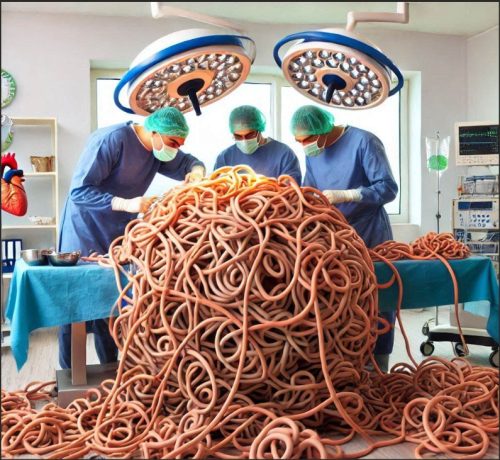
Healthcare’s Tangled Ball of Confusion

by James A. Bacon

The cold-blooded killing of United Health CEO Brian Thompson has unleashed a wave of invective against health insurance companies. There is widespread sentiment that insurance companies (along with their much-detested brethren, the pharmaceutical companies) are the root of all evil in American healthcare. They make profits, goes the claim, by denying healthcare to people. They cause immeasurable human suffering. Medicare-for-all, they suggest, is the answer.

The U.S. healthcare system is indubitably a hideous mess. Health insurance companies contribute to that mess, but they are hardly the root cause of it. A single-payer healthcare system is no answer at all, just an invitation to more of the over-regulation, rent-seeking, and dysfunction that plagues the American political system.

The problem starts with the idea that Americans see “healthcare” as an entitlement. Denial of any healthcare procedure, regardless of cost or circumstance, is regarded as an affront to justice. The problem, given peoples’ unquenchable desire for health and longevity, is that demand for healthcare is effectively infinite. New pharmaceuticals and medical procedures have been introduced with great regularity, and they will continue to be. Ozembic. Artificial organs. Gene therapy. CAR-T cell therapy. Transgender therapy. Designer babies. It is a fundamental law of economics regardless of how a healthcare system is structured: Society cannot pay for all the healthcare that everyone wants. Healthcare must be rationed. The only question is how.

In the private sector, access to healthcare is governed by contract. Insurance companies negotiate yearly with employers to cover a suite of services at a certain set of prices. We will cover X but not Y. We will cover annual physicals, for example, but not experimental drug therapies of unproven efficacy. We will pay up to $1 million in chemotherapy, to take another example, but not a dollar more. In effect, employers decide how much they are willing to pay and then outsource to insurance companies the job of devising benefit plans, negotiating with providers, and administering the contract.

How, we must ask, did this state of affairs come about? It originated during World War II as a way for wartime employers to entice workers with a fringe benefit without violating wage-price controls. Healthcare benefits were not taxable — and still aren’t — with the result that most private healthcare insurance is acquired through the workplace. In a more rational world, insurers would contract with consumers directly, just as they do for auto and homeowner insurance. Consumers would decide how much healthcare coverage they were willing to pay for, and insurance companies would be responsive to them, not their employers. Consumers would push back in a way they do not now.

Only half of Americans get employer-based insurance coverage. The rest rely upon Medicare, Medicaid, or Obamacare. Medicare and Medicaid dictate reimbursement — they tell healthcare providers what they will pay. And, amidst ever-escalating costs, they pay less than what it costs to provide the services. To cover their costs and stay in business, hospitals, physicians, and other providers shift costs to the private sector, forcing insurers (and ultimately employers) at the cost of tens of billions of dollars. This massive wealth transfer ratchets up the pressure on private insurers (acting with the acquiescence of employers) to control costs by tightening coverage.

To increase their negotiating clout with insurance companies, providers have consolidated the medical sector. Here in Virginia, “healthcare systems” have acquired hospitals, physician practices, outpatient surgery centers, diagnostic centers, mental health facilities, and everything else they can lay their hands on — sometimes even including insurance companies. They have created monopolies and oligopolies everywhere and exclude competitors by manipulating Virginia’s anticompetitive Certificate of Need regulatory process. When one or two healthcare systems control a market, insurers lose power to negotiate lower rates. So, they control what they can control, which is patients’ access to the system.

There is much else wrong with American healthcare. For instance, there is minimal price transparency, making it impossible for patients to shop around for discretionary procedures. Mandated insurance benefits, imposed here in Virginia by the General Assembly, make it impossible to purchase “bare bones” health insurance policies. It’s the Cadillac health plan or nothing at all. Meanwhile, providers mark up charges to insane levels, discounting steeply to Medicare, Medicaid, and private insurers, and then stick uninsured patients with massive costs that bear no relationship to cost. Health insurers themselves contribute to frustration by piling on layers of bureaucracy, forcing doctors and patients to spend endless hours seeking approvals. The administrative expense is horrendous.

Every national healthcare system rations access somehow. Canada’s national creates long waits for diagnostic and specialized services. The United Kingdom’s leaves thousands of patients lying in gurneys as they wait for hospital rooms. But no one in Canada or the U.K. is shooting government healthcare executives for denying service. If Americans adopt the same resignation toward healthcare rationing as Canadians and Brits, national healthcare might work out about as well for us. If patients don’t stand for the rationing of government-funded service, it won’t,

Without question American health care is a mess. It is the outcome of decades of piecemeal government “reforms” at the state and federal level, creeping regulation, subsidies, cross-subsidies, lobbying, industry consolidation, gaming of the system, and rampant fraud, all in the name of serving an American public that feels entitled to limitless care amidst a scientific boom that is creating an endlessly expanding smorgasbord of options.

Brian Thompson didn’t create this tangled, dysfunctional ball of confusion. Those who relish his demise are profoundly misguided.


ADVERTISEMENT

(comments below)


Comments


Comments

18 responses to “Healthcare’s Tangled Ball of Confusion”

  1. walter smith Avatar
    walter smith

    The system is beyond screwed up…and yet better than where "free" healthcare exists. Canada recently enacted MAiD (Medical Assistance in Dying) and something like 1 in 20 deaths were "assisted." The wait in the UK and Canada far exceeds our time delays.
    We need less regulation and more freedom. How did America survive without our current healthcare system? Or taxes? Not perfect, but not bad. Generous people started charitable systems with their own money to care for those in need.
    The Christian solutions that aren't insurance (but really, sorta, kinda, are – like Medishare) work because risk is spread, costs are shared, but without all the mandated coverages (like abortion and transing, etc). They run on the exact same principles as insurance, but have been legislatively exempted from being called insurance. Maybe…instead of mandating all sorts of things and pushing the costs (and demand) on people who can't pay for all that, our "betters" ought to try freedom and market solutions?

  2. When people discuss healthcare, they are discussing cancer treatments being denied, outrageous insulin costs, ridiculous ambulance costs, and so on. Trying to pretend these are unreasonable entitlements, especially when one considers that Life itself is one of just three conceits our founderโ€™s listed as inalienable rights, makes this one of the most funny grasping at straws to avoid the real problem with our healthcare.

    Itโ€™s like saying people feel entitled to having fires put out. Democrats wonโ€™t be out of power long if you treat people like greedy peasants for wanting medication and surgery.

  3. LarrytheG Avatar

    30-some other countries provide healthcare to all their people for 2/3 or less than what we pay and they have a longer life expectancy.

    And yes, per Rosie, in America, we DO feel ENTITLED to EMS, fire , law enforcement, interstate highways, etc, etc.

    And if we REALLY did health insurance LIKE we do other insurance like home and auto, etc, many of us would not even be offered health insurance, much less at the same price of others younger and healthier.

    The older ones pay $174.70 per month which is 25% of the actual total premium. If that means seniors are getting health care for $800 a month (which if they paid all of it, would make it no cost in the budget), that's not terrible. Many seniors today do NOT live in or near poverty BECAUSE of Medicare.

    We just can seem to make up our minds on the realities of the necessity of
    govt involvement (or not). This is not a question in those 30-some other countries with longer life expectancies.

    Too many refuse to accept the fact that this IS a valid interest of government – like it is in other countries.

  4. Dick Hall-Sizemore Avatar
    Dick Hall-Sizemore

    You start off by declaring, " A single-payer healthcare system is no answer at all, just an invitation to more of the over-regulation, rent-seeking, and dysfunction that plagues the American political system." Then, you proceed to describe the "over-regulation, rent-seeking, and dysfunction" that is characteristic of our current healthcare system!

    Instead of being regulated by a single payer, providers are regulated by multiple payers. If a patient is covered by UnitedHealth, the provider will get reimbursed X amount of dollars for a procedure. However, for a patient covered by Anthem, the provider may get reimbursed Y dollars for the same procedure. For another patient, the provider may have to get a special authorization for the same procedure for another patient covered by Cigna.

    When doctors need to have staff whose sole function is to deal with insurance companies and when doctors themselves have to spend a significant amount of time arguing with insurance bureaucrats over coverage for treatments they have determined are in the best interests of their patients, you know that our system is seriously screwed up. (My daughter is a pediatrician who has occasionally vented about her problems with insurance companies.)

    All that being said, I have to report that I am very satisfied with my coverage through Medicare, supplemental insurance (Anthem), and part D (prescriptions–Cigna). But, as I stated before, it is astounding to see a statement in which the charge by the provider is discounted by up to 90 percent. We really do need a more rational system.

  5. Nancy Naive Avatar
    Nancy Naive

    What we know for sure is James is in remarkably good health, likely on Medicare, and has not had a denial of coverage claim in his life.

    Theyโ€™re not insurance companies. Itโ€™s a payment plan with a 20% capped overhead as opposed to Medicare with like 3% overhead.

    Aside from the Sacklers with oxycodone and a couple of greedy grabs, e.g., the Epipen and that crud, Shkreli, itโ€™s not the pharmaceutical companies, itโ€™s the Pharmaceutical Benefits Managers โ€” the 3 big middlemen that control the retail price of drugs. We know this because โ€œif you cannot afford your medications, AstraZeneca can helpโ€ฆโ€ by arranging direct to retail delivery. Frankly, I donโ€™t expect these arrangements to last the next two years.

  6. Nancy Naive Avatar
    Nancy Naive

    In the way of a โ€œnot really funnyโ€ humorous situation, a friendโ€™s wife received an โ€œapprovalโ€ letter and a โ€œdenial of coverageโ€ letter for his $10,000 per month life-saving prescription ON THE SAME DAY, dated the same day with neither letter referring to the otherโ€ฆ no way to determine precedence.

    She spent several hours on the phone with no resolution. I suggested that rather than enter the phone tree again, she ask the local pharmacist which of the two was in effect. He should be able to determine immediately whether the insurance will cover or not. Havenโ€™t heard if she went with it.

  7. energyNOW_Fan Avatar
    energyNOW_Fan

    Aside from the structural problems, I suppose COVID has put quite a stress on the system in recent years. Another thing going on in recent years are the expensive miracle drugs (Humira and equivalents) (and Ozempic and equivalents).

    In a broader sense, all American industry faces demands of perfection (cheap energy and goods with zero pollution) or else you are voted off the island. This is why everything needs to be made in China…this entitlement thing we have going.

    The effect of all this, medical has become the main industry remaining everywhere in USA.

  8. Nancy Naive Avatar
    Nancy Naive

    The solution is clear. If someone had used the competition innately found in for-profit medicine, they would have gotten three bids to perform that emergency spaghettictomy.

  9. Eric the half a troll Avatar
    Eric the half a troll

    โ€œHealthcare must be rationed. The only question is how.โ€

    No that is not the question at all. The questions that are far more important are how much and who decides how much. If you canโ€™t get the questions right, it is unlikely you have the answers.

    โ€œTo cover their costs and stay in business, hospitals, physicians, and other providers shift costs to the private sector, forcing insurers (and ultimately employers) at the cost of tens of billions of dollars. This massive wealth transfer ratchets up the pressure on private insurers (acting with the acquiescence of employers) to control costs by tightening coverage.โ€

    Oh, I see, it is actually because of Medicare that insurers deny coverage to their insureds. It has nothing to do with controlling costs for the sake of corporate profits. You have provided no evidence for this claim, of course. You just call it a massive wealth transfer because it fits your mindset and narrative. The flaw in your โ€œlogicโ€ (well one of them anyway) is that insurance companies also โ€œtell healthcare providers what they will payโ€ and are therefore, by your definition, nothing but a massive wealth transfer. Absurdโ€ฆ.

    โ€œWhen one or two healthcare systems control a market, insurers lose power to negotiate lower rates. So, they control what they can control, which is patientsโ€™ access to the system.โ€

    So, the private healthcare system is failing us all in the one thing they should be able to doโ€ฆ. negotiate lower HC prices. Since they must always pursue corporate profit as an overriding goal, the only place to cut is in the one thing that their customers pay them to provideโ€ฆ healthcareโ€ฆ. and people are dying because of it.

    The private healthcare system is completely broken and must be replaced by a single payer system. Unless, of course, you believe that only the rich are due basic healthcare.

  10. Marty Chapman Avatar
    Marty Chapman

    A much greater and systematic emphasis on prevention rather than cure seems to be part of the equation. If he makes it through confirmation, I am anxious to see what reforms RFKjr will propose.

    Chronic disease are big factors in health care costs. Medicare/ Medicaid are huge drivers of budget deficits/ national debt.

  11. William O'Keefe Avatar
    William O'Keefe

    A competitive market place, pooling, and less government regulation–state and federal– would go a long way to improving the system.
    John Goodman, not the actor, is a health care expert. Here are two articles that address the current mess– https://www.goodmaninstitute.org/2024/08/14/why-health-policy-problems-rarely-get-solved/ and https://www.goodmaninstitute.org/2024/08/26/why-health-policy-problems-rarely-get-solved-part-ii/

  12. LarrytheG Avatar

    re: " The U.S. healthcare system is indubitably a hideous mess. Health insurance companies contribute to that mess, but they are hardly the root cause of it. A single-payer healthcare system is no answer at all, just an invitation to more of the over-regulation, rent-seeking, and dysfunction that plagues the American political system."

    Single-payer works quite well in virtually every other developed country in the world. There is no rent-seeking, dysfunction, "over regulation".

    Everybody is covered and the life expectancy in those countries is the best in the world , far better than ours. Yes, it is rationed and has to be – that's the reality of ANY health insurance, free-market or govt.

    The issue is where to draw the line.

    The rich, no matter where they live, can and do buy the best care they can
    afford, as they always have.

  13. Nancy Naive Avatar
    Nancy Naive

    In June 2013, just before the October end of preexisting conditions clauses, I applied for personal insurance to retire.

    The spousal unit had a pin head size melanoma removed in 2007. The underwriters wouldnโ€™t touch her and she was tossed into the HIPA pool at $28,000/yr with a $10,000 deductible and max out of pocket of $13,000.

    Then they saw my PSA number. I waited for the Marketplace.

  14. f/k/a_tmtfairfax Avatar
    f/k/a_tmtfairfax

    Name a government entitlement program that is run effectively and efficiently. We have more than 100 federal programs designed to expand access to broadband. Fairfax County and its public schools used to, and probably still do, run competing programs to help pre-school children with delayed speech issues.

    In fiscal 2022, there were $13.6 billion worth of improper Social Security payments, according to the SSA. https://www.investopedia.com/articles/retirement/120516/social-security-fraud-what-it-costing-taxpayers.asp

    How much Medicare and Medicaid fraud? How much Department of Defense fraud? Etc. Etc.

    There is plenty of problems with today's health care system in the U.S., but putting health care in the hands of the federal government is not a solution. If socialized medicine is so good, why does approximately 12% of the population the U.K. buy private insurance? https://www.finder.com/uk/health-insurance/health-insurance-statistics

  15. Turbocohen Avatar

    When Jews and medicine are mentioned in the same sentence, what comes to mind?

    Upon our nations founding, healthcare was largely provided by traditional healers, amateur druggists, and experts in medicinal herbs. Then missionary organizations set up medical facilities. At this same time 50% of european doctors were Jewish, and they were less than 1% of that population. The term โ€œJewish doctorโ€ has has inspired countless career goals, guilt complexes and matchmaking frenzies but it also spurned the explosive growth of the Medical Establishment from about 1860 on through several wars and that led to a massive exodus to the USA during the industrial revolution. During that era there were labor shortages and many companies created their own clinics, many of which became major hospitals and universities. From that post 1960 explosion and the end of quotas limiting minority participation in medical schools (and the influence of political pick-your-poison) we have Medicaid, medicare and Obamacare competing with private for profit organizations raising the true cost to deliver healthcare because of political grift.

    Written using AI (not saying which one)

  16. LarrytheG Avatar

    A big part of the problem with Blog posts on health insurance is getting the simple facts on the table and addressing the avalanche of claims that simply are not true or lack enough context to actually know the truth.

    The very first thing right off the bat, is that NO ONE is forcing anyone to get health insurance (save for Medicare Part A). It is your choice and there are actually free market plans offered by the private sector. You don't have to buy Medicare Part B – as TMT as noted. He doesn't have to buy the govt-provided insurance, either. He CAN choose non-govt health insurance.

    We ALL, DO have choices in the so-called "free market".

    WE CAN .. CHOOSE to buy a High Deductible Health Plan (HDHP)
    even for Medicare to reduce your premiums and coverage. It IS a choice
    that you can make.

    We very much DO have "free market" choices. But we talk like we don't because we really don't like the free-market choices and actually seem to prefer the govt offerings, but then we complain about the "tangle" (as if there is no such problem with free market insurance).

    There is no "tangle" at all if you are rich and/or make choices for minimal
    coverage – your choice. You CAN choose! It's simply not true that you can't.

    Many/most of our complaints are hypocrisy on steroids IMO.

    If you don't like the govt, think it is wasteful, a fraud, etc, etc.. don't
    get their insurance.

    Get your own from a private sector company and
    don't be complaining about what is "available". It IS the free market and you don't get all of what you want in a free market – NEVER!

    When can we get THAT blog post from the folks who talk often and long about the "free market"?

    We actually DO have one!

  17. Clarity77 Avatar

    And now in the latest twist as to democRATs screwing up government programs, we have the spectacle of gender affirming care which is being promoted as a valid medically necessary treatment for a condition that is obviously rooted in mental disease.

    Discussing this with my internist days ago, our conclusion given that surgical procedures are far more lucrative than non-surgical treatment approaches, when you combine the woke mind virus along with DEI in university medical centers then of course gender affirming surgery becomes a profit center. Even though European countries are steadily discontinuing this surgical approach as it is recognized as being not beneficial but rather quite harmful to the patient, especially from a prognosis view point.

    Meanwhile, in the courts the class action lawsuits are gaining ground, as they should be, to hold accountable those leftist dominated medical institutions who have promoted this gender affirming madness.

    Cannot wait for RFK, Jr. to shed light on all this leftist perversion of healthcare and the consequent class action settlements including the stupidity that institutions like UVA have engaged in as to COVID vaccine mandates along with the Big Pharma money driven harm brought to the American public.

    MAHA!!!

  18. Nancy Naive Avatar
    Nancy Naive

    So hereโ€™s the big skinny on Healthcare. In 1960 less than 15% of people over 65 had healthcare insurance. The healthcare business was getting tired of having to bankrupt widows and widowers and taking their homes to get paid. It needed a steady stream of income to grow. Enter Medicare.

Leave a Reply


ADVERTISEMENT