Crunching the Numbers on Elite Overproduction

by James A. Bacon

Wonder why young Americans are souring on the higher-ed value proposition? The Old Dominion University Strome College of Business’s “2024 State of the Commonwealth Report” supplies data that provides the answer.

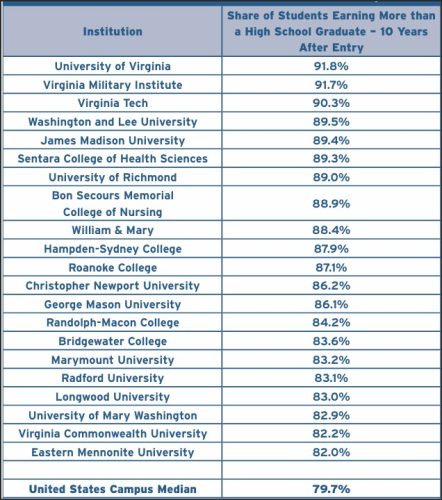
Ten years after leaving high school, one in five bachelor’s degree recipients earned less than the median income of high school graduates here in Virginia.

The aggregate numbers hide a lot of variability between institutions, degree programs, and students’ socioeconomic background, the report cautions. But the bottom line is clear.

“Substantial proportions of college graduates end up earning less than the members of their high school graduating classes who did not attend college,” states the report in its chapter entitled, “Does It Still Pay to Attend College in Virginia?”

Even at the University of Virginia, the state’s flagship university with arguably the most selective admissions standards, nearly one in twelve graduates earned less than the median income for Virginia high school grads.
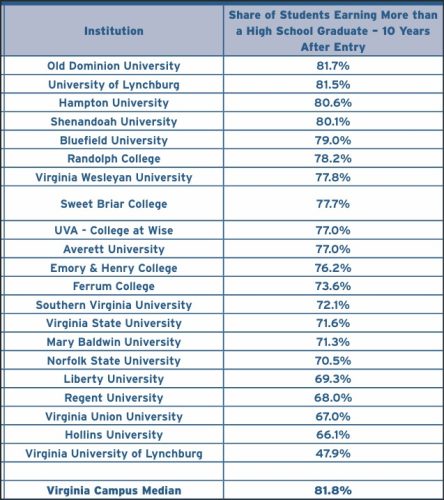
Worse yet at the opposite end of the spectrum, at the Virginia University of Lynchburg only 47.9% of graduates earned the high school average. By that measure, a majority of VUL grads were worse off than if they’d just entered the workforce after graduating high school! (The report did not examine for-profit colleges where the comparative earnings numbers for most institutions are even worse.)

Correction: In the paragraph above, I had mistakenly referred to the University of Lynchburg, a different institution than the Virginia University of Lynchburg.

The report does not address the social fallout from what some observers call “elite overproduction.” But the impact should be obvious: There will be considerable social discontent when thousands of college graduates struggle to pay off their debt with high school grad-level wages. How many baristas will suffer depression and anxiety as they direct their disillusion inward? How many waiters will become radicalized politically as they turn their disappointment outward and seek someone or something to blame?

The ODU report also does not touch upon the all-consuming racial/ethnic demographics of the low-earning graduates. We know that Blacks and Hispanics are more likely to drop out of college than Whites and Asians; they are more likely to be burdened with debt that they must repay even though they didn’t earn the credentials they counted on to generate higher incomes. Are low-earning college graduates also disproportionately comprised of Blacks and Hispanics? If so, would they have been better off had they chosen to enter the workforce debt-free and gotten a head start earning on-the-job experience?

Higher-ed propaganda promoting college attendance stresses the fact that the average college bachelor’s degree recipient earns about $1.2 million more over their lifetime than a high school graduate.

“Whether this turns out to be true for a specific individual,” notes the ODU study, “depends upon a variety of factors — what college the individual attends, what subjects they emphasize in their studies, and where the college is located.” Further, earnings may vary over time, depending upon fluctuating demands for particular skills in the labor market.

In another complicating factor, the authors question whether the higher earnings of some college grads can be attributed to the value added by the institution they attended or whether the higher earnings reflect their native abilities, their family backgrounds, and their fields of study.

The report acknowledges that college students derive value from college education that cannot be measured in dollars: “If someone’s goal is to learn and better appreciate French Impressionist painters or to master the Japanese language so that one can converse with one’s relatives, then most of the analyses we have presented in this chapter may be interesting but are largely irrelevant.”

Very true. The college experience — which can also include a lot of partying, football games, dating and mate-seeking — can be viewed in economic terms as a form of consumption. But Virginia (and other states) don’t invest billions of dollars in their public systems of higher education so students can engage in four years of partying, finding themselves, or appreciating other cultures. They invest billions of dollars (1) to equip citizens with the skills to thrive in the increasingly knowledge-based economy, and (2) to provide a ladder of social mobility for the poor and minorities.

Given the numbers published in the report and highlighted in this post, one might legitimately ask how well Virginia’s public and private higher-ed institutions are advancing either goal. The authors of the study endeavor to address that question. The quick answer is that there is no simple answer. I’ll explore more of ODU’s findings in follow-up posts.


ADVERTISEMENT

(comments below)


Comments


Comments

13 responses to “Crunching the Numbers on Elite Overproduction”

  1. LesGabriel Avatar

    One of the benefits of an education touted by those who promote "investments" in public education is to give graduates tools to function as a productive member of civil society. I wonder what percentage of college/university graduates employ such tools better than their high school graduate (or even high school dropouts) counterparts. Such comparisons are practically immeasurable (due to the unavoidable biases of whoever would construct such an instrument). Still, one could speculate, and my speculation is that college graduates would fare substantially worse than their 4 to 1 advantage in income.

  2. LarrytheG Avatar

    So I read this and in context with current news, tell me again why we need H1B visas?

  3. William O'Keefe Avatar
    William O'Keefe

    There is not enough information in this post to draw accurate conclusions about the value of higher education. There could be many reasons why the percentage is not higher.
    Why is the main focus earning power. The primary purpose of higher education should be in training the mind to think more insightfully and to gain the satisfaction that comes with such a mind in my opinion.

  4. LarrytheG Avatar

    We have a lot of folks going to college these days that really don't want to work or pursue a real career.

    They just want to get a diploma and go occupy a paid position without much of a clue about their future other than having secure job with a paycheck.

    Meanwhile, there are thousands of jobs wanting people to do them but people with a real education and career focus.

    Is this a "liberal", "elite" thing? Nope.

  5. James McCarthy Avatar
    James McCarthy

    JAB, by your own words and discussion of non-earning variables, the bottom line is not at all clear. This post ranks along with yesterdayโ€™s worst of BR in 2024.

  6. Nancy Naive Avatar
    Nancy Naive

    Two-thirds of bachelorโ€™s degrees in the United States are awarded by public universities.3 College-educated workers enjoy a substantial earnings premium. On an annual basis, median earnings for bachelorโ€™s degree holders are $40,500 or 86 percent higher than those whose highest degree is a high school diploma.4 The earnings gap between college graduates and those with less education continues to widen. In 2023, median income for recent graduates reached $60,000 a year for bachelorโ€™s degree holders aged 22โ€“27. For high school graduates the same age, median earnings are $36,000 a year.5 Eighty-seven percent of bachelorโ€™s degree holders report financial wellbeing, 20 percentage points higher than groups with any other level of education.6

    Recent college graduates also weathered the Great Recession far better than their peers with a high school diploma. Today, the jobless rate for bachelorโ€™s degree holders is less than 3 percent.7 And the incidence of poverty among bachelorโ€™s degree holders is 3.5 times lower than it is for those who hold high school degrees.8 A college education is expected to become even more valuable. Over the past decade, all net job growth has gone to workers with bachelorโ€™s degree or graduate degrees.9

    https://www.aplu.org/our-work/4-policy-and-advocacy/publicuvalues/employment-earnings/#:~:text=The%20earnings%20gap%20between%20college,earnings%20are%20%2436%2C000%20a%20year.

    Okay James, so 1 in 5 grads earn less than their hs cohort median income some 10 years out. What was that statistic in 2014? 2004? These are two distributions with an overlap, but with the information above, if you tell me what a man earns, I bet I can tell you if heโ€™s a college graduate or not.

    Life is a continuous process.

    BTW, how many of those 1 in 5 were women, who having married a graduate whoโ€™s earning 5x the hs median, have taken lesser jobs with convenient hours to raise their kids?

  7. Eric the half a troll Avatar
    Eric the half a troll

    โ€œTen years after leaving high school, one in five bachelorโ€™s degree recipients earned less than the median income of high school graduates here in Virginia.โ€

    โ€œBy that measure, a majority of Lynchburg grads were worse off than if theyโ€™d just entered the workforce after graduating high school!โ€

    Nope! This is a non sequitor. In one case you are comparing the individual to the high school graduate mean and in the second case you are trying to compare the individual to what the individual would have earned had they not gone to college. There is no way to say that this individual would have earned at or above the median income had they not attended college.

    If you are going to look at this as a comparison of populations, you really should be comparing the college grad median income ten years out to the HS grad median income ten years out – then do 15, 20 and 25. Fairly sure it will paint a different picture than what you are attempting here. Rememberโ€ฆ

    https://uploads.disquscdn.com/images/237498082ca829c9d3d8a03c6fb4a9f8a8c4adab565332d954fb469f5377c193.jpg

  8. Eric the half a troll Avatar
    Eric the half a troll

    โ€œHow many waiters will become radicalized politically as they turn their disappointment outward and seek someone or something to blame?โ€

    College gradโ€ฆ?

    https://www.cbsnews.com/news/fbi-explosives-largest-history-virginia-farm-brad-spafford/?ftag=CNM-00-10aab7e&linkId=702432367

  9. DJRippert Avatar
    DJRippert

    If the price of anything rises faster than the rate of inflation (or wage growth) for a long enough period of time, it will become unaffordable. Substitutes will emerge.

    The fact that the self-described geniuses who run our higher education system can't understand this is a testament to either their lack of common sense or their hubris.

    The demographic cliff is coming, more and more employers are dropping the requirement for a 4 year college degree from their job postings.

    Ten years from now, many of the colleges on Jim's list will be defunct.

  10. f/k/a_tmtfairfax Avatar
    f/k/a_tmtfairfax

    My grandfather always recommended that we "take up a trade." None of us did, but it is far from bad advice.

  11. James McCarthy Avatar
    James McCarthy

    The prospect of the US experiencing severe Musketization of its economy, values, and GNP should depress this author's concerns about "elite overproduction." Too many educated elites endanger the prospect of the massive dumbing down of the entire population.

  12. Eric the half a troll Avatar
    Eric the half a troll

    Another critique of this โ€œanalysisโ€ they are comparing college graduates with 6 years of experience with high school graduates with 10 years of experience. Do you think the numbers may be a bit different if we look at equal years of work experience? At what point might that 4 year advantage disappear? 15 years? 20?

    The more you look at this study, the more it is clearly an exercise in cherry picking dataโ€ฆ fits right in here at BRโ€ฆ

  13. Heather Bradley Avatar
    Heather Bradley

    Hi James. Thanks for your work on this article. I noticed that you made an error that many others make – discerning between "The University of Lynchburg" and "Virginia University of Lynchburg." If you'll refer to page 87 of the State of the Commonwealth Report, you'll see that the University of Lynchburg is actually at 81% – Virginia University of Lynchburg is the school at 47.9%. University of Lynchburg graduates are actually thriving more than many others across the state. Could you please amend your post to reflect this? Thanks so much!

Leave a Reply


ADVERTISEMENT