Waiting for NAEP

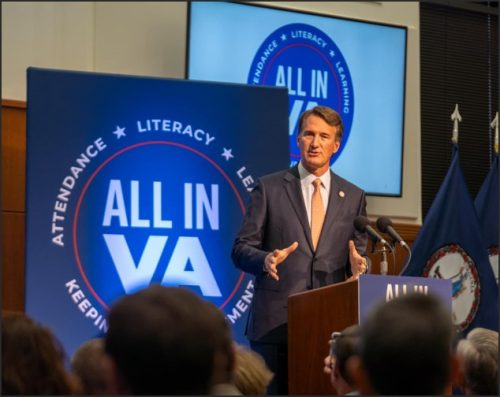
Photo credit: Governor Youngkin’s Facebook account

by Charles B. Pyle

On December 18, the governing board of the National Assessment of Educational Progress (NEAP) -– the battery of fourth- and eighth-grade exams in reading and math known as the Nation’s Report Card -– announced that the results of the 2024 tests will be released January 29, 2025.

State-by-state NAEP results are typically published in the fall, but during presidential election years the governing board delays reporting to keep the assessment program from becoming ensnared in national politics.

But state politics don’t factor into the NAEP governing board’s timetable. And in Virginia, the results of the national tests students took at the beginning of 2024 will land in the middle of a contentious General Assembly session and in what promises to be a bruising election year as Republicans seek to retain the top three statewide offices and Democrats battle to hold their narrow majority in the House of Delegates.

The 2024 NAEP results will be as much of a report card on the educational policies and initiatives of Governor Glenn Youngkin as a measure of the reading and math skills of Virginia elementary and middle school students.

As discussed in an earlier column on this site, Youngkin seized on the disastrous performance of Virginia students on the 2019 NAEP during his 2021 campaign for governor. The former Carlyle Group executive tied the sharp declines in the performance of Virginia students on the national reading and math tests with the low bars set for corresponding state Standards of Learning tests during the Northam administration.

Youngkin’s call for raising the rigor of the SOLs was buttressed by a 2021 National Center for Education Statistics (NCES) “mapping” study comparing how states define proficiency on their own tests compared with the bars set on the national assessments.

The study found Virginia was the only state that defined proficiency in both fourth- and eighth-grade reading at the “below basic” level on the national tests. The national testing program describes below basic as denoting performance that falls below its lowest performance level (basic).

Youngkin repeated his call for higher standards after the 2022 NAEP documented further declines in reading and math among Virginia students — declines the governor described as catastrophic.

A follow-up NCES mapping study released in November 2024 shows that despite Youngkin’s repeated vows as a candidate and governor to increase the rigor of the SOLs, Virginia still sets the lowest bar in the nation on its fourth- and eighth-grade reading tests compared with expectations on the corresponding national assessments. According to the latest timeline, the state Board of Education won’t set new SOL proficiency benchmarks until after Youngkin leaves office in early 2026.

The Youngkin administration also has been slow to carry out its pledge to increase the rigor of the commonwealth’s school accountability system. A new ratings system that prioritizes proficiency and mastery of content will finally go into effect in the fall of 2025, more than three years after Youngkin appointees achieved a majority on the state Board of Education.

In fairness to the state board, it should be noted that for much of the first two years of the administration, the board’s agenda was micromanaged by Youngkin’s former chief of staff, a businessman like his boss with little interest in advice from education policy hands from previous GOP administrations.

More time was lost as the governor’s second imported state superintendent sought to curry favor with school divisions by developing school accountability proposals strangely at odds with Youngkin’s call to prioritize proficiency in evaluating school performance.

So, given the slow-walk on raising standards, what can we expect when the 2024 NAEP results are released in January?

The performance of Virginia fourth and eighth graders this past spring on the SOLs suggests that the 2024 NAEP results will not mark a turnaround from the sharp declines of 2019 and 2022.

Reading and math pass rates on the 2024 SOLs were essentially flat. For example, 73% of fourth graders met Virginia’s low bar in reading, the same percentage as in 2023. Eighth graders managed a one-point improvement, from 71% to 72%, hardly more than statistical noise. The pass rates for African American students were much lower in both grades.

It is important to keep in mind that the state and national tests are different. Representative samples of fourth and eighth graders sat for the national tests in January 2024, while practically all students in the state took the SOLs for their respective grades a few months later.

The tests also serve different purposes. While NAEP items are designed to assess mastery of “complex grade-level content,” the purpose of the SOLs is to determine whether students and schools meet basic accountability standards.

Nevertheless, it is entirely appropriate to compare the relative rigor of state expectations with how proficiency is defined on the national tests. That is why the NCES produces mapping studies after each NAEP administration.    

During the 2000s and early 2010s, increases in the rigor of Virginia’s standards and improved student performance on the SOLs led to gains on the national tests. Conversely, the watering down of accreditation standards and the lowering of SOL cut scores during the McAuliffe and Northam administrations set the stage for dramatic NAEP declines in 2019 and 2022.

If the 2024 SOL scores presage another round of dismal NAEP results, the release of the 2025 SOL pass rates next summer — scored against the very benchmarks the governor has repeatedly decried as dishonest — will represent an ironic last hope for Youngkin to claim an end-of-term success he’ll need to compete with potential 2028 rivals like Florida’s Ron DeSantis for the mantle of the nation’s foremost Republican “education” governor. 

Charles Pyle covered the roll out of the SOL reform as a reporter with WWBT (NBC12) in the 1990s and served as director of communications of the Virginia Department of Education 2000-2023.


ADVERTISEMENT

(comments below)


Comments


Comments

9 responses to “Waiting for NAEP”

  1. Nancy Naive Avatar
    Nancy Naive

    Speaking of out-of-touch governorsโ€ฆ

    โ€œThe Republican governor of Texas, Greg Abbott, mistakenly offered his condolences to Jimmy Carterโ€™s dead wife shortly after the Democratic former president died on Sunday.

    Abbottโ€™s statement sent โ€œprayers and deepest condolencesโ€ to former first lady Rosalynn Carter and the rest of her family shortly after her husbandโ€™s death at the age of 100, as the Dallas news station WFAA reported. But Rosalynn Carter had died more than a year earlier โ€“ on 19 November 2023, at age 96.โ€

  2. Clarity77 Avatar

    As has been pointed out repeatedly as to the Virginia state education system governors limited to one 4 year term are obviously at a great disadvantage when it comes to confronting the root of the problem which is the feckless leftist democRAT state educational establishment which is entrenched at every level from primary to tertiary.

    So stop the flogging of governors and focus on the actual pathological entity which now has mutated into a woke DEI variant even more obvious and plain as day!

    And do not waste time on disinfectants, sterilants, fumigants, vaccines, etc. A good old fashioned blowtorch proven 100% effective throughout the ages.

  3. LarrytheG Avatar

    After the dust settles, whenever, I wonder how the kids that are "failing" in Va schools will be addressed. We're still chewing on data and I don't see so far
    what we're going to actually do to address the NAEP/cut scores "shortfalls" that we are chewing on.

    I know it's not going to get fixed in Youngkins term but I AM curious if he
    and DOE have a discrete plan/approach?

    Will he, for instance, recommend that vouchers be prioritized to the kids who are failing as opposed to vouchers for any/all?

    Will voucher schools be required to hire the resources needed to teach these kids that do not learn in public schools?

    stuff like this… Right now, it feels like an inside struggle deep in the
    administrative weeds….

  4. Gary Masters Avatar
    Gary Masters

    Is Trumkin packed and ready to leave the Governor's residences yet?

  5. Kathleen Smith Avatar
    Kathleen Smith

    Matt and Charles make absolute sense. As a veteran educator and VDOE employee directed to improve failing schools:

    It is all about expectations not money. I thought about this overnight and throughout the day to day. Not only is it about expectations, but it is about setting the right kind of expectations.

    When SOL accountability first started, we used only the 70% pass rate. The scores moved pretty quickly to about 70% as the average. But that still left out 30% of the kids, mostly black, brown, and/or poor. Then politics got in the way and everyone wanted to make a new accountability system that would make everything OKAY as long as your scores showed growth for black, brown, and/or poor kids. As a side kick, we also added a way for a kid to show proficiency through locally administered tests. Then we added things like absenteeism as well as growth as well as proficiency.

    I am going to give a simplified example of what happens when you don't keep the "main thing – the main thing."

    A school has 100 kids and all take the SOL test. The bar is 90% passing – the main thing is the main thing. The school struggles and when it finally gets to 80% passing, it finds growth slowing down. Something like a C student suddenly becoming an B student and to get to the A student level it is a little harder.

    The lawmakers are tired of waiting for the schools to make 90% as real estate assessment is declining. They pass a new accountability system that says if you make don't make 90% BUT can show growth AND your kids are not absent more than an average of 18 days per year, we will make it so your school will be considered a 90% school. Plus, we will even drop the cut score to make it easier under the Blame COVID movement. WOW.

    So, the 20% of the kids that were making less than 80% proficiency came to school almost everyday. They are able to show growth by an increase like from 67% to 68% with very little intervention. They just don't graduate or make 90% passing. However, 70% of the kids who made 90%+ proficiency averaged 20 days absent a year (18 days and below is required). These kids also graduated on time. So in the end, you school has an 83% pass rate, but shows growth and it brings it to 90%, and a makes the cut for 95% graduation rate (over 6 years not 4) and a very poor absentee rate.
    You put all of efforts into?
    A. making sure that 90% of the kids pass the test.
    B. make sure that your low scoring kids improve by 1 percentage point.
    C. Improve the absentee rate for the kids already passing the test at 90%.
    D. None of the above.

    The low-hanging fruit in this scenario is to con those little geniuses into coming to school everyday. Then, if possible make sure those low performing buggers make an extra point. So the black, brown and/or poor kids really don't make that much in gain, maybe 1 point.

    Even if I get 100 percent of my kids to come to school every day, if it doesn't change their overall achievement, it hasn't done a thing.

    I say, get rid of all of the fluff and go for a higher percent of questions correct to be considered proficient and hold schools accountable for a specific percentages only (80%). If scores are improve, other stuff will fall into place. Keep the main thing, the main thing.

    Just explicitly teach the stuff needed for kids to learn and demonstrate mastery.

    Thanks Matt and Charles.

  6. Charles Pyle Avatar
    Charles Pyle

    Note to education writers with the upcoming NAEP release in January: Get into the weeds. Check the participation data for students with disabilities, English learners, etc. Virginia was always a model state for making sure these student groups were fully represented in the testing pool. I hope that is still the case but pretty much all of the folks who maintained the integrity of the program are gone.

  7. Clarity77 Avatar
    Clarity77

    Hey Dick and McCarthy, so you denigrate Youngkin as a republican governor when it comes to education policy. Now tell us how wonderful it is to have a democRAT governor such as in New Jersey and New York where both governors no longer require teachers to pass a math or literacy test.

    Oh, of course, you want evidence. Read then for yourself. Maybe you can work on getting Murphy and Hochul down here to Virginia to make our schools "great" again!

    https://thedailybs.com/2024/12/30/teachers-will-no-longer-need-to-pass-basic-reading-writing-and-math-test-for-certification-in-this-blue-state/?utm_campaign=james&utm_content=12-31-24%20Daily%20AM&utm_medium=newsletter&utm_source=Get%20response&utm_term=email

  8. LarrytheG Avatar
    LarrytheG

    Will catch up more in the morning..

    Thank you Charles and Kathleen… for helping this ignorant one out a bit.

Leave a Reply


ADVERTISEMENT