Well, blow me away. Alex Madrigal, senior editor at the Atlantic, is touting Richmond as a regional center of innovation. “Richmond is blossoming into a tech hub thanks to a great research university, a big creative agency, and cheap, beautiful real estate,” reads the sub-head of the first in a series of articles.
The quality of life is high, real estate prices are reasonable and “the stock of homes is beautiful.” He credits Virginia Commonwealth University and the Martin Agency as being critical nodes in the innovation system. (I would add Capital One, which has recruited many talented people to the region, many of whom leave and start their own enterprises.)
Madrigal seems taken with the wealth of great urban neighborhoods and the old industrial buildings renovated into apartments, offices and cool start-up space. I eagerly await his upcoming posts.
Ninety-four percent of the 600 Virginia residents polled by a Roanoke College professor believe in God, 87% believe in heaven, and… 47.9% believe pets are admitted into the Pearly Gates. (Read the poll results here.)
Wow, I am really out of step! I don’t want to start a theological hissing contest, but I have to ask a question about this finding: “A strong majority of Virginia residents (80%) believe in life after death. Even more (87%) believe in heaven.”
Am I missing something here? How can you believe in heaven and not believe in life after death, as 7% of Virginians apparently do? Doesn’t the former presuppose the latter? … Ooh, ooh, I’ve got it. Seven percent of the population must believe that there’s a heaven for pets but not for people!
Under the provisions of Patient Protection and Affordable Care Act, the 50 states must set up health insurance “exchanges,” marketplaces where individuals and small businesses will find it easier to acquire coverage, by 2013. If they don’t, the federal government will step in and set up the exchanges for them.
Gov. Bob McDonnell is no fan of Obamacare, but the law is the law… and he’d rather Virginia run its health care exchange than let the U.S. Department of Health and Human Services do it. And Virginia legislators agree.
“Virginia can and should set up its own health-care exchange,” said Del. Terry G. Kilgore, R-Scott, chairman of the House Commerce and Labor Committee, as quoted by the Times-Dispatch.
The purpose of the health care exchanges is to fill gaps in the health insurance marketplace that make it prohibitive for individuals and small businesses to obtain health care coverage. One critical component of the exchanges — a requirement that everyone either obtain coverage or pay a penalty — is under legal attack, however, and probably won’t be considered by the U.S. Supreme Court until next year. Because the exchanges will rely upon the participation of healthy people to keep rates down, they likely would go into a death spiral if the Supremes invalidate the mandatory coverage.
That creates tremendous uncertainty for state officials. The Times-Dispatch reports that the legislature is awaiting an overdue report from the governor’s Health Care Reform Initiative Advisory Council before making key decisions about how to craft the law. Another big question is whom to put in charge of the exchanges. There is some sentiment to make it a responsibility of the Bureau of Insurance under the State Corporation Commission.
Just remember: Health exchanges are a government-engineered solution to flaws that government that created in the first place. The problem arises from the fact that health care insurance obtained through employers is tax deductible, whereas insurance that individuals purchase on the open marketplace is not. Thus, the entire medical insurance industry is organized around selling insurance to employers, not the ultimate customer — in contrast, say, to the auto insurance industry. Inserting employers between insurers and patients sets into motion a whole train of dysfunctional and expensive behaviors too lengthy to detail here.
Needless to say, however the exchanges are crafted, they will be imperfect, and there will be cries for further fixes. State government undoubtedly will be more responsive than the federal government, so the pragmatism of McDonnell, Kilgore and others is probably justified.
The Case for Baseline Budgets Center for Budget and Policy Priorities A “current services baseline” budget shows what government spending would look like after inflation, economic growth and population increases, showing the impact of policy changes with greater clarity. Virginia is one of 28 states that does not use this form of budgeting.
California’s Experiments with eGovernment New America Foundation
Report potholes, broken sidewalks, graffiti and barking dogs on your smart phone! Make city data accessible to the public online! California municipalities use information technology to make government more transparent and accountable.
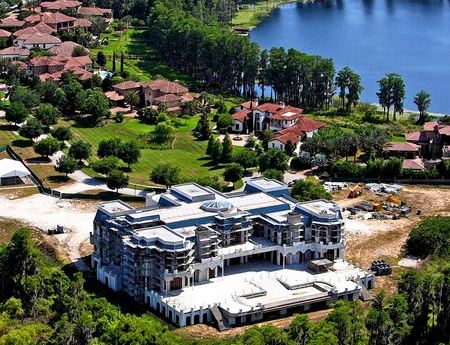
Poor Jaqueline Siegel. She’s another victim of the credit crunch. Her steel- and wood-frame Florida home remains unfinished. As she stands on the deck of her Florida room, she wipes away tears as she speaks to a Wall Street Journal writer. “Maybe it will still work out,” she says. “It always does, right?”
It’s not a sob story that many Americans can relate to. Ms. Siegel’s dream house is a monument to conspicuous consumption: 90,000 square feet (believed to be the largest private home in the United States), a 7,200-square-foot ballroom, a bowling alley, five kitchens, 23 bathrooms, 13 bedrooms, two elevators, two movie theaters, a 20-car garage and artificial, 80-foot waterfall. When her husband’s business, Westgate Resorts, got slammed by the recession, the couple had to pay off about $1 billion in notes they had personally guaranteed. The house had to go. It’s now on the market for $75 million.
Jacqueline and David Siegel belong to what writer Robert Frank calls the “High-Beta Rich,” a comparison to high-beta stocks that rise and fall in value with great volatility. The new mega-rich, who often engage in conspicuous consumption, are often only one crisis away from financial ruin, Frank observes. The Siegels managed to downsize quickly enough to stay solvent, but they had to lay off 14 of their 15 housekeepers and their chef, and enroll their children in public school. Waaah!
But many like them go belly up. Americans who live atop the economic ziggurat today are not a stable group. As Frank writes:
Though often described as a permanent plutocracy, this elite actually moves through a revolving door of riches, with some of today’s nouveau riche becoming tomorrow’s fallen kings. Only 27% of America’s 400 top earners have made the list more than one year since 1994, one study shows.
It wasn’t always this way. For decades after World War II, the top one-percenters were the most steady line on the income and wealth charts. They gained less during good times and lost less during contractions than the rest of America. Suddenly, in 1982, the wealthiest broke away from the rest of the economy and formed their own virtual country. Their incomes began soaring higher during good times. The top 1% of earners more than doubled their share of national income, to 20% as of 2008. Looking at another measure, the richest 1% increased their share of wealth from just over 20% to more than 33%.
Those surges were often accompanied by mini-crashes, even though the direction over time was always up. A top 1% that had once been models of financial sobriety set off on a wild ride of economic binges.
As Frank rightly observes, this new class of high-beta rich doesn’t conform nicely to ideological stereotypes. It certainly doesn’t fit the conservative stereotype of vast wealth as the reward for years of hard work and thrift. Many of America’s great fortunes are fueled by huge indebtedness and good luck, not real wealth creation (think Donald Trump). Nor does it fit the liberal notion that America is dominated by a new “ruling class” or plutocracy. One year people are rich, next year they’re not.
As we think about using tax policy to get “millionaires and billionaires” pay their “fair share,” it’s useful to remember that only one quarter or so of the taxpayers in the top 1% remain there year after year. For most Americans who break into that illustrious club, it’s a temporary stay. American society is still very, very fluid.
You can say what you want about embattled President Barack Obama, but the fact is that he’s had a number of foreign policy successes.
Here are a few:
After years of failure, Al Qaeda leader Osama bin Laden was finally surrounded and killed by U.S. special forces — something the Bush Administration failed to do for seven years.
Despite Republican complaints, Obama and Secretary of State Hillary Clinton followed a thoughtful and patient course that supported insurgents in Libya and select NATO airstrikes. Now Muamar al-Gaddafi, a brutal dictator who has been a thorn in the side for four decades, is dead and Libya holds the promise of transforming into a modern democracy.
The U.S. did not stand in the way of the twitter movements in other countries such as Tunisia and Egypt.
The heavy-handed, arrogant policies and personalities of Donald Rumsfeld and Dick Cheney made Washington a pariah amongst its traditional allies. Obama and Clinton have changed that.
As announced today, Obama will return U.S. troops in Iraq home by the end of the year. Some 4,400 of them were killed along with 100,000 civilians in a war that was not necessary since no Weapons of Mass Destruction were ever found and the Bush Administration lied about evidence that they existed.
Greatly reducing U.S. presence in Iraq will greatly alleviate budget and spending pressure — something conservatives are loath to admit when it involves Bush’s wars.
To give credit where due, George W. Bush did turn things around in Iraq with “The Surge.” And Obama’s had a very rough time on the economic front in part because of his lack of experience and also because of the utter lack of cooperation from the likes of John Boehner and Eric Cantor. But his foreign policy successes cannot be denied no matter how hard the conservatives may try to twist facts and perceptions.
Headline from the Pilot Online: “Group urges McDonnell to crack down on dangerous animals”
No, no one is urging the governor to rein in the General Assembly.
In the wake of the big-game scare in Ohio earlier this week, the Humane Society of the United States wants Gov. Bob McDonnell to toughen the sale and possession of dangerous wild animals within the state.
Virginia has virtually no restrictions on the possession of primates, warns Debbie Leahy, a captive wildlife regulatory specialist.
School Choice in Texas: Making Progress but Could Be Better Texas Public Policy Foundation
Texas has made strides toward greater school choice in recent years but the state needs to make significant policy changes before it becomes a leader in education reform.
TANF and Child Welfare Programs Need Better Coordination Government Accountability Office
In 2010, one third of the children received Temporary Assistance for Needy families lived with non-parent caregivers, often grandparents. Better coordination is needed between TANF and child welfare services.
What’s Wrong with Kansas? Public Schools. Kansas Policy Institute
Kansas needs to reinvent its public schools to provide more choice by moving away from large, uniform mega-schools to smaller, specialized schools that can accommodate particular learning styles.
Wind Power Not Cost Effective at Cutting CO2 Emissions Manhattan Institute
Meeting the goal of generating 20% of U.S. electric power with wind by 2030 would cost roughly $850 billion. Compared on the basis of cost per ton of CO2 emissions reduced, that’s three times as costly as the European Union’s emissions trading scheme.
A re-write of the regulations governing the acceptance of secondary streets into the state-maintained road system was approved by the Commonwealth Transportation Board yesterday with only one dissenting vote. The changes affect mainly the extent to which subdivision streets must interconnect with one another and other streets.
The purpose of the regulations, which arose from a 2007 law, was to encourage developers to design subdivisions with multiple connections to nearby roads and streets to avoid the problem of everyone in the subdivision emptying onto congested state roads at the same spot. In theory, greater connectivity between subdivisions gave drivers more potential routes to reach their destination without using overloaded main roads. If subdivisions failed to meet the requirements, the Virginia Department of Transportation would not accept them into the state system for maintenance.
In this year’s General Assembly, home builders pushed for changes to the acceptance requirements, which they said imposed an inflexible template on their subdivisions, regardless of circumstances. In particular, they disliked the Connectivity Index, which rated a subdivision plan based on the number of street segments and intersections. The formulaic approach did not work well for laying out subdivisions, which they described as a creative endeavor that is more an art form than a science.
The re-written regulations get rid of the Connectivity Index and substitute a simple requirement that every subdivision must have at least two exits, with an additional exit to be added for every 200 houses.
Smart Growth advocates were not adamantly opposed to the change, but they did say that so few new subdivisions have been built in the past four years that the Connectivity Index was really never given a chance. Why not wait and see how it works in practice before getting rid of it?
James E. Rich, Culpeper district representative, cast the only dissenting vote. He had only recently begun to get feedback from people on the re-write, he said. What was the rush in passing the new regulations? “I don’t like to vote on these things in a vacuum.”
A Commonwealth Transportation Board subcommittee seems to be making progress in deciding how to make Virginia’s formulas for allocating road maintenance dollars more equitable and efficient. In a meeting yesterday, the five-member group agreed upon the following statement:
The most equitable approach to distribution of scarce maintenance funding may be a formula that incorporates a prioritized needs-based factor along with a commitment to maintain statewide assets, regardless of maintenance responsibility.
State funding formulas are balkanized and inconsistent. One set of rules, based upon lane-miles of roadway, applies to cities and towns. Another set of rules applies to Arlington and Henrico Counties. And yet a third governs the distribution of maintenance funds to all other counties, whose roads are maintained by VDOT.
The subcommittee is moving toward a single set of criteria for dispensing maintenance dollars. However, the group resolved to gather more data on the condition of roads in cities, which VDOT currently does not collect, and to convene again with city and county stakeholders to hash out the issues. Inevitably, any change in the formulas will create winners and losers.
A consensus appeared to emerge, however, around the idea that maintenance dollars should be distributed according to the basis of need, with “need” being determined by a composite of factors such as the condition of the roads, the number of people who use the roads, and the economic value of the roads. Sheppard Miller, an urban at-large member from Hampton Roads, spoke of a mile-long road that he lives on and shares with only two or three other families. Regardless of its physical condition, his road just isn’t as important as a road that carries thousands of drivers. Maintenance on other roads should take precedence, he said. “I’d look at the needs across the state, serve the most critical needs first, and look at which roads have the most value.”
The subcommittee report received a positive response from other CTB members. Virginia should not be hamstrung by 80-year-old legislation, said Cord Sterling, the Fredericksburg district representative. “We need more resources. But we also need to more effectively manage the resources we have.”
A week ago I questioned a fundamental premise of the argument that Virginia needs to raise taxes in order to build more roads: the fact that Virginians aren’t driving more, they’re driving less. Citing DMV figures, I noted that total Vehicle Miles Driven in the Old Dominion declined in 2009 and 2010. (See “Is Congestion Really Getting Worse?“) What I didn’t know then were the numbers for 2011. As the economic recovery (such as it was) took hold, would Virginians head back to the roads?
The Virginia Department of Transportation thought they would, budgeting a 2.7% increase in motor fuels taxes for the first quarter of the fiscal year. But we found out differently when John Lawson, CFO for the Virginia Department of Transportation, updated the Commonwealth Transportation Board on the department’s financials. Through September, he reported, motor fuels tax collections have declined 3.2% year to date compared to the same period last year. (In Virginia’s fiscal year, “year to date” covers July, August and September.) The decline for September was even worse — down 4.1%. Ouch!
Fuel tax collections are a function of two things: average gas mileage and vehicle miles driven. While improved gas mileage of the Virginia motor vehicle fleet might have contributed marginally to the dip in tax collections, the driving force (so to speak) was Vehicle Miles Traveled (VMT).
I asked Lawson if he thought the decline reflected temporary economic conditions or a more profound change in driving patterns. He declined to speculate. But it’s a question that VDOT officials and state legislators need to start asking. If Virginians are driving less, not more, the justification for many transportation projects gets blown out the exhaust pipe.
The Free Market Case for Opposing Caps on Medical Malpractice Heritage Foundation
The insurance industry does a better job than government of punishing bad doctors. Capping malpractice awards undermines mutes incentives for physicians to reduce the risk of negligent injuries.
Texas Halts Erosion of Property Rights Texas Public Policy Foundation
Texas courts let the state’s traditionally strong property rights erode by giving more power to government. But recent Supreme Court rulings have reigned in the excesses.
Where does Gov. Bob McDonnell stand on the issue of devolving responsibility for secondary road maintenance to the counties? I’m not aware that the governor has staked out a formal position, but his transportation secretary, Sean Connaughton, gave some strong hints today about where he stands.
Two weeks ago, the Fairfax County Board of Supervisors voted to increase the density of Tysons Corner by 7%, Connaughton volunteered in a free-ranging riff during a meeting of the Commonwealth Transportation Board this afternoon. When informed that the cost of building the transportation infrastructure to serve that density would cost $1 billion, he continued, the county response was, “It’s the state’s responsibility.” In effect, he was saying — at least, this is what I read into his remarks — that the system that separates responsibility for land use and transportation is broken.
Fairfax County’s actions have been replicated on a smaller scale endlessly across Virginia. County boards of supervisors make major land use decisions knowing that they can pass the buck for road improvements to the state. That’s the main reason the General Assembly passed legislation a few years ago allowing counties to take over responsibility for their secondary roads. So far, every county has balked at taking on the obligation, usually on the grounds that they distrusted the ability of Virginia Department of Transportation to pay them enough to make it worth their while. (Cities, towns and the counties of Arlington and Henrico maintain their own road systems in an arrangement that dates back, with minor modifications to 1932.)
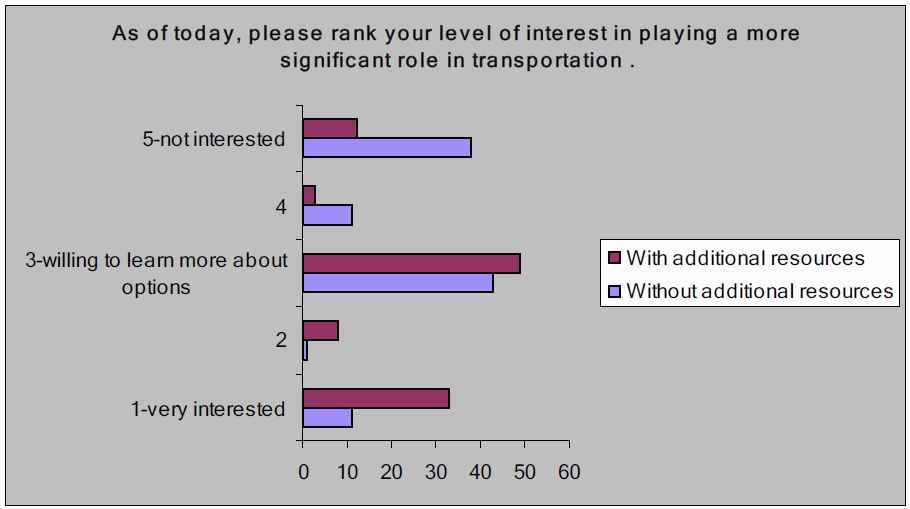
Click on chart for more legible image.
The counties’ skepticism was driven home in a survey of county officials recently conducted by VDOT. Although county officials assign a far higher priority to maintenance over new construction, only a small minority are interested in taking over maintenance themselves. The number of positive responses did increase measurably (see chart) on the condition that the state provided additional resources.
“Senator [Harry] Byrd was looking at a world of country roads” during the Great Depression when he crafted the road-maintenance responsibilities between cities, counties and the state, Connaughton said. But the situation is very different today. Three of the top ten wealthiest jurisdictions in the country are located in Northern Virginia. “We pave their cul de sacs,” he said. By contrast, the town of Dumphries in Prince William County is one of the poorest jurisdictions in the region. “They have to maintain their own roads.”
(While Dumphries does pave its own roads, the state distributes maintenance dollars to offset the cost — I don’t think the secretary meant to imply otherwise.)
Connaughton framed the larger issue this way: Should the state accept Fairfax County cul de sacs into the state secondary road system, or should the commonwealth focus on primary roads? Just because Virginia has done things the same way for nearly 80 years, he seemed to say, is no reason to continue doing it. “There’s a lot of crazy stuff that no one’s had the courage to look at.”
Sounding very much unlike a former Northern Virginia politician — he previously served as chairman of the Prince William County board of supervisors — Connaughton dismissed the conventional wisdom that Northern Virginia doesn’t get its fair share of transportation revenues. He can’t speak for other areas of government, he said, but when it comes to transportation funding, “the rest of the state is subsidizing Northern Virginia.”
When it costs $11 billion just to add an extra lane to Interstate 81, he said, addressing a topic raised earlier in the meeting, the state doesn’t have enough money to fulfill everybody’s wish list. “It’s more than just a revenue issue now,” he said. “It’s about roles and responsibilities.”
A major north-south highway in Northern Virginia took a step closer to reality today when the Commonwealth Transportation Board voted to develop a master plan for a “corridor of statewide significance” that would cut through Prince William, Fairfax and Loudoun counties.
Northern Virginia has the worst congestion in the United States, said Deputy Transportation Secretary David Tyeryar. The gridlock is aggravated by poor access to Dulles airport, which forces people to drive much farther along major arteries like Interstate 95, Interstate 66 and the Dulles Toll Road than they should. The new corridor would better integrate Dulles with the region.
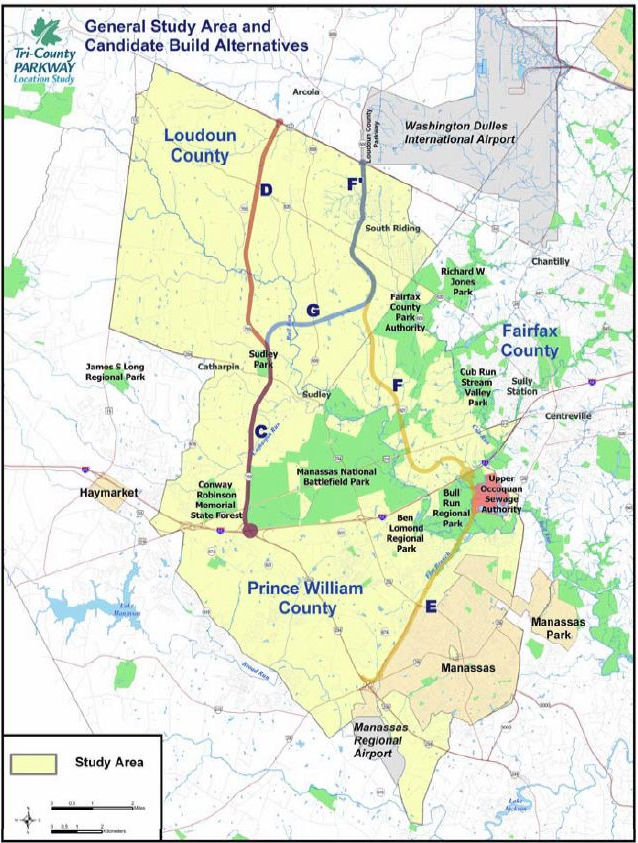
While the route bears a strong resemblance to a proposal for an outer Washington beltway spanning the Potomac River that was scrapped a decade ago, McDonnell administration officials were at pains to say that this project is more limited in scope. The corridor will originate in a southern terminus on Interstate 95, align with the proposed Tri-County Parkway (shown in map), run north past Dulles airport and terminate at Route 7, Tyeryar said. “We will not study a river crossing,” he emphasized.
Tyeryar got pushback, however, from two CTB members who said that the corridor should include a river crossing. “I don’t think we should put artificial limits on what we look at for connecting Dulles,” said J. Douglas Koelemay, who represents the Northern Virginia transportation district. “My goal is river to river. We have connectivity needs with Maryland.”
“The governor of Maryland has been contacted,” said Gary Garczynski, an urban, at-large member from Prince William County. “Senator [Mark] Warner favors a river crossing. It’s in dialogue.”
The only board member to express reservations about the study was James E. Rich, representative of the Culpeper transportation district. It makes more sense to fund smaller projects that can improve mobility in Northern Virginia right now, he said, than to conduct a long study for a megaproject for which no money currently exists, he said. “There are concrete affordable steps to improve access to Dulles.”
Other than Rich, however, when it came to a vote, all CTB members voted in favor of the study. When asked when he could get started, Tyeryar replied that he’d already taken the liberty of putting the project into motion. He promised the board to report back at 6-, 12- and 18-month intervals.
Powerful interests are pushing for construction of a major thoroughfare. The localities along the proposed route have added 300,000 people in the last 10 years, said Robert Chase, president of the Northern Virginia Transportation Alliance. The next two decades will see another 650,000 people settle in the region. That’s nearly a million people — almost the population of Fairfax County. “There is a huge demand for a north-south corridor. If we do something or not, those people will be there.”
Smart Growth representatitves were quiescent at the board meeting. But they have criticized the outer beltway in the past on the grounds that it would contribute to sprawl by opening up vast tracts for development while diverting funds from smaller, more targeted improvements that would do more to reduce congestion.
Dealing with Diversity in Virginia Center for American Progress
Think tank sponsors roundtable discussion about increasing ethnic diversity in Northern Virginia.
Saving the Unemployment Insurance Funds Tax Foundation
Thirty-four states have borrowed a total of $37 billion from the federal government to pay unemployment benefits. States must begin paying interest on their balances in 2011. Good luck with that.
The year: 2075. The American colonies on the Moon are getting restless under Washington’s tyrannical rule….
This second edition of “Dust Mites” has a snazzy new cover, includes helpful lunar maps, and is 5,000 words tighter than the original. The sequel, “Trogs,” is scheduled for publication this summer.
Advertisement
Advertisement
Advertisement
Advertisement
About
Bacon’s Rebellion is Virginia’s leading politically non-aligned portal for news, opinions and analysis about state, regional and local public policy. Read more about us here.
Fund the Rebellion
Shake up the status quo! Your contributions will be used to pay for faster download speeds and grow readership. Make a one-time donation by credit card or contribute a small sum monthly.
Can’t wait until tomorrow
For your Bacon’s Rebellion fix?
Enter your email address to receive immediate notifications of new posts by email.
SUBSCRIBE
Search Bacon’s Rebellion
Categories
Archives
The Jefferson Council
Protecting Thomas Jefferson’s Legacy at the University of Virginia
Forgot Your Password?
Shoot me an email and I’ll generate a new password for you.