• Government Benefits in a Post-Boomergeddon World


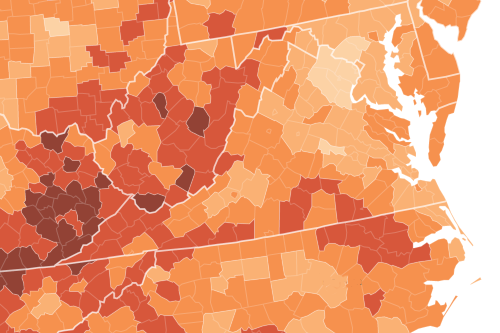
    How bad will it hurt when Boomergeddon hits and the federal government goes into default/hyperinflation mode? One way to measure the economic impact is dependence upon federal government transfer payments. The New York Times has tallied up expenditures onย Social Security, Medicare, Medicaid, veterans payments, unemployment insurance and income support, and plotted them as a percentage of income for every county in the United States.

    To interact with the “Geography of Government Benefits” map, click here.

    When things fall apart and the government starts whacking benefits, the economies of Pittsylvania County,ย Lee County and other benefits-dependent localities could go into freefall.

    Interestingly, Northern Virginia relies less upon transfer payments than any other part of the state. The region standsย to lose a lot from direct government spending — the Beltway Bandits will take a big hit when federal finances fall apart — but the population could be spared a double whammy from cuts to transfer payments.

    — JAB


  • The Atlantic: Virginia’s Pathetic Leadership

    With proposals such as mandated ultrasounds for abortion seekers and bans on Sharia law, state legislatures avoid actual governance in favor of dead-end ideas.

    virginia-ultra-body.jpg

    Virginia’s attempt to intrude (literally and figuratively) upon the privacy of its pregnant women would be bad enough if it were merely a rare example of state lawmakers unhinging proposed legislation from law, science, and sense. Unfortunately, however, such official recklessness has become a national trend. All over the country, and especially since the 2010 election that swept Tea Party candidates into office, local lawmakers have spent a great deal of time and effort promoting measures they either don’t fully understand or can’t reasonably believe are constitutional.

    Here’s howย The Washington Postย explainedย how and why Virginia’s anti-abortion measure got as far as it did before enough grown-ups began to pay attention:

    Confusion over the legislation and ultrasounds — and considerable national media attention — preceded the unraveling of the bill. The original measure stated, simply, that a woman needed an ultrasound before an abortion. Many lawmakers did not understand that at the young fetal age abortions usually occur, the invasive vaginal ultrasound would be needed to establish gestational age, as required by the bill.

    The fact that these lawmakers evidently didn’t understand what their law would mean to women, and what it would require of doctors, didn’t stop the legislators from pushing forward with the measure anyway. Ignorance of the law may be no legal defense to you and me, but ignorance of the law among thoseย who are passing the lawย surely is the definition of bad governance. For the politiciansย now scrambling awayย from Virginia’s measure, however, pleading ignorance perhaps is easier today than confessing the truth, which is that the pols who supported the measure probably didn’t care in the first place if its mandated procedures offended women. That was the whole point, wasn’t it?

    At a minimum, the barely-averted disaster in the commonwealth raises questions about whether the same intellectual disconnect is happening in New Hampshire, where the Republican-dominated legislatureย is pressing aheadย with anti-abortion measures over the objections of medical experts. Or in Iowa, where a GOP lawmaker recently introducedย a billย that would ban abortionsย andย generate potential life sentences in prison for doctors who perform what the law calls “feticide.” Or in Nebraska, where legislators areย considering a billย that would create a legal defense — justifiable homicide, it’s called — for the murder of a doctor who intends to harm a fetus.

    It’s not just the divisive issue of abortion that has generated legislation divorced from reality. According to Bill Raftery, who smartlyย tracks such trendsย at the Gavel to Gavel site of theย National Center for State Courts, 22 states have legislation pending now that would ban the use of Sharia law or international law in their state courts. Never mind that there is no discernible proof that state or federal judges are suddenly swooning over sharia law, or that there is some vast judicial conspiracy afoot to supersede constitutional doctrine with foreign principles. It’s enough that the proposed legislation merely suggests that this is so.

    Most of these newer anti-sharia measures do not explicitly use the word “sharia law” — a lesson lawmakers seem to have learned from theย thumpingย Oklahoma’s voter-approved Sharia law ban has received so far from the federal courts that have reviewed it. Such stylistic alterations likely won’t matter. The Bill of Rights and the Constitution — which were themselves based upon English common law and other international norms — forbids the government from discriminating in this fashion. Did I say discrimination? In Iowa, a measureย now before the state senateย would imprison any judge (on a Class 4 Felony) who employs international law in a decision.

    Indeed, the past 16 months have seen persistent and pernicious efforts by state lawmakers to undermine the independence of the judiciary. I have written about this topic before as it relates to New Hampshire. But it’s rampant all over. In Arizona, lawmakers angry about a state court’s redistricting decision are trying to punish the state’s judicial system byย dramatically reducingย the number of appellate judges from 22 to six. Meanwhile, in Maryland, Florida, Minnesota, and Tennessee, to name just a few states, conservative legislators are seeking to strengthen rules that would allow “commissions” toย remove judges from officeย for unpopular decisions. Kansas has even managed a quinella, combining anti-judicial sentiment with the “birther” movement, by pushing a measure that would require judges to prove their citizenship.

    At a time of great economic turmoil and pain, while Americans have clamored for jobs and financial security, how many thousands of official hours have our state legislators spent since the 2010 election on bills that purport to solve problems that don’t exist (like a Sharia-led takeover of American law) or which cannot exist in conformity with criminal law (like a state law which protects those who kill abortion providers) or which contravene individual constitutional rights (like laws that are aimed at religious minorities)? These legislative Jeremiads, frivolous even in the best of times, seem downright obscene today.

    America, sadly, has grown accustomed to “symbolic” legislation which is designed not to advance the public good, or even to become sustainable law, but rather to appease particular interest groups. The campaign promise becomes the pending measure; the donor’s crusade becomes the subject of public hearings. And what is squeezed out of the legislative process as a result of such pandering is the more moderate legislation, the more practical measures, whichย doย stand a chance of passing constitutional muster and whichย doย solve real problems in sensible ways. That’s no way to run a country — or even a state.

    When public outrage forced them into a choice this week between appearing stupid about the ultrasound law or appearing venal toward it, Virginia’s Republican lawmakers, and the Commonwealth’s governor, chose to act stupid. It’s a choice that zealous lawmakers all over the country would be forced to make if their own senseless, unlawful legislation ever made it to the Supreme Court. But chances are those bills never will. Instead, America’s pet legislation will continue to whistle to all the political dogs out there while wasting everyone else’s time and money.

    Taken from Andrew Cohen’s essay in The Atlantic.

    Posted by Peter Galuszka


  • Another Reason to Loathe Special Tax Breaks

    An exemption on a 2% sales tax on a $40 million plane creates a real competitive advantage.

    by James A. Bacon

    On May 27, 2010, Governor Bob McDonnell announced that Yorktown-based Orion Air Group, “one of the world’s leading operators of business aircraft,” would invest $4 million to consolidate its operations in Newport News. The project would create 51 new jobs within the next 12 months with an average salary of $81,569. According to the press release: “The Virginia Economic Development Partnership worked with the City of Newport News, the Hampton Roads Economic Development Alliance and the Peninsula Airport Commission to secure the project for Virginia.”

    In the 2011 General Assembly session, Senators Tommy Norment, R-Williamsburg, andย John Miller, D-Newport News, co-sponsored SB 1188, a bill that would create an aircraftย sales and use tax exemption for companies that (a) were headquartered in Virginia,ย (b) invested at least $4 million, (c) created at least 50 new jobs in the state thatย paidย 150% or more of the prevailing wage, and (e) entered ย into a Memorandum of Agreement withย the Virginia Economic Development Partnership (VEDP).

    The bill passed the Senate comfortably by a 31 to 7 margin, passed the House and was signed into law.

    It’s hard to avoid the conclusionย that the tax exemption was carefully tailored to benefit Orion Air Group and none of its competitors.

    The tax break was significant. According to an analysis by Judy Lin Bristow and Matthew C. Marshall with the Williams Mullen law firm, Virginia normally imposes a 2% tax on the lease, charter and retail sale of aircraft within the state. The tax, theyย write, is ย “a costly expense for businesses that maintain or relocate their aircraft fleets in Virginia. For example, relocating a $40 million aircraft to Virginia has meant a 2% or $800,000 tax. ”

    A tax break of that magnitude would confer upon Orion a major competitive advantage over the dozens of other aircraft charter, leasing and management companies in the state.

    Mike Mickel, owner of Dominion Aviation Services in Richmond and a friend of mine, tells me the legislation really ticks him off. “This company [claims] they will be investing $4M and hiring 50 employees, while companies like mine, that have been investing tens of millions and have consistently had hundreds on the payroll for over 25 years still have to pay the tax!ย  In 2011, new aircraft purchased for my fleet alone paid over $360K in sales and use tax.”

    For that kind of money, Mickel could have worked the political system to get a similar exemption for himself and come out way ahead.

    According to the Virginian-Pilot, Orion and its CEO Scott Terry has donated $3,500 to Miller, $3,000 to Norment, and $3,000 toย former Del. Glen Oder, R-Newport News. Additionally, the company hired Miller as its director of community relations to oversee the company’s charitable giving and volunteer efforts.

    That’s all old news to Peninsula residents. Miller’s acceptance of the position became a re-election campaign issue last fall. Republicans accused him of “trading tax breaks for a job and campaign cash” (as opposed to trading tax breaks for just campaign cash like the Republican bill sponsors did). But the story is back in the news because it appears that federal investigators are asking questions about the lobbying effort behind the legislation. Mike Wade, a lobbyist and Republican activist, told the Virginian-Pilot that he had been interviewed twice recently by Federal Bureau of Investigation agents who were trying to ascertain if the law was broken.

    Regardless of whether laws were broken, the whole thing stinks. It’s another example of rent-seeking businesses corrupting Virginia’s political process and ofย politicians of both parties allowing themselves to be corrupted. How isย politics in Virginia different than politics in Washington? The sums of money are smaller, that’s all. How areย Republicans different from Democrats? When it comes to ethics, there is no discernible difference. Well, maybe there is one difference. Republicans purport to support free enterprise and a level playing field for business while Democrats make no bones about picking winners and losers. What a laugh. I guess that makes Republicans hypocrites as well.


  • “Our Bodies; “Our Idiot Selves”

    By Peter Galuszka

    Forty two years ago, a feminist group titled โ€œthe Boston Womenโ€™s Health Book Collectiveโ€ got together to start researching their own books about female health since they distrusted what they considered the male-dominated medical establishment.

    A substantial part of their research had to deal with birth control since the pill had been out for several years although the Roe vs. Wade U.S. Supreme Court decision, allowing limited abortion, was still three years away. Their book โ€œOur Bodies, Ourselvesโ€ became a best-seller.

    Flash forward 42 years to Virginia. The General Assembly is embroiled in a fiasco over conservative attempts to force-introduce state power into the sexual lives of women through laws that would force women exercising their legal right to an abortion to have ultrasound exams in their first trimester of pregnancy to somehow shame them into not going through with the procedure. Another would declare โ€œpersonhoodโ€ as being that point when an egg is fertilizer and a human life is created.

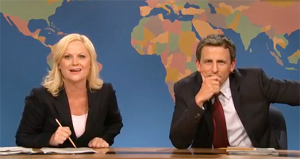
    The result, of course, has been one of the biggest legislative disasters in years. Virginia is the butt of jokes on Saturday Night Live and the Daily Show. Republican Gov. Robert F. McDonnellโ€™s multi-year-young effort to recast himself from social to moderate conservative is in shambles, his future in national politics in doubt.

    So, how did we get here? The story appears to be one of ignorance and incompetence, so very unlike what happened in Boston four decades ago. The key issue is that legislators apparently didnโ€™t understand that to determine the age of a fetus accurately, the use of a probe that is put inside a womanโ€™s vagina is needed. They had apparently assumed that the ultrasound could be achieved in a less upsetting way by smearing the pregnant womanโ€™s abdomen with a jell and then using a sound wand. According to The Washington Post, Sen. George Baker, a Fairfax Democrat had doubts and asked fellow Democrat, Sen. Ralph S. Northam, a doctor from Norfolk, who said heโ€™d check. It turned out that yes, an invasive vaginal probe was needed.

    The news completely changed the politics of the bill. But one wonders why legislators didnโ€™t know this from the beginning. If they did, they weren’t exactly forthcoming about it.

    One answer could be by studying the background of Del. Kathy Bryon, a Lynchburg Republican, who has been a legislator since the late 1990s. She introduced one of the bills that would require the transvaginal ultrasound. Ms. Bryon is a grandmother whose personal education did not go beyond high school. She worships at Thomas Road Baptist Church, home base for the late and controversial televangelist Jerry Falwell. When not working on public matters, she and her husband run a small telemarketing company.

    Bryon was also an official of the Tobacco Indemnification and Community Revitalization Commission, a body set up back in the late 1990s to handle hundreds of millions of dollars in funding the state is receiving from a 1996 lawsuit with 45 other states against four big tobacco firms, including Phillip Morris USA. The Commission was supposed to use some of its funds to help out tobacco belt towns with economic development projects.

    It did get a black eye when its former executive director, John Forbes II was convicted and sentenced to 10 years in prison for diverting $4 million from an alleged educational program to his own use. Although Bryon was not been linked to the Forbes scandal, she has been criticized for helping arrange a $12 million grant in public, tobacco fund money to help build the โ€œCenter for Health and Medical Sciences.โ€ It is part of Lynchburgโ€™s ย Liberty University, which, of course, is a religious school affiliated with the late Jerry Falwellโ€™s church.

    Thus, Byron’s involvement seems one of ย local political logrolling, Lynchburg-style, than a sophisticated understanding of womenโ€™s health issues. A case in point: the ultra-conservatives pushing the ultrasound idea didnโ€™t get the difference between a transvaginal probe and a sticky abdominal jell and just how the former presented an even more profound violation to a womanโ€™s rights. The fact that the U.S. Supreme Court says she has a right to an abortion in limited cases makes Bryonโ€™s ignorance and activism even more disturbing.


  • Careful There, Fellows, You May Not Like Where Your Logic Leads You

    by James A. Bacon

    Gov. Bob McDonnell’s PR shop has taken to touting the immediate job-and business-creating benefits of Virginia’s accelerated road building and maintenance program. The governor had better be wary about that short-term focus– he might not like where the logic leads.

    One recent press release touted an analysis of 10 highway projects funded by the administration’sย $4 billion transportation program. Just those 10 projects will supportย nearly 3,700 direct jobs during their construction, $190.8 million in personal income, $14.8 million in state and local tax revenues and other benefits to Virginia.

    In another release, McDonnell drew attention to the fact that the 495 Express
    Lanes project on the Capital Beltway had awarded nearly $450 million in contracts to small and disadvantaged businesses — 75% of which were located in Virginia.

    Temporary job creation and the handing out of boodle to small businesses is, admittedly, a benefit of public works spending. But that doesn’t make it a wise investment of resources. Here’s what we should be asking: What is the long-term benefit, the Return on Investment, if you will, once the construction phase is finished?

    The problem with the short-term focus is that roads and highways are not the best public works projects for putting construction workers back on the job. As the Southern Environmental Law Center notes in its Junction ATL blog, “Not all transportation projects create jobs equally.” Research conducted by the University of Massachusetts at Amherst concludes that mass transitย projects create more jobsย — 17,784 jobs for every $1 billion in spending compared to 12,638 jobs per $1 billion spent on new road construction and 14,790 for $1 billion spent onย maintenance. I doubt that’s a road the McDonnell administration wants to travel down.

    The purpose of public spending on transportation is to provide mobility and access, improve the safety of travel, help ย the environmentย and stimulate economic development. Those are the criteria we should use when deciding how to allocate public dollars, not the creation of temporary jobs.


  • Bob McDonnell: Natural Libertarian

    by James A. Bacon

    It is with great trepidation that I venture into the shark-infested waters of Virginia’s culture wars, which I regard as a distraction from the pressing fiscal, economic and environmental issues facing the state. I belong in the muddled middle of the electorate that sees elements of truth in both sides of culture-war arguments and, like many Virginians, wish the liberal and conservative zealots who feed on one another’s extreme views would just go away. But the world is as it is, not how I would like it, and the culture warriors will not oblige me.

    Moreover, as Peter Galuszka has observed in recent posts — as much as I take issue with the tenor of his rhetoric, I do agree about this — Virginia’s culture wars affect realms of activity that I care deeply about, like building prosperous, livable and sustainable communities. For instance: Insofar as culturally liberal northerners with skills and/or capital regard Virginia as a culturally retrograde state, they are less likely to locate here, or even do business here. That is not sufficient reason for cultural conservatives to sacrifice their core principles, but it is reason for the rest of us to regret all the hoo-ha that gets played out in the national media.

    Yesterday, I spent three-quarters of an hour talking to a bright young man who graduated from the University of Richmond then went on to get a Harvard MBA, among other credentials, and is thinking about relocating to Virginia, where he and his fiancee envision launching one or more enterprises. I spent much of my time arguing that Virginians as a whole are far more moderate in their social views than one might deduce from legislation emanating from the General Assembly this year, much less the selected excerpts highlighted in the national media.

    Political pundit Larry Sabato once said that Virginians are no so much liberals or conservatives as they are libertarians. I would refine that statement. Virginians are what Lee Harris, author of “The Next American Civil War: The Populist Revolt against the Liberal Elite,” calls “natural libertarians.” They are libertarians by inclination, not ideology. Writes Harris:

    The natural libertarian, whenever he feels that his self-image as a free and independent individual is under assault, will turn to a defense mechanism that is not listed in the classic Freudian inventory: he will become ornery. … Orneriness is often a highly effective defense mechanism against bossy people and bullies. …

    One of the most striking characteristics of ornery people is that they don’t want to boss other people around any more than they want to be bossed around themselves. … The ornery man’s idea of liberty is the liberty to be left in peace, to tend to his own affairs, to pursue his business, make his home, raise his kids, without being told what to do or how to do it by other people.

    In a nutshell, most Virginians subscribe to the philosophy, “Live and let live.” Which brings us back to Virginia’s culture wars. While I regard the left as the greatest overall threat to our personal liberties nationally, in this instance, the assault came from the right. Legislation would have required women seeking an abortion to undergo an invasive, transvaginal ultrasound procedure to determine the gestational age of the fetus. Not only has this provision subjected Virginia to national ridicule, it raised the hackles of us natural libertarians.

    In one of the most deft political moves during his tenure in office, Governor Bob McDonnell framed his opposition to the measure in terms that we natural libertarians can relate to:

    Mandating an invasive procedure in order to give informed consent is not a proper role for the state. No person should be directed to undergo an invasive procedure by the state, without their consent, as a precondition to another medical procedure.

    For this reason … I am requesting that the General Assembly amend this bill to explicitly state that no woman in Virginia will have to undergo a transvaginal ultrasound involuntarily. I am asking the General Assembly to state in this legislation that only a transabdominal, or external, ultrasound will be required to satisfy the requirements to determine gestational age. Should a doctor determine that another form of ultrasound may be necessary to provide the necessary images and information that will be an issue for the doctor and the patient. The government will have no role in that medical decision.

    It is gratifying to see that many, if not most, Republicans have fallen in line. Yesterday was a victory for natural libertarians everywhere.


  • Bad Days for Mickey D.

    By Peter Galuszka

    There must be considerable gnashing of teeth in the Governorโ€™s Mansion. Robert F. McDonnell had been working so hard to distance himself from his social conservative past, notably that nettlesome and Neanderthal anti-gay and anti-female graduate thesis.

    He had worked hard to remake himself as a reasonable moderate, thus setting himself up for the Big Time, namely a vice presidential slot. Up to now, things had been looking good. True, his plans to privatize state liquor stores and erect offshore oil platforms have gone nowhere, but McDonnell has enjoyed strong popularity ratings and has received a fair number of invites on national TV talk shows.

    This Republican-dominated General Assembly, however, is helping destroy a lot of his hard work. Virginia is getting negative national attention for such mindless, hard right policies such as lifting sales restrictions on handguns and forcing women seeking a legal abortion to pay for a trans-vaginal ultrasound test. Legislators have slapped gay couples across their cheeks by making it harder for them to adopt children. โ€Foreignโ€ looking people must go through citizenship checks if they are stopped by police who donโ€™t who donโ€™t have the time, money or will to do so.

    Virginia has already made the โ€œReallyโ€ segment of Saturday Night Live and now Jon Stewart is sniffing around. But thereโ€™s more to Mickey Dโ€™s woes. Wild man Atty. Gen. Kenneth Cuccinelli has bucked the state GOP establishment and is running for governor when Republican power brokers had already hand-picked affable Lt. Gov. Bill Bolling. An even bigger-time wingnut, Bob Marshall, is running for Senate, challenging GOP favorite George Allen. Neither move helps McDonnell.

    The blogosphere is rife with rumors that Mickey D is considering some serious backpedalling. Norman Leahy, always a reliable source, reports that some Republican legislators and McDonnell are brainstorming schemes to weaken or delay the ultrasound fiasco, that has brought more than 1,000 protestors to Capitol Hill, not an ordinary event in genteel Richmond. Leahy quotes political insider Paul Goldman as saying,ย โ€œYou donโ€™t get selected the VEEP on a winning political ticket when Saturday Night Live skits are part of the package put together by a Presidential nomineeโ€™s team vetting running mates.โ€

    That raises another question. Which candidate would McDonnell serve as VP candidate? The easy answer had been Mitt Romney. But things arenโ€™t going so well for Romney right now. As for Rick Santorum, the last thing theyโ€™d need is a VP with as much social conservative baggage as McDonnell has.

    McDonnell might be able to finesse the problems by unplugging the transvaginal business and moving forward with his budget. He had planned one of his smoke and mirrors specials to boost transportation funding by cheating education out of a part of the sales tax. Now it looks like we might get a hike in the gasoline tax, at least to mesh with inflation. And that, dear children, would make Mickey D. look worse than Tim Kaine ever could have.


  • Panama Canal a Long-Term, not Short-Term, Game Changer

    Virginia ports rock! But let's not get carried away.

    by James A. Bacon

    The Virginian-Pilot has published a piece on the “cargo bonanza” potentially awaiting the port of Virginia when the Panama Canal opens its bigger locks, enabling monster container ships to cut their travel times between Asia and the East Coast of the United States. Much of the article recounts background information that will be familiar to readers of this blog. But writer Robert McCabe expands the ongoing conversation in one very important way: West Coast ports and railroads, he notes, know they have a lot to lose, and they are fighting back.

    While Virginia’s ports have distinct geographical advantages that give them a shot at winning an outsized share of the increased East Coast container cargo — most notably the deepest channels on the Atlantic — the boon to the state’s maritime industry may be less than meets the eye. McCabe provides a number ofย  reasons to be cautious.

    First, Virginia can’t go it alone. Writes McCabe:

    Shipping lines generally call on a series of ports, discharging and taking on cargo at one site after another as part of a “rotation.” So being able to handle the biggest ships might not help one East Coast port if the others aren’t ready.

    Peter Tirschwell, senior vice president for strategy at UBM Global Trade, wrote in The Journal of Commerce this month that he doesn’t see a way for Hampton Roads to solve this problem by making itself a sole East Coast cargo destination.

    “Given a population base dispersed throughout the mid-Atlantic and a modern inland-rail network that’s still chasing customers rather than the other way around, Virginia isn’t there yet,” he wrote. “It essentially has to wait for the other ports to catch up.”

    Second, it will take time to alter deep-rooted trade patterns. Not only will West Coast ports maintain a competitive advantage for time-sensitive products — the oceanic transit takes 11 or 12 days to the West Coast compared to 24 to 26 days to the East Coast — ports and railroads can defend their business by cutting rates. McCabe quotes Tom Finkbiner, former chief of Norfolk Southern’s intermodal operations who now chairs the Intermodal Transportation Institute’s board of directors at the University of Denver. The canal, said Finkbiner, “is not going to divert a lot of West Coast traffic to the East Coast because of all the supply chains set up already. It’s not in the cards.”

    It’s perfectly understandable for Virginia port officials to salivate over the growth prospects created by the Panama Canal widening. It’s perfectly appropriate for the McDonnell administration to try to leverage the once-in-a-generation economic-development opportunity. But it’s also important for the state not to get swept up in boosterism.

    Of greatest concern to me is the $500 million the administration has allocated to a public-private partnership, still under negotiation, for building an upgraded U.S. 460 that will improve Hampton Roads’ access to Interstates 95 and 85. If so much container traffic is destined to materialize, why can’t financing be structured so that shippers pay for the improvement? If the project is not financially viable without a half-billion dollar public contribution, is the project economically justified?

    Don’t mistake my questions as hardened opposition to the U.S. 460 project. I would love to see the Tidewater economy blossom from increased trade. Let’s just say, though, that, based on what I know at this point, I remain unconvinced. The McDonnell administration has hinted at economic-development prospects that might change public perceptions when they come to light. I eagerly await the news.


  • National Laughingstock, Again

    By Peter Galuszka

    Saturday Night Liveโ€™s recent mocking of the Virginia General Assemblyโ€™s proposed legislation to force women considering abortion to have trans-vaginal ultrasound exams and establishing conception as the moment of lifeโ€™s beginning makes the Old Dominion the butt of national jokes once again.

    It seems that no matter how Virginians try to build their Commonwealth into a prosperous, happy and rational place, their legislators or politicians let them down. Virginia seems cursed to be regarded as a backward and Gothic Southern state where the rich few are in charge, oppression is rampant and enlightenment far out of reach.

    SNLโ€™s skit on Feb. 18 was just another in a series of embarrassments.

    Former U.S. Sen. George Allen, now running again for the Senate, brought national shame on Virginia when he rudely called S.R. Sidarth, a 20-year-old aide for opponent Jim Webb โ€œmacacaโ€ during the 2006 campaign. Since Sidarth is dark-skinned and of Indian decent, the comment painted Allen as a racist. He apologized, but lost the election in large part because of the gaffe.

    A year before, Virginiaโ€™s legislator likewise drew international mockery for the so-called โ€œdroopy drawersโ€ bill. The law would have called for $50 fines for wearing underwear over the top of the waistband of oneโ€™s trousers. โ€œMost of us would identify this as a coarsening of society,โ€ according to one legislator.

    Showing underwear has been a cultural style thatโ€™s been fashionable among young people around the world. It had been popular among young African-Americans, so the racial implication was clear. Itโ€™s far from the only slight the white-dominated General Assembly has thrust on people of color. As late as the 1960s, for instance, it was a felony for a white person to be married to an African-American.

    To be sure, a handful of other states have passed similar ultrasound requirements. Yet Virginia, despite its fine universities and well-educated labor force, simply cannot escape its image as a backward place. Virginiaโ€™s leadership needs to take the Old Dominion into the 21st century, or maybe even the 20th.


  • Questions about VDOT’s On-Budget/On-Time Performance

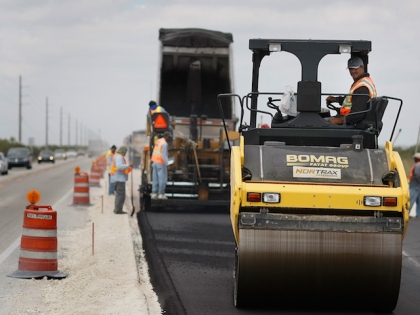
    VDOT construction project. (Click for more legible image.)

    The Virginia Department of Transportation is doing its best job of delivering projects on budget and on time since FY 2010. According to VDOT’s most recent quarterly report, the department had 340 maintenance and construction projects due for completion during the October-December quarter. Of those, 77.1% were completed both on time and on budget — edging out its target of 77%.

    Stated Governor Bob McDonnell in a prepared statement: “Iโ€™m pleased
    to report that VDOT is on-time and on-budget for all VDOT-managed construction and maintenance projects during this quarter. This is especially significant since so many additional projects and project phases are under way following our historic investment in transportation made during last yearโ€™s General Assembly session, advancing more than 900 projects.โ€

    It’s good to know that VDOT performance is meeting goals. Kudos all around. But the governor’s statement leaves a few questions unanswered.

    • Now that VDOT has met its 77% target, is it realistic and appropriate to raise the target — say, to the 83% on-time/on-budget performance of the 2Q of FY 2009?
    • The on-budget/on-timeย performance wasย the best since FY 2010. Gosh, that means it was the bestย in six quarters. Not exactly earth shaking news. Indeed, the question arises, why didย VDOT performance dipย in FY 2011, when only 66% of projects came inย on-time and 68% on-budget?
    • While we’re on the subject,ย how does the most recent quarter compare to years before FY 2010? VDOT has been tracking performance for nine years now. How does current performance stack up against the best performance recorded?
    • Given the fact that bids are coming in 15% or so under official VDOT estimates, why are any projects coming over budget?

    Bacon’s Rebellion — asking the questions nobody else asks.

    Update: To answer some of the questions above, it seems that VDOT hit 80% on-budget/on-time in 2007 and maintained that level for the next two years. So, my new questions are (1) what caused performance to dip in 2010, and (2) why would the McDonnell administration bring attention to an issue that no one was asking about?

    — JAB


  • Creating a Real Medical Marketplace in Virginia

    Graphic credit: American Enterprise Institute

    by James A. Bacon

    Excellent story in the Times-Dispatch today. Too bad it’s buried on the business page. It should have been squeezed ontoย the front page, or at least in theย A section, to shareย space with the wall-to-wall coverage of abortion,ย gun bills and the rest of the Culture War effluvia that so mesmerizes the reporters and editors of Virginia’s newspapers.

    The underplayed article focuses on a topic that affects everyone, rich and poor, young and old: the lack of price transparency in health care. Tammie Smith illustrates the point by recounting the story ofย Lisa Ownby, a Williamsurg mother of two boys who suffer from a condition in which their tooth enamel easily erodes. Dentists recommended complex oral surgery for the two. But when Ownby asked how much the procedures would cost, no one could tell her.

    “I was told I could not be given a dollar amount of what I’d owe,” she said. Figuring that the procedures might cost her a $1,000 copay, she went ahead and had the procedures done. She was floored to find that the charges amounted to nearly $40,000 beforeย health insurance-negotiated discounts. The final charge was $17,000 paid by the insurer and $3,000 out of pocket.

    “If I had known it would cost $40,000, I would have said, ‘No.’ They were baby teeth,” Ownby said. “It’s not even like they were saving permanent teeth. I could have chosen to say, ‘I couldn’t afford this.’ I wasn’t given that option.”

    This story highlights the greatest single failing of the American health care system today: the total lack of price transparency. It is ludicrous to describe what we have today as a “market-based” health care system, and an intellectual fraud to attribute the inadequacies of the system to “market failure.”ย When there are no prices, there is no market economy!

    There are two basic approaches to fixing the problem. One approach, adopted by the U.S. and the economically advanced democracies, is to move toward a government-dominated, command-and-control health care economy. The other, attempted only in isolatedย pockets such as cosmetic medicine, Lasik surgery and medical tourism, is toย move toward a consumer-driven health care system in which prices play a major role in decision making.

    Virginia has made some feeble gestures in the direction of increasing price transparency, supporting the activities of the private, not-for-profit Virginia Health Information. VHI has a contract to collect and report state health data, including health care prices on some 30 common medical procedures such as abdominal ultrasound and hip replacement. But VHI lacks the resources to post data for thousands of other medical procedures that Virginians encounter.

    However, HB 343 submitted by my representative, Del. John O’Bannon, R-Henrico, and SB 135, co-sponsored by Sen. Toddy Puller, D-Mount Vernon, and Sen. Dick Saslaw, D-Springfield, would establish a Virgina All Payer Claims Database system. The purpose would be to: “facilitate data-driven, evidence-based improvements in access, quality, and cost of health care through understanding of health care expenditure patterns and operation and performance of the health care system.”

    As O’Bannon told the T-D: “The ultimate goal is to give people knowledge that they can use when they go for their day-to-day health care needs, so that they will know the value of something, what something costs, how good the quality is.”

    This is arguably the single-most important piece of legislation before the General Assembly today, and O’Bannon, Puller,ย Saslaw and other co-patrons should be applauded for collaborating on a bipartisan basis to pull it off. According to the Richmond Sunlight website, the House and Senate both have passed their respective versions of the bill. It is unimaginable to me that Governor Bob McDonnell would not sign the legislation into law, but I have not seen any pronouncement from him on the issue.

    There are a couple of possible sticking points. One could beย cost. It’s one thing to authorize the creation of a medical claims database, another thing to appropriate money to set it up. How much will this cost, and who will pay for it? That’s not clear from the bill.

    Another question is whether the state database would conflict with private initiatives popping up in the Virginia medical marketplace like Castlight, which allows enrollees in major insurance programs to do comparison shopping for doctors, services and conditions. Ideally, the state initiative would complement private-sector initiatives, not duplicate them.

    Consumer dataย cannot come too soon. Large private insurers are increasingly shifting to consumer-driven insurance plans with huge deductibles. My insurance plan combines a high deductible and a Health Savings Account with personal wellness coaching and the Castlight service. But I’m guessing that a relatively small percentage of the population enjoys access to this kind of data.

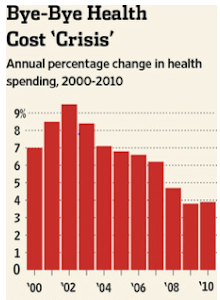
    The spread of consumer-driven health care, contends a Wall Street Journal op-ed written byย the Americanย Enterprise Institute’s J.D. Kleinke, is behind the deceleration in rising health care expenditures that began in 2002, when cost increases exceeded 9%, toย 2009 and 2010,ย when theyย fell below 4% annually.

    Theย AEI mentioned a number of factors responsible forย the decline, including the ability of patients to purchase generic versions of blockbuster drugs developed in theย 1980s and 1990s, advances in prevention and disease management,ย and the shift from Health Maintenance Organizations (HMOs) to consumer-driven health care. (Undeniably, a less positiveย factor was the 2007-2008 recession and slow economic recovery.)

    “Combine all these new medicines, information channels and business
    compulsions with the slow, steady transfer of economic responsibility
    for health care โ€” from corporate and government bureaucrats to consumers
    and their families โ€” and suddenly health-care starts to look almost like
    an actual market,” writesย Kleinke. “Contrary to the perennial doomsaying, the health-care system is — almost in spite of itself — getting better.”

  • Our Upstanding Founding Fathers

    By Peter Galuszka

    Since it is Presidentโ€™s Day and Virginia is the โ€œMother of Presidents,โ€ I thought it might be interesting to put some things in perspective.

    One of the more curious blog postings of late on the site was Jim Baconโ€™s gushy advocacy of a move to private, religious-oriented schools because of what he sees as the massive educational and moral failure of the public school system.

    Naturally, this is not a new idea. There have been church schools galore for decades. But what really interested me was Baconโ€™s canonization of Ann McLean, a โ€œblonde bankerโ€™s wifeโ€ andย  โ€œdevout Christianโ€ who wants to develop what she imagines to be a โ€œclassical educationโ€ that would help develop the moral โ€œcharacterโ€ of students. Jim somehow sees this as passing some made-up โ€œentrepreneurshipโ€ test, making it all A-OK.

    As Bacon puts it: โ€œThe founding fathers, says McLean, understood that humans were by nature selfish and fallen, the only antidote for which was the cultivation of personal virtue. โ€˜The American experiment depends upon an educated populace founded on Christian values,โ€™ says McLean, who makes no secret of her political and cultural conservatism.

    It seems that we are getting a big of romanticizing here โ€“ in this case about the so-called โ€œFounding Fathersโ€ who are now imagined by many conservatives to have actually been early-form fundamentalist Protestant preachers. Iโ€™ve seen a lot of myth-making in my life, especially here in the South where I partly grew up and now work and in the present and former Soviet Union where a lot of 80 and 90-somethings like to gather together, wear their 59 medals from The Great Patriotic War and glorify Stalin.

    But before we get too far afield, letโ€™s take a quick look at who our โ€œFounding Fathersโ€ actually were and what their moral standards actually might have been:

    • The brilliant Ben Franklin was such a serial womanizer, his mastery of swordsmanship helped the fledging United States impress the sex-loving French, who saved our Bacon (forgive the pun) time and again, notably at Yorktown.
    • Money guy Alexander Hamilton had an infamous sex scandal with a married woman.
    • James Buchanan had a close, same sex relationship with a slave owner.
    • If the Founding Fathers were alive today, they would probably despise large corporations that make some of the biggest politician donations today. They especially hated the British East India Trading Company because it roamed the world doing business with other peopleโ€™s money and brutalized many.
    • Thomas Jefferson had his own idea about the Bible. In fact, he took a razor to it. He rearranged Matthew, Mark, Luke and John in chronological order and dumped the Resurrection. Jefferson ended things with the big boulder being rolled up against Jesusโ€™s tomb.
    • Plus, TJ apparently fathered six children with child-slave Sally Hemming. This little taboo has had put the Old Guard of Things Virginian on their heads for years.

    Itโ€™s always fun to look at what the myths are and what the truth is. Unfortunately, Virginia has been hit with branding issues for decades. One always sees everything from strip malls to old aged homes with โ€œPatriotโ€ monikers. Ditto the Tea Party. They are masters of mythology by stealing the โ€œDonโ€™t Tread on Meโ€ rattlesnake flag (which has nothing historically to do with their viewsโ€ and, of course, the usual โ€œPatriotโ€ nonsense, in which they imply they love their country more than you do.


  • Uncertainties and Risks in the Charlottesville Bypass Bid

    by James A. Bacon

    Uh, oh, it looks like the bidding process for the Charlottesville Bypass is running into complications. Prospective bidders for the construction phase of the controversial project, estimated to cost $244 million, have lots of questions… and the Virginia Department of Transportation doesn’t have all the answers.

    A document obtained by Charlottesville Tomorrow under the Freedom of Information Act responds to 220 questions submitted by firms formulating bids. Questions revolve around fundamental points such as traffic projections, noise analysis and bridge design. On 15 occasions in the 33-page document, writes Sean Tubbs, VDOT provides the following response:

    The Department does not represent or warrant that the information contained in the supplemental information package is reliable or accurate or suitable for designing this project.

    When VDOT does provide concrete answers, bidders may not always like them:

    • The contractor will be responsible for designing and paying for any environmental mitigations that might be required as part of a Federal Highway Administration review not due to be complete until later this year.
    • The contractor is responsible for acquiring any additional right-of-way that might be required to meet revised stormwater management requirements.
    • The winning contractor must produce a traffic study showing thatย its design for the 6.2-mile bypass and two interchanges can maintain a level of service of โ€œCโ€ — continuous and free-flowing — by the yearย 2036.
    • The builder must demonstrate to the U.S. Army Corps of Engineers that wetlands near the South Fork Rivanna Reservoir will not be impacted.
    • The builder must confirm with the Virginia State Historic Preservation Office that its plan avoids cultural-resource sites.
    • VDOT will not increase the $100,000 paid to each team for producing a qualified proposal.
    • To keep the procurement process on schedule, VDOT will not take time to answer any more questions.

    The bidding process shows every sign of being rushed in order to meet a schedule imposed from above. Here’s what taxpayers have to worry about: Uncertainty will heighten the perception of risk among bidders. Bidders may feel compelled to pad their bids to offset those risks — better to lose the job than to win a money loser — and some may drop out of the bidding entirely.

    I’m not sure what happens if the low bid exceeds the $197 million allocated by the Commonwealth Transportation Board to cover the balance of the project’s costs. Presumably, the administration will have to go back to the CTB and ask for a supplemental allocation. Given the way the administration hid the cost and design controversies raging inside VDOT at the time (see “In the Dark,”), the McDonnell team may have some explaining to do.


  • How to Leverage an Indexed Gas Tax

    The state Senate has passed a budget bill, which must reconciled with the House of Delegaes budget bill, that seemingly does something right: It rejects Governor Bob McDonnell’s idea of diverting up to one-quarter of a percentage point from the state’s 4.5% sales tax from the General Fund to transportation. Transportation should be funded on a “user pays” basis to the greatest extent possible and should not compete with other core functions of government that lack a dedicated revenue source.

    In place of that diversion, the Senate proposes indexing the motor fuels tax, now 17.5 cents per gallon, to the U.S. Department of Labor’s producer price index for non-residential construction. This provision recognizes that the gas tax, adjusted for inflation, has eroded so dramatically since 1986 that the state is fast running out of money for new construction.

    Eventually,ย Americans will shift to alternate energy sources such as all-electric vehicles, propane, natural gas or even fuel cells.ย At that point,ย Virginia will have to give serious consideration to aย Vehicle Miles Driven tax. But that day is years off.

    A more immediate concern is that the Senate bill dumps more money into Virginia’s transportation system withoutย reforming the wayย the money is spent. It is widely acknowledged thatย Virginia needs to align decision-making for transportation and land useย at the same level of government. The McDonnell administration is inching closer to doing precisely that:ย devolving responsibility for secondary roads to local governments. The political sticking point is the localities’ fear that they’ll get get stuck with the expense without sufficient means to pay for it.

    Added revenue from indexing the gas tax could make devolution more palatable politically if it were used to sweeten the pot for local government. As such, the tax should be tied to a fundamental reform of the transportation system, not part of a Business As Usual budget bill. Use the money to drive structural change that not only puts more money into road building/maintenance but encourages local government officials to make more responsible decisions about land use, which determines demand forย roads and highways in the first place.

    — JAB


  • Why Tobacco Exports Are Wrong

    By Peter Galuszka

    Virginiaโ€™s business lobby is blasting President Barack Obama for balking at pushing U.S. grown tobacco leaf in upcoming trade talks involving Pacific Rim nations.

    Barry E. DuVal, president and CEO of the Virginia Chamber of Commerce, complains that Obama is โ€œtargeting tobaccoโ€ by trying to leave it out of upcoming talks involving the Trans-Pacific Partnership involving Australia, Brunei, Chile, Malaysia, New Zealand, Peru, Singapore, Vietnam and the U.S.

    Doing so, writes Duval, โ€œis a step in the wrong direction and is cause for serious concern.โ€

    What, actually, is a step in the wrong direction and a cause for serious concern is DuValโ€™s disingenuity about the issue. The fact is, according to the World Health Organization, tobacco killed 100 million in the last century globally and could kill up to 1 billion (thatโ€™s billion with a โ€œbโ€) in this century.

    โ€œNearly 80 percent of the worldโ€™s one billion smokers live in low and middle income countries,โ€ according to the WHO.ย  Thus, the countries where Virginiaโ€™s leaf exports go are not well equipped to handle the tremendous health toll on their populations from smoking. They do not have the funds to treat lung cancer or various other lung diseases, especially in countries where ignorance about the fatal consequences runs high.

    Duvall dodges the issue. โ€œTo be clear, this will not reduce smoking or improve public health in any measurable way and will only punish Virginia farmers by shutting them out of the global market.โ€

    Hot flash to Mr. DuVal. Virginiaโ€™s tobacco growers have been in serious decline for years, especially since changes in tobacco regulation took away the federal quota system that made tobacco growing four times as profitable as growing useful crops like corn or soybeans. This happened roughly a decade ago, but maybe it is news to DuVal.

    Another dirty little secret is why Philip Morris USA and Altria just happened to relocate from New York to Richmond a few years back. A mass of lawsuits on health issues convinced Philip Morris to split itself into two firms.

    One was to go to Richmond and urge people not to buy its products while selling them anyway. Look at its Website if you donโ€™t believe me.

    The other part, Philip Morris International, moved to Switzerland where, according to The Wall Street Journal, it ruthlessly markets higher nicotine and tar products to unsuspecting, low income people in places such as Indonesia, Malaysia, Russia, China and India.

    DuValโ€™s argument seems to be that Virginianโ€™s should sell deadly products overseas because, hey, itโ€™s legal and it wonโ€™t matter much anyway regarding health concerns. Thatโ€™s rather cynical.

    Obama should hold firm on the issue when his representatives meet in Australia next month. If Virginiaโ€™s growers donโ€™t like it, maybe they should consider switching their crops to more useful ones if they havenโ€™t already.