• Bail outs for Failed States? No Way!

    The Blue State governance model

    by James A. Bacon

    As Greece stumbles towards default on its budget promises and the European Union continues its slow-motion meltdown, a growing number of people are wondering if default is in the cards within the Dollar Union, in other words, the good ol’ United States of America.

    California’s projected budget gap has increased from $9 billion in January to $16 billion today, a gap that Gov. Jerry Brown proposes to close with a debilitating combination of tax hikes and spending cuts. Meanwhile, despite jacking up income taxes last year (or perhaps because of it), Illinois faces a $2.7 billion revenue shortfall. In desperation, Gov. Pat Quinn is pushing cuts to programs serving his core Democratic constituencies, Medicaid recipients and public sector employees.

    The Blue State governance model is in free fall. Normally, states don’t incur budget crises until a recession devastates their revenues. Now, we’re experiencing budget crises three years into a business cycle. I would advance the argument that a number of Blue States — California and Illinois, most visibly — have entered into an irreversible downward spiral. If they don’t raise taxes and cut spending, they will default on their debts, with incalculable consequences. If they do raise taxes, they’ll chase businesses and the productive class out of the state. If they cut spending programs, they will betray their core constituencies. When the U.S. falls back into recession, as eventually it will, the Blue States are toast.

    Now people are seriously pondering the possibility of bailouts for failing states. In a Wall Street Journal op-ed, Representative Kevin Brady, R-Texas, and Senator Jim DeMint, R-South Carolina, argue that it’s time to take that option off the table.

    As big government-low growth states fall deeper into the fiscal hole, the question becomes whether Washington politicians will force taxpayers in more prudent states to bail them out. This cannot be allowed to happen. As the 2008 financial crisis proved, bailouts never solve anything. They only create more problemsโ€”moral outrage on one side, and moral hazard on the other.

    It is becoming clear that the only way to force recalcitrant states to put fiscal reform on the table is for Congress to take state bailouts off of it. Recent experience on Wall Street and in Athens suggests that if decision makers in Illinois, New York, California or anywhere else believe Washington will bail them out of their fiscal mismanagement, we cannot expect any self-directed reform from them. … Congress mustโ€”in word and if necessary in lawโ€”make plain that the taxpayers will not protect these states from the consequences of their policies.

    I whole-heartedly concur. Virginia is among the fiscally responsible states that have worked diligently on a bipartisan basis to balance budgets, issue debt with restraint and maintain an attractive business climate. We haven’t done everything right by a long shot — as I frequently remind readers. Over and above engaging in dubious budget tricks, we have pusillanimously avoided fundamental reform of basic institutions from education and health care to transportation and land use. But, hard as it is to believe, we’ve screwed things up less royally than many others. Virginians should not be asked to pay for the glaring failures of others.

    Virginia’s Congressmen need to join Brady and DeMint to make it crystal clear that they will oppose any bid to bail out failed states… a bid that is surely coming, whether nextย  year or next decade. It won’t be hard for Republican representatives, who have no sympathy whatsoever for the travails of the Blue States, to say no. But Democrats could find themselves conflicted.

    Republican candidates for Jim Webb’s U.S. Senate seat should press the inevitable Democratic nominee, Tim Kaine, on whether he would vote to bail out the blue states. Get him on the record. If he waffles, make it a campaign issue.

    For that matter, it wouldn’t hurt to put heat on Sen. Mark Warner. While Warner has been vocal about the dangers of the impending federal budget apocalypse, he voted for the Obama stimulus and for Obamacare. Virginia voters cannot take it for granted that he would oppose a budget-busting bail out of failed Blue States. Let’s get him on the record.

  • How Robots in Parking Garages Can Advance New Urbanism


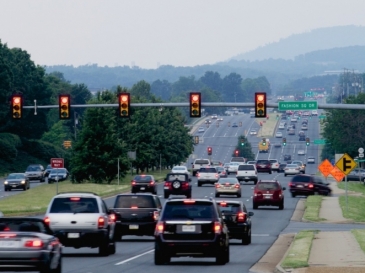
    Robotics and information technology are migrating off the factory floor and appearing in the most remarkable places. Boomerang Systems, an exhibitor at the Congress for the New Urbanism conference last week, outfits garages with automated parking systems. In projects where construction costs are high or land is valuable, it can make economic sense for property owners to invest in the company’s RoboticValet service.

    RoboticValet works like this: A passenger drives his car onto a foot-high palette. A robot the shape of a giant gift box slips under the palette and provides the locomotion. Following electronic guides embedded in the cement floor, the robot steers the car to its parking space. The system conserves space in several ways: (1) there is no need for a ramp, only a car elevator, (2) robots can move the palettes sideways and can spin in place to change directions, (3) cars can be parked two or three deep and need no space for opening doors, and (4) there is no need to provide for passenger entry and exit.

    RoboticValet isn’t cheap — the robotic system costs between $12,000 and $15,000 per parking space, says Rich Cline, Boomerang’s VP of business development. But, depending upon the circumstances, the system can cut the space requirements of parking decks in half. With structured parking costing between $10,000 to $30,000 per space, and twice as much if underground excavation is required, building owners can save a lot in construction costs or free up valuable space for lease to tenants. Other advantages: the robotic equipment can be depreciated more rapidly than buildings, money is saved on lighting and ventilation systems, and car owners aren’t at risk of dings and scrapes from maneuvering in tight places.

    Boomerang Systems, which started as an automated self-storage enterprise, got into the business after developers and architects asked for a more space-efficient way to park cars, says Cline. The first system was installed October in Crystal Springs, N.J., another is going into a condominium project in Miami, Fla., and the company has 10 projects under contract to deliver 3,000 parking spaces over the next 18-24 months.

    Bacon’s bottom line: It will be interesting to see how this business progresses. The technology is expensive but in the right projects it can bring down the cost of structured parking and it can free architects to be more creative with how they utilize space. By itself RoboticValet won’t significantly alter land use patterns, even if it proves commercially viable, but it is one more tool that can help make density work.

    — JAB


  • McDonnell Still Plugging Port Development Subsidies

    Governor Bob McDonnell is campaigning hard for an amendment to the 2013-2014 budget that would provide grants to companies locating in the Port of Virginia Economic and Infrastructure Development Zone. A press release from the Governor’s Office lists more than 30 local governments, Chambers of Commerce and other groups, from the Virginia Manufacturers Association to the International Longshoreman’s Association, that support the measure.

    The General Assembly had rejected an earlier proposal that offered tax credits on the grounds that tax credits are harder to track than grants. Grants would range between $1,000 per new job for companies that create 25 or more new jobs to $3,000 per job for companies that create 100 or more jobs. Companies involved in distribution, manufacturing, warehousing, wholesaling and the maritime sector would qualify. Total grants would not exceed $5 million in any year.

    McDonnell offered this rationale: “Businesses, local governments, and citizens all across the Commonwealth recognize the tremendous importance of the Port of Virginia and its role in spurring economic development and job creation. As we look forward over the rest of this decade, this impact is project to grow tremendously. To realize this growth potential, however, we have to level the playing field with our competitors and incentive the distribution, manufacturing, multi-modal, warehousing and other types of facilities necessary to support a major international port to come to Virginia. Without these types of incentives, the economic development and job creation opportunities surrounding our port will go elsewhere and our competitors will continue to grow.”

    Focus on the words “support a major international port to come to Virginia.”

    What is this? Is an international corporation considering building a new port in Virginia? If so, who is this entity? Where would they build? Is this entity playing Virginia off against other states? Can we get a clearer explanation of why subsidies are needed over and above the Governor’s Opportunity Fund? Can we have a little more transparency, please?

    Update: The General Assembly approved this amendment to the budget May 14.

    — JAB


  • Cville Bypass Bids Come in Under $244 Million Estimate… Or Maybe Not

    Photo credit: The Hook

    The low bid for the Charlottesville Bypass, submitted by Virginia Beach Skanska- Branch/JMT, came in below cost estimates, says the Virginia Department of Transportation (VDOT), as reported by Charlottesville Tomorrow Friday. โ€œBased on the apparent low bids all project costs are within the allocated amount in the Six-Year Improvement Program,โ€ said Lou Hatter, spokesman for VDOTโ€™s Culpeper District.

    But foes of the controversial bypass say the cost will exceed official estimates. “The Virginia Department of Transportation opened the bids from contractors to build the Charlottesville Western Bypass–which ranged between $18 million and $96 million higher than VDOTโ€™s estimated construction costs as best as we can determine based upon the very limited information we have received from the agency at this time,” said Jeff Werner, Albemarle and Charlottesville land use officer for the Piedmont Environmental Council in a press release.

    Moreover, said Werner, the public still doesn’t know what it’s getting for its money. The bids are based on preliminary designs that haven’t been made public yet. The designs submitted by bidders under the design-build project may vary significantly from the sketches displayed by VDOT during public hearings.

    Last year, the Commonwealth Transportation Board voted to allocate an additional $197.4 million to the bypass, a sum that would cover construction, design and additional right-of-way acquisition. The CTB approved the sum unaware of controversy inside VDOT over how much the project would cost. The McDonnell administration later acknowledged that the original design might have to be modified but contended that there was ample cushion thanks to efficiencies resulting from the design-build process and a track record of construction bids coming in below estimate in recent years.

    The total cost of the project, including money spent on engineering and right-of-way, is estimated to be $244.5 million. Of that amount, reports Sean Tubbs for Charlottesville Tomorrow, VDOT had set aside $125.6 million for additional engineering and construction. Skanska’s bid was $136 million, or seemingly $10 million higher. (The highest bidder submitted a bid of $214 million.)

    It was not clear from Tubb’s story how VDOT could claim that the Skanska bid came in below estimate. Nor was it clear from its press release how the PEC calculated an $18 million cost overrun. The issue is of more than academic importance. If the project cost exceeds the amount allocated by the CTB, the McDonnell administration might have to go back before the board and request additional funds. Getting approval might not be so easy second time around, given all the events that have transpired in the past 10 months.

    Werner said the bids did not include several important elements, including landscaping, noise mitigation for neighborhoods and schools, and other adjustments as may be required by an environmental assessment that is not yet complete.

    If I can sort out the issues, I’ll follow up with another blog post.

    — JAB


  • Americans Need to Drive Less, Walk More

    by James A. Bacon

    WEST PALM BEACH, FLA.–Something is very wrong with America’s health,ย Dr. Richard Jackson, professor of environmental health sciences at the University of California-Los Angeles, told the Congress for the New Urbanism today.ย Rates of depression, obesity and diabetes are soaring. “We’re looking at the first generation in American history that will have a shorter life span than their parents.”

    There is no single villain behind the deterioration in public health. But from a big-picture perspective, the problem is easy to explain. Americans are eating more than they did 30 years ago, and they’re getting less exercise. And a major reason they’re getting less exercise can be traced to changes in the built environment. “The environment is rigged against the child and rigged against the doctor,” he said. “We have medicalized what is an environmental health challenge.”

    Jackson was preaching to the converted. New Urbanists have long fought the auto-centric design of the American suburbs and preached the virtues of compact, walkable, mixed use communities. Originally, walkable communities were seen mainly as an antidote to traffic congestion, the high cost of automobile ownership and the erosion of community. But in recent years, New Urbanists have been touting the health advantages of urban design that make it practicable for people to walk and ride bicycles.

    Jackson blasted the contribution of automobiles to mortality and illness at many levels. Automobile crashes are the number one cause of death for Americans between the ages of three and 33, he said. Air pollution from cars and trucks causes an ever larger number of deaths. Children living in communities with high levels of pollution have 3.3 times the risk of asthma than children living in communities with low levels. But the greatest health threat of all is the lack of physical exercise. Children enjoy little mobility in suburban communities. They cannot walk to school, visit their friends or engage in scheduled activities unless driven by an adult.

    Children are out of shape, and obesity rates are surging, Jackson said. Only 37% of California kids can meet a fitness standard of running/walking a mile in 12 minutes. Two out of seven volunteers get rejected by the military because they don’t meet minimal fitness standards. By 2030, obesity rates for adults are projected to reach 42%.

    Physicians have found they can’t treat obesity with medication, and counseling doesn’t seem to work. The environmental factors reinforcing over-eating and under-exercising are too strong. It may be possible to reduce caloric intake by such measures as taxing soft drinks, Jackson said, but Americans need to re-build their communities to get them out of cars and onto sidewalks and bicycles. The nation needs to “make physical activity a routine and integral part of life.”

    Bacon’s bottom line: I don’t agree with all of Jackson’s prescriptions (like raising taxes on sugar), but there’s no denying that he’s diagnosed the problem. For what it’s worth, obesity seems to be a particular problem in Virginia. Hampton Roads is the 4th fattest region in the country, according to a recent Newsweek tally, and Richmond is the 2nd fattest! Holy moly! No wonder the Bon Secours Virginia Health System sponsored Jackson’s presentation.

    As Jackson said, this is a “code blue” emergency. Obesity and the health complications arising from it, particularly hypertension and diabetes, will cost the health care system hundreds of billions of dollars that will cost even the healthy among us. Time to get cracking!


  • Krier Decries Kitsch, Inhuman Scale of Modernist Architecture

    WEST PALM BEACH, FLA–Leon Krier, one of the world’s leading neo-traditional architects and urban planners, finds a lot to be unhappy about what planners, architects and developers are building these days. He dislikes high-rises and skyscrapers, which he views as affronts to human scale. He detests modernist architecture, which, by sacrificing traditional forms and proportions, fills the landscape with kitsch. He loathes the use of synthetic materials, which replace natural materials rooted in local environments and cultural traditions. Vast swaths of the built environment are not only ugly and inhuman but they are built upon a foundation of the fossil-fuel economy that will collapse sooner or later.

    “We have created problems for which there is no human resolution,” said Krier this morning in a keynote address to the Congress for the New Urbanism. “There is a love story and religious respect for hyper-scale. … These things are unstoppable and unreformable.”

    Krier provided a pessimistic note in an otherwise forward-looking and up-beat conference. Many of his comments presupposed the audience’s familiarity with ongoing debates and schisms in the architecture/planning field and, for rustics such as myself, called out for more context. Much of his address was unbloggable.

    However, one theme did emerge that I find worth illuminating. It is Krier dogma that buildings should be built to a human scale. “If I were dictator,” he said, “I would dictate that no building be more than three floors high.” Invariably, people would figure out how to get around the dictator’s rules and maybe build to fourย or five stories, which would be fine.

    He views skyscrapers and high-rises as “vertical cul de sacs,” as egregious as the horizontal dead ends of suburbia. Skyscrapers isolate people in their buildings and limit human interaction. People arrive in cars, park in underground parking lots and ride elevators to their offices. Then they leave the same way. The streets at ground level are often empty of people.

    The genius of the development style in traditional European cities — he didn’t say this, but I’m extrapolating here and drawing upon Richard Florida (see previous post) — is that they achieved a density and design that optimized human interaction. Humans are social creatures and they crave interaction, so Krier’s optimal density satisfies basic human needs. Also, the often-random encounters that occur on city streets spark new ideas that lead to innovation. Finally (borrowing from urbanist Jane Jacobs) Krier’s optimal density puts more “eyes on the street,” which reduces crime and other anti-social behavior.

    Thus, if I am reading Krier correctly based on his remarks, there is an optimal level of density somewhere between what we see in American suburbs and what we find in Manhattan. To maximize peoples’ satisfaction with their surroundings and spur creativity and innovation, we should strive to build communities that achieve that optimal level of density.

    — JAB


  • The Creative Class Meets New Urbanism

    by James A. Bacon

    WEST PALM BEACH, FLA–Richard Florida, the author of the “Rise of the Creative Class,” has long remarked upon the creative class’ penchant for living in certain cities rather than others. He has devoted much of his energy over the past 10 years to illuminating the importance of a community’s tolerance for cultural diversity and its openness to newcomers as a trait valued by the creative class. But there has always been as sub-theme in his writing. Creatives also are drawn to cities with a vibrant urban fabric.

    In my own Virginia-centric writing about economic development in knowledge economy, I have drawn upon Florida’s insights about the creative class to argue that one of the ย challenges facing Virginia’s metro regions is creating an environment where creatives want to live. And I have turned to the work of the New Urbanists for insight into how to create more livable and sustainable communities.

    Thus, it was a source of great delight to hear Florida address the 2012 Congress for New Urbanism this afternoon here in West Palm Beach. Florida and various New Urbanism luminaries had crossed paths before, but this was the first time he ever participated in a CNU event. Most ย of his remarks were vintage Florida, familiar to anyone who has read his books. But he threw out fresh meat to creative class junkies like myself by sharing the results from some of his recent research.

    Florida’s original insight was that corporations are not the key drivers of economic growth and development. Members of what he calls the “creative class” — those artists, scientists, educators, entrepreneurs, professionals and solvers of complex problems who comprise roughly 30% of the workforce and account for the vast majority of innovation in our society and economy — drive economic development. Corporations follow the talent. They do business where they can gain access to people with the skills they are seeking. Additionally, when creative people ย mix, mingle and combine ideas, they ferment entrepreneurial opportunities, generating new enterprises from the ground up.

    The moral of the story: Rather than recruit corporations and corporate investment directly, regions should focus on creating an ambiance that attracts and retains the creative class. For the most part, creatives aren’t looking for the traditional cultural status symbols like stadiums, convention centers, symphonies and ballets. They are looking for cool neighborhoods with vibrant street culture and “authenticity,” an urban fabric rooted in the city’s unique history and culture, as opposed to the sterile mall culture of chainย stores and restaurants.

    Florida identifies three primary things that give people purpose, meaning and happiness in life. First is family, friends and social relationships. Second is the ability to perform creative work. And third is the place where they live. Sure, everyone wants low crime, good schools, a clean environment and the presence of arts and culture. But two traits drive strong emotional attachment to a region. According to Florida’s recent research, the second most important factor is tolerance — openness to diversity regardless of race, religion, ethnicity and sexual preference. The most important is the community’s aesthetics, beauty — what he calls the “quality of place.”

    The quality of place is something that the New Urbanists think about day and night, and their influence upon Florida’s thinking is clear. In Florida’s mind, quality of place is influenced by a number of factors: (1) the degree to which a city (or region) has valued and preserved its history and heritage; (2) the extent to which neighborhoods are walkable, have mixed uses and offer transportation alternatives, (3) the depth of community investment in arts and culture, including popular art and music, not just the high-brow stuff, and (4) the integration of the natural and built environment in a way that’s accessible to the population. Thus, things like parks, rivers and tree canopy assume far more importance than traditional economic developers would ever imagine.

    As I consider my home town of Richmond, these things all ring true to me. That’s why I’ve been blogging recently about building murals, indie bands and art districts as a sign of Richmond’s cultural renaissance and eventual entrepreneurial rebound. There will always be a role for recruiting corporate headquarters, back offices and manufacturing facilities. But, as Richmond has discovered the hard way, corporations come and go. Traditional economic development must be accompanied by community development — creating the “great places” that attract and retain society’s wealth creators. Richmonders are making that transition in thinking, but they are not fully there yet. I’ll do what I can to nudge them in the right direction.


  • What the New Retail Revolution Means for Building Vibrant Communities

    Ghost shopping mall

    by James A. Bacon

    WEST PALM BEACH, FLA–Americans between the ages of 16 and 34, known collectively as the Millennial Generation, are exerting a powerful influence upon the economics of the retail industry and thus, indirectly, upon real estate development and community revitalization. That was the message I got from a presentation by Kennedy Smith, principal of the Community Land Use and Economics Group, in a presentation today at the Congress for the New Urbanism.

    Millennials aren’t as interested as their parents are in buying a lot of stuff and accumulating possessions, Smith said. They are more likely to purchase used products or acquire products that last a long time. They are more likely to rent before they buy. Perhaps most significantly, they place a higher value on the shopping experience. They like to know the story behind the product — where the potatoes in Lay’s Potato Chips were grown, for instance. And they prefer unique, authentic and locally owned places over cookie-cutter chain stores.

    The changing tastes of this massive generational cohort, which at 80 million strong is as large as the Baby Boomer generation, adds to the woes of the retail sector, which is reeling from the collapse of credit-fueled growth in consumer spending, increased competition from Internet-based retailers and the new possibilities created by the rise of social media.

    “We have to unlearn what we’ve learned about the way retail works,” Smith said. Phenomena like smart phone-powered flash mobs and geotagging, which allows people to append photographs and commentary to a geographical location found on Google Maps, are changing the rules of the game. ย There still will be a role for traditional “destination” retail and for “convenience” retail but that role will be diminished. Social and technological trends appear to be shifting in favor of nimble, entrepreneurial retailers who can offer place-based experiences impossible to replicate in chain stores and who utilize social media to build loyalty with customers.

    Mall occupancy is declining, and Smith does not see the trend reversing. The United States is the most over-retailed country in the world to begin with, and the big chain stores that anchor malls and shopping centers are swimming upstream against negative market trends. The big retail chains will shrink. Big box stores will shift to smaller footprints. Retailers will seek to develop new distribution channels, making greater use of everything from vending machines to Internet fulfillment. Smith said that 25% to 30% of the nation’s shopping centers will be re-purposed.

    So, what does that mean for the evolution of human settlement patterns? Smith did not speculate. But basic conclusions seem evident enough. The retail sector, a key driver of real estate development, may experience development activity in high-growth metro areas or in localized re-development projects but it will suffer prolonged contraction overall. Virginia will see more ghost malls and phantom shopping centers, and local governments will lose a major source of sales and property tax revenue.

    While stock holders in large retail chains may take a beating, the trends augur well for home-grown entrepreneurs. For decades, the economies of scale favored giant retailers who could conduct national advertising campaigns and build hyper-efficient supply chains. ย The Wal Marts, the Targets and the Best Buys drove tens of thousands of mom-and-pop stores out of business. But one thing the chains cannot mass produce is the authenticity derived from strong local roots and sense of place. Neither are chains well equipped to build the same personal bonds with customers.

    Local government practitioners need to master new best practices for growing a vibrant retail sector. Once upon a time, all it took was working with developers to open new malls and shopping centers. The critical new skill set will be knowing how to develop a strong sense of “place” — unique locations with strong local roots, authenticity, character and charm. By their nature, these places cannot be mass produced. They can only be grown organically, nurtured by the shared passion of many small businesses and individual property owners. Local governments can’t force feed these places but they can help by creating attractive, walkable streetscapes and providing supporting servicesย such as parking, mass transit and/or law enforcement.

    Local governments that crack the code early in the game will prosper. Those that are slow to get the message will flounder.


  • New Urbanism Needs a Re-Boot

    Andres Duany. (Photo credit: Domus)

    by James A. Bacon

    WEST PALM BEACH, FLA–Since its genesis three decades or so ago, the New Urbanism movement looked to the 1920s as the golden era of urban development in the United States. City builders had adapted to the rise of the automobile as dominant transportation mode while retaining continuity with previous urban forms that emphasized walkability and human scale. But the time has come to look to a different era for inspiration, the 1870s, says Andres Duany, one of New Urbanism’s founders and intellectual leaders.

    Planners, developers and designers need to adjust to the new age of economic austerity, said Duany at a plenary session of the 2012 Congress for the New Urbanism this morning. America needs to embrace “lean” development, a concept that encompasses both “green” building and sustainability and economic efficiency. New Urbanists need to create business models that allow development to occur incrementally and on a smaller scale without mega-millions in hard-to-get project financing. “The new economy is about doing things economically.”

    “By our wits, we colonized a continent” in the second half of the 19th century, said Duany. Somehow, Americans managed to do it without a Department of Housing and Urban Development and without banks that bankrolled massive real estate deals. Somehow, Americans housed tens of millions of immigrants and laid out some of the country’s great cities, from Oklahoma City to Portland “out of nowhere” — cities that created so much wealth that they could support opera houses and universities.

    The masters of the system, said Duany, were the Mormons. Between 1855 and 1905 they laid out 534 towns and cities, from Salt Lake City to San Diego. The Mormons were so poor then they they couldn’t afford Conestoga wagons. Yet they were brilliant managers. Not one of their towns failed. One Mormon secret was the large city block, one of the most flexible constructs in America. These urban units could be cut up into villages or they could accommodate an entire university. They were supremely adaptable and capable of evolving to meet new conditions.

    In new projects he is working on, Duany said, he is looking for ways to bring down costs. Previous New Urbanism design tropes from the 1920s, such as mixed uses within a single building (retail on the ground floor, residential on the second and third floors) often are too expensive for the current economic environment. One solution is to achieve mixed use horizontally — placing flatter buildings with different uses adjacent to one another.

    In other remarks, Duany defended the New Urbanism Smart Code, an open-source template for urban design originally developed by his firm, Duany Plater-Zyberk & Company, as an alternative to traditional zoning codes. He does not hold up the Smart Code as a universal prescription. But the country needs an alternative to the traditional zoning codes that are largely responsible for the phenomenon of suburban sprawl.

    ‘The default setting in America is to have a code,” Duany said. But the dominant code built around segregated land uses leads to “kitsch.” It is dysfunctional. And efforts to circumvent its rigidities, such as handing over decisions to “aesthetic committees,” can lead to arbitrary decision making. “I would rather know what the rules are than be subject to the opinions” of such committees, he said. Moreover, the United States has 27,000 planning departments. They aren’t going away. The Smart Code provides them an alternative set of rules to apply.

    However, Duany acknowledged that there needs to be “code free” zones, or at least zones free from the strictures of the Smart Code. Thirty percent to 40% of the population doesn’t want to live in compact, walkable, mixed-use communities, and they shouldn’t be made to. The core principle, he said, is to give people a choice.


  • West Palm Beach, Ho!

    Brace yourself, West Palm Beach, the Rebellion is heading your way!

    Blogging will be spotty the next few days. I’m off to another conference, this time the Congress for the New Urbanism. I’ll participate in a panel discussion, “Understanding the Role of Sustainable Urbanism in the Conservative Agenda,” making the case that the phrase “conservative smart growth” is not an oxymoron. I’ll also bone up on the latest thinking in the New Urbanism movement and, as time permits, blog the highlights.

    — JAB


  • NoVa Prosperity Under Pressure

    Northern Virginia remains the economic engine of the state but it faces major challenges.ย  Job creation isn’t keeping up with population growth and income inequality is growing, concludes the Commonwealth Institute in a new report, “Under Pressure: The State of Working Northern Virginia.”

    Employment grew at a strong pace in 2011: The region added 25,000 jobs, a job-creation rate of 1.9%. But the “jobs gap” — the number of jobs needed to return to a pre-recession unemployment rate — stood at almost 100,000 in 2011.

    Graphic credit: Commonwealth Institute. Click on graph for more legible image.

    More highly educated Northern Virginians have weathered the recession in better shape. Those with a graduate or professional degree experienced a 3.67% decline in real earnings between 2007 and 2010, compared to a 17.5% decline for workers with less than a high school degree.

    In 2010, the median household income in Northern Virginia was $98,700, about 60% above the statewide median, but it was still below the pre-recession peak of $102,600. Moreover, high incomes don’t necessarily translate into high living standards. It took an income of $63,000 in 2010, says CI, for a family of four to maintain a minimal standard of living without public assistance. Meanwhile, income disparity has increased. In 2007, top income-quintile households earned 7.6 times the income of bottom-quintile households. By 2010, the ratio had increased to 8.3%.

    Graphic credit: Commonwealth Institute. Click on graph for more legible image.

    The most interesting finding for those interested in metropolitan dynamics can be seen in this chart showing how wage increases varied by political jurisdiction. Arlington, Alexandria and Fairfax — closest to the metropolitan core — saw the greatest wage increases, while localities on the periphery — Spotsylvania and Loudoun — actually saw declines in inflation-adjusted average weekly wages between 2007 and 2010. This is more anecdotal evidence that growth and development (perhaps we should say “growth and re-development”) is shifting back to the urban core, leaving weakened jurisdictions on the metropolitan periphery.

    — JAB


  • New EPA Regs and the Virginia Economy

    First in line for shut-down: the aging Clinch River power plant. Photo credit: ILoveMountains.org.

    Six coal-fired power plants in Virginia accounting for 35% of the state’s coal-generated electricity could be forced to shut down prematurely by new and proposed Environmental Protection Agency regulations, according to a report, “Economy Derailed,” published recently by the American Legislative Exchange Council (ALEC).

    In a state-by-state breakdown, the ALEC report stated that Virginians could see electricity rates rise by 10% to 15% and lose nearly 11,500 jobs (direct and indirect) accounting for $6.1 million in wages. The Old Dominion would suffer less from the regulations than many other states, however. It did not rank among the 10 states determined to be “worst hit.”

    The EPA justifies the regulations on the grounds that they will reduce emissions of mercury, carbon-dioxide, sulfur dioxide, particulates and other pollutants. ALEC, which promotes conservative causes, contends that the cost far outweighs the benefits. Who should we believe? I don’t know. Regardless, even under the best case scenario, there will be short-term pain for long-term gain.

    — JAB


  • The Agenda 21 Hobgoblin

    O'Keefe

    by William O’Keefe

    The late H.L. Mencken once observed that the โ€œwhole aim of practical politics is to keep the populace alarmed… by menacing it with an endless series of hobgoblins, most of which are imaginary.โ€ย The volume of blogs and other communications from Tea Party members over the U.N. Agenda 21 make me think that the Tea Party has adopted Menckenโ€™s definition of โ€œpractical politicsโ€ as a tactic to use fear to further anti-government objectives.

    Most people regard the United Nations as so impotent and inept that it would have a hard time organizing a three-car funeral. And yet, the anti-Agenda 21 crowd sees it as an insidious threat to our freedoms.ย Is either of these views correct, or is this a case of cognitive dissonance?

    Agenda 21 was a product of the 1992 Earth Summit in Rio de Janeiro.ย  Although the United States attended the summit and supported its final report, Agenda 21 is not part of a Senate-ratified treaty.ย Hence, Agenda 21 is primarily a set of lofty goals that can be implemented only by state or federal action.ย  Here is a summary of what some of these goals are:

    • Human beings are at the centre of concerns for sustainable development.ย  They are entitled to a healthy and productive life in harmony with nature.
    • States have the sovereign right to exploit their own resources pursuant to their own environmental and developmental policies.
    • Development must equitably meet developmental and environmental needs of present and future generations.
    • In order to achieve sustainable development, environmental protection shall constitute an integral part of the development process.
    • To achieve sustainable development and a higher quality of life for all people, States should reduce and eliminate unsustainable patterns of production and consumption.
    • Environmental issues are best handled with the participation of all concerned citizens at the relevant level of impact.
    • States shall enact effective environmental legislation.ย  Environmental standards, management objectives and priorities should reflect the environmental and developmental context to which they apply.
    • National authorities should endeavor to promote the internalization of environmental cost… taking into account the approach that the polluter should, in principle, bear the cost of pollutionโ€ฆ
    • Environmental impact assessment shall be undertaken for proposed activities that are likely to have a significant adverse impact on the environment.

    It is hard to understand why anyone would find these aspirational goals sinister or even objectionable. There is potential danger in their vagueness but most aspirational goals are vague and subject to different interpretations.ย What is important is how they are achieved.ย Is a balanced approach used or one that infringes upon individual rights, property rights and the rule of law? Read more.


  • Virginia Tobacco Bonds in Technical Default. Is Anyone Paying Attention?

    Uh, oh, tobacco revenues declining faster than predicted.

    by James A. Bacon

    Alarming news about Virginia bonds. The NYT reported last week that Virginia is one of three states that have tapped special tobacco-bond reserves to pay their bond holders — “something analysts consider a technical default because it effectively means the bondholders are being paid with their own money.”

    The underlying problem is that the bonds are backed by payments from tobacco companies under the 1998 settlement agreement, and those payments are not coming in as projected. The bonds were issued on the assumption that tobacco payments would decline about 1.8% a year as cigarette consumption slowed. But in fact payments have been declining about 4.1% per year, the Times quotes Richard Larkin, director of credit analysis at Herbert J. Sims & Company, as saying. Writes the Times:

    Many of the tobacco bonds have maturities of decades, and if smoking keeps declining at the current pace, some of the reserves set up as backstops will run dry, Mr. Larkin said. At that point, investors โ€” including individuals, insurance companies and mutual funds โ€” will be at a loss. …

    In Mr. Larkinโ€™s analysis of tobacco bonds issued by seven states and New York City, he found that if tobacco payments continued to decline by 4 percent per year, full-blown defaults would begin in 2024, when Ohio would be about $350 million short on $1.1 billion of tobacco bonds maturing that year.

    New Jersey, California, New York City and Virginia would be several billion dollars short on tobacco bonds maturing in the years after that.

    This can’t be good news, but it’s not clear to me exactly how bad it is. Documents published by the Virginia Tobacco and Indemnification Commission shed no light. The 2012 Annual Report has yet to be published online, and even when it is, it probably will be worthless. The 2011 report contains only a bare-bones statement of assets, liabilities, revenues and expenditures, and it provides no narrative explanation of the commission’s finances. Further, the commission website contains no press releases. There is no record that the commission took any public note of the necessity to dip into the bond reserve fund.

    The Strategic Plan does not discuss commission finances. A 2007 Blue Ribbon Panel provides only a cursory overview of commission finances, mainly touching upon issues relating to the investment of the commission’s endowment fund. The minutes of the January 10, 2012, commission meeting make no mention of invading the bond reserve fund. Minutes of the January 2012 executive committee meeting contain a discussion of the endowment’s financial performance but make no allusion to the bond fund. There’s no mention either in the December 2011 minutes.

    The problem may be less alarming for bond holders than portrayed by the Larkin report. Virginia did not spend the billions of dollars it raised through bond sales right away. It deposited the money into an endowment, which draws a modest interest income, and it has been drawing down the endowment steadily but slowly. As of June 30, 2010, the endowment stood at $923 million. In June 30, 2011, it stood at $830 million. Presumably, the Tobacco Commission could cover any shortfalls from tobacco company payments with its own assets. That would short-change economic-development funding programs in Southside and Southwest Virginia but it would preserve the credit rating of the state bonds.

    Still, any time people in the financial community bandy around the phase “technical default” in conjunction with Virginia bonds, even if those bonds are not backed by the full faith and credit of the commonwealth, it should be a cause for concern. It’s also scary that the “best run state in the country” should be keeping company with the likes of California, New Jersey and New York City.

    Perhaps most disturbing of all is the apparent lack of any discussion of the funding gap in any of the Tobacco Commission documents or anywhere else in the public record accessible by Google. (Perhaps I have missed something. If so, please let me know.) This is a long-brewing problem. It did not pop up overnight. Is the Tobacco Commission board even aware there’s an issue? Is anyone in the McDonnell administration paying attention?

    Hat tip to FreeDem.


  • Clarity Amid Blather on Dulles Rail

    By Peter Galuszka

    It has always been supremely puzzling to me why this blog has taken such a strident and shrill anti-union attitude. The shining example is the smear campaign against project labor agreements (PLAs) and Phase Two of the Silver Line of Metro to Dulles airport. The attacks extend to attempts to liquidate personally Dennis L. Martire, a union leader and member of the Metropolitan Washington Airports Authority, whose crimes against the people I cannot understand.

    This McCarthy-esque anti-union campaign has become dogma among the harder right Republicans in Virginia. Itโ€™s as if weโ€™re standing up and saying there are 50 Communists in the State Department, but no one bothers to ask that the list of names be read because there arenโ€™t any. Ditto the supposed vulnerability of the stateโ€™s anti-union Right to Work law, which has been around for decades and is in no serious jeopardy whatsoever.

    So, after paddling through all the Bacons Rebellion blather regarding the MWAA and the PLA, I find it refreshing to have a moment of clarity. It comes in todayโ€™s Post in a column written by Steve Pearlstein, whose hard-nosed sensibility has caught my eyes before.

    Pearstein zeroes in on the all-Republican Loudoun County Board of Supervisors who are throwing big wrenches into long-standing plans to bring public rail transit to Dulles and bring the official airport of the nationโ€™s capital into the 21st century. Gee, I even lived in the DC area when Dulles was opened in the early 1960s and it still doesnโ€™t have the transit links that most of the major airports of the world have.

    Here are some points from Pearlsteinโ€™s piece:

    • Loudounโ€™s new board is suddenly sticking its nose into something that county officials generally donโ€™t. That is a $5 billion project managed by a regional agency representing three states and dozens of local jurisdictions.
    • Previous Loudoun boards have long ago committed to Dulles Rail. Only 4.8 percent of the Silver extension and half of the cost of the Loudoun stations and track work are being financed by Loudoun taxpayers.
    • The point of the PLA is not to kiss Big Laborโ€™s butt, but to get enough skilled workers to do the job. The first PLA on Phase One involved a no-strike pledge and flexibility on work rules, Pearlstein says.
    • Despite this background in which a functional process was set up and put to work, Associated Builders and Contractors mostly non-union firms, saw some daylight to quash unions as hard right Republicans and Tea Potters canโ€™t strength.
    • A new deal was hatched. No PLA of sorts, but bidders would get extra points in the bidding competition if they had one. Gov. Robert McDonnell and his Transportation Secretary Sean Connaughton seemed OK with this but later went back on it. Thereโ€™s even a new state law outlawing PLAs in the Dulles project.
    • Someone hit the โ€œsendโ€ button on a new propaganda campaigning about the projectโ€™s supposedly exorbitant costs with organized labor somehow responsible. PLAs were alleged to come with a 10 to 15 percent cost markup. ย In Phase One is was actually about 3 percent for labor and non-labor units, in effect, a wash. Little problems with the facts there.
    • Despite opponents claims that no one will use the last link of the Silver Line to Dulles, new studies show that residents within a few miles of the stations will likely start using them for their commutes to downtown DC. The added convenience of rail access should be a bump, although limited, to some housing prices.

    The vicious anti-union campaign has always left me a bit dumbfounded. It would be one thing is there had been a major and crippling strike in the DC area or anywhere in Virginia, for that matter. The only big strikes that I can remember involved Verizon workers about 12 years ago, Steelworkers at the Newport News Shipyard decades ago and the United Mine Workers of America strike in the mid-1980s. There really hasnโ€™t been anything confrontational in years.

    So, why the big attack on labor and Martire and the like? The reason seems to be that the hard right (which may be damning the Romney campaign to the dustbins) has decided that collective bargaining is one the devils it must destroy. We are reeling from barrage after barrage of the evil of labor unions even though Americans have a constitutional right to organize. Unions, which fought for and won better living standards for workers years ago, have been in decline for decades.

    Why are they the target?ย It is somewhat like undocumented aliens. They are an easy target.