• Confederate Monuments’ Uncertain Future

    Some have been banished or destroyed, and others are threatened, while one is slated for reinstallation.

    Bronze statue of a historical figure in military uniform, holding a sword, set against a backdrop of a stone building.
    The Stonewall Jackson monument in Richmondโ€™s Capitol Square, which faces likely banishment, with the Old City Hall in the background. (Photo: Catesby Leigh)

    by Catesby Leigh

    For a vocal minority, the memory of 2020โ€™s โ€œSummer of Love,โ€ with its orgy of โ€œBlack Lives Matterโ€ sloganeering, occupied zones, and statuary vandalism, shines brightly. Itโ€™s not hard to see why. The expulsion of Confederate monuments from the streets, squares, and parks of cities across the South, mostly during the disturbances that followed George Floydโ€™s killing, marks a historic victory for wokedomโ€™s cancel culture.

    Though 2020 is a year most Americans would be happy to forget, the theatrics of statuary excommunication still attract politicians on the Left. President Trump may have resurrected Christopher Columbusโ€™s effigy in the nationโ€™s capital, but Capitol Square in Richmond, Virginia, is now in the crosshairs. With three Confederacy-related statues still in place, including an outstanding figure of Stonewall Jackson (1874) by the distinguished Irish sculptor J. H. Foley, the square also includes a Virginia Civil Rights Memorial, a monument to the stateโ€™s Indian tribes, and a Virginia Womenโ€™s Monument that reflect more recent political concerns and artistic sensibilities. Capitol Squareโ€”site of the statehouse, governorโ€™s mansion, and a multi-figure nineteenth-century monument focused on a mounted George Washingtonโ€”has thus offered a display of the common sense that lost traction during the Summer of Love.

    The crusade against Confederate statues, which has enjoyed the unflagging support of the nationโ€™s progressive media, reflects a flattening rather than a broadening of historical and cultural understanding. Weโ€™re no longer encouraged to ponder the loyalties or virtues of great commanders like Robert E. Lee and Jackson. Weโ€™re supposed to view them as nothing more than โ€œtraitors who killed American soldiers to defend slaveryโ€โ€”poster boys for white supremacy. Regarding them as role models, as many a Southern-born warrior now engaged in the campaign against the Iranian mullahs surely does, is unthinkable. All that matters about Confederate monuments is that they stood or stand for the racial oppression that stains the history of the South. Wokedom thus thrives on a perversely simplistic, Manichean outlook. Its impact on the Southโ€™s public realm, as a vacuous exhibition of banished Confederate statues in Los Angeles attests, has been disastrous. The sooner Americansโ€”North and South, black and whiteโ€”see this authoritarian mindset for what it is, the better.

    (more…)
  • When People Vote with their Feet…

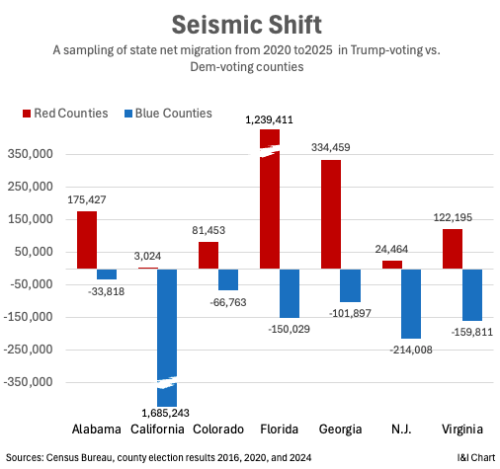
    more move to red states, and red counties in blue states.

    A bar graph illustrating state net migration from 2020 to 2025, comparing Trump-voting (Red) and Democrat-voting (Blue) counties across various states including Alabama, California, Colorado, Florida, Georgia, New Jersey, and Virginia.

    From Issues & Insights:

    The past five years have seen a massive migration of Americans out of heavily Democratic counties and into ones where Donald Trump won majorities in each of the past three elections. … Most analyses of internal migration patterns look only at state-level data. And what they show is that blue states are losing population to red states, and have been for many years.

    I&I wanted to go deeper, so we used the latest Census data on migration betweenย counties, and compared that with how these counties voted in the past three presidential elections. What we found was that millions arenโ€™t just moving out of blue states, but are moving out of blue countiesย withinย states.

    Virginiaโ€™s blue counties lost nearly 160,000 to net migration, while its solidly red ones gained more than 122,000


  • When Schools Overreach

    by Stephanie Lundquist-Arora

    As Virginiaโ€™s public schools fail at their core missionโ€”educating childrenโ€”state legislators are expanding their role in ways that encroach on parental rights.

    Debra Gardner, a former social worker who was first elected to Virginiaโ€™s House of Delegates in 2023, introduced HB 355 in January. Beginning in the 2028โ€“2029 school year, the bill would require Virginiaโ€™s public schools to administer annual mental health screenings to all students in grades 6โ€“12, unless parents choose to opt out their children. The legislation has passed both chambers of the General Assembly and is now awaiting action from Governor Abigail Spanberger, who faces an April 13 deadline to sign, veto, or amend the bill.

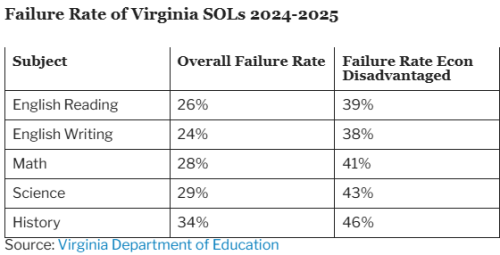
    Virginiaโ€™s public schools are failing at teaching children basic subjects. The table below shows that over a quarter of children in the stateโ€™s public schools are failing their Standards of Learning (SOLs) tests. Rates of failure are significantly higher among economically disadvantaged students.

    Table displaying the failure rates of Virginia Standards of Learning (SOLs) for the 2024-2025 academic year, showing overall failure rates and rates for economically disadvantaged students across subjects: English Reading, English Writing, Math, Science, and History.

    Read the whole column at The Daily Signal.


  • Why Democrats Should Bail out Spanberger on April 21

    by Paul Goldman

    If the current polls showing a close contest are correct, history says the redistricting referendum will be defeated. As a general rule, support for a controversial referendum diminishes as election day approaches. This is due to the unique dynamics of issue referendum politics: if the polls showing the pro-sideย leadย barely higher thanย the statistical margin of error are accurate, the historical data says the late deciding voters will sink the referendum on Election Day.ย 

    As I wrote last year, such a devastating loss would leave Spanberger a hobbled loser at home at the start of her term and a knee-capped sinking star in national Democratic politics. Around the country, fellow Democrats would be scratching their heads asking: how could she win a 57% victory a few months ago, but fail in her effort to help the party nationally combat Trumpism? Their likely answer: She won last year as a lucky recipient of the anti-Trump vote not due to any pro Spanberger constituency. A fatal political analysis.

    My view: Whether you agree with her or not on the constitutional amendment, it serves no useful purpose to turn the Democratic Governorย of Virginia into a lame duck nationally in the fight against Trumpism. The President has made clear heโ€™s trying to remake our republic in his own image by whatever electoral means possible. Heโ€™s playing political hardball to achieve it

    (more…)

  • Fairfax County Coddles Illegal Alien Criminals.

    by Kerry Dougherty

    Two men pose for a photo outdoors, one wearing a black ski mask and leather jacket, and the other in a business suit, both smiling and embracing each other.
    Credit for AI-generated image of Steve Descano: Grok

    More than 1 million people live in Fairfax County, Va.

    They arenโ€™t like the rest of us.

    For reasons no one can explain, voters in this wealthy suburb repeatedly vote for a chief prosecutor who coddles criminals and has an absolutely bizarre philosophy about crime and punishment. Elected first in 2019 and re-elected in 2023, Steve Descano is the worst commonwealthโ€™s attorney in Virginia, and it isnโ€™t even close. Naturally, heโ€™s backed by George Soros money.

    Here is Descanoโ€™s morally indefensible theory of crime and punishment:

    โ€œIf two people commit the same crime, but only oneโ€™s punishment includes deportation, thatโ€™s a perversion of justice and not a reflection of the values of Fairfax County. – Fairfax County Commonwealthโ€™s Attorney Steve Descanoโ€™s website.

    This perverse fondness for illegal aliens who have committed serious crimes – including murder – has resulted in the release of scores of illegals and lenient plea deals for others.

    Normal Virginians are outraged when someone who is in the country illegally turns out to be a predator. Not Fairfaxโ€™s top prosecutor.

    Fairfax prosecutors coddle illegal alien criminals and go to great lengths to keep them in their community, even as the body count rises. They also show compassion for males who sexually assault girls in public schools.

    This insane attitude toward crime will spread across the commonwealth if voters approve the April 21 referendum to gerrymander congressional districts. Continue reading.


  • Spanberger Signs Tighter School Cellphone Ban Into Law

    by Todd Truitt

    Virginiaโ€™s move toward cellphone-free schools has now become a bipartisan through-line across two administrations.

    Democratic Governor Abigail Spanberger yesterday signed Senator Stella Pekarskyโ€™s (D-Fairfax County) follow-up school cell phone legislation, which had unanimously passed the Senate and overwhelmingly passed the House of Delegates. The law tightens the existing ban by replacing the word โ€œrestrictโ€ with โ€œprohibit,โ€ making unmistakably clear that the ban applies from the first bell to the dismissal bell โ€” including lunch and passing periods.

    In July 2024, then-Republican Governor Glenn Youngkin issued an executive order directing the Virginia Department of Education (VDOE) to issue guidance for Virginia schools on school cell phone bans, launching Virginiaโ€™s push toward phone-free classrooms. That VDOE guidance issued in September 2024 defined the stateโ€™s approach as the bell-to-bell model. And last year, then-Gov. Youngkin signed the Commonwealthโ€™s first statewide student cellphone law with that bell-to-bell model, which was almost unanimously approved by the General Assembly.

    But some districts had used creative lawyering around the original lawโ€™s use of the word โ€œrestrictโ€ to allow for exceptions in lunch and/or passing periods. For those school divisions that treated the prior language as flexible, the General Assemblyโ€™s intent is now impossible to miss. It is officially a bell-to-bell prohibition written into state law.


  • Will Union “Dues Skimming” Come to Virginia?

    by Chris Braunlich

    Members of the Service Employees International Union at a recent Loudoun County board meeting.

    There are many reasons why Governor Abigail Spanberger should veto the collective bargaining bill headed to her desk, a bill requiring local and state governments to bargain with union bosses even if less than a majority of public employees want the union or the bargaining.

    There is the fact that it will force major spending increases on local governments, just as it added $350 million to Richmond Cityโ€™s costs when that city voluntarily approved collective bargaining four years ago, and to Fairfax County, which giddily adopted collective bargaining, only to find itโ€™s driven a $300 million shortfall this year.

    Then there is the fact that the state estimates the bill will create new bureaucracies, add 333 new state employees to the payroll and require additional spending of up to $92 million over the next five years before any salary increases.  Those costs will only grow.

    There is also the fact that most local government leaders oppose it, including dozens of Democratic elected officials, who say it would add an unfunded mandate on local governments and school boards, imposing a โ€œone-size fits allโ€ collective bargaining approach on local governments.ย Those Democrats want to see collective bargaining remain voluntary.ย 

    Democrats like Prince William School Board Chair Babur Lateef (who ran for the Democratic Lt. Governor nomination) is one, as are seven urban Democratic mayors.

    They are also the ones who must make local government work, as opposed to those worthies in the General Assembly who are happy to impose their idea of governance on others but not have to take responsibility themselves. Which explains why General Assembly Democrats specifically exempted their own employees from the legislation, an example of โ€œMandates for thee, but not for me.โ€

    (more…)

  • Steve Descano and Fairfax County Make National Headlines

    by James C. Sherlock

    Steve Descano and Fairfax County have made the kind of national headlines they donโ€™t want, but have earned.


  • Voting Rights and the Left in Virginia

    Voting Rights and the Left in Virginia

    by James C. Sherlock

    Dick Sizemore-Hallโ€™s Mailing It In caught this authorโ€™s attention. So did the comments. Neither somehow mentioned four Democratic elephants in the room on voting rights:

    • federal intervention into the voter education and assistance processes,
    • voting by the mentally disabled,
    • ballot harvesting, and
    • Voting by non-citizens.

    The left looks at that list and sees opportunities, not problems.

    (more…)


  • Mailing It In

    by Dick Hall-Sizemore

    In Virginia, there is โ€œno-excuseโ€ absentee voting by mail.ย  Any registered vote can cast a ballot by mail.ย Furthermore, if a voter chooses to mail the absentee ballot to the registrar, it will be counted as long as it is received by the general registrarโ€™s office by noon on the third day following the election as long as it is postmarked before or on Election Day.

    Both of these provisions of Virginia law are under attack. President Trump really does not like mail-in absentee voting. He wants them allowed only for illness, disability, military or travel.ย He recently issued an executive order intended to restrict their use.

    As for the counting of absentee ballots received after Election Day, the U.S. Supreme Court recently heard oral arguments in a case challenging a Mississippi law authorizing the counting of absentee ballots received after Election Day.ย Many court observers feel that a majority of Justices seem ready to overturn the state law.

    (more…)

  • A Total Lack of Credibility

    Why should anyone believe anything that comes out of Trump’s press office when a spokesman says that Trump has “the most talented cabinet and team in American history”? For starters, I would refer him to George Washington’s first cabinet, which included Thomas Jefferson, Alexander Hamilton, and Henry Knox.


  • Does Medicaid Pay Enough for Nursing Home Residents?

    Does Medicaid Pay Enough for Nursing Home Residents?

    by James C. Sherlock

    A reader of the last post in this series asked an excellent question: “Is there such a thing as a highly rated facility that has a high number of Medicaid patients?โ€ His premise was that perhaps Medicaid does not pay enough.

    In an attempt to answer, the author built a spreadsheet that has extensive data on all nine of Virginiaโ€™s Medicaid-only nursing facilities. That is a challenging comparison, because Medicare beds in skilled nursing facilities are more profitable than Medicaid long-term care beds.

    As shown, six are standard Medicaid-only nursing homes; three are specialty facilities. One of the standard nursing homes is run by a county, so that is discounted for the comparison, leaving five from which to attempt to answer the question.

    The Medicare Compare Overall and Health inspection ratings of those five are terrific, averaging 4.25 out of five.

    One of them, for-profit Skyline Terrace Convalescent Home, has earned 5 stars for its inspection rating and 4 stars overall. The staffing quirk happened only in Q3 of 2025. It happens to the best of them.

    The answer to the question

    Skyline Terrace has operated as a proprietary business on Medicaid reimbursements alone since 1974, which answers the question.

    Legislators should remember that the next time Virginia Health Care Association (VHCA) lobbyists tell them their industry can no longer survive without a Medicaid reimbursement raise above inflation.

    The answer to the questionโ€™s premise

    Medicaid pays enough.

    In too many Virginia nursing homes, far too much Medicare and Medicaid money is coming in the front door and going out the back without touching resident care.

    All of Medicare and 65% of Medicaid funds in Virginia are federal money, but the feds rely on the states to police Medicaid. That has proven to be a mistake in the cases of Virginia Medicaid’s long-term care funding and its programs for the intellectually and developmentally disabled.

    The Attorney General investigates and prosecutes Medicaid fraud. Unless this author missed something in his reviews of state Medicaid fraud prosecutions, those cases have yet to reach the out-of-state owners of some Virginia nursing home chains and the in-state owners of businesses that offer services to the developmentally and intellectually disabled, paid for by Medicaid and so plaguing Virginians today. But to be fair, evidence gathering to support prosecutions takes a long time, as do the trials themselves. Judicial outcomes will always be too late for the people who need help.

    Virginia executive branch regulators, charged by federal and state law to police Medicare and Medicaid providers, have failed in their duties. Neither DMAS, VDH, nor DBHDS, all of whom have the authority, has ever taken the shutdown actions required by state and federal laws. DMAS and the Health Commissioner at VDH have summary authority, meaning they can act and then go through an appeals process.

    It gets worse.

    As with the Virginia Senateโ€™s 2026 SB30 discussed in a previous article, the House of Delegatesโ€™ HB30 budget bill may help explain why the executive branch has failed to act.

    (more…)


  • Virginia Nursing Home Quality and the Publicโ€™s Right to Know – A New York Solution

    Virginia Nursing Home Quality and the Publicโ€™s Right to Know – A New York Solution

    by James C. Sherlock

    The author cannot help but note the service the Virginia Health Care Association (VHCA), the lobbyist for the nursing home industry, offers to Virginia consumers. It deserves recognition.

    A person looking for a nursing home for mom can visit the VHCA website to find a โ€œquality care provider.โ€ Someone living in Henrico County on such a search will find this:

    “Quality Care Providers” indeed. Henrico Health & Rehabilitation Center, as regular readers of this author and anyone who checks Medicare Compare will know, is Virginiaโ€™s sole Special Focus Facility. By that designation, it is the worst nursing home in Virginia.

    It would be useful if VHCA made note of that, but alas, it does not. So when searchers for momโ€™s nursing home click on the link to that facility, they find this.

    Well. Perhaps not โ€œThe Smartest Choice.โ€

    (more…)


  • Spanberger Pushing for July Return to RGGI and Its Carbon Tax

    by Steve Haner

    The drop in operations at two Virginia independent electricity plants while Virginia was in RGGI, and the rebound after Virginia left.

    The Abigail Spanberger Administration has told an energy industry publication that it plans to rejoin the Regional Greenhouse Gas Initiative by July, in time to participate in the September and December 2026 carbon dioxide allowance auctions.

    Because of the accelerated timetable, the Department of Environmental Quality will not publish a draft regulation or take any public comments before acting, the reporter for Argus Media was told. Baconโ€™s Rebellion was provided with an email copy of the Argus report, which is not yet on the public website.ย 

    It was not clear until now that the other RGGI states would let Virginia rejoin before the end of 2026. What was not reported and may not be decided yet is just how many allowances Virginia will be granted to offer in those two auctions.ย Argus reported:

    In addition, the agency has been working with RGGI member states to iron out the finer details of Virginia’s return to the program, such as its allowance allocation. Calling its discussions with member states “positive,” DEQ said that Virginia’s allocation “will be consistent with the prior regulation” when the state first joined RGGI in 2021.

    The final two auctions of 2026 are also the final two auctions of the current three-year RGGI contract period.ย Whatever allowances are granted for sale in 2026, a different and likely smaller amount will be assigned to Virginia for 2027 and beyond.ย The completion of Dominion Energyโ€™s offshore wind facility should also push down the number of allowances granted.ย 

    (more…)

  • The Institutionalization of Corruption in the Virginia General Assembly

    The Institutionalization of Corruption in the Virginia General Assembly

    by James C. Sherlock

    A late friend, who was on the local bar associationโ€™s ethics committee, offered wise overarching advice to attorneys.

    If it doesn’t feel right, donโ€™t do it.

    Fairness is often defined as impartial and just treatment or behavior without favoritism or discrimination. ย In this case, we are not talking about political favoritism, which is an outcome of elections, but about corruption, which has become institutionalized in the General Assembly.

    Multiple studies have shown that even babies know what is fair.

    The bottom line here is that children, even young ones, show remarkable sophistication not just in their understanding of and conformity to norms of fairness but also in their ability to enforce fairness in others and to flexibly tune fairness to different situations.

    Sure, children are selfish sometimes. We should recognize, however, that just like in adults, alongside their impetus for self-maximization runs a deep and maturing concern for fairnessโ€”not just for themselves but for others as well.

    Even in adulthood, most citizens retain the ability to know what is fair. ย The General Assembly fails that test.

    Major issues in its operations have become intertwined and additive, producing what we have now: a system that combines short sessions, unlimited campaign donations, and a purposeful shortage of professional staff, leading to uninformed members and undue influence by lobbyists. ย Tolerance for conflicts of interest completes the degradation.

    This author has witnessed firsthand how those factors destroy any reasonable expectation that the public interest is adequately reflected in the Code of Virginia. That outcome and their daily experiences in Richmond simply cannot “feel right” to most members.

    So stop doing it.

    (more…)