
by Dick Hall-Sizemore

In Virginia, there is “no-excuse” absentee voting by mail. Any registered vote can cast a ballot by mail. Furthermore, if a voter chooses to mail the absentee ballot to the registrar, it will be counted as long as it is received by the general registrar’s office by noon on the third day following the election as long as it is postmarked before or on Election Day.
Both of these provisions of Virginia law are under attack. President Trump really does not like mail-in absentee voting. He wants them allowed only for illness, disability, military or travel. He recently issued an executive order intended to restrict their use.
As for the counting of absentee ballots received after Election Day, the U.S. Supreme Court recently heard oral arguments in a case challenging a Mississippi law authorizing the counting of absentee ballots received after Election Day. Many court observers feel that a majority of Justices seem ready to overturn the state law.
All this attention on mail-in absentee ballots could cause one to wonder about the role of such ballots in Virginia. (At least, it caused this observer to so wonder.) The primary question would be what percentage of the various vote totals are attributable to mail-in absentee votes.
Another line of questioning would be whether election results would be different if mail-in absentee votes would not be “no-excuse” and more restricted or if mailed ballots arriving after Election Day were disallowed. However, in engaging in such speculation, one must bear in mind that a changing of the rules usually results in changes of behavior. Thus, if 2,000 people mailed in absentee ballots for Candidate Jones under a “no-excuse” policy and the law suddenly changed so that only 200 of those voters were eligible to vote by mail-in absentee, it does not follow that Candidate Jones would lose 1,800 votes. Probably not all, but most, of those 1,800 would vote for Candidate Jones in person, either early or on Election Day. It is not possible to reliably estimate any vote fall-off for Candidate Jones as a result of restricting who can cast a mail-in ballot.
The same problem would exist with respect to ballots received after Election Day. If a mail-in ballot had to be received by the registrar by Election Day in order to be counted, a large portion of the voters intending to cast a mail-in ballot for a candidate would likely either (1) mail in their ballots sooner and not wait until the last minute or (2) vote in person. Again, it is not feasible to project, with any reasonable accuracy, how many of those voters would (1) still end up having their mailed ballots delivered after Election Day, (2) get their ballots in the mail soon enough to get to the registrar before or on Election Day, (3) vote in person, or (4) get discouraged and not vote at all.
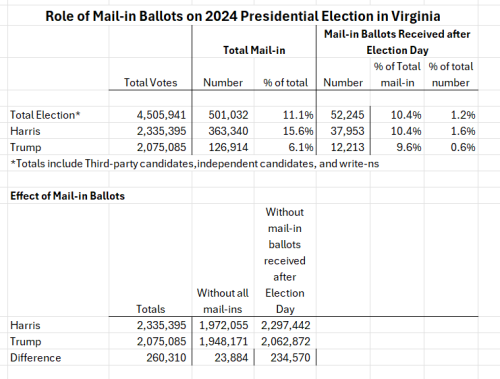
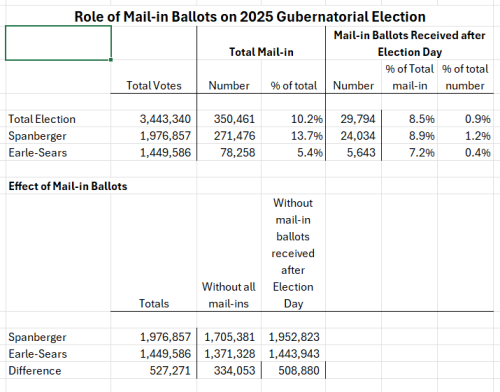
The Virginia Dept. of Elections has data on recent elections that can shed some light on some of these questions. The tables below, based on that data, show the role played by mail-in absentee votes in the 2024 Presidential and the 2025 gubernatorial elections. (The agency does not have comparable data on earlier statewide elections.)
On a statewide basis, mail-in absentee ballots comprised about the same percentages of the total ballots in each election. A significant portion of the mail-in ballots, 8 percent to 10 percent, were received after Election Day. However, those “late” ballots constituted only about one percent of the total vote.
Broken down by candidate, however, the picture is different. In each election, the mail-absentee ballots constituted a larger proportion of the Democratic candidates’ totals than of the Republican candidates’ totals.
In neither election did the mail-in absentee ballots affect the outcome. However, it is clear that almost all of Harris’s margin of victory over Trump in the Presidential election can be attributed to the mail-in ballots.
Leave a Reply
You must be logged in to post a comment.