

by James C. Sherlock
A reader of the last post in this series asked an excellent question: “Is there such a thing as a highly rated facility that has a high number of Medicaid patients?” His premise was that perhaps Medicaid does not pay enough.
In an attempt to answer, the author built a spreadsheet that has extensive data on all nine of Virginia’s Medicaid-only nursing facilities. That is a challenging comparison, because Medicare beds in skilled nursing facilities are more profitable than Medicaid long-term care beds.
As shown, six are standard Medicaid-only nursing homes; three are specialty facilities. One of the standard nursing homes is run by a county, so that is discounted for the comparison, leaving five from which to attempt to answer the question.
The Medicare Compare Overall and Health inspection ratings of those five are terrific, averaging 4.25 out of five.
One of them, for-profit Skyline Terrace Convalescent Home, has earned 5 stars for its inspection rating and 4 stars overall. The staffing quirk happened only in Q3 of 2025. It happens to the best of them.
The answer to the question
Skyline Terrace has operated as a proprietary business on Medicaid reimbursements alone since 1974, which answers the question.
Legislators should remember that the next time Virginia Health Care Association (VHCA) lobbyists tell them their industry can no longer survive without a Medicaid reimbursement raise above inflation.
The answer to the question’s premise
Medicaid pays enough.
In too many Virginia nursing homes, far too much Medicare and Medicaid money is coming in the front door and going out the back without touching resident care.
All of Medicare and 65% of Medicaid funds in Virginia are federal money, but the feds rely on the states to police Medicaid. That has proven to be a mistake in the cases of Virginia Medicaid’s long-term care funding and its programs for the intellectually and developmentally disabled.
The Attorney General investigates and prosecutes Medicaid fraud. Unless this author missed something in his reviews of state Medicaid fraud prosecutions, those cases have yet to reach the out-of-state owners of some Virginia nursing home chains and the in-state owners of businesses that offer services to the developmentally and intellectually disabled, paid for by Medicaid and so plaguing Virginians today. But to be fair, evidence gathering to support prosecutions takes a long time, as do the trials themselves. Judicial outcomes will always be too late for the people who need help.
Virginia executive branch regulators, charged by federal and state law to police Medicare and Medicaid providers, have failed in their duties. Neither DMAS, VDH, nor DBHDS, all of whom have the authority, has ever taken the shutdown actions required by state and federal laws. DMAS and the Health Commissioner at VDH have summary authority, meaning they can act and then go through an appeals process.
It gets worse.
As with the Virginia Senate’s 2026 SB30 discussed in a previous article, the House of Delegates’ HB30 budget bill may help explain why the executive branch has failed to act.
HB30, the House of Delegates Democrats’ budget amendment, proposes:
1. to restore funding and modify language in the introduced budget to permit a provisional diagnosis of autism spectrum disorder for children aged 5 or younger in order to receive Applied Behavioral Analysis (ABA) services. The introduced budget included language that required a final diagnosis of autism spectrum disorder in order to receive ABA services. The Medicaid fraud in other states in autism treatment is off the charts. Members must not read much.

2. a big cut to DMAS’s administrative budget in the 2026 budget amendment package. The part that pays people to watch the store.
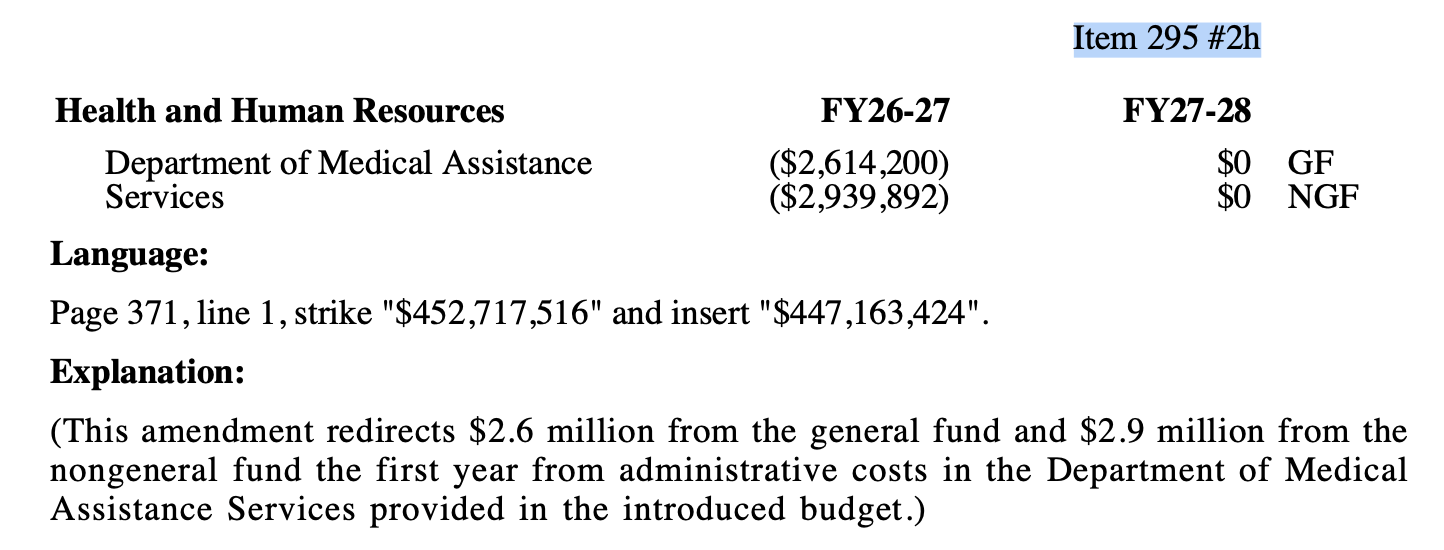
This amendment is in a package of budget amendments that markedly increases the DMAS workload. Is it meant to ensure that no one in DMAS has time to question the nursing home payments? A warning about pursuing fraud?
Bottom Line
By such actions and others discussed earlier in this series, the General Assembly is poking the federal bear.
Virginia risks Minnesota’s fate with the federal share of Medicaid. This is written to help know who to blame.
Updated April 4 at 13:15 to clarify the Virginia executive branch’s lack of sanctions related to out-of-state nursing home chain owners and in-state providers of services to the intellectually and developmentally disabled.
Leave a Reply
You must be logged in to post a comment.