
by Steve Haner

The Abigail Spanberger Administration has told an energy industry publication that it plans to rejoin the Regional Greenhouse Gas Initiative by July, in time to participate in the September and December 2026 carbon dioxide allowance auctions.
Because of the accelerated timetable, the Department of Environmental Quality will not publish a draft regulation or take any public comments before acting, the reporter for Argus Media was told. Bacon’s Rebellion was provided with an email copy of the Argus report, which is not yet on the public website.
It was not clear until now that the other RGGI states would let Virginia rejoin before the end of 2026. What was not reported and may not be decided yet is just how many allowances Virginia will be granted to offer in those two auctions. Argus reported:
In addition, the agency has been working with RGGI member states to iron out the finer details of Virginia’s return to the program, such as its allowance allocation. Calling its discussions with member states “positive,” DEQ said that Virginia’s allocation “will be consistent with the prior regulation” when the state first joined RGGI in 2021.
The final two auctions of 2026 are also the final two auctions of the current three-year RGGI contract period. Whatever allowances are granted for sale in 2026, a different and likely smaller amount will be assigned to Virginia for 2027 and beyond. The completion of Dominion Energy’s offshore wind facility should also push down the number of allowances granted.
By design, RGGI reduces the number of allowances steadily to discourage the use of coal, natural gas and oil to make electricity. The shrinking supply also forces up the price generation firms must pay for allowances, an expense they pass on to customers. Argus predicted the $25 per ton paid in the March 2026 auction could exceed $28 for the December 2026 auction.
The Argus report also noted Virginia’s soaring electricity demand due in large part to the data center explosion and said the state is a “considerable source of demand” for RGGI allowances.
For the three years Virginia was previously part of RGGI, 2021 through 2023, the number of allowances Virginia had to sell slightly exceeded the demand from Virginia-based generation plants, meaning some of the Virginia RGGI tax revenue was being paid by plants in other states (or speculators, who also buy allowances). Depending on the new allocation, the situation may reverse and Virginia-based generators may be paying some of the other states (or those same speculators) for allowances.
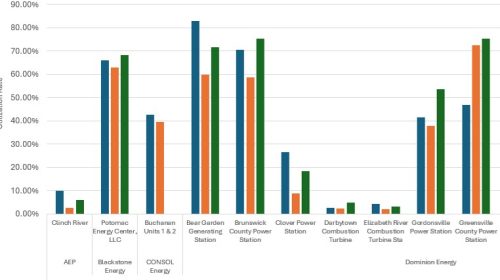
In 2025, the various electric generation units in Virginia using hydrocarbons reported more than 29 million tons of CO2 emissions, far above the likely allocation amount. Just under 70 percent of that amount was from Dominion Energy facilities.
One industry analyst who has been sharing data compiled from public sources has tracked how Virginia-based generation plants slowed down their operations during the three RGGI years then increased their usage again after Governor Glenn Youngkin took Virginia out of the compact. The full chart is too large to share in a post, but you can see it here. Portions of it have been shared with this post.

Advocates for RGGI intentionally ignore how meaningless that all is, because Virginia is a major importer of electricity. Many of the largest states in the PJM Interconnection are not part of RGGI, and several RGGI states are in other regional transmission organizations. As Virginia’s hydrocarbon plants run less often, hydrocarbon plants in PJM not constrained by RGGI run more often. The technical term for this is “leakage,”
But if your mind can accept that a 10-1 Congressional map is a sign of “fairness,” then it is easy to fool yourself into thinking that only emissions from Virginia matter in the “battle to save the planet.” RGGI isn’t really about that. RGGI is really about the money, and apparently Virginia will begin to reap that extra revenue in September. The impact on your power bills will follow at some point.
Leave a Reply
You must be logged in to post a comment.