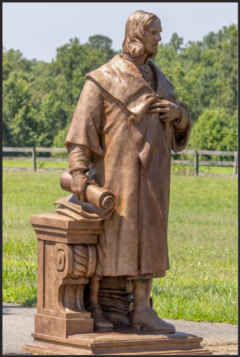
Richmond’s statue of Christopher Columbus is heading to upstate New York. It’s a sad, sad tale.
At the height of the George Floyd “mostly peaceful” protests, leftist militants tore down the statue in Byrd Park, spray-painted it, set it on fire and threw it into nearby Fountain Lake. They claimed to be motivated by solidarity with America’s indigenous population.
Americans don’t honor Columbus for his mistreatment of native Americans; they honor him for his discovery of the Western Hemisphere. But militants do remember him for his abuse of the natives, which, apparently, is far more worthy of singling out for moral condemnation than native American societies that engaged in incessant warfare, enslavement and/or human sacrifice of one another.
For more decades than one can remember, the policy of the Commonwealth, with one exception, has been to pay for road construction with money raised by gasoline and other transportation-related taxes. Money in the state’s general fund, consisting of revenue from income, sales, and other miscellaneous taxes, was not available for road construction.
The exception was the widening of U.S. Rt. 58, which stretches along the state’s southern border from the Atlantic Ocean to the Kentucky border, to a divided, two-lane highway along its full length. In 1989, the General Assembly authorized the State Board of Transportation to issue up to $600 million in bonds for the project. The source of debt service for the bonds was up to $40 million per year from state recordation tax revenues, which was one of the sources of revenue for the general fund. In 2008, the source of money from the general fund was changed to the state tax on insurance premium revenue. (See summary of funding for the Rt. 58 program here.)
There is still much we don’t know about the COVID-19 virus and the effect it has on the human body. One enduring mystery is the syndrome dubbed “long COVID,” when symptoms persist months or years after the infection. Why do some people get it while others don’t? What are the risk factors? What are the odds of contracting long COVID?
The Virginia Department of Health (VDH) issued a preliminary report based on interviews of 68 Central Virginia residents a half year ago. Soon, according to the Virginia Mercury, VDH will conduct a study focusing on Southwest Virginia residents.
The findings of the initial study were informative. Obesity is a risk factor: 52% of long-COVID sufferers were obese, and another 27% were overweight. (The combined percentage is higher than the 68% of all Virginia adults being overweight or obese.) Failure to keep up with COVID vaccinations is another risk factor: 88% of long-COVID patients were not up-to-date with their vaccinations.
The more we know the better. The VDH studies are worthwhile. But there are other big knowledge gaps that warrant study — in particular, the prevalence of vaccination side effects. Some scientific studies have linked the vaccinations with a higher incidence of blood clotting, certain types of cancers and an elevated mortality rate in the population.
Why aren’t we studying the vaccination side effects as well?
The latest poll from Virginia Commonwealth University has Donald Trump up 3% — 39% to 36% — over Joe Biden after being behind by six in the school’s previous survey of public opinion. Top Trump advisor Chris LaCivita has been telling people publicly and privately Trump will win Virginia as part of a coming MAGA landslide.
Not so fast.
Having done a few polls in my lifetime, I view these results as more a reflection of Biden’s current weakness than any new Trump strength. In 2020, then-incumbent President Donald Trump lost Virginia by a whopping ten percentage points, considered a landslide defeat in the world of elections. Candidate Biden got 54% of the vote, the biggest Democratic winning margin in Virginia since FDR crushed Thomas Dewey in 1944 when Virginia was still part of the “solid South“ of Democratic segregation states. Even President Lyndon Johnson, while winning the biggest Democratic national landslide ever, carried Virginia by only 7% over GOP loser Barry Goldwater in 1964.
Sure, there was a time between 1968 and 2004 when the Commonwealth had proven to be the most reliable GOP bastion among the Southern states in presidential elections. The GOP “lock” on Virginia got picked by Barack Obama in 2008. Even defeated Democratic presidential candidate Hillary Clinton carried Virginia by a comfortable 5% in 2016.
Americans are rightly concerned about the impact of the flood of foreigners entering the country illegally through a broken border — not just the fiscal burden of increased outlays for healthcare, schools, and social services but the longer-term risk of creating an unassimilable mass in the body politic. Such fears gain traction when we observe cultural elites trying to radicalize “people of color” by portraying them as victims of systemic racism. Every racial disparity in the metrics of wellbeing is said to be evidence of oppression — as if immigrants from Third World villages should feel entitled to the same income level as native-born Americans who have been lifted up over generations.
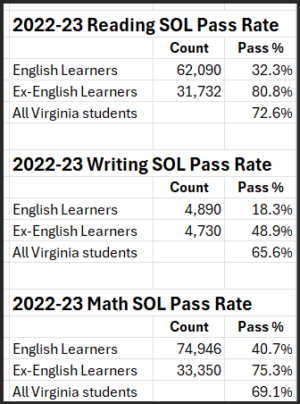
One of the disparities that critics of American society see as unjust is the racial/ethnic gap in educational outcomes. English Learners score much lower on their Standards of Learning (SOL) test scores than English-fluent students. The learning gap is often said to be proof of bias.
A close examination of the testing data, however, shows quite the opposite. It shows remarkable upward mobility for immigrants, at least in terms of academic achievement.
We cannot tell from Virginia Department of Education (VDOE) data how many immigrant children there are in public schools. But we have a decent proxy. VDOE tracks the number of “English Learners.” By VDOE’s count, there were about 130,000 in the 2022-23 school year. Not surprisingly given the difficulty in understanding their teachers, they passed their Reading, Writing, and Math SOLs at rates that were half to one-third of their English-fluent peers.
Not the turbine in question, but follow the link to the WBZ story and there is a photo of the very large chunks of debris.
Posted on Boston’s CBS affiliate WBZ this morning:
NANTUCKET – The federal government has ordered the Vineyard Wind farm to shut down until further notice because of a turbine blade failure this weekend.
Several beaches were closed on Tuesday while crews worked to clean up “large floating debris and fiberglass shards” from the broken wind turbine blade off the coast of Martha’s Vineyard. A total of six south shore Nantucket beaches were closed to swimming due to debris that washed ashore.
“You can walk on the beaches, however we strongly recommend you wear footwear due to sharp, fiberglass shards and debris on the beaches,” the Nantucket Harbormaster said.
Late Tuesday afternoon, the Bureau of Safety and Environmental Enforcement said all operations are shut down until further notice.(more…)
Three recent announcements from Dominion Energy Virginia in rapid succession point a path forward for the utility that complies in part and utterly rejects in part the carbon-free energy pipe dream of the Virginia Clean Economy Act (VCEA).
All three of the announcements will result in major cost increases to the company’s 2.6 million ratepayers. Just how much the projects will all cost combined is still unknown, and frankly nobody is likely to press that issue until the utility is ready to show its cards. The utility’s next integrated resource plan, to be filed later this year, should shed some light.
The most recent announcement is the most surprising. Dominion has proposed to build a $550 million liquified natural gas plant and storage facility for the sole purpose of providing a fuel backup to its newest two natural gas generation plants. The facility will be fed by the Transco Pipeline and be attached to the Greensville and Brunswick generation plants. Combined they produce about 3 gigawatts of reliable electricity into Dominion’s territory or the surrounding PJM regional transmission organization. (more…)
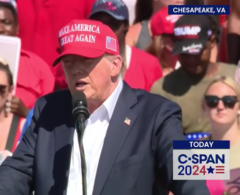
Mike Imprevento is not only my partner on “The Kerry and Mike” talk radio show (9 to 10 every weekday!) but a successful attorney and until recently, a Captain and Staff Attorney for the Norfolk’s Sheriff’s Office. It was in his latter capacity that he was part of the law enforcement team that protected Donald Trump during the former president’s Chesapeake rally last month.
The assassination attempt last weekend spurred him to write about his experience at the earlier Trump rally. Mike wrote this in his personal capacity. — Kerry Dougherty
By Mike Imprevento
This never would have happened in Chesapeake. The attempted assassination of Donald Trump, that is.
On June 28, 2024 in the City of Chesapeake, thousands of patriots who love this country and support former President Trump came together to hear his message. The venue, Greenbrier Farms, presented challenges just as Butler, PA did.
That is for later.
Despite the long wait in the heat and delays in the screening process, the attendees saw and experienced a celebration of political speech and freedom in a volatile political season. Trump brought a bevy of Virginia’s elected representatives and former political figures on the stage. All were safe. All were secure.
In the fall of 2023, 54 new professors joined the faculty of the University of Virginia College of Arts & Sciences. Dean Christa Acampora hailed the “extraordinary talent” of the new wave of scholars.
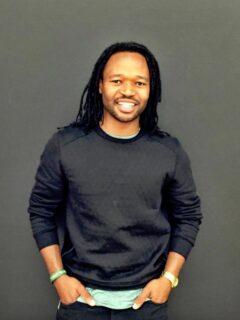
One of the new hires was Sethunya Mokoko, a native of the southern Africa country of Lesotho and professor of rhetoric and communications in the English Department.
Two days ago, according to The College Fix, Mokoko posted to X (formerly Twitter) that the Saturday assassination attempt on former President Donald Trump was “staged theatrics” performed by Secret Service to garner “idiots’ vote.” Trump’s secret service, he theorized, purposefully “ignored” eyewitnesses who informed police of an armed man on a roof before the shooting took place.
I could not verify the accuracy of College Fix’s article — Mokoko’s X account no longer has the post — but I have no grounds to question it.
The Secret Service’s failure to stop the assassination attempt does raise legitimate questions. Many witnesses spotted the shooter and tried to draw the attention of law-enforcement authorities. But the idea that the Secret Service stage-managed the shooting is beyond absurd. Did someone orchestrate the bullet passing within an inch of blowing Trump’s brains out of his head? Did the conspirators recruit a 20-year-old local with minimal training in marksmanship to execute a shot demanding incredible precision? Was Trump willing to place his life at risk to garner a few votes?
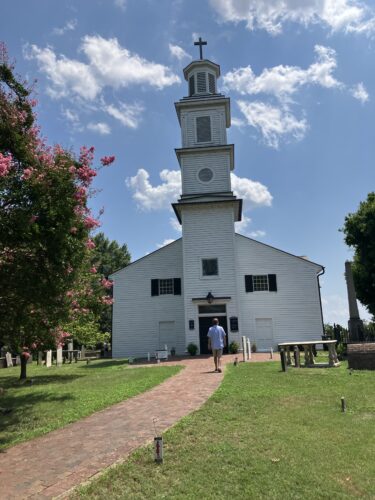
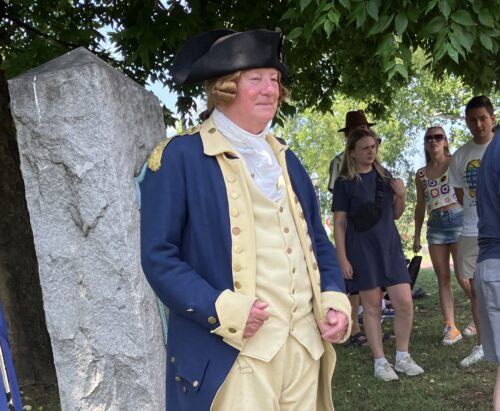
Each Sunday afternoon during the summer, the Historic St. John’s Church Foundation presents a reenactment of Patrick Henry’s famous “Give Me Liberty or Give Me Death” speech. The reenactment, which has been presented for almost 50 years, takes place in the Historic St. John’s Church in Richmond, the site of the original speech.
Historic St. John’s Church
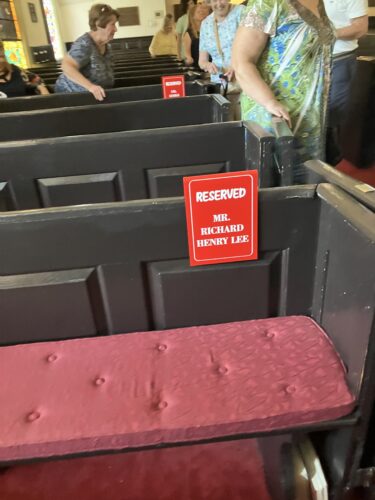
During the presentation, actors assume the roles of eight of the delegates to the Second Virginia Convention of 1775: George Washington, Thomas Jefferson, Peyton Randolph, Edmund Pendleton, Benjamin Harrison, Richard Henry Lee, Thomas Nelson, and, of course, Patrick Henry. During the summer, the roles rotate among the company of actors.
Before the reenactment begins, one of the actors provides a short history lesson, setting the stage and context of the Convention.
During the presentation, the delegates/actors are seated among the audience and rise in their places to participate in the debate over Henry’s resolution that the colony of Virginia establish an armed militia. The debate culminates in Henry’s famous declaration:
“Is life so dear, or peace so sweet, as to be purchased at the price of chains and slavery? Forbid it, Almighty God! I know not what course others may take; but as for me, give me liberty or give me death!”
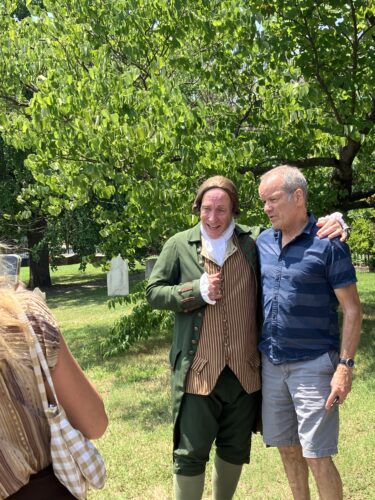
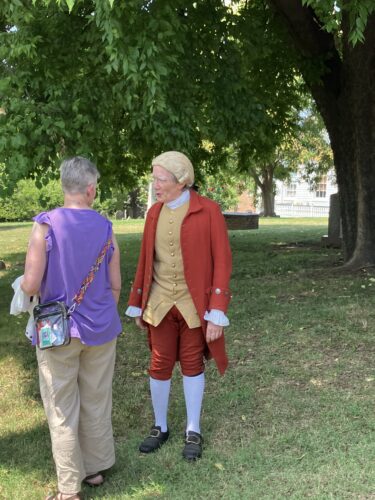
After the reenactment is concluded, the actors gather outside to talk to members of the audience and pose for pictures.
It is a wonderful, meaningful way to spend a Sunday afternoon.
For those of you not willing to bear the dreary slog of Sunday afternoon traffic on I-95 in the summer (and I know, first hand, what it is like), here is a presentation filmed by C-SPAN.
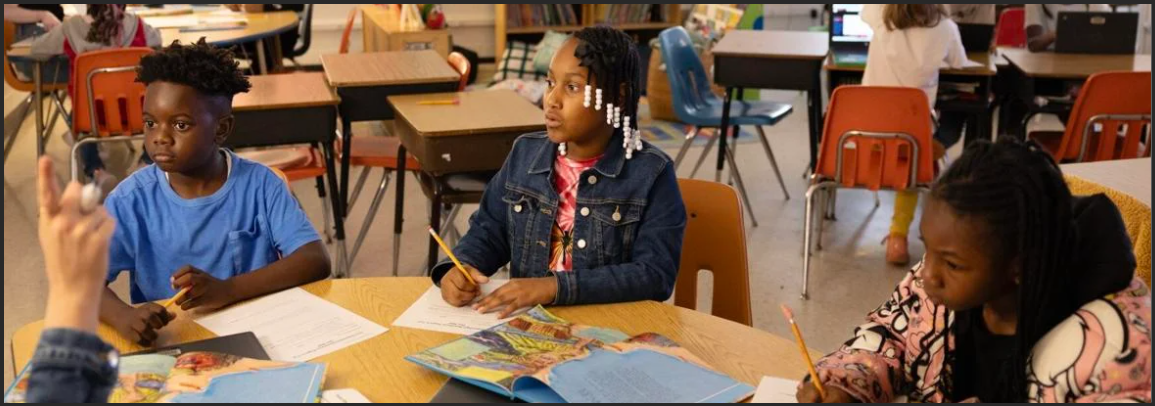
Students at Chimborazo Elementary School. Photo credit: Richmond Times-Dispatch
by James A. Bacon
There are glimmers of hope for Virginia’s public education system. Last week, Governor Glenn Youngkin issued an executive order ordering the Virginia Department of Education to create new guidelines limiting the use of cell phones in schools. Meanwhile an amendment to the Virginia Literacy Act effectively bans the use of a failed teaching method for reading known as “three-cueing” this fall.
The three-cueing technique, based on educational theories developed in the 1960s, downplays phonics in favor of deducing an unfamiliar word from its semantic, syntactic, and graphophonic contexts. A 2019 survey cited by the Richmond Times-Dispatch found that 65% of college education professors teach it as an instruction technique and 75% of K-2 and elementary special education teachers use it.
The education profession is prone to intellectual fads based upon novel academic theories such as three-cueing. But critics contend there is little social scientific evidence to support three-cuing. The tried-and-true method of teaching students to sound out words — phonics — is much more effective.
“Prior to really digging into the science of reading, a lot of cueing happened,” Lisa Coons, Virginia’s state superintendent of public instruction told the RTD. “It was more of a guessing game, and we were working to use pictures and cues and other words around it to try and figure out what the word said.
Are public officials in Virginia engaging in more petty crimes and misdemeanors these days? Maybe it’s just coincidence that so much misbehavior is being reported on the same day.
Warren County embezzlement. From the Northern Virginia Daily: former Warren County supervisor Ronald L. Llewellyn and his wife Corinne have been arrested and charged with multiple counts of embezzlement that took place between 2011 and 2018. Ronald Llewellyn was indicted on 44 counts of embezzlement, 10 of conducting an unlawful financial transaction and one of forging a document. His wife was indicted with 22 counts of embezzlement and seven of unlawful transactions. Details were not available on what government or business entity was victimized.
Stalking and general creepiness. Rodney Lamont Hubbard, the 52-year-old owner of a car repair business and Republican candidate for Lynchburg City Council, has been charged with stalking and “unlawful filming” of another, reports Cardinal News. In other run-ins with the law, Hubbard is charged with misdemeanor assault and battery and misdemeanor carry of a concealed weapon. His record includes convictions for drug possession and distribution, destruction of property, possessing a gun as a nonviolent felon and unlawfully obtaining documents from the DMV.
I guess Patrick County won’t be getting that hospital. From Cardinal News….
I didn’t see this one coming, but I’m delighted to hear of it: Secretary of Education Aimee Guidera and Secretary of Finance Stephen Cummings have written the presidents of Virginia’s public universities asking them to verify that their endowment investments are not influenced by political considerations.
Aimee Guidera
The state wants to ensure higher education institutions “invest in a manner that prioritizes risk-adjusted investment returns independent of social, political or ideological interests,” wrote Guidera and Cummings, according to Cardinal News, which obtained a copy of the letter.
The query follows a conversation between Gov. Glenn Youngkin and the state Council of Presidents in March that was prompted by calls of pro-Palestinian groups on college campuses to divest university assets tied to Israel, according to the letter.
Stephen Cummings
I’ve followed this issue closely for the Jefferson Council as it has played out at the University of Virginia, and I refer Guidera, Cummings and Bacon’s Rebellion readers to this article: “Board Shows No Interest in Israel Divestment.”
President Jim Ryan and the Board of Visitors have ignored a resolution passed by the student body to divest companies doing business in Israel from UVA’s endowment.
However, UVA’s investment arm, UVIMCO, does have an ESG (environmental, social, governance) policy, and it maintains an Advisory Committee on Investor Responsibility. UVIMCO’s primary ESG focus has been mitigating systemic risks of climate change.
The year: 2075. The American colonies on the Moon are getting restless under Washington’s tyrannical rule….
This second edition of “Dust Mites” has a snazzy new cover, includes helpful lunar maps, and is 5,000 words tighter than the original. The sequel, “Trogs,” is scheduled for publication this summer.
Advertisement
Advertisement
Advertisement
Advertisement
About
Bacon’s Rebellion is Virginia’s leading politically non-aligned portal for news, opinions and analysis about state, regional and local public policy. Read more about us here.
Fund the Rebellion
Shake up the status quo! Your contributions will be used to pay for faster download speeds and grow readership. Make a one-time donation by credit card or contribute a small sum monthly.
Can’t wait until tomorrow
For your Bacon’s Rebellion fix?
Enter your email address to receive immediate notifications of new posts by email.
SUBSCRIBE
Search Bacon’s Rebellion
Categories
Archives
The Jefferson Council
Protecting Thomas Jefferson’s Legacy at the University of Virginia
Forgot Your Password?
Shoot me an email and I’ll generate a new password for you.