“Give Me Liberty or Give Me Death”

Patrick Henry Credit: National Portrait Gallery

by Dick Hall-Sizemore

Each Sunday afternoon during the summer, the Historic St. John’s Church Foundation presents a reenactment of Patrick Henry’s famous “Give Me Liberty or Give Me Death” speech. The reenactment, which has been presented for almost 50 years, takes place in the Historic St. John’s Church in Richmond, the site of the original speech.
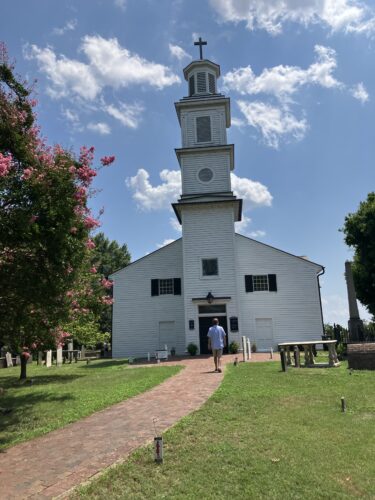
Historic St. John’s Church

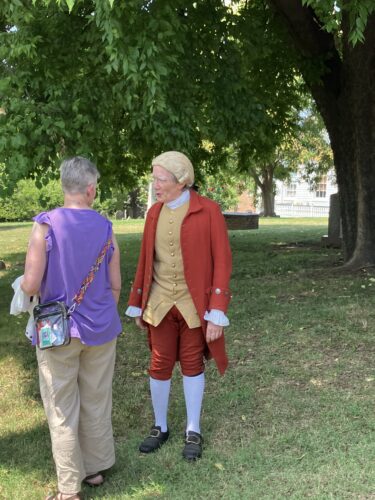
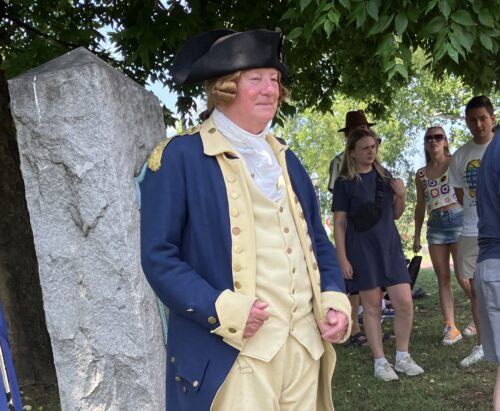
During the presentation, actors assume the roles of eight of the delegates to the Second Virginia Convention of 1775: George Washington, Thomas Jefferson, Peyton Randolph, Edmund Pendleton, Benjamin Harrison, Richard Henry Lee, Thomas Nelson, and, of course, Patrick Henry. During the summer, the roles rotate among the company of actors.

Before the reenactment begins, one of the actors provides a short history lesson, setting the stage and context of the Convention. 
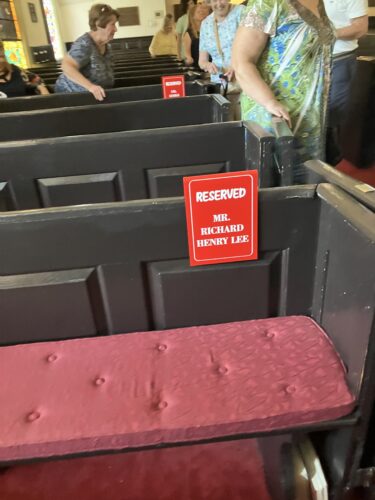
During the presentation, the delegates/actors are seated among the audience and rise in their places to participate in the debate over Henry’s resolution that the colony of Virginia establish an armed militia. The debate culminates in Henry’s famous declaration: 

“Is life so dear, or peace so sweet, as to be purchased at the price of chains and slavery? Forbid it, Almighty God! I know not what course others may take; but as for me, give me liberty or give me death!”

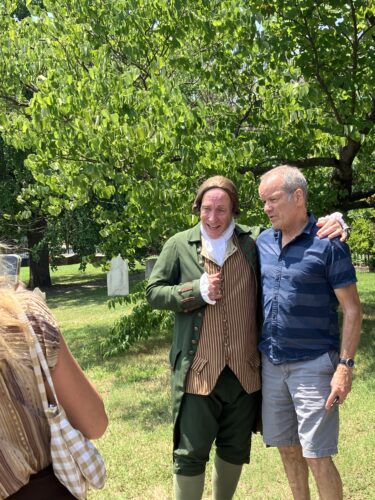
After the reenactment is concluded, the actors gather outside to talk to members of the audience and pose for pictures.

It is a wonderful, meaningful way to spend a Sunday afternoon.

For those of you not willing to bear the dreary slog of Sunday afternoon traffic on I-95 in the summer (and I know, first hand, what it is like), here is a presentation filmed by C-SPAN.

Some of the actors/delegates on July 14, 2024:

ADVERTISEMENT

(comments below)


Comments


Comments

32 responses to ““Give Me Liberty or Give Me Death””

  1. LarrytheG Avatar
    LarrytheG

    re: " George Washington, Thomas Jefferson, Peyton Randolph, Edmund Pendleton, Benjamin Harrison, Richard Henry Lee, Thomas Nelson, and, of course, Patrick Henry"

    I know (or think I do)… SOME of these guys but I'll be honest and admit mostly ignorance for some of them and I guess I'm a little ashamed.. must not have been paying attention in class or something.

    1. Dick Hall-Sizemore Avatar
      Dick Hall-Sizemore

      Here are summaries of the least known (now) of these:

      Peyton Randolph (Williamsburg)–member of one of Virginia's oldest and wealthiest families. Unanimously chosen as president of First Continental Congress, briefly servedas president of the Second Continental Congress; presided over the Second Virginia Convetion; close friend of Washington. Widely respected.

      Edmund Pendleton (Caroline)–well-known and respected lawyer. Served in the First Continental Congress; presiding officer of the convention in which Virginia ratified Constitution. First speaker of the House of Delegates. Advocated reconciliation with England. Political rival of Patrick Henry and often thorn in his side.

      Thomas Nelson (Hampton). Member of Continental Congress. Signer of Declaration of Independence. Served as fourth elected governor of Virginia

      1. LarrytheG Avatar
        LarrytheG

        Born September 10, 1721

        A lifelong resident of Williamsburg, the colony's capital, Randolph was to follow in the footsteps of his father, grandfather, and great-grandfather, all of whom served as speaker of the Virginia House of Burgesses.[7]

        wow! 4th generation in 1721?

        1. LarrytheG Avatar
          LarrytheG

          So which generation of settlers in America revolted against England? And who were their fathers in terms of ties to England , wealth and govt connection to England?

      2. James Wyatt Whitehead Avatar
        James Wyatt Whitehead

        Peyton Randolph was a big deal. Speaker of the House of Burgesses. Replaced the legendary John Robinson. Died at a dinner Jefferson attended in Philadelphia. A massive stroke.

        Nelson, a signer, lost everything in the war. Even encouraged Washington to bombard his own home during the siege of Yorktown (Cornwallis had his HQ here).

        Pendleton helped to rewrite Virginia's Constitution. His grand nephew was General Lee's chief of Artillery. His great grand nephew was Stonewall Jackson's most trusted staff officer.

        Thanks Mr. Dick. Enjoyed reading this.

    2. Nancy Naive Avatar
      Nancy Naive

      Thomas Nelson. Had a community college named for him. Had.

  2. Marty Chapman Avatar
    Marty Chapman

    We had to memorize and recite that speech in 4th grade

  3. WayneS Avatar

    That sound like a good way to spend a Sunday afternoon. I'll have to check it out. Google maps says it's a +/-1 hour drive from my house, and I won't have to drive [or ride] on I-95 or I-64.

    1. Dick Hall-Sizemore Avatar
      Dick Hall-Sizemore

      If you go, you will need a ticket in advance. https://www.historicstjohnschurch.org/reenactments

      1. WayneS Avatar

        That's good to know. Thank you.

      2. WayneS Avatar

        Thanks again. Tonight my wife and I are going to decide which Sunday we will attend, and purchase our tickets.

        1. Dick Hall-Sizemore Avatar
          Dick Hall-Sizemore

          You may want to give some thought to where you want to sit. The doors open at 1 p.m. and seating is first come, first served. If you sit on the front row, as I did, you will have an upfront view of Patrick Henry as he paces across the front speaking. However, the remarks and speeches made by other delegates seated in the audience will be behind you. There are tradeoffs wherever one sits, but I have concluded that rows 4-6 in the middle are the best.

          1. LarrytheG Avatar
            LarrytheG

            is there a balcony?

    2. Lefty665 Avatar
      Lefty665

      Bet you can ride 250 aka Broad street from home right up to the Church. But… there's an awful lot of traffic lights (billions and billions) between Short Pump and Church Hill. 64 to 95 south to the Broad street exit puts you right in downtown and it's only a mile or two on 95. It's not many blocks from there across the bottom and up the hill to the church on the right for which the neighborhood is named as you're headed east.

      1. WayneS Avatar

        Even better. Route 6 almost the entire way.

        In Goochland County I can hop on 288 and then transfer to a couple of larger, busier (but probably faster) highways, or I can continue on 6 all the way to where it becomes Kensington Avenue. At that point I'm just a few blocks from the church. Maybe I'll take Main Street the rest of the way.

        It'll depend on whether we're on a motorcycle or in a car.

      2. WayneS Avatar

        Even better. Route 6 almost the entire way.

        In Goochland County I can hop on 288 and then transfer to a couple of larger, busier (but probably faster) highways, or I can continue on 6 all the way to where it becomes Kensington Avenue. At that point I'm just a few blocks from the church. Maybe I'll take Main Street the rest of the way.

        It'll depend on whether we're on a motorcycle or in a car.

      3. WayneS Avatar

        Even better. Route 6 almost the entire way.

        In Goochland County I can hop on 288 and then transfer to a couple of larger, busier (but probably faster) highways, or I can continue on 6 all the way to where it becomes Kensington Avenue. At that point I'm just a few blocks from the church. Maybe I'll take Main Street the rest of the way.

        It'll depend on whether we're on a motorcycle or in a car.

      4. WayneS Avatar

        Even better. Route 6 almost the entire way.

        In Goochland County I can hop on 288 and then transfer to a couple of larger, busier (but probably faster) highways, or I can continue on 6 all the way to where it becomes Kensington Avenue. At that point I'm just a few blocks from the church. Maybe I'll take Main Street the rest of the way.

        It'll depend on whether we're on a motorcycle or in a car.

        1. Lefty665 Avatar
          Lefty665

          6 becomes Patterson Ave, then Kensington, but you knew that. That's still 3,xxx West, and there's lots of lights on Patterson before you get to Kensington, and Kensington dead ends in the fan so you have to jump over to Broad or Monument. The church is around 2,500 east. That's 50-75 blocks of in town traffic total and billions of traffic lights. The Fan since the advent of 4 way stops and bike lanes is a bigger pain than ever. If 288 is easy to get to I'd go 288 to 64E to 95S to Broad. There is a little monkey motion to head east on Broad (around the block, 95 exit at Broad, right on College to left on Marshall to left on12th to left on Broad.) The church is at 24th. That's a dozen blocks with only a few lights. Getting back on 95 headed out is simpler.

          The longer I live in the country and the older I get, the less tolerance I have for dealing with Richmond. I get in as close to where I'm going as I can on limited access and out the same way. Even coming in 33 I usually hop on 295 to either 95 or 64 to get further in town.

          1. WayneS Avatar

            Thanks.

  4. I've seen the reenactment three times. It is superbly scripted. It gives full weight to the arguments of those who opposed provoking the English. Patrick Henry's words are all the more powerful when you see the context in which they were made.

  5. LarrytheG Avatar
    LarrytheG

    So, here's some more ignorance on display but hoping some folks maybe know more. Jamestown was 1607 and Patrick Henryโ€™s famous โ€œGive Me Liberty or Give Me Deathโ€ speech was 1775.

    That's somewhere around 168 years – of, I presume English Rule though I admit I don't know a timeline of significant events between the two.

    When I wiki Patrick Henry – 1736- 1799 he was born 129 years after
    Jamestown.

    His father was John Henry, an immigrant from Aberdeenshire, Scotland, who had attended King's College, University of Aberdeen, before emigrating to Virginia in the 1720s (113 yrs after Jamestown).

    https://en.wikipedia.org/wiki/Patrick_Henry

    So, at that point, Virginia already had more than 100 years of some kind of governance but apparently not independent of England at all.

    So when/where/how in that 100 years did things change from being a
    colony of England to revolution from England?

    If I ever took course material related to these issues, I clearly don't remember and it could well be that I never did get "schooled" this history
    much at all.

    Anyone who can help fill in with perhaps a timeline and/or other ?

    1. Dick Hall-Sizemore Avatar
      Dick Hall-Sizemore

      There is no one event that sparked the change. The biggest reason for the desire for independence from England is probably that suggested by your timeline. It had been 168 years since Jamestown was settled. As more and more generations were born in the colonies, the attachment to England grew weaker and weaker. Another key component, which I think is often overlooked in modern times, the colonies had 150 years or so to develop their institutions of self-government.

      So, during those 168 years, they developed their own economies, still tied to England, but less and less so as the years went by. They developed their own higher ed institutions–Harvard, William and Mary, Princeton, etc.–so the sons of the gentry did not have to go abroad for their education. They began to see themselves as Virginians, Bostonians, Marylanders, etc., rather than as Englishmen. As Benjamin Franklin said, "A new breed–Americans." They began to resent more and more English intrusion into what they viewed as local affairs.

      The one event that probably served as a catalyst was the French and Indian War. Americans fought along with the British in that conflict–Washington gained fame for his leadership. That war was a part of the Seven Years War being fought in Europe. England emerged victorious, but broke. To help service its debt, it began levying taxes in the colonies. That, as we know, did not go over too well with the colonists.

      Another result of the war was the Royal Proclamation of 1763, which forbid colonial settlement beyond the line of the Appalachian Mountains. Americans, particularly Virginians, had been anxious to push west and this proclamation engendered great anger. https://history.state.gov/milestones/1750-1775/proclamation-line-1763

      As John Dickinson of Pennsylvania, portrayed in the movie 1776, and Benjamin Harrison and Edmund Pendleton of Virginia illustrate, not all of the colonial elite wanted to split with England.

      With the luxury of hindsight, one can easily make the case that a split with England was not inevitable in 1776. The English were arrogrant and dismissive of the colonies. If Parliament had been more accommodating of the American colonies, independence perhaps could have been put off for many years. The United States would have been like Canada.

      1. LarrytheG Avatar
        LarrytheG

        Thanks, Dick… in terms of wealth and land, didn’t England give the land to the colonists? Were some of the colonists already wealthy when they came from England to Virginia and then got land to boot from England?

        1. Dick Hall-Sizemore Avatar
          Dick Hall-Sizemore

          Yes, the king of England gave large land grants in the colonies, both to reward people loyal to him and to encourage settlement of the colonies. (I am not sure this was true as much in New England as it was in the rest of the colonies.) Some of the leading families in Virginia could trace their wealth to those land grants.

          But many of the Founding Fathers were not dependent on that inherited wealth. When Washington's father died, most of his father's estate went to his older brothers. There was just enough provided to Washingon's mother to sustain her and her children. Washington made his money the old-fashioned way–he married the wealthiest widow in the colony. Patrick Henry grew up in one of Hanover County's finest homes (his father had married a wealthy widow). However, during his adult years, he struggled financially while operating several stores and was somewhat dependent on his in-laws. It was only after he studied law and began his law career that he became financially comfortable. Benjamin Franklin came from a hard-scrabble background. John Adams was a lawyer and not a large land holder. Again, by 1776, the leaders of the colonies were "a different breed" from their large landowner ancestors.

          1. LarrytheG Avatar
            LarrytheG

            So, yes, America was originally a colony – one of many that England "owned" that unlike many of the other colonies, successfully broke away and gained its' freedom and went on to become the greatest country in
            the world. Others were much less successful and remained a colony of England for a long time and even when they gained independence, did not achieve what America did although some lke Canada came close.

            But it's HOW that happened that I am largely ignorant of and should be less so, and so I thank you again for your article!

          2. Lefty665 Avatar
            Lefty665

            <i>"Some of the leading families in Virginia could trace their wealth to those land grants.</i>

            Many still trace their lineage to land grants, and many of those are very comfortable.

            Many of the Virginians were large landowners. For example, Patrick Henry's home during the revolution, Scotchtown, was no shabby shack and had large fields. Henry had prospered by the time of the revolution. Same with Washington's home. Mt Vernon, and Mason's home, Gunston Hall. They were pretty spectacular plantations, and that's just scratching the surface.

            The landed gentry were largely who had the time and resources to foment revolution.

    2. WayneS Avatar

      I think the Declaration of Independence does a good job of laying out what had changed over the years between the colonies and the home country.

      1. Dick Hall-Sizemore Avatar
        Dick Hall-Sizemore

        Good point, although few people take the time to read the lenghty list of "grievances".

  6. LarrytheG Avatar
    LarrytheG

    So, here's some more ignorance on display but hoping some folks maybe know more. Jamestown was 1607 and Patrick Henryโ€™s famous โ€œGive Me Liberty or Give Me Deathโ€ speech was 1775.

    That's somewhere around 168 years – of, I presume English Rule though I admit I don't know a timeline of significant events between the two.

    When I wiki Patrick Henry – 1736- 1799 he was born 129 years after
    Jamestown.

    His father was John Henry, an immigrant from Aberdeenshire, Scotland, who had attended King's College, University of Aberdeen, before emigrating to Virginia in the 1720s (113 yrs after Jamestown).

    https://en.wikipedia.org/wiki/Patrick_Henry

    So, at that point, Virginia already had more than 100 years of some kind of governance but apparently not independent of England at all.

    So when/where/how in that 100 years did things change from being a
    colony of England to revolution from England?

    If I ever took course material related to these issues, I clearly don't remember and it could well be that I never did get "schooled" this history
    much at all.

    Anyone who can help fill in with perhaps a timeline and/or other ?

  7. Lefty665 Avatar
    Lefty665

    Been awhile since I've done that, but it was a fine experience. My kids loved it.

    Hanover also periodically re enacts Henry's Parson's Cause trial at Old Hanover Courthouse (1763, interesting in itself and about 15 minutes from St. John's church these days) that kicked off his career, often with many of the same reenactors as the St.John's Church scene. That trial was rigged. Henry's relative (uncle?) was the sheriff who picked the jury. These days sometimes they pick audience members to be the jurors in the reenactment. As they did, we know the right way to vote:)

Leave a Reply


ADVERTISEMENT