
by Don Smith
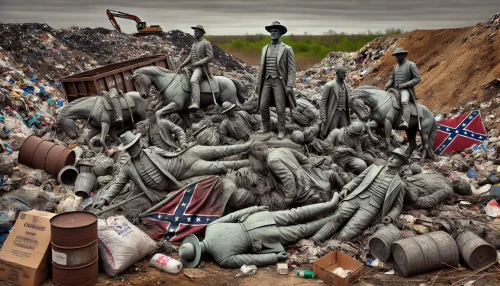
Does America have state universities? Or does it have publicly funded universities that just happen to be located in a particular state? They’re not the same thing.
Regular Bacon’s Rebellion readers know that I have more than a passing interest in Confederate history and heritage. (Insert rolling-eyes emoji here). In January of 2023, I’d just read the report of the Naming Commission. The commission chose to opine on the overall worth of Confederate heritage within the Department of Defense, now and in the future. America’s military is possibly its most respected institution. If the federal government takes actions or renders opinions that indicate that a certain segment of American society no longer warrants respect from our military, that echoes far beyond the confines of military bases and federal facilities.
The Naming Commission’s judgments on Confederate heritage, and the sweep and totality of their recommendations, are scathing and contemptuous toward former Confederates, their descendants and their communities. For example, its final report said that
…during the end of the nineteenth century and the start of the twentieth century, the South and much of the nation came to live under a mistaken understanding of the Civil War known as the “Lost Cause.” As part of the “Lost Cause,” across the nation, champions of that memory built monuments to Confederate leaders and to the Confederacy, including on many Department of Defense assets. In every instance and every aspect, these names and memorials have far more to do with the culture under which they were named than they have with any historical acts actually committed by their namesakes. [Emphasis added.]
As thousands of Virginians fought in the Confederate forces, many thousands more are descended from them, and many Virginia communities built Confederate monuments; that statement can’t go unchallenged.
America’s history is complex and complicated. Good people who lived in different times had different beliefs and perceptions than we do now; that doesn’t make them undeserving or unworthy of understanding and respect nowadays. Monuments and statues have different meanings for different people. Apparently, the Naming Commission — and Congress — couldn’t come to grips with that.
But what about Virginia state universities? Shouldn’t the Old Dominion’s public colleges be mindful of Virginia’s heritage? Shouldn’t they speak up for the honor of past Virginians — or, at the very least, ensure their side of the argument is heard? (Just as public defenders ensure that all citizens get a proper defense)? If public colleges are agents of the Commonwealth, shouldn’t they at least try to make sure that the legacies of past Virginians get the respect they deserve? I suspect that millions of Virginia taxpayers and tuition-payers would say “Yes.”
So, I put that to the test.
In January of 2023, immediately after the Naming Commission’s final report was published, I reached out to the history departments of the University of Virginia, William and Mary and Virginia Tech. I asked them to review the Preface of the Naming Commission’s report and the biographies it created for each of the Confederate generals who (at that time) had an Army base named after them.
“[Your university] is one of the flagship public universities in Virginia,” I told each of them. “That gives your opinion and voice, for lack of a better word, gravitas on this issue. I would think that [your university], or at least one of its prominent Civil War instructors, would be willing to comment publicly on an act of Congress which cast sweeping judgements on an integral part of Virginia’s heritage. What are your thoughts? I’m sincerely interested in your perspectives, so I’m open to having a discussion, if you’re willing to have one.”
I then showed them the biography the Naming Commission — whose chief historian was from Yale and vice-chair was the former chair of the history department at West Point — prepared for Robert E. Lee. Here is that biography.
[Camp Lee] is named after Robert E. Lee, one of the best-known Confederate Officers of the Civil War. A West Point graduate and an exceptional U.S. Army officer with over three decades of service to the United States, he decided to serve in the Confederate Army when his home state of Virginia seceded in 1861.
In “staying with his state,” Lee proved the exception rather than the rule: of the eight Virginians who were West Point graduates and Army colonels at the outbreak of the Civil War, only Lee chose to fight against the United States. The main difference between these eight was that Lee and his family enslaved other humans. At the outbreak of the war, the Lees of Arlington owned approximately 200 slaves. While Lee thought it improper for white Americans to enslave other humans, he still declared enslavement as appropriate and beneficial for Black Americans.
Lee’s leadership, strategy, and tactics, not without failings or defeats, allowed for victories for many important battles, stopped United States advances and prolonged the Civil War. His strategy to march through Maryland and Pennsylvania to endanger Washington and force the United States to sue for peace may have succeeded had he won at Antietam or Gettysburg. He hoped to destroy rail links in Pennsylvania and compel Maryland to join the Confederacy, surrounding the capital and cutting it off from supply. Though difficult to fully account for the amount of violence and death Lee caused to U.S. Soldiers, the number rests in the hundreds of thousands. In the final year of the war alone, Lee’s armies killed or wounded at least 127,000 U.S. servicemen fighting for the nation.
How did the universities respond? One history professor said they were “in the midst of the beginning of a very busy semester and do not have a comment or reaction.” One history department chair said, “Thank you for your follow-up email. We received your message and do not have a comment on the issues you raise, in part because our scholarly specialties lie far outside their scope.” From the other two history departments I got silence — which, as James Carville said recently, is one of the loudest and most powerful forms of speech.
If the legacies of past Virginians lie “far outside the scope” of the “scholarly specialties” of Virginia’s top academic historians, then we should think twice about letting those academics shape the public’s perception of the Commonwealth’s heritage and legacy. Especially with our nation’s 250th anniversary coming up.
I did not name the history department chair or too-busy professor — although I know who they are — because it’s possible that they feared woke retribution. Well, these are different times now. After this past national election, our “experts” should be willing to stand up to the wokeists. Americans are heartily sick of wokeism. If those same experts stay silent, then they shouldn’t be surprised if many taxpayers take that to mean that they either agree with the wokeists or are too scared to stand up to them. The silence will simply be too loud to ignore anymore.
Donald Smith was raised in Richmond. His mother was born in a house not far from VMI, and family members still live there.


Leave a Reply
You must be logged in to post a comment.