

by James A. Bacon
Diversity, Equity, and Inclusion (DEI) training is now an $8 billion-a-year industry. More than half of Americans have been exposed to it. The training varies considerably in rhetoric and content, but programs that emphasize structural racism and White bias engender attitudes that can make race relations worse, not better, finds a new study, “Instructing Animosity: How DEI Pedagogy Produces the Hostile Attribution Bias.“
Remarkably, for all the resources poured into DEI training, the efficacy of the programs has been little studied, contend the authors, who are affiliated with the Network Contagion Research Institute (NCRI) and the Rutgers University Social Perception Lab. The study addressed the research deficit by conducting a randomized, double-blind study that compared attitudes of 423 participants after exposure to the thinking of DEI “anti-racism” popularizers Ibram X. Kendi and Robin DeAngelo.
The experiments touching on attitudes toward race (and religion and caste as well) assess a crucial question, the authors write. “Do ideas and rhetoric foundational to many DEI trainings foster pluralistic inclusiveness, or do they exacerbate intergroup and interpersonal conflicts? Do they increase empathy and understanding or increase hostility towards members of groups labeled as oppressors?”
I have been asking the same questions of the DEI programs at the University of Virginia and Virginia’s other public four-year institutions. Do DEI programs do what they are designed to do — increase a sense of inclusion and belonging among traditionally under-represented groups — or, by placing greater emphasis on racial identity, do they accentuate feelings of victimhood and alienation?
University boards of visitors should pay attention to the NCRI-Rutgers findings:
The prominent “anti-oppressive pedagogy” in DEI programming can carry perceived rhetorical threats for those whose politics or other beliefs run counter to the fundamental premises of the critical paradigm from which the pedagogy derives. Programming may reflexively cast members of so-called “dominant” groups or those who disagree with “anti-oppressive,” “anti-racist,” or modern-day “anti-fascist” training as oppressive, racist or fascist.…
Across all groupings, instead of reducing bias, [anti-racism training] engendered a hostile attribution bias, amplifying perceptions of prejudicial hostility where none was present, and punitive responses to the imaginary prejudice.
In the experiment, participants were exposed to a preliminary text: a neutral one about U.S. corn production and an essay which combined educational texts from prominent DEI proselytizers Kendi and DeAngelo.
The DEI themes included:
- White supremacy and racism are a systemic and nearly universal norm, mindset, or worldview.
- Normal institutions and Western ideologies are secretly enforcing racist agendas and White people are beneficiaries and entitled to the benefits of systemic white supremacy and racism.
- The universality of white supremacy agonizes people of color by virtue of endless hostile encounters.
- Western countries are compromised by virtue of their racist ideology and past.
- Anti-racist discrimination is the only solution to racist discrimination.
After reading the anti-racist/corn-production texts, students then were asked to evaluate a college-admissions scenario that intentionally avoided any mention of the student’s or admissions officer’s race: A student applied to an elite East Coast university in Fall 2024. During the application process, he was interviewed by an admissions officer. Ultimately, the student’s application was rejected.
Students who had read the Kendi/DeAngelo texts were far more likely than those who read about corn cultivation to display what the authors describe as a “hostile attribution” bias: reading racial motivations that simply did not exist into the scenario.
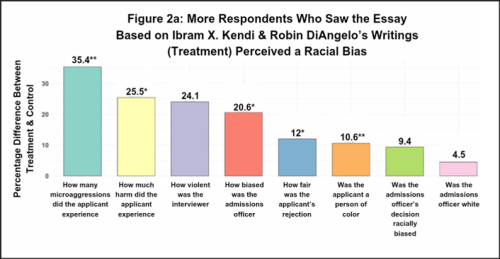
Also, of relevance to discussion of religion at the University of Virginia, where a religious diversity task force recently issued its findings, the study found that “anti-Islamophobia” training had effects similar to anti-racism training. Training using materials produced by ISPU, a leading group in promoting narratives of systemic anti-Muslim bias, “may cause individuals to assume unfair treatment of Muslim people, even when no evidence of bias or unfairness is present.”
Another troubling NCRI/Rutgers finding is that the anti-oppression narrative contributes to “authoritarian policing” and demands for harsher punishment for those alleged to be guilty of racist behavior. This policing (much of which presumably occurs on social media) spreads through social contagion.
The authors identify a vicious cycle at work that they concede needs to be fleshed out in future studies. The steps include:
Anti-Oppressive Intervention. DEI training rooted in anti-oppressive rhetoric introduces narratives that lead people to assume that certain groups are inherent oppressors and others as inherent victims.
Increased Racial Suspicion. Exposure leads to hostile attribution bias, causing participants to see discrimination when there is no evidence that discrimination has occurred, driving racial prejudice, intergroup hostility, suspicion and division.
Authoritarian Policing. This heightened suspicion triggers authoritarian policing tendencies, leading people to endorse surveillance and purity testing, strict social controls, and escalating responses from corrective to coercive.
Punitive Retribution. Participants show greater support for extreme punitive measures against perceived oppressors as well as those seen as ideologically impure.
Calls for More Interventions. The heightened punitive atmosphere feeds back into demands for more anti-oppressive DEI training, creating a self-reinforcing cycle of suspicion and intolerance.
That model is only a model — it does not necessarily describe the reality at any particular institution. Think of it as more of a hypothesis of the racial dynamics that provides a framework for analysis. My sense from my study of UVA over the past three years is that the model is useful, though imperfect, for understanding what happens there.
There is no single training paradigm at UVA; the various schools and colleges have some leeway in how to execute the DEI imperative. Moreover, DEI training is not the only force at work shaping attitudes toward race. The oppression narrative is propagated by faculty in classrooms, reinforced by the Student Guides who give historical tours, buttressed by official rhetoric emanating from every level from the president’s office to Student Council, and policed by social media mobs. In other words, the oppression narrative permeates the entire university culture.
If the goal is actually improving the experience of minority students at UVA — making them feel more welcome, conferring a sense of belonging — rather than instilling a leftist worldview calculated to cause alienation, then reviewing DEI training programs is a good place to start. But it’s only a start.
James A. Bacon is contributing editor of The Jefferson Council.


Leave a Reply
You must be logged in to post a comment.