• The “Cooch” Makes Things Really Interesting

    By Peter Galuszka

    Kenneth Cuccinelli’s announcement that he will run for Virginia governor in 2013 presages some very interesting days ahead.

    The controversial and hard-right Attorney General has been a highly polarizing figure in state politics. Despite ample evidence to the contrary, he stubbornly ย insists that humans have little to do with climate change and has indulged in a months-long witch hunt against a former University of Virginia scientist who, like most of his colleagues in the civilized world, do see a link. Cuccinelli has trampled on gay rights by refusing to extend legal protections against discrimination against gays in public universities. He has fought headlong against President Barack Obama’s health care reform, spending plenty of taxpayer money in the process.

    Meanwhile, Cuccinelli hasn’t come up with any positive proposals or platforms. Perhaps that’s not his job as attorney general, but voters have no clear idea of what he stands for, only what he is against. Given Cuccinelli’s obvious and robust reactionary ideas, it will be hard for him to remake himself into a moderate as Gov. Robert F. McDonnell, once a hard-line social conservative, seems to have done successfully.

    The state GOP establishment has been pushing Lt. Gov. Bill. Bolling as McDonnell’s successor, notably by calling him the “go to” guy on jobs. The fact is that Bolling is pleasant — ย and utterly forgettable.

    Who else could run among the Republicans? One possibility is Sean Connaughton, McDonnell’s secretary of transportation and former chairman of the Prince William County board of supervisors. Connaughton is a technocrat professional who once head the National Maritime Administration and has been both a Coast Guard and a Navy officer. He’s been on a tear recently. He fired just about the entire board of theย Virginia Ports Authority for failing to keep up with Baltimore and Savannah and has been the brains behind a big bond push to build new roads. Although his methods may be heavy-handed, at least Connaughton is a doer, not a reactionary. Should he run, Connaughton might be a more reasonable choice for the GOP.

    Either way, the state Democrats badly need to get their act together. And fast. They are going to have to come up with a better candidate than Creigh Deeds who was easily beaten by McDonnell last time.


  • Why People Are Pissed

    There are good reasons why the American people are angry at the big bankers on Wall Street. The latest news is the revelation by way of Bloomberg that the Federal Reserve Bank discretely lent up to $1.2 trillion to United States banks at below-market interest rates during the height of the financial meltdown, a gift that translated into roughly $13 billion of income. There was no transparency to the action, and no accountability. This subsidy came on top of the subsidies made available through the Troubled Assets Relief Program.

    With their purses thus padded by public intervention, executives in the financial sector went on to pay themselves obscene compensation packages. (The New York Times estimated pay packages averaged $595,000 per employee at Goldman Sachs and $463,000 for JPMorgan Chase.) While millions of Americans were losing their jobs, scrimping by on part-time work and coping with wage cutbacks, they were also paying for the privilege of enriching the masters of the universe whose great claim to business acumen was the ability to borrow and risk extraordinary sums of money, pocket the gains when they won their bets, and socialize their losses when they lost.

    This is not free-market capitalism. This is heads-I-win-tails-you-lose crony capitalism. Wall Street does provide a legitimate and valuable function for society in allocating capital. But it was a party to a grotesque mis-allocation of hundreds of billions, if not trillions, of dollars in the 2000s, and the Attilas and Tamerlanes in pinstripes who pillaged the nation should be prostrating themselves in gratitude that they live in a country where the peasants don’t string up their oppressors by the gibbet.

    Of course, the mercy bestowed upon these wealth destroyers may have something to do with the fact that the financial sector has donated $130 million so far in 2011-2012 to Congressional and presidential candidates of both parties, including President Obama. Donate millions to the politicians, reap billions in ill-gotten gains. That’s a pretty good Return on Investment.

    — JAB


  • Why Not Public-Private Partnerships for Parks?

    by James A. Bacon

    Few people outside the Roanoke area have heard of Virginia’s Explore Park, a 1,100-acre facility set in the mountains of Roanoke and Bedford counties. Launched with great fanfare in 1986 as a public-private partnership, the park offers mountain bike trails, a forester’s trail, a fishing and kayaking access point to the Roanoke River, special events like trail runs and adventure races — and a Film Center that has been involved with 16 film and documentary productions over the years, including the soon-to-be-released “Alone Yet Not Alone” (see trailer), which explores the conflict between English settlers and native Indians.

    Virginia’s Explore Park is operated by an entity created by the General Assembly: the Virginia Recreational Facilities Authority (VRFA). The Roanoke community sank considerable funds into the venture but it never lived up to expectations,ย  andย  it closed in 2007 during the adverse conditions of the financial meltdown and recession. But it has since reopened, and the VRFA board has a new plan, which it describes in a report to the General Assembly, “Virginia’s Explore Park Status Report.

    The board has articulated a new vision: “to be a leader in providing outdoor recreation opportunities, stewardship of this region’s heritage, and advocacy for environmental conservation for the enjoyment, education and inspiration of present and future generations.” The VRFA, states the report, is poised to “reinvent” the park by seeking out concessionaires, developers and outfitters to create privately generated revenue streams. (Among other revenue-generators, the board recently agreed to authorize two cell phone towers on park property.)

    The board touts the park as a potential model for other public-private partnerships around Virginia, “allowing the state to stretch limited resources and share the burdens and jobs of investment with local governments and private individuals, foundations and corporations.”

    Here’s the catch: The board would like the state to step up as a partner. It doesn’t seem to be asking for much: just tweak the representation on the board, move theย  park from non-state agency status to a line item in the Department of Conservation and Recreation, allow Virginia departments to assist and collaborate, and “consider” investing in capital development venues and revenue-producing programs.

    It’s not like the VRFA is asking for a lot of money that the state doesn’t have, so why not? Maybe Virginia’s Explore Park can act as a template in our new age of austerity for expanding Virginia’s park lands through public-private partnerships. Let’s give it a try.


  • How to Rate Schools by Educational Choice

    by James A. Bacon

    An increasing number of people across the ideological spectrum are coming to the conclusion that “school choice” is a desirable goal of educational reform. The trick is defining what constitutes “choice.” Conservatives typically think of private schools, charter schools, homeschooling and vouchers. But there are many other measures, as a new report by the Brookings Institution makes clear.

    In “The Education Choice and Competition Index: Background and Results 2011,” Brookings scholar Grover J. Whitehurst has developed an index based upon 12 indicators, which takes the view that school choice can be a meaningful strategy for driving positive change within public school systems. His measures include:

    1. Availability of alternate schools, such as charter schools, magnet schools, denominational schools and private schools. Schools vary by curriculum, teacher workforce, parental involvement, length of school day and year, school autonomy, quality of facilities and per-pupil budgets. “In economic theory, competition produces efficient markets. Competition on the features of schooling can only occur to the extent that there is both choice of schools and variation in features.”
    2. Policies on virtual education. “Under current K-12 models of virtual education, a state or, more typically, the local school district is able to determine whether the virtual schooling meets its standards and is acceptable as a credit towards graduation. At the local district level, this places the bureaucracy that may be most disrupted by the introduction of virtual education in the position of gatekeeper.”
    3. Funding follows students. “A primary driver of competition among schools is the loss or gain of funding that comes from changes in enrollment. A school that is unpopular with students and losing enrollment should lose funding. Likewise, a popular school should gain funding as it attracts more students.” Many schools systems function according to the opposite principle.
    4. Restructuring or closing unpopular schools. “Changes in student-based funding may not be immediately obvious or consequential to staff, whereas the prospect that the school will be closed or restructured if it continues to decline in popularity is hard to ignore.”
    5. Assignment mechanism. “The antithesis of choice is an assignment mechanism based on residence, with little or no chance of parents being able to enroll their child in a school other than the one in their neighborhood. In contrast, the paragon of assignment systems is one in which students are assigned to schools through an application process in which parents express their preferences and those preferences are maximized.”
    6. Application. “The ideal [application] process has a common application for all public schools within a districtโ€™s boundaries, including charter schools.”
    7. Comparable standards and assessments. “Common standards and assessments provide transparency for choice and allow schools to be compared on a common metric.”
    8. Gain scores. “Information presented to parents as a basis for judging school performance should include student achievement gains based on longitudinal data on academic growth of individual students.” In other words, schools should be rated on their ability to add educational value, not their ability to select the best students.
    9. Accessible online information. “Information about the choice process and school performance data should be easily accessible on a district website, presented clearly, permit side-by-side comparisons of schools, and be sufficiently complete that there isnโ€™t a population of ‘in the know’ parents.”
    10. Additional performance data. “Best practice for districts includes the provision of additional information on such things as student and teacher absentee rates, measures of parental satisfaction, and course offerings. Also important in a system of open enrollment is information on school popularity as revealed through the ratio of applications to slots. Publishing popularity scores on schools in districts that have open enrollment plans could, we believe, have a significant influence on school leaders at both the building and district levels.”
    11. Transportation. “An ideal choice system is one in which students are provided transportation to any school of their choosing within district borders on the same terms as for the neighborhood school.”
    12. School quality. “School choice is a sham if all schools are low performing. In that scenario little competition is likely to result.”

    The Index ranks 25 large school districts around the country, including Fairfax County’s, based on these indicators. Receiving “B” ratings, New York City and Chicago schools enjoy the highest rankings for educational choice. Fairfax County rates 8th, with a “C+” rating. You can view the details of the rankings here.


  • Second IG of the Day: State Budget Squeeze


    Over the past three decades, state governments enjoyed steadily growing revenues. That felicitous trend ended abruptly in the 2007-2009 recession and shows no sign of resuming. This chart, taken from the “Fall 2011 Fiscal Survey of the States” shows the weak recovery. As the stock broker ads always warn, past performance is no guarantee of future performance. Still, it’s hard to conjure up a scenario in which state revenues suddenly stage a rebound.

    The situation for Virginia looks somewhat better. In fiscal 2011, Virginia General Fund expenditures increased 4.5% compared to a national average of 4.0%. In fiscal 2012, Virginia expenditures are projected to increase 7.1% compared to a national average of 2.9% (see Table 6 in the Fall 2011 survey).

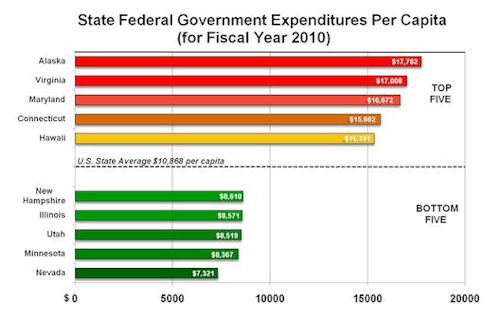
    Looking to the future, of course, the big wild card for Virginia is what happens if federal spending falls off a cliff? The chart below, just published by Veronique de Rugy at the Mercatus Center, shows that Virginia’s economy is the second most dependent of all states upon federal spending. (And unlike Alaska, we don’t have vast oil wealth to fall back upon.)

    — JAB


  • IG of the Day: The Wage Gap


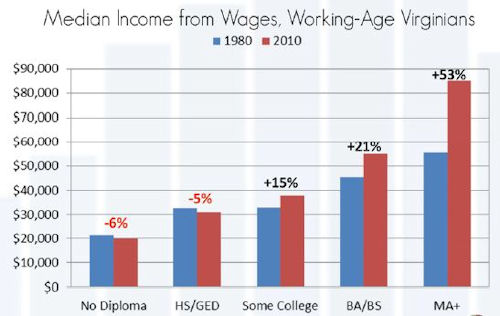
    This chart, taken from the Weldon Cooper Center’s newly published, “Virginia Income Trends, 1980-2010,” illuminates the growing income gap in Virginia. This chart, which shows the growing disparity in wages, has more meaning to me than stats showing the disparity as measured by adjusted gross income reported to the Internal Revenue Service, a commonly cited metric.

    If income inequality on the lower end results from the breakdown of the family structure and the rise of single-parent families, the problem is cultural in nature, not economic. Likewise, if income inequality on the upper end arises from an increasing number of two-income families, my reaction is, what’s wrong with that? But if income inequality results from a higher rate of return on education and declining opportunities for Americans with low levels of education — as shown here — the public policy implications are very different.

    — JAB


  • Core Confusing Word: “City”

    Here comes another idiot list: Men’s Health has produced a list purporting to rank the happiest cities in the United States. By “happiest,” the magazine really means “least unhappy,” as measured by the percentage of the population using anti-depressant drugs and feeling the blues all or most of the time.

    It turns out that among the 100 largest “cities” in the country, Virginia Beach rates an A-,ย  placing number 12 on the list, while Chesapeake scores B+ and a number 13 spot. Norfolk comes in at number 42, Richmond at number 68, and Washington, D.C. at number 81.

    Here’s the problem: While Virginia Beach and Chesapeake may be “cities” from a state constitutional perspective, they bear little sociological similarity to “cities” such as Norfolk, Richmond and Washington, D.C., much less other “cities” on the list, which encapsulate traditional urban cores with higher levels of poverty. Having experienced most of their population growth in the past three decades or so as the middle class fled crime, poor schools and high taxes in the traditional urban core of south Hampton Roads, inhabitants of Virginia Beach and Chesapeake are more affluent, better educated and have fewer social pathologies. Men’s Health is comparing apples and oranges.

    This misuse of the word “city” is a classic case of what E M Risse calls “core confusing words.” For the record, when I use the word “city” on this blog, I refer to it as a municipality designated a “city” under the Virginia state constitution with administrative and taxation powers distinct from those of “counties” and “towns.”

    — JAB


  • Rail-to-Dulles Prairie Fire

    The grassroots rebellion against the Metropolitan Washington Airports Authority’s mandatory Project Labor Agreement for Phase 2 of the Dulles Corridor Metrorail project is gaining momentum. The Loudoun County Republican Commitee has called upon the Loudoun County Board of Supervisors and General Assembly representatives to “oppose mandatory PLA provisions or union-driven rules in the final agreement with the MWAA.”

    The Republican resolution follows the introduction of a bill by Del. Robert G. Marshall, R-Manassas, to prohibit the use of state revenues for construction of Phase 2 if (1) the project is subject to a Project Labor Agreement, (2) MWAA’s Freedom of Information Act policies are inconsistent with Virginia’s, or (3) the project is not subject to state audit. (For details, see my post on Marshall’s bill.)

    Marshall personally addressed the Loudoun Republican committee and made the case that full MWAA transparency should be a precondition for the state to fork over another $150 million, as called for in a recent Memorandum of Agreement signed by MWAA and the McDonnell administration. The wording of his bill was reflected in the resolution.

    According to my sources, David LaRock and Sally Mann, Loudoun County Chairman Scott York spoke in favor of the resolution, as did Del. Joe T. May, R-Leesburg. Sen.-elect Dick Black is drafting a comparable bill to submit to the Senate. This issue is not going away. The McDonnell administration could have a real fight on its hands come January. I don’t envy the governor, who inherited the Rail-to-Dulles mess from the Kaine administration, but he’s stuck with it. He needs to hold MWAA accountable.

    Some of my friends in the Smart Growth movement may wonder why I seem to hell bent on highlighting the PLA issue. The answer is simple. I believe in mass transit. We need mass transit. But mass transit is subject to massive cost overruns and operating subsidies that Virginia cannot now afford and certainly will not be able to afford in the future. If we want to see more mass transit in Virginia’s future, we have to bring the capital and operating costs under control. That means holding groups like the MWAA accountable and making sure it doesn’t negotiate sweetheart deals with labor unions that potentially could cost taxpayers hundreds of millions of dollars.

    — JAB


  • Hair Braiders and Tow Trucks

    Virginia hair braiders — free at last!

    Gov. Bob McDonnell has just announced a “government reform initiative” that will eliminate two state agencies and 19 boards and commissions, and consolidate another 23 boards and commissions. Sounds really impressive… until you realize that the reforms are touted to save only $2 million a year.

    In a budget exceeding $40 billion a year, $2 million is chump change. If I were governor and saw it laying on the floor, I wouldn’t stoop over to pick it up. (Actually, I would pick it up. I’m just engaging in hyperbole here.) Making the changes is better than not making them, so this does represent progress of a sort. But let’s not kid ourselves, this is not what we’re talking about when we discuss the need to reinvent government.

    The two agencies slated for the deep six are the Virginia National Defense Industrial Authority and the Board of Towing and Recovery Operators. Among the boards and commissions to be eliminated are the Interagency Dispute Resolution Council, the Virginia Council on Indians and the Virginia Juvenile Enterprise Committee. Yawn.

    The most positive change to come from this initiative doesn’t affect agencies, boards or commissions at all. The governor is also de-regulating three professions: hair braiders, mold inspectors and remediators, and interior designers. Good. The state had no business meddling in those professions in the first place.

    Now that we’ve gotten the easy stuff out of the way, maybe we can focus on the stuff that really matters.

    — JAB


  • Washington on the James? Not yet, but We’re Working On It.

    Virginia has a low rate of long-term indebtedness compared to other states, but the debt burden can still take a bite out of the budget. Virginia will pay nearly $600 million in interest in 2012 after borrowing record amounts during the past few years, reports Peter Smith for Virginia Statehouse News.

    Interest payments will increase next year. Writes Smith:

    Bill Echelberger, a Senate fiscal analyst, told lawmakers gathered at the committeeโ€™s fall retreat that Virginia had seen the โ€œfour largest tax- supported debt acquisitionsโ€ in history during the past four years, including Gov. Bob McDonnellโ€™s $600 million transportation package.

    The large scale borrowing is expected to increase debt payments by $50 million in fiscal 2012, which comes as the state prepares for budget cuts. …

    Debt has more than doubled in the past six years, increasing from $5.8 billion in fiscal 2005 to $11.9 billion in fiscal 2011. Annual interest payments have increased at an even faster rate from $236 million in 2005 to a projected $593 million in 2012.

    Not included in those sums is $54 billion in unfunded pension obligations.

    If it’s any consolation, Virginia’s measly $600 million in interest payments compares to $240 billion budgeted for the federal government in 2012. Virginians account for 2.5% of the U.S. population, making our share of interest payments on the federal debt roughly $6 billion. Thus, the commonwealth’s debt burden is roughly one-tenth per capita of that of the U.S.

    — JAB


  • Penny Pinching Is Fine. But Virginia Needs to Think Big.

    It's no fun being governor when all you do is cut, cut, cut.

    James A. Bacon

    Gov. Bob McDonnell has the right instincts: When it comes to preparing the next two-year budget, Virginia needs to brace for the worst. The governor has asked state agencies to submit proposals for achieving budget reductions of 2, 4 and 6 percent of their General Fund appropriations. And they have responded, flooding the governor’s office with ideas from the profound to the quirky — from closing 1,000 prison beds to scrapping funding for the dangerous dog registry — giving him many options to choose from. (See the Times-Dispatch story here.)

    State revenues are forecast to grow 3.7% through the current budget year and 3.3% through 2013, but that’s not enough to cover the rising cost of state services and loss of aid from the federal government. And that’s the good news. The bad news? The failure of the congressional supercommittee to devise a federal deficit-reduction plan could trigger $1.2 trillion in automatic budget cuts, which will be divided equally between domestic and defense spending. With its economy so heavily tied to defense, Virginia could be especially hard hit. Meanwhile, there’s no predicting the impact on the U.S. economy of the European sovereign debt crisis or, a wild card, a possible melt-down of the super-heated Chinese economy. Never in my adult lifetime has there been so much uncertainty about where the economy is heading.

    So, I’m in favor of penny pinching. Even if that means saving $45,000 by delaying the replacement of equipment at veterans cemeteries or selling Department of Forestry buildings, to list two ideas noted in the Times-Dispatch article. Two-percent cuts in affected agencies would yield $77 million in savings in the fiscal 2013-2014 biennium, while 4% cuts would save $147 million, and 6% would lop off $220 million.

    The problem is that the economic uncertainties are so great that we could be talking about budget gaps measured in the 10 digits — $1 billion or more. Trimming and pruning line-item spending is necessary and good. But it’s not enough. If Virginia wants to close the long-term budget gap, it needs to fundamentally re-think how it delivers core services. At the risk of repeating previous posts, I would argue that legislators need to go for big, dramatic savings such as (in rough order of importance)…

    Reform transportation and land use. The scattered, disconnected, low-density pattern of human settlement patterns prevalent in Virginia drive up the cost of utilities and public services for local governments and create inexorable demand for more state transportation spending. We need to re-think the zoning policies and funding mechanisms that promote sprawl. There is no need to resort to leftist social engineering — just insist that Virginians pay the full costs relating to where they live, shop and work, and give developers more freedom to pursue infill and re-development.

    Build a market-based health care system. Now that Medicaid and employee health insurance are the fastest-rising component of state spending, Virginia should aspire to creating the most productive, efficient and innovative health care system among the 50 states. Primarily, that means creating new models for delivering health care, which requires more freedom for entrepreneurs to innovate and more flexibility in how Medicaid and private insurers pay for medical services.

    Reinvent K-12 education. Bust up the monopoly of the public schools, increase parental choice and foster experimentation and innovation. Promoteย  virtual learning. Encourage that incubator of testing and experimentation, “home” schooling, which is fast evolving into a sophisticated form of parental-led educational cooperatives. Allow parents to contract with teacher cooperatives. Government’s job should not be to educate every Virginian but to ensure that every Virginian gets an education.

    In the new age of austerity we find ourselves, we must aspire to achieving mind-bending gains in productivity through audacious change. Tinkering on the margins of existing programs will lead to nothing but an endless and unsatisfying cycle of cuts, cuts and more cuts.


  • Social Security Psychosis

    by James A. Bacon

    Calling politics in Washington, D.C., “dysfunctional” severely understates the incompetence, hypocrisy, intellectual dishonesty and cavalier disregard for the national well being that predominates in the nation’s capital. A better term would be “psychotic,” as in divorced from reality. Or even “schizophrenic,” characterized by a disintegration of the thought process and emotional control. How else can one describe a group of people seemingly bent upon the nation’s destruction?

    A case in point is the conflicting message regarding Social Security. As the Washington Post noted in a recent article, Social Security cash flow went “cash negative” lastย  year. Instead of running a surplus that gets applied to reducing the national deficit, the program ran in the red in 2o1o, augmenting the deficit by $46 billion.

    According to the most recent calculations of the Social Security and Medicare boards of trustees, the Old-Age and Survivors Insurance (OASI) fund wasn’t supposed to slip into a chronic deficit until 2025, and it wasn’t supposed to drain its trust fund until 2038. But with slow economic growth and prolonged high unemployment, Social Security is bringing in tens of billions of dollars less in revenue than forecast, meaning that the trust fund will run dry earlier than anticipated. Meanwhile, the Disability Insurance fund began running a deficit in 2009 and is projected to exhaust its trust fund in 2018.

    And the reaction in Washington?

    โ€œLetโ€™s worry about Social Security when itโ€™s a problem. Today, it is not a problem,โ€ said Sen. Harry Reid in a March rally. Later, in an MSNBC interview, he added, โ€œSocial Security does not add a single penny, not a dime, a nickel, a dollar to the budget problems we have. Never has and, for the next 30 years, it wonโ€™t do that.โ€

    Wow! This guy is the Senate Majority Leader, the second most powerful politician in the country? Reid may not be swatting at imaginary fliesย and gibbering nonsense on the street corner, but he has constructed an alternate reality that exists nowhere but inside his head.

    Meanwhile, President Obama ignored the blueprint for Social Security reform advanced by his own deficit-cutting commission and decided last year instead to implement — with Republican connivance — a $105 billion payroll tax holiday. And he now proposes another tax break that would add another $267 billion to the Social Security deficit, an action so irresponsible and reckless that even Republicans have backed away from it.

    The Disability Insurance fund, an indispensable safety net for more than 10 million Americans, is scheduled to run out of money in seven years and the impending disaster is not a topic of conversation for neither the political class that purports to represent the people, nor the mainstream media, which purports to hold accountable those in power. The program currently costs $92.5 billion a year to administer. When its trust fund spends the last dollar, where will the money come from to cover the operating deficit?

    The Bowles-Simpson deficit-cutting plan would have restored Social Security to solvency by gradually phasing in payroll tax increases and trimming scheduled benefit increases so the burden didn’t fall on anyone too suddenly or severely. But the powerful AARP discouraged serious discussion of the ideas behind the plan, reports the Post, by “airing television ads in which an older man warns viewers that ‘some in Washington want to make a deal cutting the Social Security and Medicare benefits we worked for,’ instead of cutting โ€œwaste and loopholes.’”

    The phrase “pathological liar” comes to mind.

    When the reality of the Disability Insurance fund’s loomingย  meltdown has finally penetrated Congress’ collective consciousness, I am betting that it will address the problem by merging the DI fund with the much larger OASI fund, paying for disability benefits with revenues previously reserved for retirees. That would solve a smaller problem, saving the DI fund, which covers 10 million Americans, by accelerating the larger problem, the impending implosion of the OASI fund, which covers 47.5 million Americans.

    The very people who pose as champions of the social safety net are driving it to utter ruination.


  • Failed States Train Wreck Averted… for Now

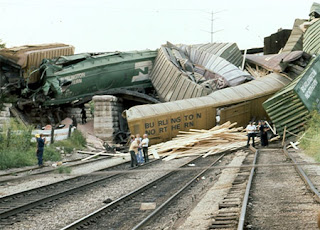
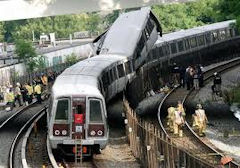
    A year ago, I approvingly cited research by Wall Street analyst Meredith Whitney who predicted a wave of municipal bond defaults by state and local governments. (See “The Next Train Wreck: Failed States.”) There have been a handful of spectacular flame-outs — most notably the city of Harrisburg, Pa., and Jefferson County, Ala. —ย  but they are exceptions that prove the rule, concludes a paper by the National Association of State Budget Officers, “Municipal Bonds in 2011: An Update on State and Local Borrowing.”

    Write the authors:

    Municipal defaults continue to be a very small percentage of both the number of issuers and the aggregate dollar value of outstanding tax-exempt debt. There were no defaults on state general obligation bonds and none had been expected. In the first nine months of 2011, there were 42 municipal defaults totaling $949 million, falling from the 79 defaults experienced in 2010, amounting to $2.89 billion. The declining number of issuers defaulting, and the decreasing dollar value of those defaults indicates that local governments and municipalities are better able to meet debt obligations this year than in 2010.

    Further, the overwhelming majority of defaults were on bonds issued by hospitals, industrial development organizations, and housing development
    projects, not general obligation bonds tied to cities, counties, and states with taxing authority. The Harrisburg and Jefferson County bankruptcies can be traced to monumental human error, not systemic conditions. Conclude the authors: “Trends in the municipal markets suggest state and local governments will continue to have access to capital for years to come.”

    In the post I wrote a year ago, I feared the possibility that the federal government would be moved to bail out irresponsible states and municipalities. Fortunately, as financial conditions for the states gradually improve and as states from Wisconsin to California make tough choices, no federal intervention has been necessary. As the failure of the Congressional super-committee to craft a budget-fighting agreement drives home, the biggest systemic threat to governance in this country remains the federal government itself.

    — JAB


  • Want More Money for Rail-to-Dulles? Make the Project More Transparent.

    Transparency is a beautiful thing.

    It does not look like the Project Labor Agreement (PLA) controversy will fade away quietly. (For background, see “Games People PLA.”) Del. Robert G. Marshall, R-Manassas, has filed a bill to prohibit the use of state revenues for construction of Phase 2 of the Dulles Corridor Metrorail project unless the project meets three transparency standards.

    The recently signed Memorandum of Agreementย  between the McDonnell administration, the Obama administration, the Washington Metropolitan Airports Authority (MWAA), Fairfax County and Loudoun County calls for a restructuring of the costs and financing of Phase 2 of the $2.8 billion Rail-to-Dulles project. The state will contribute an additional $150 million to the construction, contingent upon approval by the General Assembly. Marshall’s bill is the first indication that the legislature’s approval cannot be taken for granted.

    House Bill No. 2 would prohibit the state from contributing any funds to Phase 2 if (1) the project is subject to a Project Labor Agreement, (2) the policies or bylaws of the MWAA governing public access to meetings and records areย  incompatible with Virginia’s Freedom of Information Act, or (3) phase 2 of the project and its finances will not be subject to audit by either the Virginia Department of Transportation or Auditor of Public Accounts.

    MWAA’s board wants to use the PLA that Dulles Transit Partners voluntarily adopted for Phase 1 and as a model for phase 2 — but make it mandatory. Critics charge that such a requirement would effectively eliminate non-union company from competition, resulting in a higher bid. An agreement between the state and the MWAA clarified that any PLA had to be consistent with the state’s Right to Work law, which protects the right of workers not to join a union, but left it unclear whether the MWAA still could require the prime contractor to adhere to a PLA with other requirements, such as hiring all workers (union or non-union) through a union work hall and contributing to union retirement funds.

    The financing for Phase 2, which will rely heavily upon toll revenue paid by commuters on the Dulles Toll Road, has been highly controversial in Fairfax and Loudoun counties. Without the state’s $150 million contribution, the deal brokered by U.S. Transportation Secretary Ray LaHood could well fall apart.

    The McDonnell administration has made no public comment upon the bill. But Marshall wrote in an email distribution of his bill, “Del. Joe May [R-Leesburg] and the McDonnell administration do not appear initially supportive of my effort to secure more transparency and accountability for taxpayer funds as provided in HB 2.”

    — JAB


  • Games People PLA

    Will the recent dealย  to salvage the $2.8 billion second leg of the Rail-to-Dulles project require non-unionย  bidders to play footsy with the construction unions? The answer is far fromย  clear.

    by James A. Bacon

    A deal struck between the McDonnell administration and theย  Metropolitan Washington Airports Authority (MWAA) will not require bidders on Phaseย  2 of the Rail-to-Dulles project to sign a Project Labor Agreement (PLA). Orย  maybe it will. Itโ€™s really not clear. The wording of the Memorandum of Agreementย  (MOA) is ambiguous. At least one McDonnell administration official insists thatย  the rights of non-union workers and companies are upheld in the agreement but neitherย  the MWAA nor the Attorney Generalโ€™s office is talking.

    The PLA issue is a sensitive one. Earlier this year, theย  estimated cost of Phase 2 of the METRO rail project had ballooned roughly $1 billionย  higher than the $2.8 billion in funding sources lined up to pay for it. A dealย  brokered earlier this month by U.S. Transportation Secretary Ray LaHoodย  seemingly got the project back on track by extracting various commitments andย  concessions from the state, MWAA, Fairfax County and Loudoun County, the four funding partners. The deal referenced a side agreement between Virginiaย  and the MWAA that details โ€œprinciples and requirementsโ€ for a labor agreement.

    In Phase 1 of the construction project, which extends the METRO past Tysons Corner, prime contractor Dulles Transit Partners enteredย  into a voluntary PLA to hire workers through a union hiring hall, although itsย  sub-contractors were not required to do so. MWAA has sought to make thatย  agreement mandatory for anyone bidding on Phase 2. But non-union companies andย  many Fairfax and Loudoun elected officials objected, asserting that such anย  agreement would discourage non-union companies from submitting bids. The lossย  of competition, critics said, could result in bids $300 million or more higherย  than the official estimate.

    It is precisely that outcome that the McDonnellย  administration sought to avoid, says Thelma Drake, director of the Departmentย  of Rail and Public Transportation. A sticking point in negotiating the broaderย  deal was MWAAโ€™s insistence that bidders on the prime contract be required toย  sign a PLA. โ€œWe worried that having the PLA up front would discourage some companiesย  from bidding,โ€ she explains. The Commonwealth Attorneyโ€™s office got involved inย  drafting the language to ensure that any PLA would be consistent with stateย  Right to Work laws.

    โ€œThe PLA is not mandatory,โ€ Drake says. โ€œYou cannot requireย  your prime to sign a PLA.โ€

    Sounds clear enough. But what does the actual MOA say?

    The agreement states that no prime contractor or subcontractorย  can require an employee to join a labor union. It also says that no prime orย  subcontractor can be โ€œdiscriminated againstโ€ based upon its affiliation or non-affiliationย  with a labor union. But then the MOA says this:

    ย  No prime contractor working orย  seeking to work on Phase 2 shall be required, in order to secure or maintain aย  phase 2 prime contract, to become a party to any labor agreement other than the Phase 2 PLA.

    To some observers, the wording “other than” seems to specifically exempt the Phase 2 PLA from the rule — especially when considered in the context of what follows, a principle that states sub-contractors shall not be required to sign any labor union contract, “including” the Phase 2 PLA. The wording would seem to create an arrangement nearly identical to the Phase 1 PLA, which binds Dulles Transit Partners to a union workforce but exempts subcontractors.

    โ€œThere are a lot of questions out there,โ€ says Angieย  Gutenson, vice president of the Virginia chapter of the Associated Builders andย  Contractors, which represents the interests of open-shop contractors in theย  state. The MOA states that Virginiaโ€™s Right to Work law will be enforced andย  that non-union companies will not be โ€œdiscriminated against.โ€ But what does โ€œdiscriminateย  againstโ€ mean in this context? โ€œWeโ€™re not lawyers, so we donโ€™t know.โ€ Read more.