Virginia faces long-term budget stress due to a slow economy and an outdated tax structure, contends Sara C. Okos, policy director of the Commonwealth Institute, in the latest edition of the Virginia News Letter. “What Virginia needs,” she says, “is a 21st century revenue system for a 21st century economy.”
Okos makes a number of valuable points in this analysis, which renders it worth reading despite its chosen focus on the revenue side of the equation. Needless to say, any budgetary analysis is incomplete if it ignores the dramatic spending increases that preceded the 2007-2008 recession. But one can say only so much in a 14-page publication, so I’ll set that objection aside for the purpose of exploring her revenue-enhancing ideas.
Individual income tax. The state income tax has lost whatever progressive attributes it once had when last updated in 1987. The top tax rate — 5.75 percent — kicks in for taxable income over $17,000. Median income is much higher than it was a quarter-century ago, with the result that more than 60% of Virginia taxpayers pay the top marginal rate. If the top tax bracket had been indexed for inflation, it would be roughly $33,400 today.
Her analysis is indisputable. Her conclusion misses the mark. “Virginia,” she says, “would benefit from altering its individual income tax brackets and rates to reflect the realities of today’s modern economy, demand for public services, and income distribution in the state.” Translation: Make the tax code more progressive. If your goal is making the rich pay their “fair share” (however you define “fair”) then maybe so. If your goal is a stable source of tax revenue, then not. One thing we’ve learned about progressive tax rates in the federal government and state governments like California is that they bring in loads of money when they economy is booming but revenues collapse when the economy slows. Why? Because the income of upper-income Americans is much more volatile.
Sales tax. Two broad economic trends are limiting the take from Virginia’s sales tax, says Okos. First, the sales tax applies only to goods, yet consumer spending is growing more rapidly for services. The majority of states with a sales tax apply the tax, on average, to 40 of 168 potentially-taxable services. Virginia taxes a mere 18, including such blockbuster categories as diaper service, gift-wrapping and tuxedo rental. Secondly, federal law forbids the taxing of Internet sales, which now exceeds more than 4.0% of total retail sales.
Taxing a broader array of services could net the state as much as $900 million annually. Among the advantages, Okos notes: “Bringing services into the sales tax base could reduce the year-to-year volatility of sales tax collections.” Good point! She should think about applying the same principle to her analysis of the income tax. She makes one other interesting point. Taxing services is more “equitable” because the rich spend a larger percentage of their income on services than goods, while the poor spend a higher proportion on goods than services. If your goal is to increase the progressivity of the tax code, this is a better way to do it than increasing the income tax rate. Better it is to tax consumption (the sales tax) than hard work and success (the income tax).
One more note: If we expanded the sales tax to services, I would recommend using the resulting income to reduce some other tax — not to increase spending.
Corporate income tax. Virginia’s corporate income tax stands at 6%. The share of total tax revenue paid by corporations has declined by half since the 1970s. Part of the problem, says Okos, is that a big majority of corporate income tax collections (87 percent in fiscal 2006) are paid by multistate corporations with subsidiaries in different states. These corporations shift income between states to take advantage of jurisdictions in which taxes are lower or where corporations aren’t taxed at all. One possible remedy might be to make Virginia’s corporate tax rate more competitive by lowering it but she doesn’t consider that option. Instead, she says Virginia should mandate the filing of a “combined return,” in which corporations add the income from all their subsidiaries and apportion it to the states where the money was made.
To be perfectly honest, I don’t know enough about the corporate tax law to critique Okos’ recommendation, so I shall keep my mouth zippered on this one.
Tax expenditures. Spending through the tax code in the form of credits, deductions, exemptions and the like costs Virginia roughly $2 billion a year. These loopholes are accumulating and growing. The General Assembly has passed or changed 60 tax expenditures since 1990. Okos suggests, as a first step to plugging these loopholes, that Virginia publish an annual tax expenditure report that is more comprehensive than the partial report issued currently. Writes Okos:
In order to be useful, a tax expenditure report must include several key features. It should contain the intended purpose of each tax break, who benefits and how much they get, and an estimate of total cost. A solid tax expenditure report can shed light on under-performing programs or those that cost far more than was anticipated when the tax break was established. Such a report can also highlight programs that are meeting or exceeding expectations and that yield a high return on investment.
Sound thinking! She also suggests attaching a sunset provision to any new tax-expenditure legislation. I am in 100% agreement with both of her suggestions.
All things considered, there seems ample room to reform Virginia’s tax structure. There are broad areas — broadening the sales tax and limiting tax loopholes — where liberals like Okos and conservatives like me actually agree. The ultimate goals should be a broader, more stable tax base that makes Virginia more economically competitive. Let’s get started!
You don't like subsidizing welfare queens or bank bail-outs. Why subsidize the automobile culture?
by James A. Bacon
Once again, circumstances compel me to deliver a lecture on the difference between taxes and user fees. Gov. Bob McDonnell has forced the issue by proposing to boost spending for Virginia roads by diverting more money from the General Fund. In so doing, the governor would tilt the financing mechanism further from a user-pays system and toward an automobile-subsidy system.
Philosophically, this is fundamental. One principle of governance says, “People who use roads should pay the full cost of building and maintaining them.” The other principle says, “People like driving on roads but don’t like paying for them, so I’ll subsidize their transportation preference with taxes imposed upon the general public.”
Republicans claim to loathe social engineering. They rightly distrust those Greens and environmentalists who want to corral the population into high-density housing and force them to ride mass transit. But Republicans are social engineers of a different sort. They support tax and transportation policies that underpin the auto-centric society. Then, when the cost of those policies becomes prohibitively expensive, they turn to public subsidies to maintain an unsustainable status quo.
Once upon a time, Virginia funded most of its road building through the state motor fuels tax, supplemented by federal grants paid for by a federal motor fuels tax. It wasn’t perfect, but it worked reasonably well. Generally speaking, the more miles you drove, the greater the burden you put on the road system, and the more tax you paid. People who walked to work, biked to work or worked at home didn’t pay as much. The salesman who drove 1,000 miles a week paid a lot more than the little old lady who drove 10 miles a week. There was a rough justice in the tax.
But the Old Dominion has largely abandoned that approach. Through inaction, legislators have capped Virginia’s gasoline tax at 17.5 cents per gallon since 1986. Due to inflation, the purchasing power of that tax has declined by more than half — way more than half, actually, if you consider the inflation in construction costs. But the demand for more roads, bridges and highways has not diminished at all. To maintain road funding, lawmakers have boosted other taxes. But they have done so in a sly, underhanded way: by breaking up the taxes into little pieces that are harder for taxpayers to notice, and relying upon revenue sources that automatically increase over time.
Today, barely one third of the dollars spent by the Virginia Department of Transportation comes from the motor fuels tax. Here’s where the money is coming from this year, according to an October VDOT estimate for Fiscal Year 2012:McDonnell would further sever the connection between those who use Virginia’s roads and those who pay for them by doing three things: (1) Phasing in the transfer of an extra 0.25% of the state’s 4.5% sales tax to transportation over eight years, (2) dedicating 75% of any end-of-year General Fund surplus to transportation, and (3) dedicating an additional 1% of all General Fund revenue to transportation in years when revenues increase more than five percent. Bottom line: within eight years, the motor fuels tax will account for perhaps one quarter of VDOT funding.
Why is that so bad? After all, we use General Funds to underwrite the cost of schools, corrections and Medicaid. Why not roads, too?
Here’s why. When government subsidizes the cost of building and maintaining roads, people drive more. When people drive more, they increase the wear and tear on roads and they aggravate traffic congestion, both of which intensify the pressure on government to raise more taxes. Thus tax subsidies beget more tax subsidies.That is fiscally unsustainable.
By comparison, when government pays for public education, people don’t go out and have more children.When government pays for prisons, criminals don’t go out and commit more crime. When government pays for free health care, Medicaid patients don’t go out and get sicker… Well, actually, people probably do make less effort to stay healthy when they know that someone else will pay for their medical treatment. Bad example. That’s a big reason our health care system is so dysfunctional. It, too, needs to change.
In an economically ideal world, Virginia would eliminate every tax listed above except the motor fuels tax and raise that tax by enough to offset the lost revenue. That would mean roughly tripling the gas tax. Virginians wouldn’t be any worse off — by definition, the tax burden would be the same. Actually, I could make the case that Virginians would be better off: (a) because the tax would be totally transparent and they would know what they’re paying, and (b) they could reduce the amount of tax they pay by modifying their behavior — driving less.
Admittedly, there is one big problem with shifting to an all-motor fuels tax. That tax, as I have oft preached and McDonnell noted in justifying his raid-the-General Fund proposal, is living on borrowed time. Gas tax revenues will decline as automobile gas mileage improves and as people buy more alternate-fuel vehicles. But the solution isn’t subsidizing transportation with General Funds, it’s replacing the motor fuels tax with a Vehicle Miles Traveled tax. Any VMT tax would pose administrative challenges, so we need to start studying the options now in order to get the kinks worked out when it’s time to make the switch.
From a moral perspective, subsidies for middle-class drivers are no more defensible than payments to welfare queens or bail-outs for Wall Street bankers. In every case, government robs Peter to pay Paul. And in every case, there are adverse consequences. Just as welfare breeds a pathological culture of poverty and bail-outs encourage bankers to gamble recklessly with other peoples’ money, subsidizing roads leads to more driving, more gasoline consumption, more congestion, more pollution and greater dependence on foreign oil. Genuine conservatives will oppose McDonnell’s transportation-funding proposals.
Plans to mine uranium in Southside Virginia did not get the boost some had been hoping for now that a 22-month-long review by the National Academy of Sciences and the National Academy of Engineering has been released.
Far from rubber-stamping the plan, the independent analysis reported that there are “significant” health and environmental obstacles with the plan, which would allow mining 119 million pounds of uranium from the properties of several politically connected families near Chatham.
Among those challenges are that Virginia, which must protect the environment and the lives of mining workers, has no experience doing so and lacks any regulations covering mining uranium. The study did not give a go or no-go recommendation but said that mining could occur if proper safeguards were put in place. Getting them will take much time and effort.
In other words, the juggernaut towards the uranium mining idea, which has included all-expenses-paid trips to France for legislatures considering ending a two-decades-long ban on such mining, just got a big, bright yellow caution light, not exactly what proponents had hoped for.
Even supporters started backing away from the idea. Gov. Robert F. McDonnell, who wants to make Virginia “the Energy Capital of the East Coast” seemed to mumble that uranium mining should be done safely. Virginia Energy Resources Inc., which owns 29 percent of the mining project, put the happiest face it could on the report, stating that we now have a “roadmap” to employ the “best practices” in safety that have been in practice in the U.S. and Canada. Mining opponents hailed the report as vindication of their fears.
What’s going to be interesting is the next step. How Virginia’s business elite handles the report and the moratorium will be the determining factor about whether the ban is ended and the mining goes through.
The sad truth is that many of these people see only one side of the energy equation and are loath to consider environmental issues or even get a deeper understanding of energy itself. Instead, legitimate concerns are painted as over-regulation madness by the likes of Barack Obama and his band of socialists. What is sad is that these very critics really have no real idea of what the global energy mix and what the markets really are.
For proof, read a piece of a couple of weeks ago by Barry E. DuVal, the new president of the Virginia Chamber of Commerce who was once mayor of Newport News and a cabinet secretary under Republican Gov. Jim Gilmore. DuVal’s piece was a diatribe against the Obama Administration for not including areas offshore Virginia for exploration and drilling. He also attacked Obama’s concerns about the controversial Keystone XL pipeline that would take fossil fuel energy from an oil sands project in Canada to Gulf Coast refineries. Without a major change in direction from the White House,” DuVal wrote, Virginia won’t be able to drill offshore, expand renewable electricity sources and build nuclear power plants.
A few little problems here. First, there are no known, large deposits of oil off the Virginia coast. There may be natural gas, but nothing certain. If you want to discuss natural gas, one thing DuVal fails to mention, is that hydraulic fracking of Marcellus shale in Pennsylvania and New York, has resulted in an unexpected flood of new gas. The quantity is so great that electric utilities are shifting to gas from coal. As far as nuclear, DuVal seems to have forgotten the August earthquake that pushed the North Anna nuclear plant to its design limits and caused a national review of just how susceptible the country’s nuclear stations are to earthquakes. As for wind, Google plans a huge wind farm just off Virginia’s coast. No mention there. As for the Keystone pipeline, the petroleum is exceptionally dirty. The pipeline will result in zero jobs in Virginia, if you bother to look at a map.
And lastly, for the first time in decades, the U.S. has become a net exporter of energy. This is all happening without Bob McDonnell’s fantasy of the state becoming the “Energy Capital of the East Coast.” The Old Dominion is a huge shipping port for coal exports, but it involves coking coal for steel for skyscrapers in Shanghai and Mumbai and has nothing to do with energy.
So, given the level of understanding of the energy outlook, it should come as no surprise that this crowd will be pushing for an end to uranium mining and pressing on without substantive regulations. We hate regulations. We’re Virginians. In any event, it’s all Barack Obama’s fault.
Gov. Bob McDonnell has submitted a proposed budget for the next biennium that is built upon anticipated revenue growth of 3.3% in 2013 and 4.5% in 2014. Crafted with an eye to maintaining Virginia’s AAA bond rating, which Moody’s Investors Services had placed on credit watch this summer, the governor couples modest spending increases in core areas with several moves designed to shore up the state’s financial strength.
Among the highlights, McDonnell proposes:
Allocating $2.21 billion in total employer contributions to shore up Virginia’s under-funded retirement system, helping make up for previous under-funding.
Boosting the state’s Rainy Day Fund by $132 million in FY 2013 and $168 million in FY 2014, bringing the total to more than $600 million.
Appropriating $50 million to eliminate the accelerated sales tax affecting roughly 7,000 retailers.
Leaving $31 million unappropriated, “reflecting the need for a greater cushion given economic uncertainty.”
The new budget finds more money for Medicaid, K-12 education, higher education, mental health and economic development, and it does so without raising taxes. For the most part, it’s a sober-minded budget for a sobering time.
“I believe government must get more focused and effective,” McDonnell said in a prepared statement he was scheduled to deliver to a joint meeting of the Senate Finance, House Appropriations and House Finance Committees. “That work must occur as we navigate through a financial world marked by crisis and insolvency in Europe, the rise of China and India, crushing debt, shutdown threats and unfunded mandates from Washington and our citizens’ rightful demand that government work better.”
Looking at the big picture, McDonnell takes only one major wrong turn, but it’s a biggie — diverting tens of millions of dollars from the General Fund budget to transportation, which traditionally has relied upon dedicated revenue streams. Refusing to raise the motor fuels tax, McDonnell is abandoning any pretense of a “user pays” principle for transportation funding. That is wrong, wrong, wrong, as I will explain in a future post.
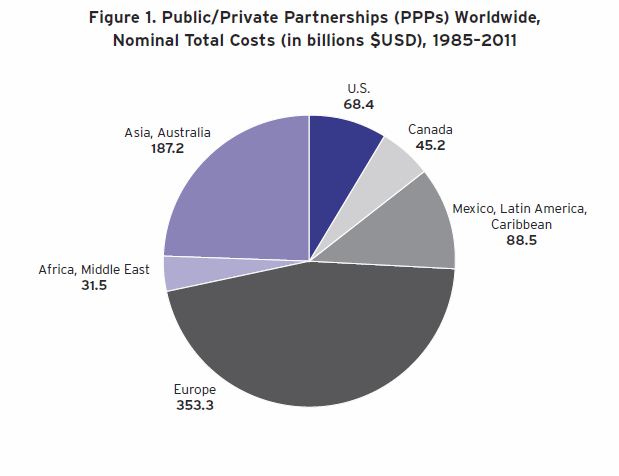
Graphic credit: Brookings Institution. (Click on chart for more legible image.)
by James A. Bacon
While Virginia’s Public Private Partnership Act may be experiencing growing pains as more projects see the light of day and invite public scrutiny (see “The Promise and Pitfalls of P3s“), there is little doubt that PPPs, or P3s, are the wave of the future. Indeed, the United States is something of a laggard in embracing this mechanism, which draws upon private-sector capital and management to build roads and other infrastructure. Europe has roughly five times the P3 investment as the U.S. Even Latin America has availed itself of this option more than the U.S. has.
However, P3s are getting more attention in the United States as resistance to higher taxes starves federal and state government of funds to ramp up more construction projects. Two very recent reports, one from the libertarian-leaning Reason Foundation and the other from the center-left Brookings Institution, are a sign that P3s are gaining legitimacy as a transportation-funding option.
Reasons’ “Risk and Rewards of Public-Private Partnerships” argues that the dynamics of P3s are well understood now that dozens have them have been implemented around the world. PPPs have five major advantages, writes author Baruch Feigenbaum. They (1) deliver needed transportation infrastructure sooner; (2) raise large new sources of capital; (3) shift risk from taxpayers to investors; (4) provide a business-like approach, (5) and enable innovation. “PPPs can be utilized in most types of projects and are most successful in states with strong enabling legislation.”
Imilia Istrate and Roberto Puentes at Brookings make another important point in their paper, “Moving Forward on Public Private Partnerships.” P3s are complex contracts, and negotiating them is not a task best left to amateurs and part-timers. The authors suggest that states develop “public private partnership units,” entities within the government that develop the technical and financial expertise to evaluate, negotiate and monitor P3 projects. It is encouraging to see that the paper specifically cites the the Office of Transportation Public-Private Partnerships in Virginia as one of only three examples of a genuine “public-private partnership unit” among the 50 states.
Virginians should take pride in the state’s recognition as a leader in implementing P3s, but the commonwealth’s enabling law still may need massaging. As I reported in “Promises and Pitfalls,” there is an inherent tension between inviting public input on the one hand and protecting the integrity of the very complex negotiations between the state and the private-sector concessionaire on the other. Citizens have a right to know how these mega-projects will affect them before deals are signed, and they should have some right of of appeal if the terms are onerous. Yet openness and transparency must be tempered by the reality that it would be impossible to ever complete a transaction if the public were involved at every turn and if key negotiating points were politicized.
A related problem is the project selection. The most fundamental question we need to ask ourselves is, “Should this project even be built in the first place?” It is of little comfort to know that a P3 can bring in a project cheaper and faster if we’re building the wrong road/bridge/rail project in the wrong location. In Virginia, the P3 projection circumvents the normal process for approving transportation projects. The Commonwealth Transportation Board is informed of major developments, but its consent is not required. The McDonnell administration is in the process of committing $1.5 billion in state funds to P3s and committing the state to 50- to 80-year concessions, all with toll-backed financing that will cost citizens billions of dollars more, and it does not appear to be accountable to anyone. No avenue exists for appealing unpopular projects.
I’m not singling out the McDonnell administration for blame here, by the way. The problems are inherent in the legislation, not the individuals in charge of carrying it out. And I’m not sure how we fix the problems. But they do need addressing.
Mid-Atlantic Regional Spaceport (MARS) at Wallops Island
by Jack Kennedy
Earlier this month, news of a proposed Virginia tax incentive for sending cremated remains into space went viral around the globe. Stories appeared in Germany, the Arab Emirates, Australia and throughout the United States. Most mocked the idea.
All missed the underlying storyline of opportunity to boost primary satellite payloads at a significantly lower cost than exists today. There is more to the story of the state tax credit than meets the eye.
If Virginia’s Legislature were to adopt a tax credit to seed the Virginia market for launching cremated human remains into low earth orbit, the buyers of mortuary space science would defray costs associated with carrying the primary satellite payloads to orbit. In many cases, the primary payloads of rockets lofting from Wallops Island are scholarly and scientific, involving students learning engineering and science skills.
In other words, Virginia high school, college and university students would have a better chance of lofting miniaturized satellite research experiments to space from Wallops Island at a more reasonable cost if coupled with a secondary commercial payload defraying the costs of the booster rocket. A small satellite (MicroSatellite or NanoSat) is typically less than 1,000 pounds with technology advancing to place them in low earth orbit at a significantly lower cost than the typical NASA suborbital sounding rocket.
Universities throughout the United States today are participating in various NanoSat space launches as a secondary payload. One such program is the University NanoSat Program administered by the United States Air Force. A similar program is underway among Kentucky universities under the moniker “Kentucky Space.”
While Virginia’s universities have yet to take a networked leadership position in building and flying NanoSats to low earth orbit, the time is right for them to make it so. The University of Virginia, Virginia Tech, Old Dominion University, James Madison University, George Mason University and others need to have such a discussion.
For example, Thomas Jefferson High School students have built a 10-centimeter cube satellite that weighs less than 1.2 kilograms. The Fairfax County students plan to place their space satellite into orbit from Cape Canaveral, Florida in 2012 after having it tested this month at Virginia headquartered Orbital Sciences Corporation.
High profile efforts like the Apollo program have come and gone. The space shuttle has been retired after 30-years of service. Government-sponsored launch programs are in demise. The entrepreneurial market for space access is emerging with a more diverse cast of actors.
Small, entrepreneurial rocket-launch firms are building markets and driving down costs. Unique and unusual means to generate cash flow will sustain business and provide access to space for the next generation of earth and space science researchers.
Virginia can seed lower cost university and high school space science experiments by boosting the economics of an underlying secondary satellite payload – human cremated ashes. Orbital Sciences Corporation, a Northern Virginia firm, first entered this unusual market when it flew human cremated remains as a secondary payload aboard a Pegasus air launch rocket in 2002.
The proposed tax credit exclusively for Virginians has a sunset provision after a few years. The chances of taxpayer costs exceeding more than a hundred thousand dollars would be slim. The opportunities created for science and engineering education may be significant, however.
Del. Terry Kilgore’s bill is already a success in generating worldwide media attention to Virginia’s emerging commercial spaceport and the tourist opportunities along the Eastern Shore. More Virginians will learn of their spaceport as well. Given serious effort, it may launch new science and innovation making the primary NanoSat payloads a more viable proposition.
If journalists resist the temptation to make the space burial legislation the butt of sarcasm, Virginia may continue as an innovative space policy leader. Building a capital nexus between student-driven NanoSat primary payload launches and the underlying secondary payload of cremated remains will provide a unique pathway to build a more dynamic Virginia space access market.
This column responds to a story, “HB19: Fly (What’s Left of) Me to the Moon,” posted by Groveton last week. The author, Jack Kennedy, is an attorney and former member of the state legislature. He holds a MS in Space Policy from the University of North Dakota. Contact him at [email protected].
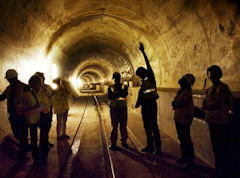
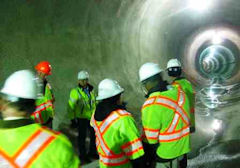
Norfolk view of the MidTown Tunnel. Photo credit: Virginia Department of Transportation
The $2.1 billion Midtown-Downtown Tunnel project will alleviate some of the worst traffic congestion in Hampton Roads. But the deal raises questions about transparency and accountability in Virginia’s public-private partnership law.
By James A. Bacon
Last week state officials and their private-sector partners took the podium at the Governor’s Transportation Conference in downtown Norfolk to describe the $2.1 billion Midtown-Downtown Tunnel project that had received the final go-ahead only days before. Chris Guthkelch, Elizabeth River Crossings (ERC) project director, described the engineering feat of moving 1.5 million cubic feet of sediment and depositing eleven massive sections of tube-tunnel, barged down from Baltimore, onto the river floor so they aligned perfectly. Dennis Heuer, Hampton Roads district engineer for the Virginia Department of Transportation (VDOT), explained how upgrading the tunnels linking Norfolk and Portsmouth would reduce congestion, improve safety and boost regional productivity by between $174 million to $254 million annually.
But across the river in Portsmouth, details of the massive public-private partnership were not being received very well. Local officials expressed outrage at project financing that would impose tolls of $1.59 for cars during off-peak hours and considerably more for trucks and cars during peak hours. In future years, tolls will escalate at the annual rate of 3.5% or the Consumer Price Index, whichever is higher. Adding insult to injury, ERC will begin collecting tolls in 2012, five years before the project is even complete and the public experiences any benefit from it.
Addressing a crowd outside City Hall, Portsmouth Mayor Kenny Wright vowed to roll back the tolls. He called upon other cities in South Hampton Roads to join the effort. The state might have signed a comprehensive agreement, locking in the arrangement for 58 years, but Wright had only begun to fight. “This thing is far from over,” he said. “It is never too late, even with a signed contract, to negotiate how the tolls will be implemented.”
Public-private partnerships like the Midtown-Downtown Tunnel are incurring closer scrutiny now that the McDonnell administration has announced a series of new projects and promised a “pipeline” of other deals in 2012. As conventional sources of road-construction funds are eroded by inflation and mounting maintenance needs, McDonnell has turned to debt – his administration will borrow $4 billion for road construction – and P3s, as the public-private partnerships are known, to fill the gap. He is counting on the P3s to attract billions of dollars of toll-backed private investment to build projects the state never could afford otherwise.
In early December, the administration announced a series of major deals in quick succession. First, news broke of the $2.1 billion Midtown-Downtown Tunnel agreement. The next day, the governor announced an agreement in principle for a $940 million HOT lanes project on Interstate 95. The day after, word came that the state would invest $124 million to advance the Coalfields Expressway. Meanwhile, the newly formed Office of Transportation Public Private Partnerships (OTP3) is actively working on a deal to upgrade U.S. 460 between Petersburg and Suffolk to Interstate standards, a project that also will require significant state funding. The OTP3 is expected to release a list of other projects under consideration next month.
But even as the McDonnell administration charges ahead, making good on the governor’s campaign promise to “get Virginia moving,” critics are getting more vocal. While the critique of individual projects may differ, depending on details, several common themes are emerging:
The P3 enabling legislation provides for little accountability. Citizens can’t see critical details of a transaction until the deal is already done, and there is no effective appeal.
Concessions take the form of long-term agreements – 58 years in the case of the Midtown-Downtown Tunnel, 73 years for the I-95 HOT lanes – that effectively lock in transportation policy for decades to come.
Some contracts contain clauses that either protect private-sector partners from competing projects or compensate them for lost revenue from future public investments, including mass transit service.
P3 projects are suitable only for mega-projects that generate revenue from tolls or, possibly, special tax districts. By circumventing the usual process of review and approval by the Commonwealth Transportation Board for the expenditure of state money, projects jump to the head of the line and lay claim to scarce state dollars that could be more effectively spent elsewhere.
Transparency vs. Confidentiality
“I’m furious. The price of the tolls is too high and the governor signed this deal without consulting the mayors of the cities affected. We haven’t had a chance to weigh in and it’s not fair.”
— Portsmouth Mayor Kenny Wright
An inherent difficulty in crafting a public-private partnership law is the need to strike a balance between transparency and public involvement on the one hand and the confidentiality required to negotiate complex transactions on the other. McDonnell administration officials maintain that current law makes reasonable trade-offs.
“Our function is to deliver a completed project to the people of the commonwealth,” says Tony Kinn, the McDonnell administration’s point man on transportation public-private partnerships. “There are a lot of checks and balances.”
Those checks and balances can be seen in the process by which the Midtown-Downtown Tunnel reached final approval. VDOT solicited conceptual proposals in May 2008. When Elizabeth River Crossings submitted a proposal in September, VDOT promptly posted it for public inspection. An Independent Review Panel (IRP) held five meetings, including two public hearings, between February and June 2009 and recommended that the proposal be kicked back to VDOT for more work. During that evaluation phase, says Dwight L. Farmer, director of the Hampton Roads Metropolitan Planning Organization and member of the 12-person panel, the proposals were an “open book.”
In January 2010 VDOT and ERC executed an interim agreement to do more detailed work. Those deliberations were not open to the public. Still, as discussions progressed, VDOT released important details. In May 2010, then-acting VDOT Commissioner Gregory Whirley made a presentation to the Commonwealth Transportation Board that contained a project estimate of $1.9 billion. He also revealed that in the base case tolls would be $2.17 for cars with transponders in off-peak hours, but expressed the goal of buying down the tolls with subsidies to $1.50 per car in off-peak hours. Those numbers proved reasonably close to the figures contained in the final agreement executed a year-and-a-half later. However, many important elements, such as the length of the concession, the size of the state contribution and the toll price escalators had yet to be worked out.
In November 2010, VDOT also delivered a “Hampton Roads legislative briefing.” (Although there is a link on the VDOT website to the presentation, the document is not functioning at the moment. The link displays an error message.)
In January 2011, VDOT and ERC entered into “comprehensive agreement negotiations.” Those talks were highly confidential. A half-year later, in July 2011, however, discussions had progressed to the point where the new P3 czar, Tony Kinn, could describe “major business terms” to the Commonwealth Transportation Board. He provided information about toll rates, the toll escalation provision, the duration of the concession, the size of the state contribution and other key terms and conditions.
Throughout the process, VDOT posted studies, press releases, presentations and other documents on a Midtown-Downtown Tunnel website nested within the VDOT website. Content includes a project timeline, procurement and environmental schedules, 14 different technical studies, seven press releases, links to Virginian-Pilot articles, a newsletter (with only one edition), presentations made at four public meetings, minutes of the Independent Review Panel, a document library and answers to FAQs.
“The question is,” says Farmer, the MPO official, “when do you re-engage the public?” There is no easy answer. The process must respect the proprietary nature of the proposals that companies submit to VDOT, he says. Businesses can spend millions of dollars fleshing out their ideas. “You can’t reveal to your competitors what you’re thinking,” he says. Furthermore, negotiations can be protracted and contentious. It would be counter-productive to conduct delicate talks in the public arena.
Those are legitimate points, critics say. But the result is that public input effectively ceases after the Independent Review Panel. Although the CTB was informed of major developments as they played out, the statewide board has no authority to veto the project. Once McDonnell announced the comprehensive agreement, which runs 160 pages plus dozens of exhibits, the transaction was done. If someone has a problem with the contract, there is no appeal. Unless the state is willing to pay significant penalties, there is no opening the deal for renegotiation.
Experience has shown, says Trip Pollard, an attorney with the Southern Environmental Law Center, that the public-private partnership act “shifts power from the CTB and the legislature to VDOT.” The law, he contends, empowers the governor of Virginia to commit to long-term, multibillion-dollar contracts with minimal accountability or oversight. And that should worry people.
Tolls, Competition and Risk
A project like the Midtown-Downtown Tunnel will define Hampton Roads’ transportation future for the next six decades. No one disputes the desperate need for some kind of improvement. Roughly 38,000 vehicles per day pass through the narrow MidTown Tunnel and travelers routinely spend a half hour in bumper-to-bumper traffic during rush hour. Addressing the bottlenecks at the Midtown Tunnel, the Downtown Tunnel and Martin Luther King Boulevard, an inter-related set of projects, is critical, says Kinn. “The benefit of those projects is huge.” The state does not have the money. The public-private partnership gets the job done.
But does Elizabeth River Crossings offer the best long-term solution for the region?
That’s hard to say because the deal locks terms and conditions into place for 58 years. The project addresses real needs today, but no one knows what the state’s transportation needs will be 20 years from now, much less 40 or 60 years from now. No one knows what new technologies, economic trends or land use patterns might transform the transportation landscape. One could argue that a more flexible, more adaptable, arrangement would better serve the region in the future.
But not only will the deal lock in tolls for the next two or three generations, it will lock in escalating tolls. Hampton Roadsters will start out paying $1.59 for cars during off-peak hours. After years of escalating at a minimum rate of 3.5% annually, tolls will climb to $12 by 2075.
One can argue that the tolls aren’t so bad. VDOT estimates conservatively that the tolls will save drivers 15 minutes each way, a total of a half hour for a round trip. Assuming drivers value their time around $16 an hour on average (the figures used by the Texas Transportation Institute in its Urban Mobility Report) that represents a time savings valued at $8. Thus, $3.18 in tolls ($3.68 during rush hour) buys $8 in time savings. “As the economy improves,” says Kinn, “those terms will lessen.”
The contract also limits the state’s ability to make other improvements that might compete for, or siphon off, toll revenue. ERC can file for compensation if VDOT undertakes initiatives such as new bridges that divert traffic from the tunnels.
Kinn stresses that the contract does not contain a non-compete clause. The state can make any improvements it wants. However, he concedes, certain state actions could trigger “compensation events.” If after detailed study it can be shown that the state damaged ERC’s revenue stream, the concessionaire can submit to the state for compensation.
Another sticking point for regional Hampton Roads officials is the fact that the tolls won’t go just to pay for new construction but to address tens of millions of dollars in backlogged maintenance needs the state should have addressed years ago as well as maintenance going forward. In effect, Hampton Roads motorists will be paying for maintenance twice – once through the motor fuels tax, the revenue source that pays for maintenance across the state, and again through tolls.
That’s true, says Kinn, but VDOT is offsetting much of the double-taxation effect by contributing $362 million in state dollars to the project and buying down tolls.
Yet another objection is that the public has no way to judge whether VDOT drove a hard bargain. ERC will contribute $318 million in equity and borrow the rest. It is not known from public documents what profit margins ERC expects to earn. Is it the same rate as, say, a regulated electric utility? Or will ROI run higher on the grounds that the company is taking greater risks that traffic volumes and revenue might not materialize? There is no requirement in the Public Private Partnership Act for letting the public know.
Similar concerns apply to other public-private partnerships around the state.
In a draft white paper he has circulated, Pollard, the SELC attorney, raises other issues. P3s circumvent the environmental review process by advancing a project before alternatives have been evaluated, he says. Requirements for competitive bidding are inadequate, he adds: It’s too easy for the company proposing a project to establish a sole-source arrangement. Also, he says, projects can lead to more driving, sprawl and environmental damage. “Most PPTA projects built or proposed thus far,” he writes, “have been highway construction that will subsidize sprawl and increase motor vehicle dependence, destroying open space and increasing air and water pollution.”
Pollard argues that the Public Private Partnership Act needs to be amended. Projects should be limited to those already contained in state transportation plans, he says, not ideas dreamed up by a private-sector player looking for business. Among other changes he seeks: The public should be allowed to comment before a comprehensive agreement is signed, and the Commonwealth Transportation Board should be required to sign off.
“Experience with PPTA projects and proposals,” writes Pollard, “indicates that the statute is seriously flawed and raises significant doubts about how effectively it serves the public interest.”
=============
This article was made possible by a sponsorship of the Piedmont Environmental Council.
Gov. Bob McDonnell is asking the General Assembly to hurry the phase-out of one of the jinkiest budgetary gimmicks ever foisted upon the people of Virgina, the so-called “accelerated” sales tax. About time! Too bad we can’t finish the job this year.
The 2010 General Assembly required larger retailers — anyone with $1 million or more in taxable sales — to pre-pay a portion of their July 2010 sales tax remittance in June, thus collecting an extra month’s revenue with which to close the budget gap. In the 2011 session, the legislature partially rolled back this abusive and dishonest expediency by raising the sales threshold to $5.4 million, thus exempting some 7,000 merchants and decreasing revenue by $45.7 million.
McDonnell’s proposal would raise the threshold again to $26 million in sales, exempting another 1,400 dealers from the accelerated tax at a cost of roughly $50 million. “I have always opposed the policy of playing budget games with sales tax receipts,” the governor said in a press release. “The accelerated sales tax can feel to retailers like a ‘double tax.’ It penalizes Virginia retailers and merchants and skews states revenues. It is bad policy and it needs to be eliminated as quickly as we can. ”
The accelerated sales tax was the ugly, co-joined twin of the General Assembly’s decision to cut payments into the Virginia Retirement System. Both maneuvers in essence took money that didn’t rightfully belong to the state and eventually would have to be phased out at considerable cost. McDonnell is doing the right thing. It’s the very least we expect from a state that purports to be serious about maintaining its AAA credit rating, and it’s exactly the kind of thing I’m talking about when I say we need to “bullet proof” the state budget.
Dulles Rail construction. Photo credit: Washington Post
The Virginia Chamber of Commerce has endorsed a bill that would prohibit state agencies from requiring labor union agreements as a condition for participating in a public works project.
The Fair and Open Competition Act in Government Contracting “ensures a level playing field” by preventing mandatory labor agreements, said the Chamber in a press release issued Wednesday. “These agreements typically discourage competition and exclude qualified Virginia businesses and their local construction workforce from working on taxpayer-funded construction projects.”
The bill would directly impact a proposal by the Metropolitan Washington Airports Authority (MWAA) to make mandatory a Project Labor Agreement on Phase 2 of the Rail-to-Dulles project. Although MWAA is not a state agency, financing for Phase 2 requires the injection of $150 million in state funds, for which the McDonnell administration is seeking approval from the General Assembly. The bill filed by Tim Hugo, R-Centreville, and Barbara Comstock, R-McLean, would restrict the ability of the state to “issue grants” or “provide financial assistance” to MWAA as long as it made the PLA a condition of bidding on the project.
The bill would not prevent project bidders from voluntarily signing a PLA or working with labor unions. Some large public-works contractors prefer working with unions. But open-shop companies would be severely disadvantaged by a mandated PLA, which would force them to change their business model in order to bid on a project, thus reducing competition.
“Research indicates public construction projects subject to PLAs are 12 to 18 percent more expensive,” said Barry DuVal, president of the state Chamber. “HB 33 will reduce costs, increase competition and create jobs for qualified Virginia businesses and local craft workers. Everyone wins when Virginia’s construction projects are procured free from discrimination and are based on the free enterprise system.”
Heh. Heh. And people thought I was stuck on a bizarre tangent by agitating against MWAA’s mandatory PLA. I guess I’m not the only one who has a problem with it. Heh. Heh.
Gov. Bob McDonnell is tackling the under-funding of the Virginia Retirement System by proposing the largest employer contribution in state history. His proposed biennial budget will recommend a total of $2.2 billion in employer contributions by state and local governments in addition to fully funding the next installments of the 10-year payback of previously deferred contributions.
Said McDonnell in a press release issued this morning: ““The plain truth is our state retirement system is underfunded, and this situation threatens the system’s long term solvency. We must fund VRS at substantially higher levels so benefits will be there for the hardworking teachers, police officers, firefighters, state employees – our neighbors, friends and family members – who are depending on the system for their retirements. ”
Is this package enough to close the $19.9 billion gap between VRS assets and liabilities? I’m no actuary but it looks like a step in the right direction.
The Richmond region has never been an “it” Sunbelt metropolis like Atlanta, Austin, Charlotte or Raleigh-Durham, but it did plug away pretty consistently, racking up better-than-average economic growth year after year. That was fine by most of us natives who enjoyed the fruits of moderate prosperity without the hassles of super-heated growth. But the time for complacency is over. We need to get our act together.
Two new reports drive the message home.
First, the Brookings Institution’s Metro Monitor shows that Richmond ranked in the bottom quintile for economic performance among the nation’s largest metropolitan areas in the 3rd quarter of 2011.
A longer-term measure of economic potential, “Best Performing Cities of 2011,” published by the Milken Institute, measures “where America’s jobs are created and sustained.” Richmond ranked among the Top 25 losers, diving from a 79th ranking last year to 119.
What’s going on? There are many transient reasons but one enduring one: insufficient innovation. The Richmond economy has given birth to relatively few fast-growth “gazelles,” the midsized companies that create the most jobs and wealth in the U.S. economy. Why would that be? Part of the answer is that we have no dominant industry clusters that spark innovation. But the problem, I think, runs deeper. Richmond is late to the game in talking about innovation ta all. The conversation about how to breed creativity has finally begun in earnest, but we’re 10 or 20 years behind more progressive communities.
When I left Virginia Business magazine in 2002, I helped create the program and line up speakers for a conference, “Virginia 2020,” which highlighted strategies for creating economic prosperity through innovation and productivity. We had great, cutting-edge topics and an excellent line-up of speakers. And the event was a total flop. It was embarrassing — no, humiliating. There were a number of reasons for the fiasco. It didn’t help to hold the event on the first anniversary of 9/11. It didn’t help that the event organizer had credibility issues relating to a previous business failure. (Close-knit Richmonders are less forgiving of failure than inhabitants of other regions.) But I’m also convinced that a lot of people just didn’t “get” it. Innovation? Productivity? In an era before Richard Florida warmed up the audience with his brilliant thesis about the rise of the creative class, people simply didn’t understand what we were driving at.
Times have changed, and so has the conversation. Slowly — painfully slowly — but surely, we’re getting some things right. People are moving back downtown into the region’s creative core. The City of Richmond is fostering the creation of a vibrant arts district. Cool development is taking place along the downtown Canal. The Virginia Biotechnology Research Park is gaining critical mass. The region is finally coalescing around a vision for the James River as an incredible recreation and entertainment asset. We have vibrant cultural events, from the French Film Festival (the largest outside France) to the Folk Festival to the James River Writer’s Festival.
As Richmond slowly morphs into the kind of community the creative class will find attractive, the next generation of corporate leaders is emerging. Health Diagnostics Laboratory, which identifies risk factors and biomarkers for personalized health, is a phenomenal success story. So is Bostwick Laboratories, which provides world-class clinical pathology laboratory services. And so is Tridium, whose Niagara Framework has become the global-standard software platform for building automation systems. Those are my favorites; there are others. We just need a few more.
I am confident that Richmond eventually will reinvent itself. The renaissance will not come from city elites acting on recommendations reflecting conventional thinking and packaged in some highly paid consultant’s report. It won’t come from building a new baseball stadium or establishing a (semi) high-speed rail link to Washington, D.C., or trying to copy some other city’s success story. It will bubble from the ground up and the results will surprise us all.
Back in October, Northern Virginia commuting guru Alan E. Pisarski updated the Washington Metro board of directors on the latest trends in commuting behavior. He made a number of important points that should temper the agitation of those who believe that Virginia’s under-funded transportation system is doomed to be overwhelmed by increasing levels of traffic.
(The following commentary is based upon data appearing in Pisarski’s PowerPoint presentation, which was shared with me. I did not hear the presentation. The analysis is mine.)
For starters, the national average travel time did not get worse over the past 10 years. Despite significant population growth, the average commute went from 25.5 minutes in 2000 to 25.3 minutes in 2010.That bears repeating: By this basic measure, commuting got no worse. Many people thought it would, but it didn’t.
Furthermore, many of the demographic forces that propelled an increase in the number of Vehicle Miles Traveled in past decades are largely (though not completely) spent:
Population growth is slowing
Household formation is slowing
Labor force growth is slowing
Migration from state to state is slowing
Growth in driver’s licenses is saturated
Growth in car ownership is saturated
I have examine all of these trends before except one — the slowing growth in the labor force. But this is fundamental. As Baby Boomers retires, succeeding generations are barely large enough to replace them. The workforce will continue to grow, but at an exceedingly slow rate. Why does that matter? Because workers account for peak traffic demand when they commute to work.
If we combine these demographic trends with the rising cost of automobile ownership, there is no reason to expect Vehicle Miles Traveled to increase nationally at anywhere near the pace that it has in previous decades. Bottom line: Throw out all national traffic projections based upon the extrapolation of past trends.
Admittedly, metro-level traffic projections are a different story. Population and economic growth in Northern Virginia, in particular, has outpaced the national averages, and it may well continue to do so. But that’s not the sure thing it seemed to be a few years ago. NoVa’s economy grew in tandem with federal spending. At some point, federal spending will level off. It may even decline. Indeed, if you believe my Boomergeddon thesis, it will crash. While it’s possible that NoVa will reinvent itself, as, say Silicon Valley has, there is a degree of uncertainty and risk that did not exist before.
Pisarski presented one other data set that should make Virginia’s policy makers perk up and take notice. Virginians are more likely than commuters in any other state in the country to leave their county of residence to go to work: 51.3% compared to a national average of 27.4%. That’s really extraordinary — and it’s an indictment of our collective failure to build communities with a balance of housing and jobs.
How to Improve Virginia’s Solid Waste Program Department of Environmental Quality
Division of Land Protection and Revitalization leadership has embarked on a culture change that places primary importance on managing risk to human health and the environment, with less emphasis on doing things just “because that is the way we’ve always done them.”
A bill filed Monday by Delegates Tim Hugo, R-Centreville, and Barbara Comstock, R-McLean, aims to prohibit state agencies from forcing bidders, contractors or sub-contractors to abide by a labor union agreement as a condition for participating in a public works project.
HB 33 is clearly targeting the Metropolitan Washington Airports Authority (MWAA) decision to require bidders on Phase 2 of the Rail-to-Dulles project to sign a Project Labor Agreement (PLA). Word of the bill was disseminated by the Virginia chapter of the Associated Builders and Contractors, an open-shop trade association, along with a press release expressing support.
The bill would make it difficult for a state agency to “issue grants” or “provide financial assistance” to any entity requiring a labor agreement. The McDonnell administration is asking the General Assembly to appropriate an additional $150 million state contribution — presumably to be routed through the Department of Rail and Public Transit — to finance construction of Phase 2 of the Metrorail extension. As the entity in charge of managing the project, MWAA would be the recipient of the grant.
“Unfortunately, unaccountable political appointees controlled by special interests have been steering taxpayer-funded construction contracts to their political supporters by mandating union-favoring PLAs on projects funded by the state,” said Patrick Dean, president of ABC-VA. “This special interest favoritism has no place in Virginia.”
“If enacted, this measure would prohibit state-assisted construction projects, such as Phase 2 of the multi-billion dollar Dulles Metrorail Silver line project, from mandating unwanted anti-competitive and costly PLAs on contractors,” said Dean. “Why should Virginia’s financial stakeholders pay for the majority of this project when the PLA mandated on the prime contractor by MWAA ensures discrimination against 96 percent of Virginia’s construction workforce – those who have freely decided not to join a union? Local workers will lose jobs to out-of-state union members given hiring priority via the PLA.”
Eleven other states have enacted similar measures, noted Ben Brubeck, ABC National’s Director of Labor and Federal Procurement. “HB 33 allows contractors to voluntarily enter into union agreements like PLAs. Unlike a government-mandated PLA, it gives contractors a real choice, which can only increase competition and help taxpayers get the best possible product at the best possible price.”
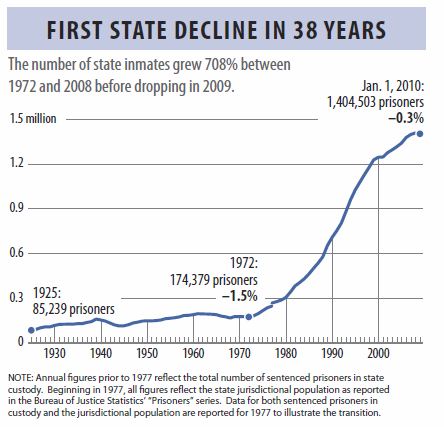
Click on graph for more legible image. Credit: Pew Center for the States.
Gov. Bob McDonnell has directed the Department of Corrections to close the Mecklenburg Correctional Center in Boydton. The decision was prompted by by Pennsylvania’s decision to remove nearly 1,000 prisoners housed under contract in Virginia, resulting in a loss of $20 million a year.
Mecklenburg inmates will be transferred to the Green Rock Correctional Center in Chatham, reducing the cost per inmate by $10,000 and offsetting some of the lost revenue, according to a press release from the governor’s office. With 730 offenders held in Mecklenburg on average, the implied savings amounts to $7.3 million yearly.
Opened in 1976, the Mecklenburg prison was designed for maximum security prisoners. It made national news in 1984 when six death-row inmates escaped, touching off one of the biggest manhunts in Virginia history. But it has since been reclassified as a medium-security facility. Not only is the design outdated, requiring more guards than state-of-the-art facilities, but it requires substantial ongoing maintenance work.
Nationally, the plummeting crime rate and declining incarceration rate (see chart above) is one of the few trends favorable to state budgets. Fewer prisoners translates into direct savings to taxpayers. Indeed, Virginia’s inmate population plunged 26% to about 30,000 between 2000 and 2010. As the population of Virginia prisons continues to decline, there should be additional opportunities to cut costs — unless other states reduce the number of inmates they outsource to Virginia facilities. It would be interesting to know how many more out-of-state inmates there are and what level of exposure the commonwealth has to further cutbacks.
The year: 2075. The American colonies on the Moon are getting restless under Washington’s tyrannical rule….
This second edition of “Dust Mites” has a snazzy new cover, includes helpful lunar maps, and is 5,000 words tighter than the original. The sequel, “Trogs,” is scheduled for publication this summer.
Advertisement
Advertisement
Advertisement
Advertisement
About
Bacon’s Rebellion is Virginia’s leading politically non-aligned portal for news, opinions and analysis about state, regional and local public policy. Read more about us here.
Fund the Rebellion
Shake up the status quo! Your contributions will be used to pay for faster download speeds and grow readership. Make a one-time donation by credit card or contribute a small sum monthly.
Can’t wait until tomorrow
For your Bacon’s Rebellion fix?
Enter your email address to receive immediate notifications of new posts by email.
SUBSCRIBE
Search Bacon’s Rebellion
Categories
Archives
The Jefferson Council
Protecting Thomas Jefferson’s Legacy at the University of Virginia
Forgot Your Password?
Shoot me an email and I’ll generate a new password for you.