• The Era of Foreclosed Possibilities

    The 2007 recession marked the end of the era of Mass OverConsumption. Suburban sprawl is over. Itโ€™s time to think about what comes next โ€“ and to adapt state and local government policies to new realities.

    by James A. Bacon

    The United States reached a historic inflection point during the Global Financial Crisis of 2007-2008. Many politicians and pundits anticipated that the economy would quickly right itself, as it had after every other recession since World War II. But it didnโ€™t. From massive deficit spending to โ€œquantitative easing,โ€ federal authorities have tried stimulating the economy through time-tested methods of pumping up aggregate demand and lowering interest rates. But the economy shows no sign of returning to normal โ€“ and the future doesnโ€™t look any brighter. The national debt, now surpassing $15 trillion, has grown so enormous that the dead weight of interest payments will constitute an increasing drag on the economy for years to come.

    Historians will look back upon the recent recession as a bookend on an epoch in American history, the period beginning after World War II in which politics and the economy were organized around a bipartisan consensus to promote mass consumption or, as E M Risse prefers to call it, Mass OverConsumption. Politicians of both political parties competed on their ability to deliver economic growth, an expanded safety net and material comfort. Every American should own his own home. Everyone should be able to go to college. Everyone should own a car filled with cheap gas. Everyone should have high quality medical care. Everyone should enjoy a long and comfortable retirement.

    The problem, simply put, is that we are running out of money. Thatโ€™s not an easy truth to accept. Since the recession, politics has been marked by political gridlock in the nationโ€™s capital and the search for scape goats in the hinterlands. The populist Tea Party and Occupy Wall Street movements have fixed their wrath upon ruling elites who plunder the nation by manipulating a corrupt political system. They have ample reason to do so. But in their more reflective moments, most Americans would admit that they have brought some of their troubles upon themselves by living beyond their means, both individually and collectively. Consumers maintained living standards by borrowing more than they could afford. Government maintained spending by borrowing more than it could afford.

    Consumers were the first to collide with reality. The debt-fueled, consumer-driven economy came crashing down in 2007 and it cannot be reconstituted. The party is over, the hang-overs are throbbing, and someone has to mop up the puke on the floor. Meanwhile, it is increasingly apparent to all that the debt-fueled, government-driven economy is headed for the same fate, if not worse.

    While the fallโ€™s raucous presidential debate has focused the electorateโ€™s attention on the fiscal constraints of the federal government, similar currents are running through state and local governments. States, cities and counties, too, are grappling with a structural budget gap stemming from chronically weak revenues and the publicโ€™s unremitting demands for more services. Local governments are more restricted in their ability to borrow to pay for spending, so their financial plight is more immediate and more pressing. To date, the primary fault line has formed over the issue of public-employee pensions and benefits. But other changes taking place at the level of cities, counties and towns are even more profound and unsettling.

    Core state-and-local institutions invented or perfected in post-World War II Epoch of Unlimited Possibilities are rusting, rattling and running on fumes. Schools are graduating illiterates. Four-year college tuitions are the size of house mortgages. Health care inflation is pushing citizens, businesses and governments to the brink of insolvency. And the nationโ€™s infrastructure, once the envy of the world, is crumbling all around. Call it the Era of Foreclosed Possibilities.

    Across the country, states, cities and counties are ill equipped to deliver their contribution to the American dream. Nowhere is the crunch more evident than in the cluster of issues associated with โ€œgrowth managementโ€ โ€“ the ability to accommodate growing populations with affordable housing supported by roads, transit, water, sewer, fire, police, schools and other public services. Just as Americans had come to expect an endless list of benefits from the federal government without fully paying for them, they developed entirely unrealistic expectations about what state and local governments could afford. Middle-class Americans wanted to live in neighborhoods of detached, single-family houses set on big lots. They wanted untrammeled mobility, meaning a car for every, and they wanted โ€œthe governmentโ€ to build a road network that would allow them to drive anywhere, anytime, without undue congestion. And they wanted to keep taxes low.

    The paradigm that guided growth and development for six decades has hit a dead end. State and local governments can no longer afford to build infrastructure for and deliver services to a population scattered over hundreds of millions of acres in scattered, low-density, disconnected human settlement patterns โ€“ commonly referred to as โ€œsuburban sprawl.โ€

    Decades of experience have demonstrated that โ€œsprawlโ€ is fiscally unsustainable. The communities that have arisen from sprawl arenโ€™t even what people prefer. Americans tolerated dysfunctional settlement patterns because they seemed preferable to the high taxes, troubled schools and horrendous crime in the core cities. But urban flight is a spent force. In healthy metropolitan areas, there is ample evidence that household preferences are changing and the flow of people out of the urban core is more than matched by a migration back into it. Jobs, especially the best paying ones, remain clustered within a relatively tight radius of the metropolitan core. Cultural attractions such as the arts, museums and restaurants loom larger as lifestyle magnets for the growing ranks of empty nesters. Frightful crime rates that once repelled middle-class households are showing marked declines.

    Meanwhile suburban counties have developed intractable problems of their own: traffic congestion, overcrowded schools and increasing pressure on tax rates. Even before the 2007 recession, few Americans would have described life in โ€œsuburbiaโ€ as idyllic.

    biggest driver of change is an economic one: the rising cost of automobile ownership. According to the New Vehicle Index, the average cost of a new car surged 86.4% between 2000 and 2010, far outpacing the 26.6% increase in the Consumer Price Index over the same period. The Internal Revenue Service mileage reimbursement, a broader measure of the cost of ownership that includes insurance, maintenance, gasoline and other factors, increased almost as rapidly, from 32.5 cents in 2000 to 50 cents in 2010 โ€“ย  or 53%. The mileage reimbursement has climbed even higher in the past year, to 55 cents per mile. After housing, transportation is the biggest component of the household budget. With incomes stagnant, Americans are finding the auto-centric lifestyle of the suburbs increasingly unaffordable.

    Although gasoline is a relatively small segment of automobile ownership, it is one that people fixate on. Todd Litman, director of the Victory Transport Policy Institute, has developed a fascinating metric for tracking the affordability of gasoline: the number of miles a person can drive on one hourโ€™s worth of earnings. The calculation works like this: In 1967 annual median income in the United States was $2,464, gasoline cost $0.33 per gallon, and vehicles averaged 12.4 miles per gallon. An hour of work could buy you enough gasoline to travel 46 miles. In 2000, median incomes were $22,346, gasoline cost $1.51 per gallon and vehicles averaged 17 miles per gallon, meaning that an hour of work could buy you enough gasoline to travel 126 miles.

    After peaking in the late 1990s, travel affordability has declined precipitously. Wages have stagnated, fuel economy has improved only marginally but gasoline prices have risen. In 2010, an average work-hour could purchase enough fuel to take you 83 miles. (Remember, thatโ€™s gasoline only, not the full cost of car ownership.)

    All of these trends โ€“ increasing congestion, fiscal stress in county governments, demographic changes, falling crime rates and the rising cost of car ownership โ€“ were evident in the 2000s but they were obscured by the real estate bubble. Low interest rates maintained by the Federal Reserve Board, the scrapping of traditional lending standards engineered by Washington politicians, and Wall Streetโ€™s mass syndication of mortgage loans without regard to credit quality all combined to induce a fever of rising housing prices and real estate speculation. Flush with credit, developers did what theyโ€™d always done: They built new subdivisions and shopping centers where land was cheap and red tape minimal on the metropolitan periphery.

    The spasm of development in the 2000s was the last hurrah of the Epoch of Unlimited Possibilities. The bubble burst, housing prices collapsed, the economy tanked and millions of Americans lost their jobs. After two decades of accumulating debt, Americans realized they had been living beyond their means and resolved, with varying degrees of discipline, to mend their ways. This new frugality, bolstered by banksโ€™ tightening of lending standards, led to a loss of buying power. Americans had no choice but to re-engineer their lifestyles not only to live within their means, but to pay down debt and save for the retirement. Spending on housing and transportation, which constitute half of total household spending, plummeted as families re-engineered their lifestyles.

    There is no returning to the way things were. Banks will not renew the reckless lending of the 2000s any time soon. State and local governments will experience fiscal stress for years to come. The cost of automobile ownership will continue rising. The suburban growth model of the post-World War II, based on scattered, low-density development and segregated land uses, is shattered beyond mending.

    Americans now are stuck with trillions of dollars of houses, shopping centers, office parks, roads, utilities and other amenities that are arrayed geographically in a matter ill matched to the economic, technological and demographic realities. Reconstructing these human settlement patterns to better serve the future will cost trillions more, which means that the process will take decades under the best of circumstances. Creating a new urban fabric โ€“ a process I call the Great Retrofit — is one of the great challenges facing America today.

    Unfortunately, public policy in Virginia has not yet adapted to the new paradigm of consumer frugality and constrained government spending. The commonwealth is borrowing billions of dollars to expedite construction of road projects conceived during the heyday of suburban sprawl and locked into place through a bureaucratic process known as the Six Year Improvement Program. There has been no re-examination of the priorities set years ago.

    Instead of repeating past mistakes, we should be thinking creatively about how to adapt to new realities. In future essays, articles and blog posts, I hope to explore a new path forward.

    By James A. Bacon

    =============

    This article was made possible by a sponsorship of the Piedmont Environmental Council.


  • Who Needs Schools? Why Not Teacher Cooperatives?

    I find Walter Russell Meade to be one of the most provocative thinkers on the American scene today. In a recent blog post to The American Interest, he lays out a vision for the future of education that is very similar in ways to my own. This is exactly the kind of thing I’m talking about when I say we need to fundamentally re-think our educational system.

    Imagine a system in which our current top down, administration heavy school districts and large schools were replaced by networks of teachers who band together to offer instruction to students in a given neighborhood or district. A cooperative firm of anywhere from half a dozen to a few score teachers might open for business, receiving a government payment for each student they enroll. Parents would have the right to enroll their children with the coop of their choice. The test scores and other information would be available so that parents could assess the firmโ€™s track record.

    These firms could compete by offering different educational and disciplinary philosophies. A group of like minded teachers who wanted to use a particular curriculum or approach would be free to do so; if enough parents bring kids, the firm is in business.

    These firms could set their own policies about how many teacher aides they had, or even about class size. (Smaller classes would mean smaller revenue, but creative teachers who believed in the importance of smaller classes could find ways to cut other corners.) Teachers would be free to teach as they thought best; they could recruit congenial and like-minded colleagues into their coops. Rather than being evaluated by political hacks and administrators, their coops would stand or fall based on their ability to recruit and retain students from the community that knew them best.

    What largely disappears in this model is management as we know it. Some sort of skeleton administration would be necessary, but its size and powers would be greatly reduced. Teachers in this system would have much more autonomy than they do now โ€” and parents would have much more choice. Because less money will be sucked up by administrators, consultants and large bureaucratic offices of enforcement and conformity promotion, more money can go to the people and services on the front lines.

    Read more.

    — JAB


  • The Wonk Salon, November 21, 2011

    U.S. Industries Need a “Competitiveness Audit”
    Progressive Policy Institute
    Local, state and federal government need a “competitiveness audit” of American industries to guide the allocation of economic development resources. Target those industries that have a chance of becoming economically competitive and write off the losers.

    New Technologies More Effective than Compact Development at Cutting Greenhouse Gases

    Reason Foundation
    If your goal is to reduce greenhouse gas emissions, new technologies such as hydrogen fuel cells and plug-in electric cars paired with electricity from hydro-power would accomplish the goal far more cost effectively than mandating more compact development.

    South Carolina Colleges Too Expensive, Graduation Rates Too Low
    South Carolina Policy Council
    Everybody’s applying a critical eye now to state systems of higher education, even South Carolina. The interests of individual institutions outweigh those of the state.

    Time to Focus on Community College Graduation Rates
    Center for an Urban Future
    Community colleges are a key vehicle for upward social mobility, but New York’s are falling short of the potential. Increasing the graduation rate by 10 percentage points could give a $71 million one-year boost to the state and students.

    How to Make College More Affordable: Expand Tax Credits
    Third Way
    College is increasingly unaffordable. So let’s do more of what caused the problem in the first place — increase tuition subsidies, this time through a consolidation and expansion of tax credits.


  • If You’ve Lost David Brooks, You’ve Lost America


    When keepers of the conventional wisdom and guardian of the status quo like David Brooks say the United States is becoming another Greece, you can pretty well assume that we’re becoming another Greece. The political divide between Ds and Rs is so wide that the New York Times columnist can’t see how the $1 trillion-a-year budget gap can be bridged.

    That’s pretty much the conclusion that I came to a year and a half ago when I was writing “Boomergeddon.” Back then, the idea that the U.S. might one day default upon its debt seemed laughable — the raving of a Tea Party fanatic. Now Mr. Establishment, David Brooks, is resigning himself to the inevitable. “The short answer,” he says, “is, welcome Greece. We’re going to be Greece.”

    Just a refresher of what I wrote before the 2010 election:

    Tea Partiers may propel the Rs to electoral gains in November, but it’s not clear that the Elephant Clan has the will to defy the organized special interests in Washington, D.C., much less to make transformative reforms that can return the country to a sustainable fiscal trajectory. As long as Obama is president, until January 2013 at the very least, even the eviction of the Donkey Clan as the majority party in Congress will result in little change for two more years. By then, the nation will be $3 trillion deeper in hock, the economy will be as hooked as ever upon Keynesian spending stimulus to keep growing, society’s “unmet needs” will be as acute as always, the evaporation of the Medicare Part B trust fund will be looming on the horizon, and foreign investors will be even more antsy about the ability of the U.S. to repay its debt.”

    Taxpayers may vehemently oppose deficit spending and the mounting national debt, but those who pay no federal income taxes — about 43 percent of the population, according to the center-left Tax Policy Center — will oppose with equal vehemence any move to cut entitlements, and both parties will demagogue anyone who proposes to touch Social Security and Medicare. Just look at what the Democrats did to George Bush’s proposal to reform Social Security, and observe how Republicans accused Obamacare of undermining Medicare. Any change, if it comes, will likely be incremental and insufficient to divert the federal government from its downward slide.” …

    Although it may be theoretically possible to extricate ourselves … the prospects that the political class, either of the two party/clans or even a majority of the American people will be willing to make the necessary sacrifices are remote.

    Once again, I repeat my refrain that the only bastion of functional government in the post-Boomergeddon world will be those forward-looking state and local governments that saw the calamity coming and acted aggressively to shore up their finances and reinvent core institutions, such as transportation, land use, schools, higher ed and health care, upon which our well being depends. The Tea Party and Occupy Wall Street are nothing compared to the unrest to come when the financial markets begin dictating U.S. fiscal policy. They are no more than a warm-up act for what’s to come. They’re not even that, they’re the roadies who walk onto the stage and tinker with the amplifiers before the warm up act. Repent, sinners, the judgment day (of the financial markets) soon will be at hand!

    — JAB


  • Link between Poverty and Obesity

    Image credit: Washington Times

    New column published in the Washington Times.

    by James A. Bacon

    A while back, I attended the homecoming game between Collegiate and St. Christopherโ€™s, two prep schools in the Richmond, Va., area. For the most part, the parents in the football stands were well-to-do professionals, executives and business owners who could afford to pay stiff private school tuition. Midway through the game, my daughter articulated a thought that had been coalescing in my own head: โ€œItโ€™s amazing. There arenโ€™t any fat people here.โ€

    I had quite a different impression a few years ago when, on a lark, I attended a World Wrestling Federation event, a form of entertainment favored by the working class. I was stunned. Iโ€™d never seen so many morbidly overweight people before. I felt as if Iโ€™d been teleported to the Brookhaven Clinic.

    Obesity has reached epidemic proportions in the United States, surging from 13 percent of the population in 1960 to 34 percent in 2006 and contributing to epidemics of hypertension, diabetes and other chronic diseases. Treating those maladies costs an estimated $117 billion annually, half of which is financed by Medicare and Medicaid.

    While everyone laments the trend, there is no consensus on what causes it. The rise of obesity coincides with the falling price of groceries over the long term and the proliferation of fast food outlets, making food more affordable and more accessible to all segments of society. But thatโ€™s not a sufficient explanation. If the means to purchase more food and patronize restaurants were what made people fat, wealthy people would be the butterballs, not poor people. But the opposite is the case. It is well-documented in countries across the developed world that obesity is correlated with lower socioeconomic status.

    Why would that be? One explanation blames forces beyond poor peoplesโ€™ control. โ€œLow-income and food-insecure people are especially vulnerable due to the additional risk factors associated with poverty, including limited resources, limited access to healthy and affordable foods, and limited opportunities for physical activity,โ€ asserts the Food Research and Action Center. โ€œHouseholds with limited resources โ€ฆ often try to stretch their food budgets by purchasing cheap, energy-dense foods that are filling – meaning that they try to maximize their calories per dollar in order to stave off hunger.โ€

    So, the prodigious appetite for potato chips and cheese puffs is driven by โ€œfood insecurity.โ€ Yeah, right. Hereโ€™s an alternate explanation: People buy junk food because it tastes good, it gives them a brief sensation of pleasure, and they donโ€™t care about the consequences – not because they are trying to โ€œmaximize their calories per dollar.โ€

    Three economists, Charles J. Courtemanche, Garth Heutel and Patrick McAlvanah, have just written a paper, published by the National Bureau of Economic Research, exploring the influence of โ€œtime preferenceโ€ – the value that people place upon present consumption versus future consumption – upon dietary choices. Some people are impatient, the authors observe. They have less impulse control. They are less willing to defer gratification.

    Drawing upon the 2006 National Longitudinal Survey of Youth, which includes a wealth of personal data, including Body Mass Index (BMI) as well as answers to questions regarding hypothetical time-related trade-offs, the scholars conclude: โ€œAs economic factors lower the opportunity cost of food consumption, impatient individuals gain weight while the most patient individuals do not. BMI therefore rises, but the rise is concentrated among a subset of the population.โ€

    Translation: As food has gotten more affordable over the years, some people have gotten fatter because they are more impulsive and shortsighted and prefer to eat food that gives them a quick sugar rush over healthier foods that donโ€™t.

    Many lower-income people are like children from more affluent families who also suffer from impulse-control issues. My eighth-grade son, left to his own devices, would happily subsist on Cheerios, Klondike bars and macaroni and cheese. The reason he doesnโ€™t is that my wife and I strip the house bare of candy, cookies, ice cream, potato chips, Twinkies, Fritos, Cheetos, sugared soft drinks and other cheap carbs. In a grueling battle of wills, we compel him (with varying degrees of success) to work broccoli, fruit and garden salads into his diet. We subject him to lectures on how his eating habits today will affect his health and physical appearance in the far distant future – like when he’s in high school.

    The difference is culture. To achieve success in the United States requires a willingness to excel at school, forgo income while spending years in college, subject oneself to the strictures of the workplace and live within oneโ€™s means – in sum, to stifle impulse and embrace the boring bourgeois virtues. The willingness to defer gratification is the same trait it takes to maintain disciplined eating and exercise habits over decades. Thatโ€™s a big reason the preppy moms and dads of Richmond have plump wallets but lean derrieres while many of the working stiffs across town are wheezing and overweight.


  • Bacon Recants on Port Post

    Joe D. Harris, media & public relations manager for the Virginia Port Authority, takes exception to a suggestion in my recent post, “A Baltimorean View of Virginiaโ€™s Ports,” that the Port of Virginia should take a cue from the Port of Baltimore and pursue a more export-oriented strategy. His observations follow:

    Your idea to use the Port of Baltimoreโ€™s cargo strategy, focusing on exports and roro/breakbulk cargoes, as a possible model for building business at The Port of Virginia proceeds from several inaccuracies and misconceptions. Allow me to explain.

    More than a decade ago, the Port of Baltimore had no choice but to find an alternative to handling containerized cargoes because Virginia successfully competed for the majority of Baltimoreโ€™s container business. The reason we secured that cargo was, in large part, simple geography: A container ship can arrive in Virginia, have its import and export boxes handled and get underway to its next destination, often before a ship can complete its inbound trip up the Chesapeake Bay to the Port of Baltimore. The operations savings to the ship line can be in excess of $75,000 per voyage by making its call in Virginia vs. Baltimore.

    In the port business, you desire balanced trade, and by this I mean you want 50 percent imports and 50 percent exports. Up until the worldโ€™s economy soured in 2008, The Port of Virginia was one of the few ports in the nation that maintained anything approaching that mix: on average we were 51/49 (imports vs. exports โ€“ containerized cargoes).

    Because the American dollar is weak, our goods are more affordable to overseas buyers, thus US exports are up across the board and Virginia is benefiting. When the dollar strengthens, the export business shrinks as American-made goods are suddenly more expensive. The hedge against these swings is a strong โ€“ balanced โ€“ import portfolio. Virginia would be ill-advised to engage in a business plan focused heavily on exports; a plan that hinges on the dollar remaining weak for the next 10 to 20 years or that labor costs in the US will become competitive enough to bring manufacturing back to our nation.

    Any maritime industry economist will tell you that in the port business, profit is made on the head-haul route – import containers from Asia to the U.S. That model is based on these facts: 1) the fixed costs 2) ease of handling 3) throughput and 4) container volumes vs. labor-intensive non-containerized cargoes. Moreover, no ship line would build a service focused on moving American exports because of the volatility associated with the market segment. One thing is certain: America remains a consumer society and regardless of economic challenges: brick-and-mortar operations will continue to feed, clothe and entertain our citizens.

    At Newport News Marine Terminal we handle paper, steel, machine tools and any manner of breakbulk cargo. In fact, at that terminal last week we took delivery of the first of many shipments of Infinity automobiles. At Norfolk International Terminals there is interest in setting up a transload operation for grain and across the harbor at Portsmouth Marine Terminal we have several companies interested setting up bulk cargo operations.

    Our strategy is seeking balance and building business based on sound planning, logic and capitalizing on our geographic assets.

    My post was based on the mistaken assumption that Virginia ports handle significantly more container imports than exports. If the container traffic is nearly balanced, as Harris says it is, then my argument — that one way to avoid the necessity of expanding transportation capacity out of Hampton Roads would be to build a more balanced import/export container traffic mix — breaks down. — JAB


  • Paying Profs to Write Books that Nobody Reads

    by James A. Bacon

    Mark Bauerlin, an English professor at Emory University, has identified one of the key productivity issues facing higher education in the United States today: the publish or perish phenomenon that drives university professors to devote insane amounts of time to writing books and journal articles that nobody reads. The problem is especially acute in the humanities.

    In a “Literary Research: Costs and Impact,” a review of four university English departments (territory that he knows first hand), Bauerlin contendsย  that thousands of English professors are collectively paid millions of dollars to produce voluminous scholarly books and articles, most of which is little read.

    โ€œThere is a glaring mismatch between the resources these universities and faculty members invest and the impact of most published scholarship,โ€ he writes. โ€œDespite the scant attention paid to this scholarship, a faculty memberโ€™s promotion and annual review depends heavily on the professorโ€™s published work. A universityโ€™s resources and human capital is thereby squandered as highly-trained and intelligent professionals toil over projects that have little consequence.โ€

    The amount of activity devoted to the publishing of literary research is extraordinary. The number of annual scholarly publications (books, essays, reviews, dissertations, etc.) in the fields of English and foreign languages and literatures climbed from 13,757 in 1959 to around 70,000 in recent years. By one count, there are 4,686 periodicals devoted to literary research and criticism. Writes Bauerlin: “The [Modern Language Association] counts 700+ departments across the country demanding that faculty members issue books and articles, indicating that the old publish-or-perish formula which used to apply to a small elite group of schools has become a national policy steering more than 50,000 graduate student, lecturer, adjunct, tenure-track and tenured language and literature practitioners and aspirants.”

    The four English departments he examined — the University of Georgia, SUNY-Buffalo, University of Vermont and University of Illinois — employ a total of 156 faculty between them.ย  Assuming that they expect professors to devote one-third of their time to research, the four English departments paidย  roughly $4 million yearly to produce an effluvia of essays: 76 authored or co-authored books, 50 edited or co-edited books, and 550 research essays between 2004 and 2009. Judging by the number of citations picked up in Google Scholar, very little of this work attracted significant attention.

    Extrapolate Bauerlin’s findings across the hundreds of college-level English, literature and other humanities departments across the country, and it is readily apparent that vast sums — perhaps exceeding $1 billion — are squandered nationally. While faculty members should be encouraged to conduct research, they should not be compelled to do so. Professors should be rewarded for teaching well — and for teaching more. The incentives are utterly perverted, focused on internal organizational imperatives and ignoring the interests of students.

    Virginia lawmakers should probe the productivity issue when dispensing state funds to higher education. It’s one thing to subsidize someone’s education — in theory, people gain valuable skills that benefit society as a result — but it’s quite another to subsidize the mass production of literary essays. If Virginia colleges and universities can’t enact culture change on their own, then the state should foster enterprises whose faculty focus on teaching, not publishing, in the expectation that they will charge a fraction of what incumbent colleges are charging.


  • IG of the Day: Staying Put

    Source: Brookings Institution, "Americans Still Stuck at Home"

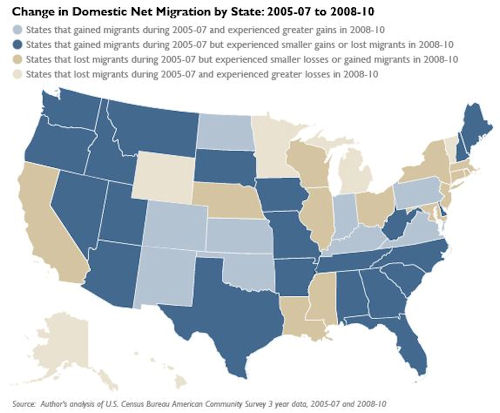
    Geographic mobility within the United States has been declining steadily since the late 1980s. Only 11.6 percent of U.S. residents moved between 2010 and 2011, down from 12.5 percent the previous year. It was the lowest rate since 1948.

    William H. Frey with the Brookings Institution attributes that decline to two broad factors. First, long-distance migration (moving to new counties or states) is off due to the recession and crash in housing prices. Second, a fall-off in local mobility is explained by the aging of the population and high rates of home ownership. “Adult college graduates, the lifeblood of the national labor market, are not finding jobs in new places, and appear to be staying in their homes,” Frey says. “Meanwhile, young adults in their early 20s โ€” newly graduated from college or starting out in life โ€” are moving much less, especially between counties, than just five years ago.”

    Fast-growth metropolises in the Sun Belt are seeing fewer newcomers. Donor states such as California, New York and Massachusetts are leaking fewer of their college grads.

    Virginia, according to Frey’s data, bucked the trend. It is one of nine states that experienced net in-migration between 2005 and 2007 and then increased the net in-migration between 2008 and 2010. My guess is that Northern Virginia, with an economy propped up by federal spending, accounts for most of those gains. It is worth noting, however, that Maryland continued to lose migrants, though at a slower rate than previously.

    — JAB


  • The Wonk Salon, November 18, 2011

    Pitfalls in Assessing the Quality of Distance Learning
    Government Accountability Office
    The Department of Education,which provided $134 billion a year in Title IV funds to college students last year, is interested in tracking the effectiveness of distance learning. Too bad the right hand doesn’t know what the left hand is doing.

    Preparing for the Workforce: Apprenticeships vs. General Education
    National Bureau of Economic Research
    Vocational education may improve the odds of a student landing a job when he enters the workforce, but narrower skills make him less adaptable — and less employable — over the long run.

    Feds Can’t Reliably Track State Awards to DBEs
    Accountability Office
    The feds want to increase participation of disadvantaged business enterprises (DBEs) in state highway contracts receiving federal funding. Trouble is, they don’t have the data to know if their goals are being met.

    Low-Cost Strategies for Helping the Poor
    Center for Enterprise Development
    With continuing shortfalls, states can’t afford to bolster social safety net programs. But they can pursue low-cost strategies for helping the poor by creating incentives for them to learn, earn, save, invest and protect.


  • The Wonk Salon, November 17, 2011

    Students without Borders
    Thomas Jefferson Institute for Public Policy
    Providing education in virtual classrooms costs 65% of what it does in traditional bricks-and-mortar classrooms. But Virginia’s education funding formulas get in the way of more widespread adoption. Chris Braunlich has a plan.

    By 2030, K-12 Education Will Be Privatized
    Hoover Institution
    Eventually, the United State will emulate the example of South Korea, Japan, India and Sweden, which encourage vigorous private-sector competition in educational services and achieve far better results.

    What a Broadband Boost Would Mean for Rural New England
    Maine Heritage Policy Center
    A seven percentage-point increase in broadband adoption in Maine, New Hampshire and Vermont would increase annual economic output by $1.4 billion, create or save $27,221 jobs, and boost annual income by $1 billion.

    Income Segregation Has Grown Since 1970
    US2010 Project
    Not only are the rich getting richer, they’re living in places where they don’t have to mix with the hoi polloi.


  • IG of the Day: Innovation in the 5th Federal Reserve District

    Source: Federal Reserve Bank of Richmond. (Click on map for more legible image.)

    The U.S. Economic Development Administration measures a region’s innovation performance relative to that of the nation based on component indices of human capital, economic dynamics, productivity and employment and economic well being. The first two measures are inputs to innovation, the second two are outputs that reflect the results.

    The Washington-Baltimore area is the largest cluster of innovation in the district, followed by the North Carolina research triangle. The one other standout is Montgomery County, Va., home to Virginia Tech. (For the second time today, eat your hearts out, Wahoos! And I say that as a Wahoo myself.)

    The rest of the region, including Richmond, Hampton Roads and Charlottesville, perform slightly below the national average for innovation.


  • Almost Heaven — Western Virginia

    Wahoos lament! According to Business Week, the best place to raise kids is… Blacksburg, Va.

    Between the Alleghany Mountains and the Blue Ridge, Blacksburg is an upscale college town that is home to Virginia Tech. The area is known for education and lays claim to seven great public schools for the younger students.


  • Rail-to-Dulles Financing Lurches Forward

    The Metropolitan Washington Airports Authority approved today a multiparty agreement that outlines a new financing arrangement for Phase 2 ofย  the Rail-to-Dulles project. All the key parties chipped in to help reach the estimated $2.8 billion cost.

    โ€œThis momentous vote guarantees that the most important transportation project in our regionโ€™s history will go forward, that we will be able to reduce costs and that drivers who use the Dulles Toll Road will see less steep toll hikes than originally planned,โ€ said Charles Snelling, Chairman of the MWAA board.

    Last week United States Transportation Secretary Ray Lahood had forged an agreement in principle to fund the project that, under the original protocol, would have stiffed Dulles Toll Road patrons with rates that could escalate to $20 or more over 20 years. The commonwealth of Virginia would contribute $150 million extra and the federal government would provide loan assistance to help Fairfax County, Loudoun County and the MWAA fund construction projects associated with the extension, such as the building of parking garages.

    The Reston2020 blog provides analysis and the text of the Memorandum of Understanding here. The General Assembly must appropriate the state’s $150 million share in the 2012 session. That contribution is less significant than it sounds. Notes the blog:

    This money will be used to defray interest costs, not the construction of the Metrorail line, in the five years following the appropriation.ย  In so doing, it will comprises merely 1-2% of the $10-$15 billion total debt servicing cost for the Silver Line over the next 40 years.

    The Feds will provide Transportation Infrastructure Finance and Innovation Act (TIFIA) loan guarantees on up to $30 million. The MOU also contemplates various cost savings, such as reducing the size and scope of the Metrorail shop facilities at the Y-15 site at Dulles airport. Bottom line, concludes Reston2020, toll road users still could wind up with $12 to $13 full tolls by the 2040s, but that’s a lot less than feared and it’s also a long time away.

    One sidelight: According to the MOU, “Virginia and MWAA have reached a separate agreement on the matter of Project Labor Agreements for Phase 2. Any Project Labor Agreement contemplated for the Project shall be consistent with applicable Federal statutory and regulatory requirements and Virginia law.” Getting a Project Labor Agreement, or PLA, which requires contractors and/or subcontractors to engage workers through a union hiring hall, was a prime objective of one of MWAA’s board members, Dennis Martire.

    The wording of the MOU makes it totally unclear what agreement was reached. Will there be a PLA, or will there not? Inquiring minds would like to know.

    — JAB


  • A Glimpse into Virginia’s Road Maintenance Future?

    by James A. Bacon

    The Virginia Department of Transportation has thoroughly documented the declining condition of Virginia roads (see the graph in this post) and the shrinking resources to pay for them. If you want to see what happens when you defer maintenance long enough, go to the City of Richmond. You’ll get a good feel for Virginia’s transportation future a few years from now unless current policy or funding changes.

    The city would have to spend nearly $277 million to address the “legacy issue” of years of inadequate funding for road maintenance and reconstruction, reports the Times-Dispatch, drawing upon the findings of a city audit. Two thirds of the city’s streets are in need of major rehabilitation or repair.

    How did that happen? Over the past five years, the city has budgeted only $2 million to $6.5 million yearly for road maintenance, far less than the $10 million needed. Next year, the Department of Public Works (DPW) expects to request $11 million, but at that rate it will take “several decades” to get streets back into proper condition, the newspaper quotes auditor Umesh V. Dalal as saying.

    Stop gap measures to fill potholes accelerates the natural deterioration of roads, increasing the cost of maintenance in later years. “The National Center for Pavement Preservation indicates that every $1 spent on pavement preservation when pavements are in good condition eliminates or delays spending $6 to $10 on rehabilitation or reconstruction later when the pavement quality has deteriorated badly,” states the report.

    The DPW has the tools to keep track of road conditions but hasn’t been using them. The department spent $9,000 on a pavement management system called Cartegraph in 2005. Despite paying annual maintenance fees of $1,800 yearly, the department hasn’t touchedย  the system since the former pavement engineer retired in 2007. “Currently, no one in the Department has the credentials (password, user ID, etc) to access the system, so the system is not being used,” the auditors note. Not that it would make much difference. Rather than asking for the funds it needs, DPW administrators have been submitting budget requests for what they thought they could get.

    Will the situation ever get this bad for the rest of Virginia? Hopefully not. VDOT has an asset-management system and uses it to prioritize maintenance spending. Also, due to policy embedded in state law, VDOT funds a higher percentage of maintenance needs than Richmond has been doing. But roadway conditions are deteriorating and VDOT is under pressure to siphon off maintenance funds to help pay for new construction projects. Without a sustainable, long-term source of revenue for maintenance funding, Virginia’s roads one day might end up looking like Richmond’s. If you think roads are expensive now, just wait.

    Not that the City of Richmond does everything wrong… The city puts a lot of its GIS information online. You can download aps and maps, and even submit your own aps. Maybe someone should devise one that shows where the worst potholes are!


  • IG of the Day: Millionaire Mobility

    Click on graph for more legible image.

    The Congressional Budget Office made quite a splash recently when it published its recent report, “Trends in the Distribution of Household Income between 1979 and 2007.” Progressives swooned in droves at seeming confirmation of their conviction that the rich are getting richer while the poor are getting poorer. (Actually, the report concluded that the richer are getting richer while the poor are treading water, while the middle class has gained ground modestly. Even then, it exaggerates the wealth gap by closing its study period in 2007. The wealth gap has declined significantly since then.)

    But I post today’s Information Graphic, the work of Veronique de Rugy at the Mercatus Center, to dispel the notion that social mobility is a thing of the past and that a plutocracy is emerging. The chart above shows that million-dollar incomes are highly variable. You can do spankingly well one year and horribly the next. For many people, incomes spike in a single year while they exercise a decade’s worth of stock options or sell a business they built over a lifetime. Literally half of the million-dollar income earners hit the million-dollar mark for one year before falling back into the ranks of the muddled masses. Only six percent of millionaires scored million-dollar incomes for more than nine years running.

    What seems to be a widening income gap actually could reflect the increasingly variable nature of compensation for society’s top money makers. Hundreds of thousands of Americans make a disproportionate share of their boodle in a short period of time, an outcome of corporate America’s effort to tie compensation to performance (bonuses, stock options, and the like) instead of treating executives to fat salaries and perks through good times and bad. Last time I checked, that wasย  a good thing, not a bad one.

    — JAB