
by Dick Hall-Sizemore
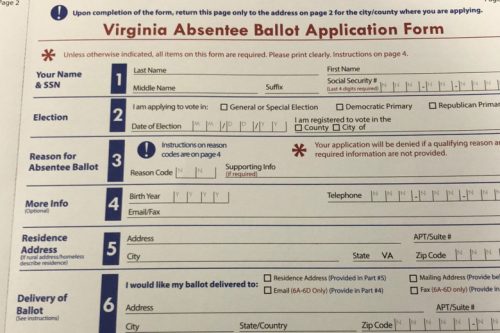
In response to my recent article on the Postal Service and mail-in ballots, Randy Hoffman posed a good question. In effect, his question was: What is all the fuss about if the Postal Service is going to use a state’s list of mail-in ballots?
The article had focused on the federal court decision enjoining the implementation of President’s Executive Order and Postal Service regulations in the 23 states, including Virginia, that were parties to the suit. Because I did not have a good answer to Hoffman’s question at hand, I decided to dig deeper. Note: In Virginia, we are used to referring to absentee ballots, but Virginia law now allows “no excuse” absentee voting, although registered voters must request a ballot to be mailed in. However, some states, such as California and Utah, send mail-in ballots to all registered voters. For the sake of simplicity, this article will use the general term, mail-in ballots.
The previous article dealt primarily with that portion of the President’s Executive Order that concerned how the Postal Service would deliver mailed-in ballots. However, the Executive Order needs to be considered in its entirety to understand its possible ramifications and to understand why a large number of states challenged the Order in court.
Section 2 of the Order directs the Secretary of Homeland Security to compile and submit to each state “a list of individuals confirmed to be United States citizens who will be above the age of 18 at the time of an upcoming Federal election and who maintain a residence in the subject State (State Citizenship List). The State Citizenship List shall be derived from Federal citizenship and naturalization records, SSA records, SAVE data, and other relevant Federal databases.”
Section 3 of the Order directs the Postal Service to establish procedures under which it would transmit mail-in ballots to voters. The Order goes into considerable detail about what should be included in those procedures. It sets out the type of envelope that must be used to send mail-in ballots to voters, including logos and barcodes. It provides that a state must send the Postal Service a list of all the eligible voters to whom the state intends to provide a mail-in ballot. It then directs the Postal Service to provide each state a list of individuals who are “enrolled” with the Postal Service for mail-in ballots.
Section 5 of the Order declares, “States and localities should preserve, for a 5-year period, all records and materials — excluding ballots cast — evidencing voter participation in any Federal election (e.g., ballot envelopes, regardless of carrier).”
The regulations proposed by the Postal Service to implement the Executive Order would establish the following process:
- Envelopes used to send mail-in ballots to voters and used by voters to return their marked ballots would have to confirm to federal standards and be approved by the Postal Service.
- Any state intending to send and receive mail-in ballots through the Postal Service must send the Postal Service a list of all the individual voters it intends to send mail-in ballots to. The list would have each voter’s name, address, and unique bar code that would be used on the outbound envelope and the unique bar code that would be used for the return envelope. States could subsequently submit additional names or modifications for the list.
- Those individuals whose information was submitted by the state would be “enrolled” by the Postal Service.
- The Postal Service would then provide the state with a “Mail-In and Absentee Participant List”, which would consist of the name, address, and unique barcodes of each person “enrolled”.
- Using that Participant List, the Postal Service would review the mailed Outbound Ballots to ensure that the envelopes complied with the standards set out in the regulations and that the ballots were “being sent out to individuals who have been enrolled with the Postal Service for inclusion on the state’s Mail-in and Absentee Participation List.”
- If any ballot were being sent to someone not on the Mail-in and Absentee Participation List, it would be returned to the election that mailed it.
- If any state does not participate by not submitting a list of individuals that it intends to send mail-in ballots to, any ballots mailed out by the state election office would not be delivered to the voters but returned to the election office that mailed it.
The effect of these provisions of the Executive Order and the Postal Service regulations would be the federal government taking over the administration of mail-in voting.
In their initial filing challenging the Order and the regulations, the states’ basic objections were:
- “The Constitution assigns primary responsibility for federal elections to the States, subject only to preemption by Congress.”
2. “Neither the Constitution nor any act of Congress confers upon the President the authority to mandate sweeping changes to States’ electoral systems or procedures.”
As discussed in the earlier article, the court agreed with the states and declared Sections 2 and 3 of the Executive Order legally void because the provisions were beyond the authority of the President and thus violated the constitutional separation of powers and enjoined the President and various federal agencies from giving effect to Sections 2 and 3 with respect to the November 2026, or any earlier, federal election in the states party to the suit, which includes Virginia.
My Soapbox
Beyond the basic principle of the President not having the Constitutional or Congressional authority to take over from the states how mail-in voting is run, there is a subtext running through the brief filed by the states. The states don’t trust the Trump administration.
The states’ brief points out that, under the provisions of the Order, states would have to deliver mail-in ballots according to a list “which is maintained outside the control of the States who administer federal elections.” It goes on to complain that “the EO erects shadow voter eligibility lists within the federal government and uses threats of investigation and prosecution to coerce States into disenfranchising voters missing from those lists.” It concludes, “the EO threatens elections officials and ‘any others involved in the administration of federal elections’ with criminal prosecution if they issue ballots to purportedly ineligible voters, laying bare a scheme to intimidate and coerce state officials into removing voters who do not appear on the federal government’s lists, regardless of the accuracy or reliability of those lists.”
In its summary and explanation of the proposed regulations, the Postal Service goes to some lengths to assure everyone that it will not make any change in the lists submitted by the states in enrolling individuals for the Mail-In and Absentee Participation List. On the other hand, President Trump has made no secret of his opposition to mail-in voting and has vowed to lead an effort to eliminate it. Coupled with Trump’s animus toward mail-in voting is his directive to Homeland Security to comprise State Citizen Lists, although even the Justice Department admits the sources that are to be used to construct such lists are not accurate. Thus, despite the assurances of the Postal Service, the states that are parties to the suit are convinced the administration will use the State Citizen Lists, regardless of their questionable accuracy, to modify the Postal Service-approved lists for distribution of mail-in ballots. Otherwise, why go to all the trouble and red tape to set up a process that would duplicate what states are doing now?
Leave a Reply
You must be logged in to post a comment.