While I labor ingloriously to ignite a second Bacon’s Rebellion here in Virginia, a Bacon Revolution has taken the United States by storm. The United States has developed a craving for bacon that cannot be satiated. We now have bacon ice cream, bacon-infused whiskey, bacon soap and, my personal favorite, served at a birthday party over the weekend: Tater Tots wrapped in cheese and bacon. Yummmm. Oh, my heart, I think my arteries just clogged up. I don’t care, give me more baaaacon!
This article at Smithsonian.com describes the culinary phenomenon sweeping the nation.
The comedian Jim Gaffigan riffs on the wonders of bacon.
Over at DollarCollapse.com John Rubino asks, “Why Isn’t Illinois a Bigger Story than Greece?” Describing the Land of Lincoln as a “failed state” with $8.5 billion in unpaid bills, $27 billion in outstanding bonds and $80 billion in unpaid pension liabilities, he writes:
For investors it’s a clear sign that some sort of default is coming.
Why then would anyone buy an Illinois municipal bond, or accept a state contract that requires future payments, or move a business to the state, or keep a business in the state, or do anything else that required faith in the willingness or ability of the state to pay its bills? The only possible answer is that Illinois isn’t Greece; it’s Spain or Italy, an entity so big and important that its failure is inconceivable. When it hits the wall, Washington will have no choice but to step in and cover its unfunded pensions and teacher salaries and muni bond interest. In the same way that a Spanish bond is really a German bond because Germany has no choice but to make good on it, the big insolvent US states are wards of the central government.
If and when the federal government starts covering the liabilities of broken states, there will be no limit to the drain on federal resources and the transfer of wealth from other states. Virginia needs to elect hard-core fiscal conservatives to Congress who will fight such an eventuality tooth and nail.
At the state level, it is all the more imperative to build rock-solid finances that can withstand the contagion of fear that will emanate from Illinois, California or any other state that might default.
And the hits just keep on coming… Gov. Bob McDonnell has announced an addendum to the 2012 transportation legislation he is seeking this year. My favorite measure is this: Authorizing the Commonwealth Transportation Board to sell naming rights for transportation infrastructure!
According to the governor’s press release, the legislation will allow private entities to place their name on highways, interchanges, bridges and other infrastructure for an annual fee. Proceeds would be applied to road maintenance.
I’m looking forward to hearing some of the creative names people come up with. The Verizon Information Super Highway for Interstate 81… or the Utz Pretzel Interchange for the Springfield Interchange…. or the UVa Heart Center Bypass for the Charlottesville Bypass. (Does anyone else have suggestions? Let me hear them.)
Another bill to watch: One that would create “transportation improvement districts” from which 25% of the growth in state tax revenues attributable to a transportation project will be transferred to the Transportation Trust Fund to fund other transportation improvements. That one sounds like mischief!
The governor also wants to tighten executive control over key boards, including those of the Metropolitan Washington Airports Authority, the Washington Metropolitan Transit Authority, the Virginia Commercial Space Flight Authority and the Virginia Port Authority.
Todd Stottlemyer, one of Gov. McDonnell's unseated appointees to MWAA
by James A. Bacon
There’s been a fascinating new development in the politics of the Rail-to-Dulles project, and I frankly don’t know what to make of it. I’ll provide the background. Perhaps readers can fill in the blanks. Governor Bob McDonnell issued a press release yesterday blasting Democrats in the House of Delegates for blocking the emergency enactment of a bill that would allow Virginia to seat two new board members to the Metropolitan Washington Airports Authority, the entity empowered to manage the $6 billion Rail-to-Dulles project.
“The move … is contrary to federal law and delays the seating of our new representatives during a time when important project decisions are pending before MWAA,” the governor said in the prepared statement. “Congress voted to reform the authority. The President signed the bill. based on that bipartisan legislation, Virginia should have a greater number of seats on the board now. It is the responsibility of our legislature to implement those reforms as soon as practical.”
Caren Merrick, Gov. McDonnell's other unseated appointee to MWAA
The controversy arises from decisions made by the MWAA board — first, to build an underground METRO station at Dulles airport, and then to mandate a union Project Labor Agreement for Phase 2 of the project, both of which could add hundreds of millions of dollars to the project. Because the added costs would be paid by users of the Dulles Toll Road, the actions created a political firestorm. Many Northern Virginians objected to such critical decisions being made by an unelected board dominated by appointees from Maryland and Washington, D.C. Rep. Frank Wolf, R-10, pushed legislation through Congress that would increase Virginia’s representation on the federally created authority.
MWAA opposed Wolf’s legislation. And when the law was passed and McDonnell appointed Virginia’s two new members — Todd Stottlemyer and Caren Merrick — MWAA would not seat them last month on the grounds that “the law is not operable until Virginia and the District approve changes to the ‘governing MWAA compact.’” (For details, see this past post.)
House Bill 252, submitted by Del. Joe May, R-Leesburg, made the necessary changes to state law. All but three of the House’s 32 Democrats objected to the emergency aspect of the legislation. Reports Anita Kumar with the Washington Post:
Democrats, who hold 32 of the House’s 100 seats, balked at passing the bill with a provision that would have allowed it to be signed into law immediately. In a statement, House Democrats said they support the Metro project and adding more Virginia voices to the board but they opposed the process.
Emergency legislation requires 80% approval, therefore 29 “no” votes from 29 Democrats were sufficient to block the bill. All Republicans voted in favor.
I don’t take the Democrats’ argument at face value. There is more to the story than appears in Kumar’s article. What’s wrong with enacting emergency legislation, which is provided for in the Virginia Constitution? Why would anyone oppose getting Virginia’s two additional board members on the MWAA board ASAP? Democrats assuredly have their reasons — I just can’t divine what they are.
The only clues come from Richmond Sunlight. On Jan. 11, the bill sailed through the Transportation Committee 22-0, with all seven Democrats voting in favor. On Jan. 18, Joe May amended the bill to delete the emergency clause. Later in the day, he withdrew the amendment. Then Del. David Toscano, D-Charlottesville, motioned to re-refer the bill to the Transportation Committee, but the motion was rejected. The next day, the bill was put up for a vote by the full House and was rejected in a 71 to 29 vote.
Meanwhile, the same bill awaits consideration by the state Senate Local Government Committee.
Every Republican supported the bill. All but three Democrats opposed it. At some point between the Transportation Committee vote and the full House vote, the issue became polarized along party lines. What happened? I don’t know. I would love to find out.
Update: Garren Shipley with the Virginia GOP says the Dems are protecting their union buddies. In an email blast he sent out today:
David Englin made it perfectly clear what was going on when he tweeted from the floor:
House just removed emergency clause from MWAA bill, virtually ensuring passage tomorrow. Victory for@VAHouseDems and friends in Labor.
Translation: By removing the emergency clause, Democrats bought their union friends another few months of public funding without accountability.
I’m not sure where Shipley gets the part about “another few months of public funding.” MWAA does not fund the unions. The issue is MWAA’s mandate that bidders on Phase 2 of the project sign a Project Labor Agreement requiring that all hiring go through union halls. Here’s my question: Will MWAA be making any decisions between now and July 1 that lock in the PLA mandate?
More confirmation that the PLA was key to Democratic opposition: In reviewing the WaPo coverage of this issue, I see that Anita Kumar quoted Englin in a previous article as follows: “Part of the concern with positioning new appointees to revisit project labor agreements is that would cause further delay on a project that is critical to Northern Virginia’s economy.”
Virginians engage in a lot of mutual back slapping. Yes, Republicans and Democrats agree, we’ve got one heckuva business climate. Thanks to our bipartisan, pro-business consensus, we’ve ranked No. 1 or No. 2 in the country practically since the dawn of time. Yessiree, we really are awesome.
Indeed, it’s a beautiful thing to be ranked No. 1 as the best place to do business. But there is a big piece missing from the story.
Virginia may rank as the top (or runner-up) state in various rankings, but we must ask ourselves, what are we ranking? For the most part, the “best state” surveys compare the relative attractiveness of states for corporate investment, whether manufacturing, back office or corporate headquarters. Corporate investment is an important source of economic dynamism, but it is only one source. Internally generated growth through start-ups and organic growth of existing industry is just as important, if not more.
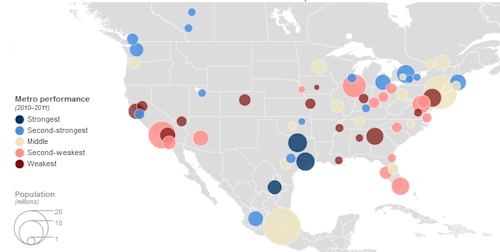
Which brings me to the Information Graphic of the day. Throughout the past decade of scoring top honors in the Best Place to Do Business sweepstakes, how well have Virginia’s major metropolitan regions actually fared in key indicators such as job creation and, even more importantly, income growth? While we’re asking, how have we fared in comparison not only to other U.S. regions but to metropolises around the world?
This map from the Brookings Institution compares the growth performance of the largest U.S. metropolitan areas with 200 of the world’s largest metropolitan economies. (For background and details, see the Global MetroMonitor.) This particular view compares metro performance for 2010-2011. But the results aren’t much better for 2007-2010 or 1993-2007.
In a global context, Virginia’s three largest metro areas (Washington, Hampton Roads and Richmond) are the very opposite of hot stuff. And the 2000s were a decade of unprecedented growth in government spending. What happens when the federal gravy train runs off the rails?
My sense is that we are collectively way too complacent, too wedded to inefficient human settlement patterns, and too resistant to reforming under-performing institutions like education and health care. Someone or something needs to light a fire under our asses.
Gov. Robert F. McDonnell has punted on the uranium controversy and that’s a good thing, assuming the General Assembly doesn’t lift the mining ban anyway.
There are simply too many unknowns about mining the tract owned by Virginia Uranium near Chatham and the state has no knowledge or regulations about mining the highly toxic and radioactive substance.
What’s more, there are big questions about whether it is needed. Market prices are stable and while developing countries such as China and India plan many new nuclear power stations, advanced economies such as Germany are scaling them back after the Fukushima disaster in Japan last year.
McDonnell’s decision comes despite an onslaught of expensive and extensive flackery by the local people who own the farms where the uranium deposit is located and the Canadians who actually control the company. The Virginia Public Access Project reports that Virginia Uranium has paid out more than $150,000 to political candidates and has hired five powerhouse Richmond-based PR firms. It paid all expenses for a dozen legislators who unwisely made a trip to France to see an abandoned uranium mine and who were treated to the delights of Paris on the way.
Virginia Uranium says it’s just dandy that McDonnell recommends delaying lifting the moratorium and continues its campaign, including a full page ad in the Richmond newspaper with drawings showing just how safely the tailings from the mine project would be stored.
The problem is that the issue isn’t just going away. If it doesn’t, the state will have to cough up money as schools go without to come up with regs. Virginia Uranium shouldn’t pay for them — they’d be tainted. But why should the state be burdened when it has so many other things on its “to pay” list?
Rendering of the Dominion Boulevard bridge (click image for more detail)
by James A. Bacon
The McDonnell administration has closed its first major transportation-funding deal with the newly created Virginia Transportation Infrastructure Bank (VTIB): a $412 million bridge-building project in Chesapeake. The mission of the VTIB is to back important transportation projects that could not get financing otherwise.
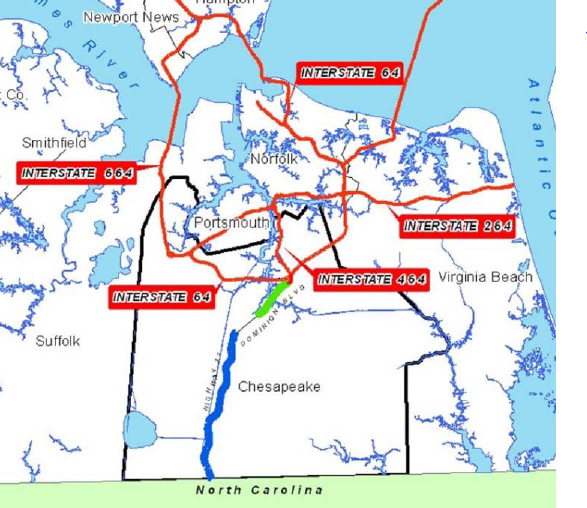
The Dominion Boulevard project will replace an old, two-lane drawbridge with a four-lane, high-rise bridge over the Elizabeth River and make related improvements to the road. In a presentation to the Commonwealth Transportation Board Wednesday, city officials described the so-called “boulevard” as one of the most heavily traveled two-lane roads in the state. Traffic averages 33,000 vehicles per day. Moreover, the drawbridge opens 6,000 times a year to allow boats to traverse the Intracoastal Waterway. The result is frequent, unpredictable and horrendous traffic jams.
The Dominion Boulevard project marked in green. Existing Dominion Expressway shown in blue. (Click for larger image.)
Not only is the road a vital transportation conduit for local traffic, it is part of the Norfolk-to-Raleigh connector linking the Hampton Roads interstate network with the North Carolina capital. “Dominion Boulevard is the number one traffic priority in Chesapeake,” said City Manager William E. Harrell.
The city pursued other avenues of financing but could not pull if off. The federal government turned down a request to back the project with much sought-after Transportation Infrastructure Finance and Innovation Act (TIFIA) loans. And it was impossible to raise the money in the bond market at investment-trade interest rates.
To make the project more attractive to investors, Chesapeake combined the existing Chesapeake Expressway, a 10-mile toll road that provides access to the Outer Banks, with the Dominion Boulevard project in order to take advantage of the credibility the Expressway has built up in successfully supporting its debt. Still, the bridge toll revenue will not provide sufficient coverage to win an investment-grade credit rating on the debt.
Under the deal worked out between the city, the state and BB&T Capital, the state will back $152 million in project debt at a below-market rate of 3.3%. The debt will be subordinated, which means that if there is any shortfall in toll revenues, private investors will be paid their interest and principle before the state will. That added protection for investors will enable the city to sell $227 in Baa1-rated bonds. The balance of the project will be paid for with conventional state funding.
Commonwealth Transportation Board members asked how the state might be impacted if toll revenues fell short. Revenues would be applied to paying the interest first, and unpaid principal would be tacked onto the loan, in effect extending the life of the loan. There is considerable flexibility built into the terms and conditions, said David Tyeryar, deputy secretary of transportation. “We’ve been very conservative.”
Loan repayment will be cycled back into the infrastructure fund to be used for other projects. A second municipality has applied for VTIB funding, and state officials said there is enough money in the infrastructure bank to provide the financing, assuming the project meets state criteria.
City and state officials did not discuss the toll rate that would be charged and the extent to which, if any, state financial support was needed to “buy down” the rate. I did question City Manager Harrell about the traffic-volume assumptions built into the financial projections. He confirmed that the financing assumes considerable traffic growth, even in the face of national and statewide declines in Vehicle Miles Traveled in recent years. The project will open up considerable land for development, which should generate more traffic, Harrell said.
Del. David Englin, D-Alexandria, has submitted a bill that would require any new legislation establishing or increasing tax loopholes (credits, exemptions, deductions, etc.) to expire within five years.
Tax expenditures, as I have long argued, are out of control at both the federal and state level. Englin’s bill represents a modest step to reining in this monster. The delegate clearly understands the issues at stake, and I wish only that he had gone further.
Tax expenditures, he writes in today’s Times-Dispatch, deprive the state of $12.5 billion in annual revenue (2008 figures). Eliminating the loopholes would free up resources to reduce tax rates (my preference) or boost spending in critical areas. A majority of the tax expenditures run on auto-pilot with little or no legislative oversight.
Englin has personally resolved not to vote for a tax preference unless it includes a sunset date and “a requirement that the Department of Taxation report the intent of the policy and how much revenue it cost” — information legislators need in order to weigh costs and benefits. He should make that second requirement the subject of a second bill, and he should apply it to all tax preferences, not just new ones.
To Obama Justice, only underdogs of history are worthy of equal protection
by James A. Bacon
The U.S. Justice Department is ever-vigilant against signs of “voter suppression” these days, most recently blocking – on the grounds that it would hurt blacks – a South Carolina law that would require voter identification. But the voting rights of some groups, it appears, are more worth protecting than others.
The territory of Guam, for instance, has called for a plebiscite on the territory’s relationship with the United States that could provide momentum for an independence movement. But the only people allowed to vote will be citizens who were native inhabitants in the year 1950 and their descendants. The provision limits the franchise to a group made up overwhelmingly of indigenous Chamorro people and excludes nearly all whites, Filipinos and other racial and ethnic groups who have moved to the island in the past six decades.
When presented with a complaint in 2009 by a white resident, retired Air ForceMaj. Arnold Davis, the Justice Department declined to intervene. In response late last year, the Center for Individual Rights (CIR) and former Justice Department Attorney J. Christian Adams filed suit in Guam federal district court to block enforcement of the voter restriction.
“The Obama administration shows hypersensitivity to race in South Carolina,” Terence J. Pell, president of the CIR, told me last week. But in Guam, where a racial agenda permeates the politics of the island and government action points to intentional race discrimination, he says, “the Obama administration can’t be bothered to look into it.”
I agree with Mr. Pell’s assessment, with one caveat. In Guam, the issue isn’t race – it’s ethnicity. Blacks living on Guam will lose their voting rights just as surely as whites, Asians and non-native Pacific Islanders. The common impulse behind Obama administration policy is its proclivity for favoring what it deems to be historically victimized minorities.
Guam was colonized by the Spanish in 1668 and then ceded to the United States in 1898 after the Spanish-American war. Organized as a U.S. territory in 1950, the island was granted increasing rights of self-governance in succeeding years. Guamanians are U.S. citizens, and their island of 155,000 residents sends a nonvoting representative to Congress. The United States lavishes the island with hundreds of millions of dollars in transfer payments, but collects no taxes in return.
But Chamorros were never given the right to vote on the constitutional measures affecting them, and some still feel like victims of colonial oppression. One obsession is the continuing demand for reparations to compensate for the depredations committed by the Japanese during World War II. Apparently, some Chamorros resent the Americans for permitting the island to be conquered – never mind that it was the Americans who subsequently liberated it.
Chamorros nurse other grievances. They worry about the erosion of their cultural identity as the U.S. continues expanding its military presence on the island and outsiders swamp the natives. Leaders felt snubbed not long ago when a major congressional delegation stopped on Guam to refuel on the way to Asia without doing the courtesy of meeting with them, and again when President Obama did the same.
To borrow the anti-colonial rhetoric of the left, native Guamanians were despoiled by an imperialist United States and were powerless to stop their country from being overrun by outsiders who now outnumber them. Chamorros make up only 37 percent of the island’s population today. They are a minority, and they are victims. Therefore, the Obama Justice Department reflexively sides with them.
In 2000, the U.S. Supreme Court struck down a measure that allowed only native Hawaiians to vote when electing trustees to the Office of Hawaiian Affairs. Reasoned the court: “Distinctions between citizens solely because of their ancestry are by their very nature odious to a free people whose institutions are founded upon the doctrine of equality.”
The Guamanian measure seeks to circumvent that ruling by making the voting restriction based on residency, not race or ethnicity. However, the measure clearly imposes what liberal legal theorists might term a “disparate impact.”
The Associated Press cites numbers showing that 30 percent of South Carolina’s registered voters are nonwhite, while 34 percent of voters lacking state-issued photo IDs are nonwhite. The Justice Department deemed that 4 percentage point difference jarring enough to warrant overturning the law.
The “disparate impact” of the Guamanian law would be immeasurably greater. Chamarros may make up 37 percent of the island’s population, but it is likely they would account for 95 percent or more of the electorate voting on the plebiscite.
Clearly, the Obama Justice Department applies the principle of proportionality only when it suits it. At some point, the rest of us have to say, “We’re sorry about what happened in the past, but get over it. We’re all American citizens now. We all have equal rights. End of story.”
This column is republished with a minor editing change from the Washington Times.
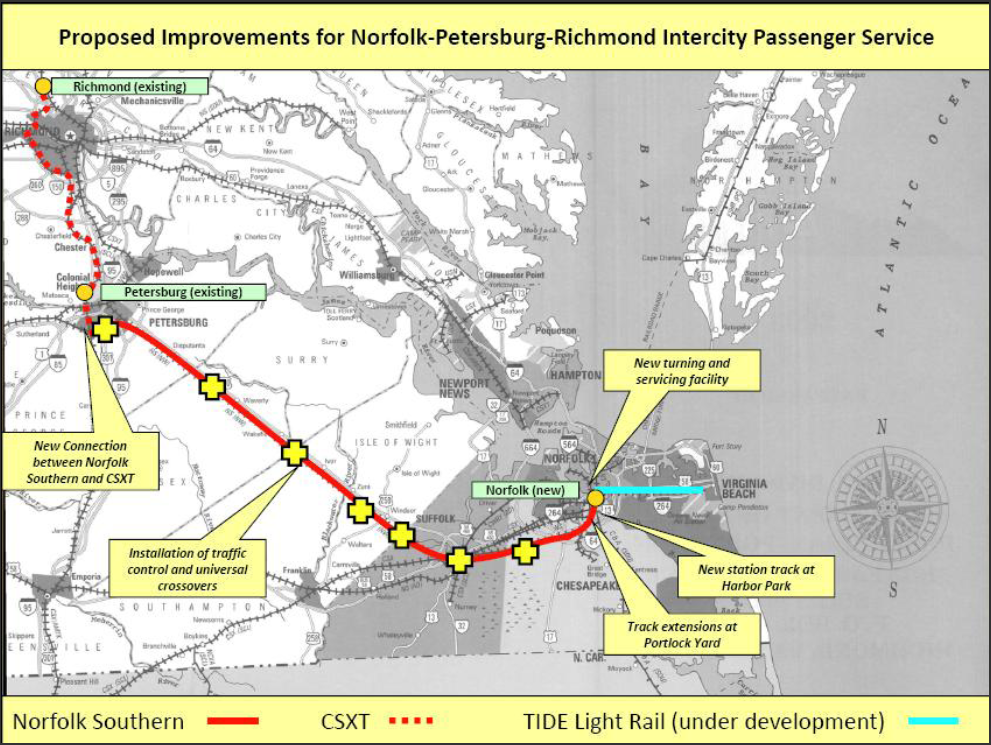
Good news from the Governor’s office: Amtrak will commence its Norfolk service by December 31, 2012 — 10 months earlier than expected! A round-trip train will bring intercity passenger rail to the city for the first time since 1977, linking Hampton Roads to Richmond, Washington, D.C., and the northeastern corridor!!
“The Commonwealth’s Virginia Department of Rail and Public Transportation (DRPT), CSX, Norfolk Southern and the City of Norfolk have been working speedily to make the necessary upgrades for the service,” boasts a press release from the Governor’s Office.
Just one little problem: The project will cost $12 million more than $102.6 million already allocated to the project. On Wednesday the Commonwealth Transportation Board allocated the additional sum, which it scraped up by bumping the Nokesville-to-Calverton double-track project, one of several integral to Norfolk Southern’s Crescent Corridor initiative for boosting freight traffic in Virginia, to FY 2015 and 2016. The press release didn’t mention the overrun.
Deferring the Nokesville-Calverton project is not expected to cause any problems for Norfolk Southern. But bumping the Nokesville-Calverton project to FY 2015 will require bumping some other project, as yet unidentified, that would have gotten its money then.
Turns out that a few previously unidentified costs were identified as the Norfolk passenger-rail project unfolded. Norfolk Southern needs to construct additional siding capacity at New Bohemia to alleviate freight train interference and provide capacity in the congested Petersburg area. Oh, and it needs to acquire additional property at the St. Julian’s Street Train Servicing Facility to prevent the rerouting of heavy truck traffic through residential neighborhoods. And come to think of it, there’s the minor matter of upgrading crossovers between Petersburg and Norfolk and upgrading the CSX railroad diamonds in Suffolk to allow for faster passenger speeds.
But other than that, they’d accounted for everything!
The CTB didn’t have any problems with all those oversights and approved the re-allocation of funds. The Hampton Roads representatives to the CTB were all in favor of passenger rail.
The only voice of skepticism came from Allen Louderback, a rural at-large member from Luray, who cited figures from mass transit projects in Northern Virginia whose massive operating deficits were covered by federal and state funds. He questioned the wage rates for mass transit employees, and he wondered what would happen to these ventures if and when federal and state governments could no longer afford to subsidize them. “If things get tough,” he said, “what are you going to tighten?”
Louderback addressed the issue that no one else on the CTB, the McDonnell administration or supporters of mass transit have been willing to confront. What happens to massively unprofitable rail and mass transit projects when the money runs out?
No one had an answer. No one even responded to Louderback’s point. The CTB just went ahead and approved the reallocation of funds.
Update: According to Peter Bacque’s story in the Times-Dispatch, the Norfolk passenger rail service is expected to cover its operating costs. Norfolk-to-Washington fares will run about $33 one way, and state officials expect high demand for the service. That would obviate Louderback’s concern for this project, and possibly for inter-city rail service from Lynchburg to Washington, which is one of the most profitable state-partnership services in the Amtrak system.
However, Louderback’s larger point remains valid for Washington Metro, the Rail-to-Dulles extension, the Norfolk Tide and other mass transit projects.
A VDOT engineer — the foot solder of Virginia's transportation program
by James A. Bacon
In 2004, the Virginia Department of Transportation maintained a staff of 10,000 employees. Today the head count stands around 7,000. That sounds like a dramatic downsizing. But there’s less to those numbers — and more — than meets the eye.
Much of the staff reduction reflects an outsourcing of the design and drafting functions to outside engineering firms, which means that lower payroll costs are offset by higher contract fees. But the shift does advance an important VDOT management goal: to focus on project management as a core capability.
Chief Deputy Commissioner Charles Kilpatrick provided the numbers in a Wednesday presentation to the Commonwealth Transportation Board. VDOT has seen “lots of change” in staffing, in processes and in how it conducts business, says Kilpatrick, a career VDOT employee who worked briefly in the private sector before taking on the No. 2 position at the department under the McDonnell administration.
There has been a wholesale change of senior personnel at the highway department. Not only did Gov. Bob McDonnell appoint a new highway commissioner, Gregory A. Whirley, and chief deputy commissioner, Kilpatrick, but VDOT has a new chief financial officer, a new director to run public-private partnerships, new people to run research, administration and planning & programming, eight new division administrators and four new district managers.
A very real VDOT accomplishment has been the ability to handle a surge in the number of maintenance and construction projects in the past year without increasing head count. The McDonnell administration has emphasized putting idle funds to work, pushing projects out the door more quickly, and ramping up a series of mega-projects financed through borrowed funds and public-private partnerships.
In one major process change, VDOT is shifting from design-bid-build projects (designing projects in-house and putting them out to bid), to design-build projects (detailing the project specifications and letting contractors undertake the construction and design). In theory, the approach can lead to more creative, cost-saving designs, while the ability to conduct design work and construction simultaneously enables private contractors to complete projects more quickly and at lower cost. Transportation Secretary Sean Connaughton has frequently expressed his frustration with the unnecessarily high cost of many VDOT projects executed under the old design-bid-build model.
Once upon a time, VDOT would have handled all the design and drafting internally. It still maintains a core design-and-drafting capability, said Kilpatrick in an interview. But the main focus has shifted to managing projects and bringing them in on budget and on time. As a consequence, VDOT has to hire more project managers and construction inspectors.
The department is authorized to have 500 more employees than it has on staff but reaching the full complement isn’t easy. VDOT has lost a large number of employees through retirement, and it has to compete with the private sector for qualified employees. “As the economy improves,” Kilpatrick said, “more people will leave.”
What Kilpatrick did not say, but surely was on his mind, is that state employees generally get paid less than their private-sector counterparts. A big advantage of being a state employee is the chance to earn juicy retirement benefits. But the McDonnell administration wants to make state employees contribute more to their retirement benefits than in the past. Moreover, young people aren’t willing to commit themselves to 40-year careers like the old guard did.
Meanwhile, said Kilpatrick in an interview, it’s possible that VDOT has over-shot its restructuring. The department may have gone too far in cutting back the number of resident engineers, whose job is to stay in touch with local government officials and the public. That undermines another key goal, which is to maintain a strong “customer focus.”
A decade ago, VDOT had an abysmal record for completing projects on budget and on time. Despite challenges, says Kilpatrick, the department is delivering the goods. Since the enactment of the governor’s transportation funding package a year ago, he says, VDOT has advanced 363 projects to preliminary engineering, 106 to right-of-way acquisition and 156 to the construction phase, and has completed 111. Another 290 projects are expected to begin construction over the next three years.
It’s a question that has suddenly wafted up when residents of the port city learned that the Virginia Ports Authority has been in secret talks with Canadian-owned PCS Phosphate to put in a plant to melt sulfur pellets for fertilizer production.
The same project had been pitched for Morehead City, N.C. but was shouted down by a lively environmentalist coalition, which sparked a controversy that reached the office of Tarheel Gov. Beverly Perdue. PCS Phosphate operates one of the world’s largest phosphate mines in coastal Beaufort County, which is an easy barge trip away from either Portsmouth or Morehead City.
It’s a story near and dear to me since it was one of the first I covered as a cub reporter at the Washington (N.C.) Daily News back in my college-day summers of 1971 and 1972. The big mine, then owned by TexasGulfSulphur, had been in operation since the mid-1960s and had created all sorts of ecological challenges for the beautiful coastal plains and swamps of Beaufort County about 120 miles south of Tidewater. Water kept filling up the huge surface mine pit, so TexasGulf drilled wells to force water from an aquifer away from the pit. That dried up homeowners’ wells for miles and prompted years of lawsuits.
Later, when French oil giant Elf Aquitaine ended up owning the mine, which makes fertilizer products, the mine got the largest-ever fine at the time from North Carolina air pollution control officials. Canada-based Potash Corp. of Saskatchewan eventually ended up buying the operation and owns PCS Phosphate.
With a history like this, it’s small wonder Portsmouthians are up in arms about a sulfur melting plant which will only employ about 10 people. Company officials insist it won’t stink up anything.
But then, Portsmouth, an industrial town that hosts the Norfolk Naval Shipyard, has always been a touchstone for unwanted industrial projects. In the 1970s, an oil refinery was proposed by some independent oilmen but was never built. In 2007, Portsmouth pushed Chesapeake into ending an ethanol plant planned across the city line. That may have been a good thing since the U.S. has too many ethanol plants.
The VPA has come under criticism for keeping the sulfur project under wraps for as long as it could. After all, isn’t the VPA a public agency (“quasi” public agency)? The plant would be built close to nice old neighborhoods that Portsmouth has labored for years to revive. It would be only one mile from Norfolk’s waterfront that also has plants for a new revival after a renaissance in the 1980s.
Funny how these plans seem to come out faster in a more open state like North Carolina.
Public-private partnerships have advantages and disadvantages as a strategy for building and maintaining the nation’s roads and highways, concludes a recently published Congressional Budget Office (CBO) report, “Using Public-Private Partnerships to Carry Out Highway Projects.”
The CBO found tentatively that partnerships have built highways “slightly less expensively and slightly more quickly” compared to the traditional public-sector approach. The speed-up in construction time is most evident in larger projects valued at $100 million or more. But the number of studies supporting that conclusion is relatively small and results regarding one project are difficult to apply to others.
Another finding is that private-sector management also can bring about a reduction in operational costs, although firm conclusions are clouded in the two studies cited by the impact of the recession and associated reduction in traffic. Private-sector managers might choose more effective procedures and schedules for maintenance, the study suggested. “In many cases, smaller, more regular repairs are a more cost-effective approach to road maintenance than are larger, irregular repairs, but they may be less common when a road is under public control because of states’ and localities’ budgeting practices.”
Public-private partnerships (P3s) offer pros and cons in financing. Public entities can tap tax-free municipal bonds; private-sector investors can use depreciation to lower their tax exposure. But private financing come with the expectation of a future return, the ultimate source of which is either taxes or tolls. The primary advantage of private financing is that it makes funds available in states or localities that “have chosen to restrict their spending by imposing legal constraints or budgetary limits on themselves.”
One other important attribute of P3s, notes the study, is the opportunity to contractually define and allocate risk. Under the traditional approach to road building, government assumes most of the risk associated with cost overruns, construction delays and, in the case of toll projects, shortfalls in toll revenues. In P3s, the private-sector partner generally assumes the risk for cost overruns and construction delays. But, after toll revenues in early projects fall short of projections, private partners have been seeking revenue guarantees from the public partner.
A drawback of P3s, says the study, is the loss of public control. Contracts typically turn toll-setting authority over to the private partner. Higher tolls are the likely result, “an outcome that may conflict with other public-sector goals.”
The study provides a useful discussion of P3 pros and cons, but it overlooks a number of important considerations.
An advantage of P3s is that projects tend to be more transparent. More information about a road project’s costs, revenues and risks are made public. The public partner can monitor performance and financial metrics and hold the private partner more accountable than it could hold its own bureaucracy.
On the other hand, P3s reduce the opportunity for meaningful public input. Much of the negotiation between government and the private sector necessarily takes place behind closed doors. Once terms and conditions are reached, it is exceedingly difficult to renegotiate them if the public doesn’t like them. The result is typically a fait accompli.
The Republican presidential primary season has taken on a peculiar wackiness, particularly when free market advocate Next Gingrich takes on front-runner Mitt Romney for his days as a private equity capitalist at Bain Capital.
The conservatives amongst us shudder at the very idea that something as precious as finance can be spotlighted (as they conveniently forget just how cravenly the finance industry nearly crashed our economy in 2008).
What raises my interest, however, is not that capitalism is inherently evil, but that there are different ways to go about it.
Harvard-trained Romney lead Bain Capital in the 1980s and 1990s and profited mightily. Bain was part of the leveraged buyout revolution of the 1980s in which financiers would target companies, amass takeover war chests, buy them and either sell them off or not. Proponents argue that this approach leads to greater efficiency and they cite the old Schumpeter saw that “creative destruction” is a necessary part of boosting free market capitalism by chipping off dead wood and letting new sprouts grow.
Sounds good, but the fact is that the LBO raiders of the 1980s were not out for the betterment of mankind. They were out to make zillions of bucks, regardless of whomever paid the real price in layoffs, shattered lives and the like. This is apparently what Romney was up to, despite his unprovable claims that he “created” 100,000 jobs. NPR has knocked that one down, noting that Bain never kept track of such things, so how would Romney know?
Another point comes up in a Sunday Washington Post article by William D. Cohan a former finance executive with Merrill Lynch and Lazard Freres who wrote “Money and Power: How Goldman Sachs Came to Rule the World.” He says that Bain and Romney not only played the LBO game, they did so ruthlessly, even by private equity rules. “In my experience,” he writes,”Bain Capital did all it could to game the system by consistently offering the highest prices during the early rounds of bidding — only to try to low ball the price after it had weeded out the competitors.” This practice led to an industry-wide mistrust of Bain — that it couldn’t be held to its word.
If so, that suggests some bad things about Romney, who is devoutly religious. But this is not to put down entrepreneurship among aspiring politicians.
For another style look at U.S. Sen. Mark Warner. Back 30 or so years, he parlayed his experience as a young Capitol Hill aide and knowledge of federal communications law to rationalize the rising cellular telephone business. One thing he did was organize auctions of bandwidth needed for the telephones. That way, a company with rights to bandwidth in Phoenix could add to its local area by swapping its bandwidth in a place such as Buffalo to a firm that wanted to expend there.
Besides sorting out bandwidth, Warner also helped create telecom giant Nextel which is now part of Sprint. He also formed Columbia Capital, which financed the high tech boom in Northern Virginia in the late 1990s. He ended up with at least $200 million in personal wealth. He’s also a Democrat.
So, who do you think has created more jobs? Mark Warner? Or Mitt Romney?
Another rare piece of good news: The “self esteem” movement is losing favor in the nation’s schools. The Washington Post has the story here.
A growing body of research over three decades shows that easy, unearned praise does not help students but instead interferes with significant learning opportunities. As schools ratchet up academic standards for all students, new buzzwords are “persistence,” “risk-taking” and “resilience” — each implying more sweat and strain than fuzzy, warm feelings.
“We used to think we could hand children self-esteem on a platter,” Stanford University psychologist Carol Dweck said. “That has backfired.”
The self-esteem movement has been one of the most destructive trends ever seen in American education and culture generally. Only by earning praise, not having it bestowed freely, can children mature into productive, achieving adults. I cheer the demise of this pernicious fad.
The year: 2075. The American colonies on the Moon are getting restless under Washington’s tyrannical rule….
This second edition of “Dust Mites” has a snazzy new cover, includes helpful lunar maps, and is 5,000 words tighter than the original. The sequel, “Trogs,” is scheduled for publication this summer.
Advertisement
Advertisement
Advertisement
Advertisement
About
Bacon’s Rebellion is Virginia’s leading politically non-aligned portal for news, opinions and analysis about state, regional and local public policy. Read more about us here.
Fund the Rebellion
Shake up the status quo! Your contributions will be used to pay for faster download speeds and grow readership. Make a one-time donation by credit card or contribute a small sum monthly.
Can’t wait until tomorrow
For your Bacon’s Rebellion fix?
Enter your email address to receive immediate notifications of new posts by email.
SUBSCRIBE
Search Bacon’s Rebellion
Categories
Archives
The Jefferson Council
Protecting Thomas Jefferson’s Legacy at the University of Virginia
Forgot Your Password?
Shoot me an email and I’ll generate a new password for you.

 While I labor ingloriously to ignite a second Bacon’s Rebellion here in Virginia, a Bacon Revolution has taken the United States by storm. The United States has developed a craving for bacon that cannot be satiated. We now have bacon ice cream, bacon-infused whiskey, bacon soap and, my personal favorite, served at a birthday party over the weekend: Tater Tots wrapped in cheese and bacon. Yummmm. Oh, my heart, I think my arteries just clogged up. I don’t care, give me more baaaacon!

 By Peter Galuszka



 By Peter Galuszka