• Fleeced by the Fed

    Fedโ€™s zero interest rate bails out Wall Street and Treasury, sinks middle class

    by James A. Bacon

    The Federal Reserve Board announced plans last Tuesday to keep short-term interest rates at near zero for another three years and said it might embark upon another bond-buying program to drive down long-term interest rates. The stock market rallied and President Obamaโ€™s supporters hailed the rising stock market as a sign of his brilliance as a manager of the economy.

    Call me a party pooper, but I see nothing good coming from this. Letโ€™s set aside fears that the Fedโ€™s jam-down-the-pedal monetary policy might drive down the dollar or ignite a monster credit bubble and focus on the topic that seems to preoccupy Washingtonโ€™s political class these days: the distribution of wealth.

    There will be winners and losers from the Fedโ€™s monetary policy. The winners will be the nationโ€™s debtors. The losers will be the nationโ€™s creditors and savers. Debtors will continue to pay rock-bottom interest rates. Creditors and savers will earn rock-bottom returns on their investments. Indeed, with the Fedโ€™s stated objective of maintaining a 2 percent inflation rate, many small savers will see the real value of their savings erode.

    The largest debtor and biggest beneficiary of the Fed policy, of course, is the federal government, which owes more than $15 trillion and is on track to owe $16 trillion before the year is out. When compiling the fiscal 2012 budget, the Office of Management and Budget assumed that the interest on 10-year Treasury notes would average 3.6 percent this year while 91-day Treasury bills would average 1.0. percent. Compare that to actual interest rates today under the Fedโ€™s easy-money policy: 2.1 percent for 10-year notes and 0.4 percent for T-bills. That averages out to roughly a full percentage point less than forecast – cutting Uncle Samโ€™s anticipated interest payments by about $150 billion.

    Thatโ€™s not the end to the Fedโ€™s largesse. As the Fed purchases more long-term bonds, it collects more interest on the bonds, which it kicks over to the Treasury. In 2010, the interest amounted to $79.3 billion. As the Fed pushes bond purchases well past the $2 trillion mark, that number is likely to rise. Thus, Chairman Ben S. Bernankeโ€™s contribution to deficit reduction could approach $250 billion this year – and yet more in 2013 and 2014.

    So, how has this economic stimulus worked out? American consumers are huge debtors, too, but they havenโ€™t seen remotely the same benefit. Total consumer credit outstanding in the third quarter of 2011 stood at $2.47 trillion – the same level as in 2009. But interest rates are lower, right? Yes, but only marginally:

    • The average interest rate on a four-year auto loan declined from 6.7 percent to 5.9 percent over the same period.
    • The average interest rate on personal loans slipped from 11.1 percent to 10.8 percent.
    • The average interest rate on credit cards eased from 13.4 percent to 12.3 percent.

    If consumer spending has boosted gross-domestic-product growth over the past year, itโ€™s not because marginally lower interest rates have made it so much cheaper for consumers to borrow. Itโ€™s because lower interest rates have devastated the incentive to save. Whatโ€™s the point of setting aside money to earn a half-percent interest in a bank certificate of deposit or money-market fund when inflation trotted along at 3.0 percent in 2011 and, if the Fed is right, will continue at 2.0 percent this year? Your savings are losing value. Why not spend the money instead?

    Mr. Obama bemoans the difficulties of Americaโ€™s middle class. His answer: Raise taxes on rich people. Meanwhile, he says nothing as Fed policy eviscerates the savings of middle-class families who donโ€™t have $1 million or more to invest in exclusive hedge funds or private-equity accounts that generate higher returns.

    Mr. Obama bashes the greed-meisters on Wall Street yet says nothing about Fed policy that props up bank profits with hundreds of billions of dollars of low-interest lending.

    The American people understand what they have to lose from higher tax rates, but they have no concept of how the Fed is fleecing them. Monetary policy is opaque even to those who follow it for a living, and itโ€™s simply beyond the comprehension of most Americans – including a brain-dead press corps that is all too happy to peddle Mr. Obamaโ€™s narrative of a growing income gap and the injustice of the tax rate paid by Warren Buffettโ€™s secretary.

    But give Mr. Obama credit for this: While his handmaiden Bernanke plunders the middle class in order to prop up Wall Street and the U.S. Treasury, the president has exploited the resulting uncertainty and unease by posing as a champion of Middle America. Thatโ€™s more than you can say for Newt Gingrich, who is attacking Mitt Romney for the sin of being a successful, wealth-creating capitalist, or for Mr. Romney, who seems incapable of defending himself. Like Sherlock Holmes and Professor Moriarty at Reichenbach Falls, they are locked in a death grip that will plunge them to their political demise.

    Iโ€™ve never been much of a fan of Rep. Ron Paul, but the man is making more and more sense when he says itโ€™s time to abolish the Fed.

    This column was published originally in the Washington Times.

  • The Ultrasound Abortion

    By Peter Galuszka

    Abortion is always a very unpleasant topic just as it must be horrendous for a woman to be in a position to make such as choice. Still, it is her constitutional right, the law of the land.

    So, after years of trying, Virginia’s conservative legislators are on the verge of putting themselves, and the power of the state, in between a pregnant woman and her doctor with a measure that would require that an ultrasound examination be performed before the abortion takes place. In six other states that have such a provision, the mother would be “offered”ย  a chance to see the result although notย  required to do so, according to Guttmacher Institute.

    Experts agree that there’s no medical reason for an ultrasound in the first trimester of a pregnancy. Rather, such a requirement is a naked psychological ploy to assault the mother with feelings of guilt and play on herย emotions to not go through the procedure. Even though abortion is legal within limits, this extra requirement would be both medieval and insulting.ย Not to mention sexist: men don’t have to endure such state-sanctionned manipulation.

    In Virginia, however, women may soon have to. By an 8-7 vote, the Republican-controlled Education and Health Committee has endorsed the ultrasound requirement and have sent it to the full Senate, which, thanks to the GOP’s refusal to share power, it is likely to pass, given the 20-20 imbalance of power and Republican Lt. Gov. Bill Bolling holding the deciding vote. Ultrasound bills are being pushed by Sen. Jill Vogel, R-Fauquier County and Sen. Ralph Smith, R-Roanoke County.

    What’s so utterly hypocritical of many conservatives is how they pick and chose their fights. Most of the time, they are lecturing us that we need to get government and its regulations away from people’s everyday lives. We need smaller government and should leave as much as possible to personal choice.

    But not when it comes to one of the most painful and personal decisions a woman makes. Swollen with their moral authority, they want to be there, dressed in a blue hospital gown beside the doctor, laying on a profound guilt trip to an experience that is most times already wracked with grief.ย They are assuming that women (not men) are too stupid to understand what abortion is despite their right to one that is bound by the U.S. Supreme Court.

    The General Assembly needs to keep its nose out of the doctors’ offices. It needs to respect the intelligence of women to make a choice that is legally theirs to make.


  • Beware Optimistic Traffic Forecasts

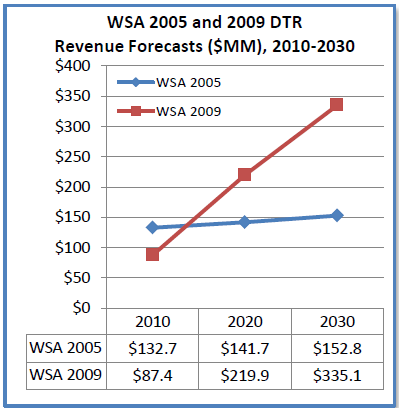
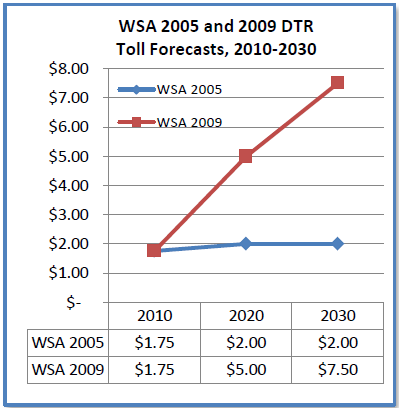
    What happened between 2005 and 2009 to account for such dramatic changes in WSA's forecast?

    by James A. Bacon

    Wilbur Smith Associates (WSA), a transportation consulting firm, is scheduled to soon complete its third traffic and revenue forecast for the Dulles Toll Road for use in a final go/no go decision on Phase 2 of the Rail-to-Dulles project. Don’t trust the results, says a study released Friday by the Reston Citizens Association. WSA chronically over-estimates its traffic counts.

    In “Wilbur Smith Associates’ Traffic and Revenue Forecasts: Plenty of Room for Error,” the authors provide an extensive review of the literature on the hazards of traffic forecasting. “Optimism bias,” the overestimating of road traffic and revenue in forecasts, is endemic in the industry, with a mean forecast error of 25% to 30% over actual traffic.

    The report is must reading for anyone concerned about the financing of Rail-to-Dulles Phase 2, which will come mostly from tolls paid by users of the Dulles Toll Road, as well as for citizens analyzing the economic viability of a slew of mega-bridge and highway projects being unleashed by the McDonnell administration. Over-optimistic traffic forecasts can induce public officials to proceed with projects that fail to live up to expectations, with potentially calamitous financial results. In the case of Rail-to-Dulles, if toll revenues fail to materialize as expected, the Washington Metropolitan Airports Authority (MWAA) could be faced with a decision to jack up rates more aggressively and incur the risk of driving away more commuters and falling short on revenue anyway.

    According to the Reston Citizens’ report, a national study of 26 U.S. toll roads found that the average overestimate of revenues for eachย  year of the first five years was 109% — more than double actual revenues. WSA accounted for half the identifiable forecasts and its results differed little from the others.

    Absent significant changes in WSA’s methodology, the Reston Citizens report warns that WSA’s upcoming study is likely to over-estimate revenues again. In two earlier forecasts, WSA had used the highest available estimates of population and employment data for Fairfax County. “Checked against the 2010 data, the forecasts for employment were overstated by 25% in the 2005 report and 52% in the 2009 report, contributing to near certain overestimates in the forecast.”

    WSA’s Dulles Toll Road forecasts also showed huge, unexplained discrepancies in toll and revenue forecasts between its 2005 and 2009 reports. “WSA’s 2009 forecast for 2030 t0lls are nearly quadruple and revenues double those in the 2005 report.”

    The Reston Citizens report identifies five risks from over-estimating Dulles Toll Road traffic and revenue:

    • The risk that the financial community will not fund MWAAโ€™s Dulles Toll Road debt or will require state or federal guarantees or funding for an investment grade rating.
    • The risk that toll rates would need to double those forecast by WSA to meet debt servicing and other expenses.
    • The risk that the higher toll rates on the Dulles Toll Road will limit the economic development potential of the Dulles Corridor as well as force traffic on to already congested nearby roads.
    • The risk that MWAA would have to use airport revenues to pay Dulles Toll Road debt servicing obligations.
    • The risk that MWAA may default or need to restructure its debt servicing agreements,resulting in more debt over a longer period and even higher tolls for toll road users.

    The Reston Citizens reports urges Rail-to-Dulles stakeholders to defer making a decision to proceed with Phase 2 until an independent Traffic Revenue forecast can be completed.

    Bacon’s bottom line: I am extremely skeptical of traffic forecasts of any kind — for rail, road, highway — based on an extrapolation of past trends. I believe we have reached a major inflection point in the economics of transportation and land use, and that the past is no predictor of the future. By way of evidence, consider these previous blog posts:

    Is Virginia’s Population Growth Slowing?

    Demographic Trends and Trends and Traffic Projections

    Stacking the Deck for Heavy Rail

    A New Metric for Gasoline Affordability

    Virginians Driving Even Less in 2011

    Perhaps the most critical inflection point for Northern Virginia is the impending stall in the key driver of Northern Virginia’s population and economic growth: federal spending. You don’t have to accept my Boomergeddon hypothesis that the federal government will default on its debt to believe that spending cannot continue on the same upward trajectory that it has for the past 50 years. Something has to give, and when it does, Northern Virginia will feel the fall-out.

    I agree 100% with the Reston Citizens Association that the Rail-to-Dulles stakeholders should engage an independent Traffic & Revenue forecast. I would also insist upon a sensitivity analysis that shows what traffic and revenue looks like under different a variety of population and economic growth forecasts for the region. To fail to do so would be the height of fiscal irresponsibility.


  • Obama Sees the Light (Well, He Sees Part of It)

    by James A. Bacon

    Give President Obama a modicum of credit: He finally recognizes that there’s more to increasing the affordability of higher education than shoveling tens of billions of federal scholarships and loans at students. Someone also has to constrain the increasing tuitions. Yesterday, the president warned colleges and universities to cut costs or risk losing some of their federal aid.

    Schools can’t just “jack up tuition every single year” and simply expect people to pay it, Obama said. “If you can’t stop tuition from going up, the funding you get from taxpayers every year will go down.”

    It’s not clear from the wire story I’m quoting from whether or not Obama understands there is a direct causal effect between the stupendous increases in federally backed loans he advocates and the high tuition rate he dercies. Regardless, his warning to college presidents reflects a welcome change in thinking.

    College and university officials are in an absolute tizzy, reports USA Today. On the one hand, I can’t blame them. The federal government excercises so much power in the higher-ed marketplace, that any reduction in access to federal money could prove devastating. On the other hand, I have zero sympathy. The higher ed lobby made its bed — now it’s time to sleep in it. Live by the subsidy, die by the subsidy.

    In the meantime,ย a new studyย raises important issues about college persistence and graduation rates. In a National Bureau of Economic Research paper, “Gains and Gaps: Changing Inequality in U.S. College Entry and Completion,” Martha J. Bailey and Susan M. Dynarski find that the gap in the rate at which upper- and lower-income Americans entered college increased significantly between 1979-82 and 1997-2000 and also the rate at which they graduated. What’s particularly interesting about the findings is that almost the entire increase in the college gap can be attributed to the outstanding performance of female students in the top income quartile.

    Write the authors:

    Sex differences in educational attainment, which were small or nonexistent thirty years ago, are now substantial, with women outpacing men in every income group. The female advantage in educational attainment is largest in the top quartile of the income distribution. These findings present a formidable challenge to standard explanations for rising inequality in educational attainment. Girls and boys are raised in the same families, attend the same elementary and secondary schools, and face the same college prices.

    Also:

    Differences in high school completion between children from low-income families and those from high-income families explain half of the gap in college entry. However, among those who enter college, children from low-income families are much less likely to get a degree. Inequality in college persistence, therefore, produces inequality in college completion, even if college-entry rates were equal (which they are not).

    Bottom line: There are ill-understood cultural forces at work affecting the rate at which Americans enter and complete college. College financing programs that blindly shovel out money “so anyone who wants to go to college can” aren’t doing a lot of them any favors. Hundreds of thousands of Americans are borrowing vast sums in the expectation of completing their degrees and earning more in the job market, but end up dropping out. Thus, they get the debt but not the credential. Insofar as poor kids and minorities are less likely to graduate, they are more likely to be saddled with a financial burden that will dog them decades.

    Obama has finally awakened to the impact of his easy-credit policies on the price of tuitions. Perhaps one day he’ll understand the impact on the poor and minorities.


  • Up to Our Alligators As Area Warms?

    By Peter Galuszka

    Holy magnolia!

    The area just south of Washington on the Potomac River and all the way north of Baltimore on the shores of Chesapeake Bay have become noticeable warmer over the past 22 years. Consequently, it is possible to grow species of plants in that zone that previously needed warmer, more southerly climates such as those from Tidewater, Va. south.

    According to a front page Post story,ย gardeners have known about the increased warming in the region for years. Now the U.S. Department of Agriculture has made it official. The general warming trend has manifested itself in other ways. Alligators have recently been spotted in southern Virginia beyond their usual limits in North Carolina.

    The agriculture department warns that its study should not be taken as fresh evidence of climate change. It also found that parts of the West Coast and South Dakota actually have had colder winters.

    Here in the Mid-Atlantic, however, the comparison is unavoidable. And that brings up the next point.

    If we’re up to our camellias in alligators, why are Virginia’s right-wing politicians continuing their persecutions of academics who suggest that global warming is real and is man-made?

    Atty. Gen. Kenneth Cuccinelli has made a second career persecuting former University of Virginia climatologist Michael Mann who says mankind if responsible for global warming, a view held by most scientific experts. After Cuccinelli saw his attempt at subpoenaing Mann’s records quashed by a court, his conservative comrade, Del. Bob Marshall of Prince William County, teamed up with the American Tradition Institute to get some of the records through the Freedom of Information Act.

    Scientific evidence apparently means nothing to Cuccinelli or Marshall. What does it matter? Cuccinelli is running for governor and Marshall for the Republican nomination for U.S. Senate. Playing to the wing elements pays political dividends.


  • What’s the Case for Inter-City Rail?

    Inter-city passenger rail service is a wonderful thing… if it can pay its own way. The folks at the Department of Rail and Public Transportation managed to cut a really favorable deal with Amtrak, so the Virginia-backed regional service connecting Lynchburg and Richmond with Washington are both break-even propositions — virtually unheard of elsewhere in the country. Supposedly, the planned Norfolk-to-Washington passenger rail service will cover its costs as well. But new terms Amtrak is imposing on Virginia will likely be less advantageous. Over the next six years, the state will need $119 million to continue the operation of its six round-trip regional trains and to make passenger-rail infrastructure improvements in the current plans.

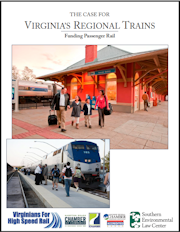
    A new report, “The Case for Virginia’s Regional Trains,” advances an argument for making that investment. Amtrak ridership has surged 50% over the past five years, says the report. If there’s a likelihood that ridership will continue increasing at that rate, thus improving the economics of the service, then perhaps it’s an investment we should make.

    But that’s a big if. More to the point: How many riders are using the trains?ย How many motorists are we taking off the roads?ย How much pollution are we preventing? What kind of Return on Investment are we getting for our public dollar? Can we improve the financial return by dropping under-performing rail connections? Finally, will Virginia be in a position six years from now to continue subsidizingย passenger rail?ย The report doesn’t tell us. Perhaps that’s because no one in Virginia has been accustomed to document the ROI for any transportation project, including roads and highways. We need to start doing so.

    — JAB


  • The Kings Dominion Law Survives Another Round

    Corkscrew logic with the Kings Dominion law

    Apparently, there are competing visions on how Virginia can thrive in a globally competitive economy amidst rapid technological change.ย  One vision makes it a top priority to educate our children in order to equip them with the knowledge and skills required to be creative, economically productive citizens across a wide variety of disciplines. Another vision subordinates our children’s education to the needs of the travel and hospitality industry.

    When forced to choose between the two, a Senate panel voted 9 to 6 in a bipartisan majority to prohibit public school districts from commencing classes before Labor Day. Currently, reports the Times-Dispatch, school systems can open early only with a waiver from the Virginia Board of Education for “good cause.” To date, 77 of the state’s 132 school districts have been granted waivers.

    Gov. Bob McDonnell, who as a Virginia Beach legislator once supported the law, made total repeal a centerpiece of his education reform initiative. Educators argued that starting the school year earlier would help better prepare students for Advanced Placement courses, the tests for which are held in early June.

    Travel & hospitality lobbyists asserted that starting school early would cost the state $369 million in lost GDP and wages and $21 million in tax income. Just a guess: The study that pulled those numbers out of a hat did not incorporate the cost to students of lower AP scores. In any case, legislators sided with their large travel/tourism business constituencies and against their students.

    — JAB


  • The Tab for Tysons Transportation: $3 Billion and Counting

    by James A. Bacon

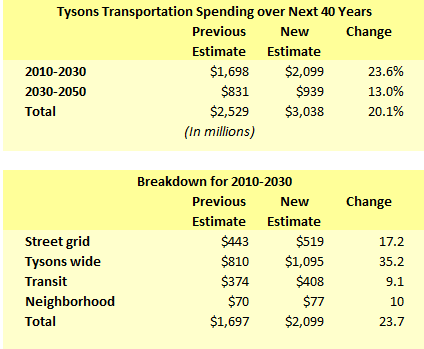
    How much will it cost to build the transportation improvements needed to accommodate the increased density of the new-and-improved Tysons Corner? The Fairfax Department of Transportation issued updated estimates last week at a meeting of the Tysons committee of the Fairfax County Planning Commission (PCTC) — and the estimate increased 20% from the previous best guess to more than $3 billion.

    Here are the numbers:


    There is a considerable fudge factor in the numbers given the inherent uncertainty of projecting so far out — and the forecast does not include an estimated $850 million to build a street car circulator within Tysons — but no matter how you add up the numbers, we are talking serious money.

    The effort to morph Tysons from a monument to helter skelter, auto-centric sprawl into a model urban community is one of the most ambitious suburban retrofits ever attempted… anywhere. The centerpiece is the Rail-to-Dulles heavy rail commuter line that will connect Virginia’s largest business center to Dulles airport and to the rest of the METRO rail system. METRO will have four stations in Tysons. Fairfax County planners are playing by the smart growth handbook. They are increasing densities around METRO stops. They are planning for grid streets and pedestrian-friendly streetscapes. They are incorporating mixed uses, including thousands of units of residential. And they are requiring developers to institute Transportation Demand Management plans. Yet the question remains, can Tysons successfully make the transformation? Or was the original design, such as it was, such an abomination that business center cannot make the transition without billions of dollars of outside subsidies?

    Roughly half the cost of Rail-to-Dulles will come from commuters on the Dulles Toll Road, a multi-billion dollar transfer of wealth. Now Fairfax planners are saying the county will need another $3 billion (and a lot more if inflation is taken into account) — without any idea of where the money will come from. The feds and the state might cough up some, but most of it will have to come from local sources.

    In an ideal world, property owners who will make a killing from added density and proximity to the METRO should share some of the massive increase in value that they did not create. One option would be a special tax district along the lines of the existing tax district that is contributing a modest share of the heavy rail construction cost. Writes one observer:

    The problem, and it’s very big problem, is that many landowners are steadfastly refusing to pay for these transportation improvements.ย  Why, they reason, should they pay this tax when many of them do not plan to redevelop [sic] for a very long time (10-15 years or more) and when their land lies outside of the TOD areas and does not qualify for the much higher densities being given to landowners near the Metro stations. Also, Lerner and Macerich, who are inside the [Transit Oriented Development] area, have already obtained county approval for their significant redevelopments and see no benefit in paying this tax.

    The reality is the landowners outside the 1/2-mile TOD areas WILL benefit from the transportation improvements, but they don’t want to pay as they feel the TOD area landowners lopsidedly benefit.ย ย  These problems associated with establishing a Tysons tax district are well-known within the Tysons landowner community, but this was the first timeย  [the Tysons Partnership] has discussed them in public testimony at a PCTC meeting.

    Another problem is that, by state law, any money raised from a tax district must be spent within the district. Yet many of the needed transportation improvements are located outside of Tysons.

    The improvements are so expensive, there are so many special interests jostling for position and the legal issues are such a thicket that it’s hard to see how the funding issues will ever be resolved. But there is one very important point to keep in mind. If commercial and residential growth doesn’t go into Tysons, where else will it go? And how much will it cost to provide the transportation infrastructure needed to serve it? Fairfax County is in so deep that it has no choice but to bull ahead and figure out how to make it work. Let’s hope they can do it without sucking in too many innocent bystanders.


  • Can “Objective” Ratings for NoVa Transportation Projects Be Truly Objective?

    The Woodrow Wilson Bridge. Are the LeMunyon-Marsden bills a stalking horse for another Potomac crossing?

    by James A. Bacon

    Del. Jim LeMunyon, R-Oak Hill, and Sen. Dave Marsden, D-Burke, have introduced companion bills (HB 599 and SB 531) that would require the Commonwealth Transportation Board to evaluate “all significant transportation projects in and near the Northern Virginia Transportation District” for the purpose of providing an objective, quantitative rating for each one.

    Relying upon computerized transportation simulations conducted by the Virginia Department of Transportation and/or the Northern Virginia Transportation Authority, the CTB would publicize the quantitative ratings for each project, and update its findings at least every three years, with the first report to be made no later than Jan. 1, 2013.

    Each report would contain two lists of at least five projects best rated to (1) reduce congestion as quickly as possible during typically congested periods, and (2) maximize regional mobility and minimize loss of life in the event of a homeland security emergency.

    Projects would include not only roads and highways but commuter rail, Bus Rapid Transit, and even additional Potomac River crossings. The lists, state the bills, “shall be used as guidance by the Board in making decisions regarding the allocation of funds.”

    I have long called for such objective prioritization of transportation projects. I would amend the criteria, however, to consider the impact uponย  safety, which, according to the AAA, accounts for roughly three times the economic loss of congestion, upon the environment, and possibly uponย  economic development if a methodology could be settled upon (which I doubt it could, for reasons too complex to go into here). While an improvement over a planning process that seemingly has no objective rating criteria, these bills do not go far enough.

    The Coalition for Smarter Growth sees little redeeming in the two bills at all. The smart growth organization has attacked them on the grounds that “they would centralize all transportation decisions in Richmond with unaccountable, unelected officials.” The bills, which the CSG asserts are pushed by the highway construction lobby, “would take power from elected officials in Northern Virginia who are most familiar with our transportation challenges and hand it to the … CTB. The bills are also designed to be anti-transit and to push segments of the controversial Outer Beltway.”

    Moreover, notes the CSG, the bills would waste tax dollars by creating a redundant and duplicative planning and prioritization process. The Northern Virginia Transportation Authority already prepares transportation plans for Northern Virginia and updates it every five years. The NVTA’s performance standards include improving travel times, reducing delays, connecting regional activity centers, improving safety, improving air quality and moving the most people in the most cost-effective manner.

    States the CSG: “The bill would apply too narrow a criteria for addressing the challenges of northern Virginia transportation.”


  • Does Vlad Have the Right Idea?

    By Peter Galuszka

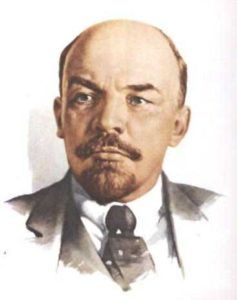
    As conservatives argue about cutting deficits and keeping low taxes for the rich both in Virginia and nationally, a bigger question is coming up: does Vladimir I. Lenin actually have the answer?

    Sounds strange, I know, but not if you read Britain’s center-right weekly business newsweekly, The Economist. In a leader titled, “The Rise of State Capitalism,” they note that the success of state-private economies in China and Singapore, countries such as Brazil and South Africa are flirting with the idea of turning back some of their privatization work and going more with state-owned companies.

    As the magazine states: “With the West in a funk and emerging markets flourishing, the Chinese no longer see state-directed firms as a way station on the way to liberal capitalism; rather, they see it as a sustainable model.”

    Also underscoring the success of state-influenced economies is a recent and startling Brookings Institution report that rates 200 global urban areas for their economic performance. Shanghai leads the list, followed by cities in Saudi Arabia, Turkey, India and more in China. None is an example of traditional, U.S.-style market capitalism.

    Indeed, you have to go pretty far down the list, to spot 19, to find the first U.S. city, which is Houston and that’s all petroleum money. Washington is No. 134. We don’t even get to the Old Dominion until No. 159 and Virginia Beach. Richmond is a stunningly bad No. 191, beating out only comatose Sacramento among U.S. cities.

    The study should be a wakeup call to Baconauts and Boomergeddons everywhere that maybe they are barking up the wrong tree. Or maybe, even worse, they are completely clueless. At Mr. Jefferson’s Capitol, legislators are playing shell games with budgets to make Mickey D. McDonnell seem like a modern, Republican governor worthy of a vice presidential run. And, we’re screwing around with public private partnerships such as the massive U.S. 460-area highway to give private biz a cut and let them toll the crap out of the rest of us for years — all in the name of Margaret Thatcher and Ronald Reagan who left the scene more than 20 years ago.

    While budget hawks complain about the big bad government and public spending on such things as social services and infrastructure, their beloved model is fading into the dust bin of history. I’m no China expert, but I, like everyone, was taken aback by theย  modern, efficient cities of Shanghai and
    Beijing when I visited in October. Unlike the U.S., transportation was clean, efficient and hassle free.

    Of course, The Economist must stay true to its OxBridge roots and come out warning that state capitalism with a big spoon of Asian Mandarin sauce might notย be the best strategyย for the West. But the trends are jolting and deserve a look.


  • U.S. 460 Project as Economic Development Powerhouse

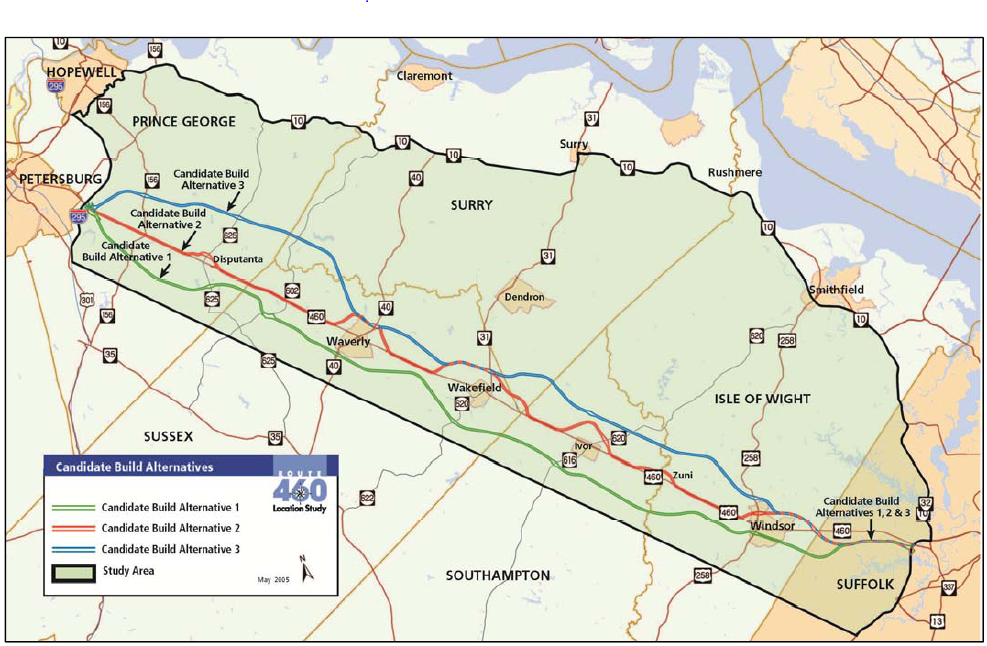
    Click on map for more legible image.

    by James A. Bacon

    The McDonnell administration’s thinking behind the $1.6 billion reconstruction of U.S. 460 between Suffolk and Petersburg has come into clearer focus with the publication of an economic study by Chmura Economics & Analytics. The I-85 Connector, as the administration has dubbed the project, will have an annual estimated economic impact of $7.3 billion by 2020 and support 14,120 jobs in the U.S. 460 corridor and 11,255 jobs in Hampton Roads, concludes Chmura.

    Over and above jobs created by construction and service businesses clustered around interchanges, the four-lane, Interstate-grade highway has three major strategic goals: (1) to accommodate the expected growth of the Port of Virginia upon completion of the Panama Canal widening project; (2) to extend the market reach of the Port of Virginia to North Carolina and beyond; and (3) to serve at least two industrial “mega sites.”

    โ€œThe new highway will not only reduce citizen travel times, but it will help create much-needed jobs and economic development in some of Virginiaโ€™s communities that have been hardest hit by the economic recession, stated Gov. Bob McDonnell in a prepared statement yesterday.

    “The Port of Virginia is one of the Commonwealthโ€™s greatest economic assets,” he continued. “Over the coming years, the port is expecting to undergo tremendous growth, but it cannot achieve this growth without the infrastructure and support systems necessary for a thriving port. The proposed new Route 460- Interstate 85 Connector will help address these infrastructure concerns and, combined with the proposed Economic Development Zone, will provide an incentive to grow for the many different businesses and support facilities that will help create jobs for thousands of Virginians.โ€

    The opening of a wider Panama Canal in 2014 is expected to transform the economics of East Coast ports. The Port of Virginia, one of the few ports with channels deep enough to accommodate the massive new vessels now under construction, is well positioned to gain market share. The primary constraints to growth are the rail and highway bottlenecks out of Hampton Roads. The state is addressing rail capacity through partnerships with Norfolk Southern and CSX, while the I-85 connector will provide a high-capacity link to Interstates 95 and 85 around Petersburg. So far, however, the McDonnell team has been sparse with details about the industrial development it hopes the project will stimulate.

    The Chmura report, “Economic Impact of the U.S. Route 460 Corridor Improvement Project,” provides background on that subject that had not been disseminated widely before:

    Plans are currently in place to develop two manufacturing mega sites in the Route 460 Corridor. Mega sites are certified manufacturing sites that are suitable for large scale economic development. These two planned mega sites are located in Sussex County near the town of Waverly and in Isle of Wight County near the town of Windsor. The Windsor mega site is over 1,860 acres,ย  while the latest document indicates that the Sussex mega site is 610 acres. The combined size of the two mega sites will be around 2,500 acres.

    Typically, writes Chmura, mega sites are used for large-scale manufacturing such as automobile assembly. Both sites are still in the development stage, however, and the targeted industries are unknown.

    Based on comparisons with comparable industrial mega-sites, Chmura estimates that new manufacturing firms have the potential to directly generate about $4.4 billion in economic output in 2020, supporting 2,635 permanent jobs. In support of that goal, McDonnell has proposed an Interstate 85 Connector Economic Development and Promotion Zone “wherein companies shipping goods through the port or engaged in maritime commerce can operate income tax free for their first two years in operation.”

    In addition, Chmura projects, increased port activities are estimated to create $1.4 billion in economic impact (measured in 2020 dollars) while supporting 4,730 jobs in the U.S. 460 Corridor. Of that amount $762.9 million will come from increased operational revenue of the Port of Virginia, which is expected to generate 2,906 direct jobs.

    Other than the Chmura study, which was prepared for Deputy Secretary of Transportation David Tyeryar, the economics and finances of the project have yet to be subjected to close public scrutiny. A year-old Coalition for Smarter Growth brief took a critical look but was written before the economic-development dimensions of the project came into clear view. While the Chmura study does quantify the economic impact of the project, it does not purport to answer the question, “Is this a good investment of state dollars?”

    The U.S. 460/I-85 Connector is the largest, most ambitious and most expensive economic-development initiative of the McDonnell administration, commanding a $500 million allocation of state dollars. Nothing else comes close. So far, it has received a sliver of the public attention it deserves. Let us hope that members of the General Assembly are asking the tough questions.


  • A Misdirected Attack on UDAs

    The paranoid style of American politics

    by James A. Bacon

    With Virginia Tea Party activists egging them on, Republican legislators have submitted at least six bills that would repeal the Urban Development Area (UDA) requirement for Virginia localities. Overturning the law would eliminate an important tool for local governments to contain growth-related costs and hold down taxes — presumably a high priority for the Tea Party.

    “The bipartisan UDA statute of 2007 is designed to reduce the costs of infrastructure and the burden on taxpayers. That’s why we are astounded that Tea Party members would campaign so hard to repeal this fiscally conservative planning tool,” said Stewart Schwartz, Executive Director of the Coalition for Smarter Growth in a Tuesday joint statement of the Coalition for Smarter Growth, the Piedmont Environmental Council, the Southern Environmental Law Center and the League of Conservation Voters.

    The opposition of the Tea Party — and I say this as a Tea Party sympathiser — arises from naive acceptance of misinformation supplied by a small group of Anti-Agenda 21 zealots led here in Virginia by Donna Holt, president of the Virginia Campaign for Liberty. Holt has energetically proselytized Tea Party organizations and other conservative groups across Virginia, and her message has taken root because no one has offered an opposing viewpoint.

    Holt portrays the Smart Growth movement in Virginia as inspired by United Nation’s Agenda 21 project, which seeks to harness the power of government to implement sustainable environmental principles in communities across the globe. Her critique of Agenda 21 itself does have a basis in reality. Agenda 21 reflects a liberal-leftist worldview that entwines environmental sustainability with equity, social justice and the redistribution of wealth. Where Holt goes off the rails is in painting Virginia’s Smart Growth groups as similarly inclined, and even attacking such mainstream figures as House Speaker William J. Howell, R-Fredericksburg, for his leadership in passing the UDA law.

    A year ago, Holt blasted out an email to Virginia Tea Parties employing characteristic rhetoric:ย “Speaker Howell is siding with big corporate developers and eco-extremists to rob you of the right to own and control the use of your private property. … If he has his way, youโ€™ll be forced to forfeit your land in the suburbs for the development of high-density โ€˜urban development areasโ€™ also called โ€˜smart growthโ€™. …ย If they have their way, single family homes will be a thing of the past. Weโ€™d become mere lease holders of the homes we live in.”

    There is no delicate way to put this: Such remarks are deluded. Virtually nothing in that quote is factually accurate.

    I have seen no indication in the Virginia Campaign for Liberty website or in the public remarks I have heard her make that Holt understands the long, complex history of zoning, land use, transportation and growth-management policy in Virginia, much less the pro growth/no growth debates that long pre-dated the articulation of Agenda 21. I doubt she has had any interaction with Smart Growth advocates here in Virginia or has any acquaintance with their thinking. Perhaps most damning, I have seen her advance no alternative ideas for how fiscally stressed state and local governments can provide core services without raising taxes.

    The anti-Agenda 21 movement is a case study in the “paranoid style” in American politics, and responsible Tea Party leaders would be well advised to entertain opposing perspectives. The Heritage Foundation, hardly an advocate of leftist social engineering, has distanced itself from the anti-Agenda 21 movement on the grounds that it is crowding out an intelligent critique of Smart Growth. (For details, see this blog post.)

    As for Urban Development Areas, they are an admittedly imperfect solution to Virginia’s growth-management challenges. But it is hard to see how anyone would construe them as a gross violation of Virginians’ property rights.ย  Time for a reality check:

    All localities with a population of at least 20,000 or a growth rate of 15% are required to designate an Urban Development Area in their comprehensive plan. These areas should be designed to accommodate 10 to 20 years of population growth by incorporating such New Urbanism or Traditional Neighborhood Design elements as:

    • Connectivity of road networks
    • Connectivity of pedestrian networks
    • Pedestrian-friendly road design
    • Reduction of front- and side-yard setback requirements
    • Mixed-use neighborhoods
    • Reduction of subdivision street widths
    • Satisfaction of requirements for storm water management

    The law also provides for minimum densities of four residential units per acre and a floor-to-area ratio of 0.4 for commercial development.

    None of that sounds terribly Marxist to me.

    The law does not diminish anyone’s property rights: “Localities that establish Urban Development Areas may not limit or prohibit development in compliance with existing zoning nor refuse to consider a rezoning application for property outside of the Urban Development Area.”

    The logic of the law is to encourage (not coerce) developers into concentrating development within a compact geographical area that state/local government can more cost effectively serve with utilities, roads and public services. It recognizes that the scattered, low-density and disconnected pattern of development that has prevailed in Virginia since the 1950s has driven up the cost of providing core services and has put relentless pressure on local governments to increase taxes.

    The UDA law is fiscally conservative in its inspiration — something that Smart Growth advocates understand.

    “The wish list for transportation projects has become simply unaffordable. Experience has shown that it is more costly to taxpayers and more damaging to farmland and forests to provide roads and other infrastructure for scattered development than for more compact, traditional neighborhoods,” said Trip Pollard of the Southern Environmental Law Center in the joint Smart Growth statement. “UDAs reduce transportation costs to the state and also save on water and sewer, police and fire, school busing and other costs.”

    “The traditional neighborhood development envisioned by UDAs is reflective of the beloved, historic towns of Virginia and our best older suburbs that engender a sense of community that we have lost as development has become more scattered,” said Dan Holmes of the Piedmont Environmental Council. “This should be something that the Tea Party supports.”

    Virginia is not California, where environmental zealots do run roughshod over property rights. Smart Growth in Virginia is not about marching to the tune of the U.N. It is not about social engineering, sweeping away single-family dwellings or taking away peoples’ automobiles. It is about subsidizing mass transit, an issue where I part company. But the Smart Growth movement does recognize a profound truth: that the cost of government services varies in proportion to which land development is compact or sprawling. Smart Growthers offer a coherent set of principles for reducing the cost of government and holding down taxes.

    Republican representatives to the General Assembly should take heed.


  • McDonnell Budget Short-Changes General Fund Programs

    Click on chart for more legible image.

    The Commonwealth Institute has come out swinging with the toughest critique of Gov. Bob McDonnell’s proposed 2013-14 budget that I have yet seen. States a new report, “Reality Check,” written by Sara Okos and Michael J. Cassidy:

    Instead of reforming, reallocating and reinvesting in the programs that make government more efficient, effective and accountable, the Governorโ€™s proposal strikes at โ€“ and cuts โ€“ the core services that Virginians rely on every day while at the same time widening tax loopholes that drain yet more resources from the state.

    The Governor has proposed more than $880 million in cuts to services to close the budget shortfall and fund his new initiatives. More than 90% of those cuts are in the areas of education and health care. His budget also widens loopholes in the state tax code by expanding tax expenditures and creating new ones “with little to no evidence of their effectiveness.”

    McDonnell has justified his budget choices by noting that state spending has increased 23% in recent years. But he overlooks the fact that all of the increase has come from Non-General Fund expenditures, the report contends, while General Fund expenditures have declined five percent over the past decade when adjusted for inflation and population growth. The General Fund supports core state programs like education, Medicaid and public safety.

    This report will provide ammo to Democrats and others who oppose McDonnell’s proposals to expand the use of tax exemptions, credits and the like and to institutionalize the diversion of General Fund revenues to transportation.

    — JAB


  • McDonnell Seeks Private-Sector Input on Operations Centers

    by James A. Bacon

    Phew, it’s hard keeping up with all the transportation initiatives flying out of the McDonnell administration. I’m breaking a sweat here at the Bacon’s Rebellion command center just tracking the press releases!

    Here’s the latest: The Virginia Department of Transportation is seeking private-sector ideas to “operate, integrate and innovate” the state’s five transportation operations centers.

    “We must use technology to get the most of our transportation system and VDOT is looking for a partner who will do that,โ€ said Governor McDonnell in a prepared statement.ย  โ€œThe end goal is find and employ state-of-the-art technology to keep traffic moving, manage congestion and respond to incidents.โ€

    In coordination with the Office of Public-Private Partnerships, VDOT has released a Request for Information soliciting proposals to operate and invest in the centers. A single respondent will be selected to operate all five centers as a unified active traffic management system platform. The centers, located in Northern Virginia, Richmond, Hampton Roads, Salem and Staunton, work with VDOT, state police and emergency response personnel to provide real-time traffic information to motorists and to clear traffic accidents from the roads. Among other tools, they use traffic cameras, variable message signs, highway advisory radio and pavement sensors.

    Gov. McDonnell and Transportation Secretary Sean Connaughton aren’t waiting for VDOT to come up with nifty ideas for upgrading the operations centers. The highway department is working on a really tight budget and wouldn’t have the funds to carry out new ideas, even if VDOT’s organizational culture rewardedย  employees for creative thinking. The state isn’t committing itself to any particular course of action — it’s just soliciting ideas right now.

    In theory, tremendous potential exists for using sensors, wireless and networking technologies to develop highly accurate, real-time data on traffic conditions that can used to fine-tune traffic light sequencing, adjust toll rates, enforce motor-vehicle laws and otherwise nudge the ebb and flow of traffic. It is very encouraging to see the governor’s transportation team seeking solutions that entail something other than the construction of new mega-projects. Thumbs up on this one.


  • Lingamfelter’s Land Mine

    Del. Scott Lingamfelter, R-Woodbridge, at left.

    by James A. Bacon

    Whoah, dude! There was a lot more in Gov. Bob McDonnell’s Round 2 package of transportation legislation than his Friday press release summary let on. In my haste to knock out a quick story late in the day, I focused on the garnish on the bill — the proposed grant of road, bridge and highway naming rights to commercial interests — and missed the meat. (See “Name that Tunnel!”)

    There was a potentially explosive provision hidden within the larger package. In the bland words of the press release, the transportation “funding and reform” bill submitted by Del. Scott Lingamfelter, R-Woodbridge, “Amends statutes regarding local transportation plans to ensure that state and federal dollars are spent in a timely and cost-effective manner.”

    Sounds pretty inconspicuous, doesn’t it? In fact, this measure would dramatically expand state authority over local transportation decisions under the rubric of integrating land use with transportation planning. In the abstract, I have long advocated stronger ties between transportation and land use. Whether this particular legislation is a good thing or a bad thing, I cannot say, but it surely looks like a very big thing. (Thanks to Bacon’s Rebellion reader “Bosun” for actually reading House Bill 1248 and bringing this to my attention.)

    As part of their comprehensive zoning plans, localities are required to identify transportation infrastructure that will be needed to support growth and development. HB 1248 would require localities also to include a map showing those improvements as well as VDOT’s estimates of how much they would cost. Further, the plans must be consistent with the Commonwealth Transportation Board’s (CTB’s) Statewide Transportation Plan and Six-Year Improvement Program. “The locality shall consult with the Virginia Department of Transportation to assure such consistency is achieved,” mandates the bill.

    In a related measure, the bill contains a paragraph designed “to integrate land use with transportation planning and programming, consistent with the efficient and economical use of public funds.” If the CTB finds that a local or regional long-range transportation plan is inconsistent with its own Statewide Transportation Plan or Six-Year Improvement Program, it can “withhold federal and state transportation funds for transportation capital improvements.”ย  Likewise, if a locality or regional planning organization requests the termination or alteration of a transportation project that has received state or federal funds, the localities involved shall be required to reimburse VDOT for all such funds expended.

    What is the thinking behind this measure? What abuses is it designed to correct? Does it represent a lead-up to devolution? Would the bill give too much power to VDOT and the CTB? Would it encumber localities with more bureaucracy? I have lots of questions and no answers. I’ll start digging. But one thing is easy to predict: Local governments will raise a ruckus.