• Does HB33 Protect Open Shop Contractors?

    by James A. Bacon

    Mea culpa. I missed a critical point in my previous analysis of the political chess match between the Metropolitan Washington Airports Authority (MWAA) and the McDonnell administration. I said naively that Gov. Bob McDonnell may have no choice under new legislation but to yank $150 million in state funds allocated to Phase 2 of the Rail-to-Dulles project.

    HB 33, I wrote, not only prohibits mandated Project Labor Agreements in state-funded construction projects, but it seeks to ensure that โ€œneither the state agency nor any construction manager acting on behalf of the state agency โ€ฆ discriminate against bidders [not adhering] to agreements with one or more labor organizations.โ€ Last week MWAAย scrapped its PLA mandate for Rail-to-Dulles but subsituted a provision that would grant 10-percent scoring bonus for bidders whose plans included a PLA — clearly discriminatory against open-shop contractors. McDonnell, I suggested, would have no choice but to find MWAA in violation of that law.

    Here’s what I missed: The bill’s anti-discrimination clauseย applies to state agencies. MWAA is not a state agency — it is an interstate compact! Thus, it could beย exempt from HB 33, commonly referred to as the Comstock bill after lead patron Barbara Comstock, R-McLean.

    That’s the argument made by Del. Bob Marshall, R-Manassas (hat tip to anti-MWAA activist David LaRock). Marshall had submitted a bill that would have addressed the problem head-on. He would have denied MWAA the $150 million if (1) Rail-to-Dulles were subject to a Project Labor Agreement, (2) MWAA policies or bylaws governing public access to meetings and records wereย  incompatible with Virginiaโ€™s Freedom of Information Act, or (3) phase 2 of the project and its finances were notย subject to state audit.

    MWAA’s fig-leaf vote, which substituted a scoring preference in place of a mandate, would circumvent Marshall’s PLA clause just like it circumventsย HBย 33. But MWAA wouldn’t get the money unless it alsoย submitted toย Virginia’s FOIA law andย state audits.

    Did the authors of the Comstock bill get snookered? I’m not a lawyer, so I don’t know. I simply repeat the arguments. I’d like to hear other people weigh in with their opinions.


  • Teaching Like Socrates

    Low tuition, classical education โ€“ whatโ€™s not to like?

    By James A. Bacon

    One day about two years ago Ann McLean, a devout Christian and mother of four, felt that she was โ€œspoken toโ€ by God and given a mission in life โ€“ to start a new school. She never looked back. If all goes well, she will enroll her first six classes of students for Hunter Country Day School this fall.

    While the decision to launch a private school based on a classical education and Christian values came on suddenly, dissatisfaction with the conventional alternatives in the Richmond area had been percolating for quite a while. Educational standards in public schools, she felt, had collapsed. The curriculum in public and private schools alike had invaded by a dominant culture coarsened by sex and violence. And the college preparatory school where her children were enrolled heaped โ€œcrushing tuitionsโ€ on parents to pay for trophy buildings and athletic programs.

    McLeanโ€™s intent is to focus on fundamentals, creating an environment where children can hone their minds and build character at the lowest tuition possible. Hunter Country Day will adopt a curriculum inspired by the classical education movement — the ultimate back-to-the-basics program — and charge only $6,000 in yearly tuition. That compares to $10,500 per pupil spent by public schools nationally this year and $10,900 in Virginia.

    A slim, blonde bankerโ€™s wife with a Ph.D. in art history, McLean epitomizes the entrepreneurship sweeping K-12 education today. Itโ€™s a time of great ferment as Americans across the country seek to reinvent an educational system they see as badly broken. Indeed, that entrepreneurial, mission-driven spirit may be Americaโ€™s best chance to break free from the rigid, suffocating stasis of the public school system. While private schools do offer an alternative, prep-school tuitions approaching $20,000 a year are unaffordable to the vast majority of Americans.

    With the backing and support of two other Richmonders, McLean has leased classroom space from the Dover Baptist Church in Goochland County and scoured the region for second-hand equipment and desks. The school will have few frills. โ€œWe donโ€™t need a huge football team. Sorry,โ€ she says unapologetically. Technology has its uses but she doesnโ€™t need high-tech school buildings either. โ€œSocrates never had a classroom. Jesus Christ never had a classroom.โ€

    Tuitions will go to hiring great teachers , keeping the teacher-student ratio down to an intimate 12 to one and implementing a classical education curriculum.ย  By โ€œclassical,โ€ she doesnโ€™t mean traditional, like teaching phonics (although she is a big believer in phonics). McLean is developing a curriculum based on the โ€œtriviumโ€ developed in the Middle Ages: grammar, logic and rhetoric. Elementary school pupils are grounded in a foundation of facts, such as grammar. Middle school pupils learn how the facts relate in a logical framework. And high school students master rhetoric, or critical thinking. The curriculum is based on language and concepts, not photos, video and other images so prevalent in education today.

    A core goal of classical education is to build studentsโ€™ character. The founding fathers, says McLean, understood that humans were by nature selfish and fallen, the only antidote for which was the cultivation of personal virtue. โ€œThe American experiment depends upon an educated populace founded on Christian values,โ€ says McLean, who makes no secret of her political and cultural conservatism. โ€œThe most important job of any culture is training the next generationโ€ โ€“ a job at which the nation is failing. She wants to reverse the nationโ€™s cultural decline. โ€œIโ€™m the little girl sticking my finger in the dike.โ€

    McLeanโ€™s philosophy of education is not for everybody. But thatโ€™s the beauty of free markets. Real competition would offer a broad spectrum of alternatives to the secular uniformity of public schools and the soaring cost of elite prep schools. More importantly, Hunter Country Day will succeed only if McLean provides the kind of education โ€“ at an affordable price โ€“ that parents want for their children.

    Virginiaโ€™s General Assembly is debating a number of proposals this session to increase private school choice by means of tax credits. None of the proposals are bold enough.ย  Based on Governor Bob McDonnellโ€™s proposed 2012-2014 budget, the commonwealth will distribute $5.1 billion, or roughly $4,000 per student, in Direct Aid to Public Education. If that $4,000 followed the students, rather than the schools, the vast majority of Virginians could afford a private education of their choiceโ€ฆ. Or, if parents couldnโ€™t find a school that suited, like Ann McLean they could start their own.


  • Port of Virginia’s Growth Opportunity

    by James A. Bacon

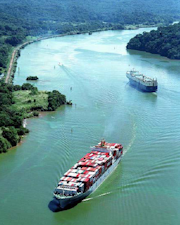
    The Port of Virginia was the third largest East Coast port ranked by container traffic in 2010, with 11% market share. It trailed Savannahย  and New York/New Jersey, and Charleston was nipping on its heals. But the market for U.S. containerized cargo is forecast to double over the next decade, and Virginia’s ports are ideally situated to benefit from that growth.

    In a presentation to the Commonwealth Transportation Board Wednesday, Jerry Bridges, executive director of the Virginia Port Authority, explained how the expansion of the Panama Canal would give Virginia’s ports a big competitive edge over its East Coast rivals. I have blogged on this topic before, but Bridges offered a greater level of detail.

    The widening, expected to be complete by 2014-2015, will allow ships holding 18,000 TEUs (twenty-foot equivalent units, half of a standard shipping container) to use the canal. Currently, the canal handles ships with capacity of 4,400 TEUs. The use of larger ships will dramatically cut shipping costs from China, Japan and other Far Eastern nations to the U.S. East Coast, bypassing America’s West Coast ports and trans-continental railroads. (I could not attend the CTB meeting Wednesday, so I am basing this post upon Bridge’s PowerPoint presentation, filling in the blanks as necessary.)

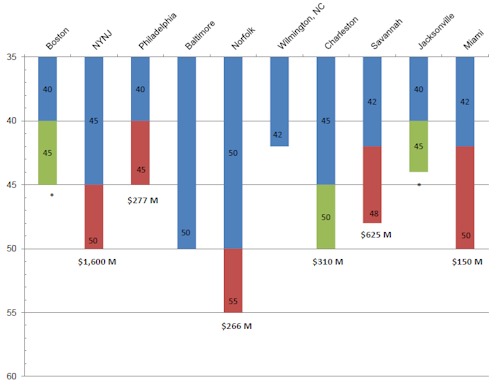
    Other U.S. ports have limited options to expand capacity. Virginia has the only U.S. port with a permitted expansion project in place. Perhaps most crucial, Hampton Roads has the deepest channels of any East Coast port, meaning that it is best equipped to handle the giganzo container ships now coming out of the shipyards. The graphic below shows the current (blue), authorized (red) and desired (green) channel depths on the Atlantic coast.

    Port channel depths. Source: Port of Virginia

    Virginia also has partnered with the two East Coast railroads, Norfolk Southern and CSX, to upgrade rail routes emanating from Hampton Roads and Virginia by allow double stacking of container trains. The Heartland Corridor and National Gateway will connect Norfolk to the Midwest, while the Crescent Corridor opens up markets in the Northeast and deep South. Even though Norfolk International Terminals has added six new on-dock rail lines and doubled the capacity of its rail yard, the railroads aren’t expected to be able to handle the influx of traffic. Thousands of containers will have to move by truck.

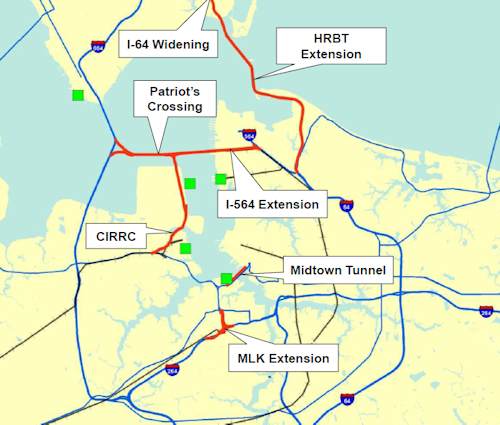
    Freight movement has multiple highway bottlenecks due to the necessity of crossing bodies of water. The map below shows the port’s priority transportation projects in Hampton Roads. Not included here is the upgrade of the U.S. 460 link to Interstates 95 and 85 in Petersburg.


    The Midtown Tunnel and Martin Luther King (MLK) extension are already funded. The other multibillion-dollar projects are not.

    Two critical questions: First, how solid is the forecast showing a doubling of U.S. containerized shipments by 2022? What assumptions are embedded in that projection? Can international trade continue at the same rate as in the past three decades? What happens if, as President Obama hopes, an increasing share of manufacturing relocates back to the U.S. as China loses its edge as a source of inexpensive manufacturing? Is the forecast solid enough to base an investment of billions of public transportation dollars? And what happens to toll-driven projects if the traffic fails to materialize? I’m not doubting the forecast. I just want to hold it up to public scrutiny.

    Second, if the demand is as powerful as Bridges says it is, and if the Port of Virginia will enjoy such an overwhelming competitive advantage in winning the growth in container traffic, why does the U.S. 460 upgrade need to commit $500 million in state subsidies? Do the three construction consortia bidding to partner with the state accept these port projections? If so, how much new truck traffic do they expect the port to generate? And why can’t they pay the full freight?

    There are good reasons to believe that the Panama Canal widening will create a great economic opportunity for Virginia. Of course, the state should endeavor to support that opportunity. But I would like to see the analysis, if it exists, that justifies committing the state to a half-billion dollar subsidy.


  • A Pathetic Half-Time

    By Peter Galuszka

    Itโ€™s so-called halftime at the Virginia General Assembly, and with conservative Republicans holding sway and many serious problems facing the Commonwealth, hereโ€™s what weโ€™ve come up with so far:

    • Women exercising their constitutional right to have an abortion now will be forced to undergo and pay for an ultrasound before the procedure. Thereโ€™s no medical reason for this, just to shame the woman into reconsidering so that right-to-lifers can feel good about themselves. Conservative Republicans, mind you, want to keep the government out of our private lives.
    • After years of supplying a lot of the East Coast with handguns, Virginia limited purchases to once a month. No longer. Now gun fanatics can exercise their Second Amendment Rights as many times a month as they want and blast away. Rock on!
    • If you have been laid off or were born into a low income family and need public housing, the state wants to check into your urine to see if you abuse drugs. If you are poor, you are suspect. If you are rich, congratulations, sir!
    • If you look foreign and sound like Cheech and Chong, the cops have to check to see if you are in this country legally if they happen to stop you for running a red light. How they do this quickly, no one knows exactly, since drivers licenses can be issued to anyone regardless of nationality. The police community is screaming that they donโ€™t have the resources to handle this and even the Richmond Times-Dispatch says it is a bad idea. No matter, hard-right-wingers have to keep up with Alabama and Arizona.
    • In a move that is certain to save Virginiaโ€™s economy from the horrid onslaught of labor unionism, state money canโ€™t be used to fund public works projects that have agreements that require that some of the work go to firms represented by unions. It has to do with Dulles Rail, a big transit project up DC way. It is important to let them Yankees and DCists know that this hereโ€™s the South and we donโ€™t cotton to no unions.

    Meanwhile, more pressing matters await, such as a budget. It seems that Gov. Robert F. McDonnellโ€™s plan to put the screws to education and use part of its General Fund payments to boost transportation isnโ€™t getting very far.

    Ditto the conservative schemes to stick it to our lazy and inept public school teachers. They want to upend the status quo with new plans to subject teachers with tougher new performance appraisals. Mind you, there has been no solid evidence or public outcry that this is needed. Rather some of the right-wing think tanks decided it should be an issue. One reason could be that some teachers are organized into, God forbid, labor unions. It also has racist overtones since it seems aimed at minority teachers in minority and low-income areas.

    The anti-teacher movement seems to have been orchestrated months before the legislative session. Read six months of some of the postings on this blog and you will see that somewhere, someone has decided that public school teachers are a major, major problem. Maybe you didnโ€™t notice yourself, but you read it here first!

    The big irony is that McDonnell has worked so hard to recast himself from social to moderate conservative so he can more easily pursue national political ambitions. As much as he spins the GA session as progress, it clearly ainโ€™t. The agenda is being controlled by the likes of Bob Marshall and other wingnuts.

    As for me, I blame the Democrats, especially national party boss and former governor Tim Kaine. They let the hard righters get a slender majority in the last election and now thereโ€™s hell to pay. Ironically, however, the one who might end up paying the most will be Bob McDonnell.


  • Goodbye Grundy! Hello, Wal-Mart

    By Peter Galuszka

    Hours west of Richmond by car ย lies the old coal town of Grundy, lying at a confluence of the flood-prone Levisa Fork River below steep cliffs of sedimentary rock of sandstone and shale.

    Grundy has been a touchstone for my various trips to the Virginia coalfields over the years. I hadnโ€™t been that part of the woods in a while and when I drove through on Tuesday, I went into a state of shock.

    Utterly gone was the pleasant old town with its rich collection of Depression-era buildings that could have been the subject of a Walker Evans photo study. Vanished was the black statute of the coal miner looking expectantly to heaven. The little movie house was gone. Everything was gone.

    In its place around the dynamited sides of mountains was a multi-level Wal-Mart. I had to rub my eyes in the misty rain. An entire town had disappeared to make room for a Big Box.

    To be sure, this had been a long time coming. The Levisa Fork is flood prone, in part because ruthless strip mining practices in the Southwest Virginia coalfields have ripped out vegetation that can hold back rainwater. One of the biggest floods came on April 4, 1977.

    Grundy became a cause celebre among local economic development officials and U.S. bureaucrats. U.S. Rep. Rick Boucher worked out a plan in 1997 to forever change Grundy with town leaders, the U.S. Army Corps of Engineers and the Virginia Department of Transportation. Helped by $96 million in public money, VDOT bought and ripped down the old Lynwood Theater and local hardware stores and fives and dimes. The Army spent $100 million ripping out 2.4 million cubic yards of rock, enough for 68 football fields, and helped relocate rail tracks.

    In all, according to a 2007 Post story, Grundyโ€™s makeover ended up costing $196 million or $175,000 for every man, woman and child in town. But all didnโ€™t work out according to plan. Many of the building owners, the Post reported, did not rebuild as planners hoped. They merely pocketed their money and left.

    Whatโ€™s left is a Wal-Mart in perhaps the most dramatic geological setting possible. The utter madness of the scene is commemorated on YouTube with a pictoral.

    Even nuttier is that government officials have spent so money on Grundy when there is still so much oppressive poverty and health care needs that have infected the coalfields from the day the first coal prospector set foot on the remote and beautiful mountains of Southwest Virginia.


  • MWAA Plays Chicken with McDonnell over PLAs

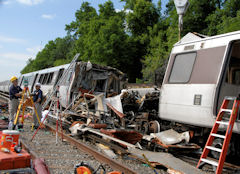
    Train wreck. Photo credit: Washington Metropolitan Area Transit Authority.

    by James A. Bacon

    The Metropolitan Washington Airports Authority (MWAA)ย boardย pressed aheadย yesterday in itsย bid to preserve the $2.8 billion Phase 2 of the Rail-to-Dulles project as a union job.

    First, under pressure from Republican legislators, the board retracted a previous decision mandating that Phaseย 2 be subject to a Project Labor Agreement (PLA). Instead of requiring the prime contractor to hire workers from a union hiring hall, the board substituted a 10-percent scoringย bonus for bidders whose proposals contain a PLA. That bonus gives companies using a union workforce a significant advantageย in the bidding process expected to take place later this year, and it could be sufficient to even deter many non-union contractors from submitting bids.

    MWAA’s action appears to be designed to skirt bills passed by House of Delegates and the state Senate that would prohibit mandatory PLAs for any project receiving state funds.ย If the MWAA board had kept its PLA mandate, it would have put into jeopardy a contribution of $150 in state funds that was critical to a delicate restructuring of the project financing worked out under the auspices of U.S. Transportation Secretary Ray LaHood.

    The PLA is a top priority of Dennis Martire, vice president of theย Laborers International Union (LiUNA), which between itsย nationalย andย Mid-Atlantic offices hasย contributed $1.1 million to political candidates since 2008, overwhelmingly to Democrats.ย The MWAAย board is comprised mainly of appointees by Democratic officials, and Democrats in the General Assembly have opposed Republican-sponsored bills to hold the MWAA board accountable.

    Second, the board heard a presentation by a consultant who warned that rates for the Dulles Toll Road could double starting next year if, in the words of the Washington Post’s Dana Hedgpeth, “Virginia doesnโ€™t deliver on a promise to contribute $150 million for the second phase of Metrorailโ€™s new Silver Line.”ย  The not-too-subtle message: If Governor Bob McDonnell refuses to hand over the $150 million, he’s to blame for toll rates going up.

    Under the financing arrangement agreed to by the funding parties, Loudoun County, Fairfax County, MWAA and the Commonwealth of Virginia will pay fixed sums. Any additional costs — such as a winning bid higher than the official $2.8 billion cost projection — will be covered by Dulles Toll Road commuters, who will pay higher tolls. ย Writes Hedgpeth:

    Tolls for a one-way trip that now costs $2.25 could increase to $4.50, according to a consultantโ€™s report prepared for the Metropolitan Washington Airports Authority and presented during a board meeting Wednesday. If the state money comes through, tolls for the same trip could still rise to $2.75.

    The MWAA board appears to be playingย a game of chicken with the McDonnell administration. If the governor refuses to hand over the $150 million,ย MWAA may have no alternative but to jack up rates on Dulles Roll Road commuters, many of whom live in Loudoun County. If that happens, Loudoun County might drop out.ย Isย McDonnell willing to see the Rail-to-Dulles financing run off the rails because he won’t cough up the state’s promised share?

    McDonnell may have no choice but to withhold the funds.ย HB 33, whose lead sponsor was Del. Barbara Comstock, R-McLean,ย not only prohibits mandated PLAs, but it seeks to ensure that “neither the state agency nor any construction manager acting on behalf of the state agency … discriminate against bidders [not adhering]ย to agreements with one or more labor organizations.” Arguably, MWAA’s 10-percent bonus for PLAs would discriminate against non-union contractors.

    Northern Virginia needs mass transit to accommodate its transportation needs in an age of ever-increasing congestion and gasoline prices. But the process of building heavy rail is so polluted by special interest maneuvering — labor unions, big construction firms, real estate owners — that costs mount inexorably and financing becomes a game of the politically strong shifting costs onto the weak.ย As Old Dominion enters an era of ever tighter fiscal constraints on state and local government, we need to find a cost model for mass transit that Virginians can afford and a political process that doesn’t leave citizens feeling like they’ve been raped.


  • Lawmakers with Nothing Better to Do

    How’s this for inane micro-management of the education system? Sen.ย Dave Marsden, D-Burke, ย submitted a bill requiring all textbooks approved by the Board of Education, when referring to the Sea of Japan, toย note that the body of water is also referred to as the East Sea.

    Only Marsden knows what prompted this exercise in geographical correctness, but it clearly messes where the General Assembly shouldn’t be aย messin’. It seems that the Koreans are irate that the body of water lying between Japan, Korea and Russia (see map) should be referred to as the Sea of Japan. They propose the neutral-sounding “East Sea.” Of course, the sea is “east” of Korea, but “west” ofย Japan, thus implicitly endorsing its connection to Korea.ย If I were Korean, I’d probably get torgued up, too. But it appears that the Japanese are equally keen upon retaining the name. (Two posts by Japanese citizens upon the Richmond Sunlight website make good reading, if you are interested in geographic and historical arcana.)ย Thankfully, the Russians have kept their noses out of it so far.

    It has been common usage among Western countries to call the body of water the Sea of Japan since at least the early 1800s, and so the nameย appears in the textbooks read by Virginia students.

    The last time I checked, the federal government is responsible for the conduct of diplomacy and foreign affairs, not the Commonwealth of Virginia. (Very few of the things that the federal government does are legitimate, to my mind, but this is one of them that is.) We have no dog in this fight. But both the Koreans and the Japaneseย are vital partners to Virginia’sย economic prosperity. All we can do by taking sides is to tick someone off.ย Let the textbook publishers take the heat.

    Thankfully, the state Senate did the right thing… thoughย just barely. The Education and Health Committee defeated the bill in a 7 to 8 vote. I can’t begin to imagine what the seven “yea” voters were thinking.

    — JAB


  • Devolve Federal Transportation Spending to the States

    Transportation bill to nowhere

    Worth reading: an op-ed penned by Sen. Jim DeMint, R-SC, in the Wall Street Journal today. He explains how Senate Democrats and House Republicans have “surrendered to the status quo” of unsustainable fiscal policy by cranking up transportation spending and bailing out the Highway Trust Fund with borrowed money.

    DeMint makes a modest proposition: “We should devolve the federal highway program from Washington to the states. We can dramatically cut the federal gas tax to a few pennies, which would be enough to fund the limited number of highway programs that serve a clear national purpose.”

    States then could adjust their state gas taxes, avoid congressional earmarks, devise their own transportation construction plans without petitioning the federal highway bureaucracy, and sidestep the Davis-Bacon Act requirement to pay labor-union wages on federally funded projects.

    Why aren’t Virginia’s congressmen making a similar case?

    — JAB


  • The Road to Wealth Destruction

    The soon-to-be-built Charlottesville Bypass provides a lousy economic return on investment. Only government would spend $244 million on a project that yields less than $8 million a year in benefits to the public.


    By James A. Bacon

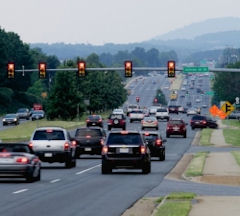
    The citizens of Charlottesville and Albemarle County think they have a traffic congestion problem on U.S 29 north of the city. Of course, everybody thinks they have a traffic problem. You should see the intersection of Parham and Patterson near my home in Henrico County around 5:30 p.m. It can take three or four cycles to get through the stop light. And try driving on Interstate 95 in Prince William County. Itโ€™s far worse than anything in the Richmond region โ€“ you can get stuck in stop-and-go traffic at 6:30 in the morning!

    The question is whether the congestion on U.S. 29 north of Charlottesville is so numbingly God-awful compared to all the other traffic hell-holes in Virginia as to warrant a $244 million investment (including sunk expenses) to build a bypass, as the McDonnell administration has decided to do.

    For more than a half year now Iโ€™ve been writing about the Bypass from a distance, here in Henrico. At times, the controversy seemed remote and abstract. To really understand the controversy, I decided I needed to experience the frustration, the agony and the road rage of driving on U.S. 29 first hand. So, one day in December, using a digital stop watch to track my time, I spent more than an hour driving up and down the congested highway corridor slated for bypass. I wanted to see for myself just how bad things got during rush hour.

    It was a regular workday, the University of Virginia was in session and traffic conditions were routine. I set some rules for myself: no lane weaving, no bumper hugging and no gunning through yellow lights to alter the outcome. While I was behaving myself, there would be no cursing, fist shaking or banging on the steering wheel either. I would drive like a normal person.

    The results were far from anything I expected.

    The stretch of U.S. 29 in question runs through 14 stoplights and is lined with restaurants, shopping malls, office buildings and other development. Although the road is designated a highway of statewide significance — one of Virginiaโ€™s three major north-south freight ย routes — Albemarle County zoned the land around it as a primary growth corridor. Thousands of people use the road to drive to work every day at the University of Virginia and other Charlottesville employment centers.

    Figuring that morning rush hour would experience the worst congestion, I picked the period of 7:30 a.m. to 8:30 a.m. to drive back and forth between Ashwood Boulevard at the proposed northern terminus of the Bypass and the U.S. 250 Bypass underpass to the south. Driving north against the rush hour traffic established a base line: My three trips averaged 7 minutes and 42 seconds. Traffic was smooth flowing throughout, although delays did occur during lengthy stop lights at the Hydraulic and Rio road intersections.

    Likewise, I drove south three times with the rush hour traffic. My first trip took the longest. I was surprised at how smoothly traffic moved but I did get hung up at the Rio Road intersection for a long stoplight cycle. Thanks to the synchronized lights, however, I whizzed through the major intersections without a hitch on the next two trips. The average drive time for all three: 7 minutes and 21 seconds โ€“ faster than when I was driving against the rush hour tide!

    At the end of the exercise, I had one question: Traffic congestion? What traffic congestion? These people know nothing about traffic congestion!! What is all the hoo-ha about?

    ROI โ€“ No, thatโ€™s Not French for โ€œKing,โ€ although It Is a Foreign Word in Virginia

    A variety of claims have been advanced in favor of building the Bypass. First, there is an economic benefit to reducing the amount of time people lose being stuck in traffic congestion. Second, the project will improve safety, reducing the number of traffic accidents on an accident-prone stretch of road. And third, it will promote economic development โ€“ not necessarily in the Charlottesville region but in points south, specifically in Danville and Lynchburg. Building the Bypass around Charlottesvilleโ€™s congestion hot spot, it could be argued, will reduce truck travel times and improve the competitive posture of manufacturing businesses that use U.S. 29 as a freight corridor.

    While the claims are not implausible on their face, no one has subjected them to rigorous study. The Virginia Department of Transportation has never conducted a Return on Investment (ROI) analysis to determine how much economic benefit the commonwealth will derive from its $244 million expenditure, much less how that ROI would compare to alternative transportation improvements.ย  (more…)


  • An Economy Built to Crash

    President Obama delivers budget remarks at Northern Virginia Community College.

    by James A. Bacon

    President Obama has a catchy new slogan. He wants a budget that will create an economy “built to last,” evokingย the best-selling book of the same name that explored the secrets of exceptional,ย long-lasting corporations.

    Unfortunately, Obama’s budget, if ever enacted, would more likely create an economy that’s “built to crash.” In essence, his formula is this: Raise taxes on the rich. Instead of using the revenue for deficit reduction, he will use it to expand government “job creating” initiatives. Evidently, the geniuses in the White House, despite having presided over the weakest economic expansion since the Great Depression, still believe they can do a better job of allocating the nation’s wealth than the people who got rich by actually creating the wealth.

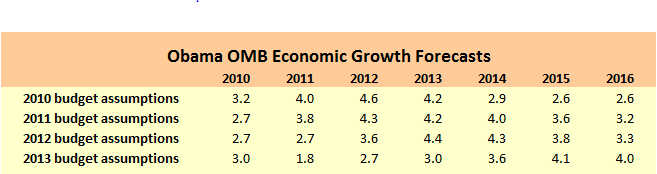
    One way to gauge the effectiveness of Obama’s interventionist policies is to compare the Office of Management and Budget real (inflation-adjusted), year-to-year growth assumptions embedded in Obama’s four budget documents. In nearly every instance, the result of Obama’s policies has been an economy that has under-performed expectations by a wide margin.
    Particularly instructive are the results for Fiscal Year 2011, which Obama assumed early in his administration would grow a robust 4.0%. But succeeding budgetary assumptions downgraded growth expectations to less than half that rate, to 1.8%, over three years. Likewise, the OMB has lowered growth assumptions for fiscal 2012 and 2013.

    But in the out years of 2015 and 2016, the fiscal forecasts get rosier than before on the basis of no known evidence or logic. Whereas the Obamanauts had assumed early in the administration that robust economic growth would taper off inย five or six years as the business cycle matured, such realistic thinking has largely disappeared. Now, for growth assumptions to prove accurate, one of the weakest business expansions in U.S. history will have to morph into one of the longest lasting. Good luck with that.

    Moreover, the optimistic growth numbers coincide with the expiration of the Bush-era tax cuts for the “rich” — millionaires, billionaires… and households making more than $250,000 a year. The projections areย predicated on the beliefs that (a) taxing the richย at a higher rateย will not induce them to shift more of their wealth into non-taxable assets, and (b) that unburdening the rich of their unjust share of the nation’s wealth will have no deliterious effects upon job creation and economic growth, with the result that (c)ย economic growth will continue unimpeded.

    Both suppositions are, I believe, incorrect, although I am fully aware thatย I will not persuade anyone who does not want toย be persuaded. Allย one can do is wait a few years, look back and see who was right and wrong… which I fully intend to do.

    If my analysis continues to prove correct, then budget deficits will greatly exceed the $7 trillion in Obama’s forecast over the next decade. Barring a seismic shift in spending patterns, the tax structure or economic growth rates, the United States will continue to rack up $1 trillion-a-year deficits for the foreseeable future. Inevitably, the United States will endure a financial crisis, either defaulting outright on its debt or engaging in its moral equivalent, the engineering of hyper-inflation. Either way, an economic catastrophe — a crash — will ensue, devastating job creation, tax revenues and the social safety net. That day is still years off, and Obama always can hope that the calamity will not take place on his watch. But it will come. Indeed, there is likely no reversing it now, regardless of which party controls Congress and the White House.

    For the record… There are two glimmers of light in the proposed 2013 budget. First, Obama continues to cut military spending and to reformulate a strategic doctrine aligned with smaller military resources. That is something that Republicans and conservatives are not willing to do, yet must be accomplished if there is any hope to balance the budget. Second, he actually proposes cuts to farm subsidies. Of course, farmers are doing better than most of the rest of us, so it’s high time they get off the dole. The proposed cuts are more of a no-brainer than an act of budgetary courage.ย But the solons in Washington typically quail before the farm lobby, so any sign of fiscal discipline, meager though it may be,ย should be celebrated.


  • Fraud a Minor Factor in Virginia Medicaid Spending

    A piece of good news on the government efficiency front: Medicaid fraud by recipients and providers cost the General Fun only $6.1 million in Fiscal 2009, according to a report published by the Joint Legislative Audit and Review Commission (JLARC).

    The less-than-g0od news is that payments to individuals improperly enrolled in Medicaid amounted to beween $18 million and $263 million, based on federal review of Virginia’s eligibility determination process. Assuming the real number lies between the two extremes, that’s a relatively small portion of Virginia’s Medicaid budget, which in fiscal 2011 was $7.2 billion.

    Still, any fraud is too much, and JLARC thinks performance can be improved. States the report: “Additional investments are needed to reduce future errors through improved State oversight of local departments of social services, modernized information technology, and provision of additional training to caseworkers.”

    — JAB


  • Shiny New Toy for Data Wonks

    Thanks to Virginia’s new longitudinal database, we can track the number of students graduating from Virginia high schools who proceed to higher education. A simple search on the Virginia Department of Education (DOE) website informs us that 62% of all students in the 2010-2011 cohort of high school grads enrolled in a two-year or four-year college within 16 months.

    We also know that females (66%) enrolled at a much higher rate than males (58%).ย And we know that Asians (76%) enrolled at a much higher rate than whites (65%), blacks (54%) and Hispanics (50%)… or evenย “Native Hawaiians,” all 105 of them, who enrolled at a 56% rate.

    We alsoย  find that 46% of “economically disadvantaged” high school grads sought higher education, while 49% of students with limited English proficiency did so.

    Moreover, the searchable database allows us to drill down to the level of school districts and individual schools. Thus, we discover that 63% of all Patrick County high school grads in Southside Virginia advanced to college-level learning compared to 74% of all Fairfax County students. We also find that the disparity narrows somewhat if we focus just on disadvantaged students. Fifty-one percent of disadvantaged Patrick County grads enroll, compared to 56% of disdvantaged Fairfax grads.

    Likewise, the database tells us that 87% of the graduates of the elite Thomas Jefferson High School for Science and Technology seek higher ed, while only 30% of those who graduate from Petersburg High School do so.

    This Postsecondary Enrollment Report gives just a taste of things to come. One day, integrated state databases will combine student standardized test scores, college graduation rates from Virginia institutions and some workforce history, allowing analysts to probe the effect of educational policy with greater depth and precision than ever before. One day, with luck, Virginians will be able to invest their multibillions in educational spending more wisely.

    — JAB


  • Citizens Asking Questions the Media Won’t

    Phase 1 Metro construction

    Writing in the Herndon Patch, Bob Bruhns has dug into the cost estimates for Phase 2 of the Rail-to-Dulles project and raises some interesting questions.

    Why, for example will it cost $235 million to build five parking decks containing 8,900 parking spaces, an average of $26,000 per space? That’s nearly twice the national average cost of $15,500 per space — even higher than the $20,000 cost per space in New York City!

    A metro station recently completed in Fairfield, Conn., not exactly a location with a low cost of doing business, cost $43.7 million — after cost overruns. Why will the comparable Rt. 28 station cost $83 million?

    Bruhns suggests that Virginians could be paying $350 million more than necessary just to build parking garages and Metro stations.

    Concludes Bruhns:

    So why did all of the official analysts miss this?ย  Did they even look at it at all?ย  And do our leaders not compare costs before accepting such incredibly expensive proposals?ย  What is going on here?ย  And what else will I find as I examine the rest of the line items?

    I love it! There’s a man who thinks just like I do. Bruhns asks great questions. Perhaps there are legitimate answers, and that’s fine. But someone needs to ask the questions just to make sure. If we don’t our public officials accountable, the people in charge will get lazy and sloppy.

    — JAB


  • Inside the Higher Ed Bubble

    Federal and state subsidies for this? Really?

    by James A. Bacon

    In their book, “Academically Adrift: Limited Learning on College Campuses,” Richard Arum and Josipa Roksa (a University of Virginia sociology professor) documented that large numbers of students were going to college “while experiencing few academic demands, investing limited effort in their academic endeavors and showing disturbingly low gains in academic performance as measured by the Collegiate Learning Assessment.”

    Now, joined by two other researchers, Arum and Roksa have published a follow-up report, “Documenting Uncertain Times: Post-graduate Transitions of the Academically Adrift Cohort.” In the report, they track what happens to college students who graduated “on time” (within six years) when they enter the job market. A college degree may be a credential that all employers value, but the study found that students with high College Learning Assessment (CLA) scores fared far better than those with low scores.

    Graduates who scored in the bottom quintile of the CLA were three times more likely to be unemployed than those who scored in the top quintile on the CLA (9.6 percent compared to 3.1 percent), twice as likely to be living at home (35 percent compared to 18 percent) and significantly more likely to have amassed credit card debt (51 percent compared to 37 percent).

    Graduates who displayed high academic engagement/growth in their undergraduate years were less likely to have credit card debt than graduates who exhibited low academic engagement/growth (38 percent compared to 56 percent).

    The report does not even touch upon the tens of thousands who start college and never earn a degree.

    What more evidence do we need to question the widely propagated idea that “everybody who wants to go to college should be allowed to,” or that the way to “build human capital” is just to send more kids to college regardless of their inclination or capability to perform college work?

    Tens of thousands of students and their parents are paying a very high price for an educational experience that teaches them very little. Not only are they saddling themselves with student loans, they incur an opportunity cost (money not earned) of attending classes when they could earning a paycheck and building skills in a field that doesn’t require a sheepskin.

    The college-is-for-everyone mania is a cruel hoax, plunging tens, maybe hundreds, of thousands of young people into indebtedness they may never be able to repay. Meanwhile, it threatens to create the next financial bubble (see “The Next Bubble: College Loans?“) that could lead to yet another bailout that the nation can ill afford. The magnitude of the disaster is only a tenth the size of the housing bubble, but it is no less demoralizing to its victims. How many of these government-spurred calamities must we endure before the politicians learn?


  • Get Your Paternity Questions Answered Now!

    by James A. Bacon

    I don’t know whether to laugh or weep. I recently heard a radio ad for Identigene, a home paternity testing kit. Apparently, not only are more women bearing children out of wedlock than ever before, they’re so friggin’ promiscuous they don’t even know who the father is!

    Hey, I came of age in the late 60s/early 70s during the relatively early stages of the sexual revolution. My contemporaries and I sometimes behaved in ways that our parents didn’t approve of. But at least we had moral standards. (Well, most of us did.) People had multiple sexual partners but they usually had them in serial monogamous relationships that involved a level of emotional commitment, however fleeting. But now, it seems, it is routine for young people to “hook up” in relationships that sever sex from emotional commitment entirely. People have taken to copulating like bonobos — quite often without the benefit of contraception.

    Sure, people have cheated on their mates since the dawn of time. Sure, uncertain paternity is not a new issue. But promiscuity was not so prevalent that a company could build a mass market business model around paternity testing!

    I love some of the Frequently Asked Questions on the Identigene website:

    • What if the alleged father is not available?
    • Can I add a second child or second alleged father to a paternity test?
    • I have multiple possible fathers but only one has agreed to the dna test. Can I do a paternity test with just one possible father?

    And my personal favorite (drumroll)….

    • What if two alleged fathers are related?

    Call me an old fogy — having just turned 59, I definitely qualify — but this is a serious sign of moral decay. I’m not saying it’s impossible to raise healthy children outside of a nuclear family — obviously many people manage to do so — but it’s a lot more difficult. Divorce is tough on children. But when parents divorce, most dads stick around to play a meaningful role in their children’s lives. If the parents never marry, dads are less likely to stick around, yet many do. But if the the father’s identity is unknown, he can play no role at all.

    I shudder to think how the next generation of Americans will turn out.