• Fuel Price Spike Hits Your Dominion Bill Next. Pow!

    by Steve Haner

    The typical Dominion Energy Virginia electric bill could rise another $22 this summer to cover the rising cost of the fuel it uses and the cost of its purchased power, according to the companyโ€™s latest filing on its fuel charge with the State Corporation Commission.

    The utilityโ€™s costs of fuel and purchased power are collected in a direct pass-through charge designated Rider A on bills, and for residential consumers it is one of the charges still visible on their monthly invoice. Right now, a consumer using 1,000 kilowatt hours per month is paying $29.68 for the current fuel charge and another $2.91 to slowly pay off the fuel cost spike that resulted from the war in Ukraine.

    Dominionโ€™s application projects its fuel costs for the 12 months beginning July 1 as $2.7 billion and seeks recovery of over $1 billion for the costs it did not anticipate during this current 12-month period. If collected all at once starting July 1 the charge for 1,000 kwh would reach $51.47 month, plus the $3 bucks in deferred costs.

    It wasnโ€™t that long ago that $50 a month would cover the whole electric bill in many households. At the beginning of 2026 here in Henrico a 1,000-kwh residential bill totaled $171.51, including the local taxes. The full fuel cost would be almost a 13 percent increase.

    It has been a busy time over at the SCC with Dominion filings. The only newspaper that even pretends to cover the SCC, the Richmond Times-Dispatch, chose to ignore the fuel filing and instead wrote this week about an SCC decision on solar customers who use net metering. Thatโ€™s about 65,000 customers. All 2.7 million Dominion customers care about the fuel charge, which is often an even larger portion of an industrial customer bill. 

    The media in Virginia is also still ignoring the flashing red warning light about the coming costs of compliance with the Regional Greenhouse Gas Initiative. The futures market price that was the basis of this Baconโ€™s Rebellion post, $41 per ton, started this morning instead at $52 per ton.

    (more…)

  • Adversarial Government Works Best

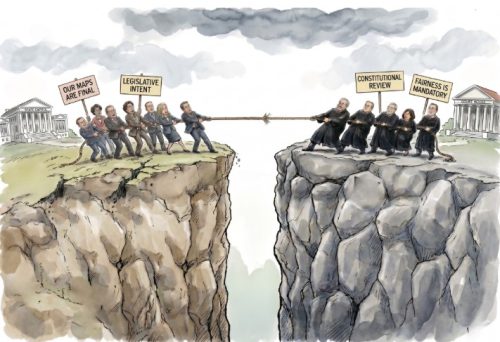
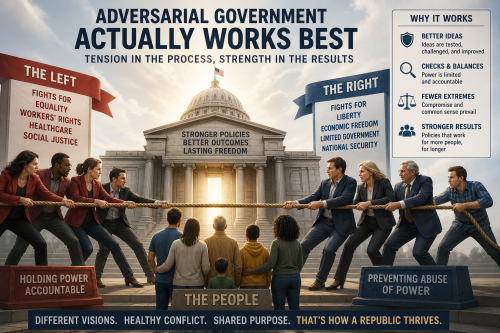
    A graphical representation contrasting the left and right perspectives in governance, depicting various stakeholders in a tug-of-war scenario, symbolizing accountability, social justice, and the balance of power in a democratic system.
    Image credit: ChatGPT

    by Chap Petersen

    A couple years ago, I wrote an essay entitled: “Single-Party Government Didn’t Work in the Soviet Union, and It’s Not Working in Fairfax County Either.”

    My goal was to point out the parallels in failing one-party systems.

    But frankly the points were too obvious. So I didn’t bother publishing it. Maybe I should have.

    The last couple weeks have been depressing. On April 21, Virginia voters by a narrow margin (3 points) approved a redistricting map which will create a “10-1” map for Democrats, by intentionally diluting the votes of rural white voters.

    A week later, the U.S. Supreme Court ruled that the 1989 Voting Rights Act violated the “Equal Protection” clause of the Fourteenth Amendment by requiring states to create “minority-majority” districts, whenever possible.

    The logic of the Supreme Court’s majority was unassailable: classifying voters based on race is inherently fraudulent, if not impossible in today’s America. (The  modern reality of mixed families defies the precepts of racial classification). The reality is a bit more complicated, however.

    With the striking down of the race-based districts, there is now an open invitation for Republican legislatures to redraw their maps, just like Virginia, and wipe out any Democratic-leaning seats, both in Congress and in state legislatures. It would make short-term partisan sense.

    But it is a terrible idea.

    (more…)

  • A Solution to the Threats to Medicaid in Virginia

    A Solution to the Threats to Medicaid in Virginia

    by James C. Sherlock

    Medicaid fraud is not a new issue, but it has exploded into the public consciousness as the Trump administration has taken action against it. Virtually every critique of Medicaid fraud, from both sides of the debate over how pervasive and costly it is and what to do about it, has been written from a Washington perspective. This article will offer a Virginia perspective. It is not a pretty one.

    As of early 2025, more than 1.7 million people are enrolled in Virginia Medicaid, including over 595,000 covered under the expansion guidelines. Mental health, substance use, home care, nursing home services, and support services for the intellectually and developmentally disabled are major sources of fraud nationwide and in Virginia.

    Medicaid, established in 1965, is a joint federal and state program fundamental to the health of the poor and disabled. It is rife with fraud because states that manage it have perverse incentives to police it, driven by the predominance of federal funding.

    Only a fundamental change in the funding mechanism will drive significant reductions in Medicaid fraud.

    (more…)


  • The Technological Republic and the Re-Industrialization of America

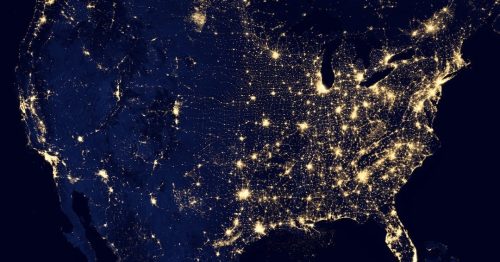
    Here’s a fact: the data center buildout is going to re-industrialize America. The sooner we embrace this reality; the sooner we reap the rewards.

    by Shaun Kenney

    A satellite image of the United States at night, showcasing illuminated city lights against a dark background.

    Data centers have arrived and itโ€™s about time they did โ€” and itโ€™s your fault, too.

    Well, not entirely your fault โ€” but if youโ€™re watching Netflix and Amazon Prime, using AI tools to generate images or research or God forbid grade term papers, youโ€™re in on the joke.

    โ€ฆand they are everywhere.

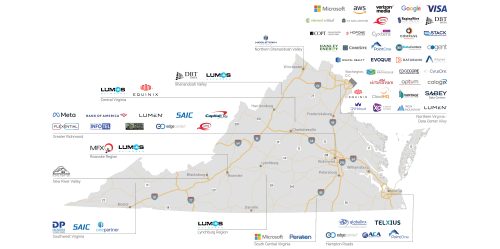
    Map of Virginia showing locations of various technology and telecommunications companies, including logos of firms such as Microsoft, Visa, and Equinix.
    Gratuitously stolen from The Virginia Mercury. source: VDEP

    Of course, organizations such as the Piedmont Environmental Council naturally takes their place in the constellation of groups that have questions, though it is difficult to tell if they oppose data centers per se or whether they oppose the present means by which data centers are changing the economy.

    One thing seems to be in agreement โ€” the internet of things is here to stay, the energy problem isnโ€™t as difficult to resolve as one might think, and the use of cool tech to cool the data centers is already here โ€” even if the ubiquity of small modular reactors (SMRs) are at best a decade away.

    Yet even if we wanted to go back to newspapers and the Res Publica Litterarum โ€” and I certainly would be in line to do so โ€” the fact of the matter is that artificial intelligence is going to be as serious a jump in technology as the automobile, the early internet, air conditioning, the steam engine, rural electrification, cell phone towers, public sanitation, and movable type.

    Itโ€™s happening โ€” the match will not be postponed.

    (more…)

  • Jeanine’s Memes

    A humorous depiction of three men standing together, with a caption discussing Alabama's student scores in math and English being higher than those in New York and California.

    View more memes at The Bull Elephant.


  • Coming Soon to a 2nd Grade Classroom Near You – Critical Whiteness

    Coming Soon to a 2nd Grade Classroom Near You – Critical Whiteness

    by James C. Sherlock

    Marx believed the economic system determines the nature of social, political, and intellectual life. ย The University of Virginia (Main Campus) School of Education and Human Development has established itself as a leader in Marxist thought in education. ย 

    This author thinks that Virginians will learn from that school’s “Critical Whiteness Study Group.ย  It is not helpful (nor perhaps possible) to summarize what these self-defined scholars have written, so it is quoted below.

    What is the Critical Whiteness Study Group?

    Basically, this book group is open for anyone to join our shared reading and critical discussions about disrupting white supremacy culture (e.g., racial hierarchy, white privilege, capitalism) at the root of the inequity. This is the first year of our grant funding, and we aim to meet monthly over the summer to discuss a book that addresses whiteness and disrupting white supremacy. At each meeting, we will vote on the next book to read together, beginning with Margaret Hagermanโ€™s 2018 book “White Kids: Growing Up with Privilege in a Racially Divided America,”ย which is a critical ethnography of ethnic-racial identity development in White, affluent children.

    Mission and Vision

    • To support emerging and established scholars committed to doing research that advances equity.
    • To deepen understanding of Critical Whiteness Studies through reading and discussion.
    • To critically examine existing research and literature that addresses white supremacy culture (e.g., How will we apply CWS to our research? ย What are the commitments/next steps of extending anti-racism from personal work to community action to empirical evidence? ย What are existing strategies for dismantling whiteness? And how do we research them? How does our research perpetuate or disrupt oppressive norms?).
    • To connect emerging and established scholars for potential future research collaborations.
    • To extend beyond our knowledge of individual, institutional, and systemic oppression toward research on how to address white supremacy culture.
    • To promote equitable climate at EHD and UVA by expanding the offering of equity-focused learning and collaboration opportunities.

    Well. ย What to take away?

    (more…)


  • The Source of All Evil: Data Centers!

    Jefferson Forum’s President Derrick Max puts out a Sunday morning summary that only some of you probably see, and I cannot really link to it for you. But today’s email had a useful and entertaining riff on the ongoing efforts to demonize Virginia’s data center industry, a clearly coordinated hit job from the left and its media allies.ย The following is useful to consider as the Democratic Trifecta in charge of Virginia continues to fight over how to (not whether, but how to) punish the data centers for their unforgiveable success in meeting market demands…

    14.) Data Centers donโ€™t damage schoolsThe Virginia Education Association, argues that the state’s aggressive tax incentives for data centers are draining vital resources from the K-12 education system by โ€œcostingโ€ $212 per student because of the schoolโ€™s loss of $267 million — their portion of the tax incentives granted to this industry. The authors fail to understand that data centers are one of the most significant positive revenue sources for Virginia localities. While the authors focused on the state sales tax exemption, they failed to understand that data centers contribute hundreds of millions to local budgets annually, which are the main funder of our schools. They also fail to understand that the revenue from data centers does not require expenditures for new schools and roads and other public services as data centers are a relatively low employment sector. The teacherโ€™s union also failed to mention the investment the data centers make to improve local power grids, roads, and fiber-optic networks, providing public benefits that would otherwise have to be funded by traditional taxpayers. Give it to the left, when they hate an industry, they can count on the teachers to do their bidding โ€“ even with false data if necessary.

    (more…)

  • “Death to America”

    The event was not registered as required by university policy. But Virginia Tech allowed it to proceed unimpeded at McBryde Hall, Room 202.

    (more…)

  • Bacon Meme of the Week

    Close-up of crispy bacon strips laid out on a surface with a humorous caption about needing a hug or bacon, featuring a container of Denny's Bacon Salt in the corner.

  • Classrooms or Campaigns?

    Virginia legislators have passed three bills this year to dilute and politicize history and civics instruction in public schools, accelerating the undeniable trend of indoctrination in the stateโ€™s public schools.

    by Stephanie Lundquist-Arora
    Published originally in IWFeatures

    Last week, a Fairfax County motherย saidย her twin 14-year-old sons were each encouraged by two publicย schoolย civics teachers to urge their parents to vote in favor of the stateโ€™s partisan gerrymandering referendum. According to the mother, the teachers used similar talking points, including urging a โ€œyesโ€ vote to make Virginiaโ€™s maps โ€œas fair as they can beโ€ and to โ€œstop [President] Donald Trump at all costs.โ€ย 

    Those teachers are likely satisfied with their efforts to disenfranchise Virginiaโ€™s conservative and independent voters. The measure ultimatelyย passedย by a 51.5% to 48.5% margin. In Fairfax County, 69.5% of voters voted โ€œyes,โ€ in favor ofย liberally colonizingย their southern neighbors. For now, the matter is in court, where multiple lawsuits are challenging the referendum as unconstitutional and unlawful.ย 

    Some families might have been shocked to hear that their public school teachers were behaving in such a blatantly partisan manner. Those of us in Fairfax County, however, are used to it. And the problem of inappropriate politicization in classrooms is likely to get worse with the Democratic Party controlling both the General Assembly and the governorโ€™s office. 

    In fact, state Democrats already have introduced three new laws to bolster activist teachersโ€™ efforts to indoctrinate public school students in leftist ideology. Beginning in academic year 2026-2027, for example, HB182 will permit students to substitute African American History courses for the World History I course or the World Geography course to satisfy history and social studies graduation requirements. 

    (more…)

  • No Kings…

    Except when they’re coming to visit. Then we love them.


  • Lawsuit Challenges Virginia’s Abortion Amendment as Deceptive

    Physicians are suing to block a ballot question they say conceals the true scope of the legislation.

    A pregnant woman in a striped long-sleeve shirt and black pants gently cradles her baby bump while standing against a plain background.

    by Victoria Manning

    A group of physicians and other medical professionals along with a local voter have filed a lawsuit challenging an abortion-related constitutional amendment on Virginiaโ€™s ballot this November. The complaint alleges that the ballot question adopted by the General Assembly fails to inform voters about significant and potentially harmful provisions in the adopted legislation.

    The amendment would overturn significant aspects of Virginia regulatory authority, including overturning parental consent requirements and abortion safety standards.

    The Founding Freedoms Law Center (FFLC) filed the suit on behalf of the plaintiffs, the Association of American Physicians and Surgeons, the Virginia Medical Freedom Alliance, and Meagan Kade, against the Virginia Department of Elections and others. The complaint alleges the ballot language fails to notify the voters of key aspects of the legislation.

    The actual ballot question says:

    Should the Constitution of Virginia be amended to (i) protect the freedom to make personal decisions about prenatal care, childbirth, postpartum care, birth control, abortion, miscarriage management, and fertility care; (ii) protect doctors, nurses, and patients from being punished for these decisions; and (iii) allow for restrictions on access to abortion during the third trimester of pregnancy except when the patientโ€™s health is at risk or the pregnancy cannot survive?

    The legal challenge alleges the ballot language โ€œprofoundly misleads by omission and misrepresentation.โ€

    (more…)

  • Natural Gas Dominates PJM’s Future Plans

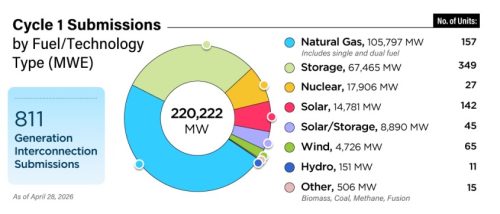
    Projects in the new PJM interconnection queue. From the PJM news release.

    by Steve Haner

    And the winner, again, is natural gas.  The 13-state PJM Interconnection regional electricity market announced this week that it has reopened its process for adding new generation and most of the new electrons are proposed to come from natural gas. 

    The news release reports 811 applications for future connection to the regional grid, with a total faceplate energy value of 220 gigawatts.ย Almost half of the faceplate energy output, 106 gigawatts, would come from natural gas plants if all the applications are approved and โ€“- the big if -โ€“ if all the plants get built.

    Nuclear projects around the region are the source of the second largest amount of new energy on the list, with about 18 gigawatts proposed.ย Only 15 gigawatts of solar projects made the list, supplemented by another 9 megawatts of solar combined with co-located battery storage.ย 

    (more…)

  • After the Vote, What’s Next for Virginia’s New Rigged Maps?

    by Ali Ahmad

    A political cartoon depicting two groups pulling on a rope across a chasm, representing a debate over legislative maps and constitutional review. One side holds signs stating 'Our maps are final' and 'Legislative intent,' while the other side displays 'Constitutional review' and 'Fairness is mandatory.'

    Between Friday March 6th and Tuesday April 21st, a narrow majority of Virginia voters went to the polls (or to their mailboxes) and voted in favor of the disenfranchisement of rural Virginia, as part of a national effort to make New York Representative Hakeem Jefferies the Speaker of the House next year.

    Of course, without shamefully deceptive ballot language and tens of millions of dollars of outside money, the vote easily could have gone the other way. And while itโ€™s over, it has yet to be certified, and when, or even if, that happens is an open question.

    Legal

    Monday April 27 saw the long-awaited oral arguments at the Supreme Court of Virginia (SCOVA) in Scott v. McDougle (named after the Democrat Speaker of the House and the Republican Senate Leader).

    I corresponded with Zachary Werrell, an attorney and author who is an expert in both Virginia law and politics. Werrell noted that both sides received tough questions and cautioned against reading too deeply into courtroom dynamics or trying to parse the intensity of the justiceโ€™s questions to each side.

    He did note, however, that both of the justices who did ask questions were โ€œlocked ontoโ€ two key issues:

    (more…)

  • Virginia Supremes Deny Emergency Appeal to Certify Gerrymander

    by Scott Dreyer

    On April 28, the State Supreme Court rejected an emergency appeal from Attorney General Jay Jones to certify the ballots from the April 21 yes/no gerrymandering election. This means, instead of the highย courtย now greenlightingย anย acceptance of the results from the controversial election, they will continue to deliberate before issuing their opinion, thus keeping the final result unknown for now.

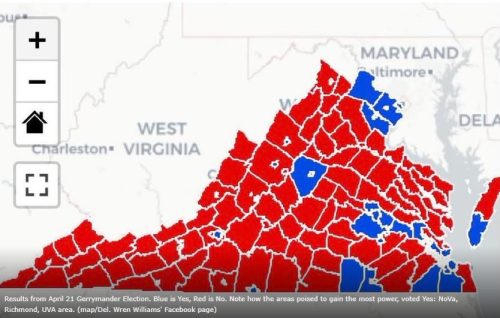
    As reported here, on April 21, a preponderance of late-reporting โ€œyesโ€ votes from Fairfax County pushed the โ€œyesโ€ side to victory, with a margin somewhat over 80,000.

    Map showing the results of the April 21 Gerrymander Election in Virginia, with blue counties indicating 'Yes' votes and red counties indicating 'No' votes.
    Results from April 21 Gerrymander Election. Blue is Yes, Red is No. Note how the areas poised to gain the most power, voted Yes: NoVa, Richmond, UVA area. (map/Del. Wren Williamsโ€™ Facebook page)

    However, on April 22, Judge Jack Hurley in Tazewell County issued an injunction banning the state from certifying the ballots. In the case he heard,ย RNC v. Koski, Hurley objected to what he described as the “biased” wording of the ballot question as well as state laws theย โ€œyesโ€ย side broke to bring the issue to a vote. (In contrast to many other Roanoke-area media outlets that gave scant or zero coverage to Judgeย Hurleyโ€™sย ruling,ย The Roanoke Starย covered the important storyย here.)

    (more…)