
by Scott Dreyer
On April 28, the State Supreme Court rejected an emergency appeal from Attorney General Jay Jones to certify the ballots from the April 21 yes/no gerrymandering election. This means, instead of the high court now greenlighting an acceptance of the results from the controversial election, they will continue to deliberate before issuing their opinion, thus keeping the final result unknown for now.
As reported here, on April 21, a preponderance of late-reporting “yes” votes from Fairfax County pushed the “yes” side to victory, with a margin somewhat over 80,000.
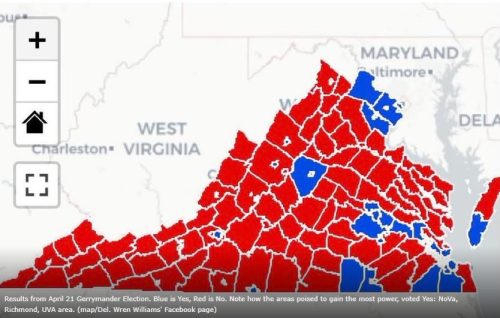
However, on April 22, Judge Jack Hurley in Tazewell County issued an injunction banning the state from certifying the ballots. In the case he heard, RNC v. Koski, Hurley objected to what he described as the “biased” wording of the ballot question as well as state laws the “yes” side broke to bring the issue to a vote. (In contrast to many other Roanoke-area media outlets that gave scant or zero coverage to Judge Hurley’s ruling, The Roanoke Star covered the important story here.)
Responding to Judge Hurley’s injunction, the State Supreme Court began hearing oral arguments from both the “yes” and “no” sides on April 27. Time is short, because at issue are the lines for Virginia’s 11 Congressional districts. Early voting for those elections begins in September.
Some court observers thought the justices’ April 27 questioning showed skepticism for the position of the “yes” side.
Attorney General Jay Jones (D), who made national headlines last October when his scandalous texts were released, in which he had fantasized about the murder of a GOP lawmaker and his two young sons, used his position as Virginia’s attorney to make an emergency appeal to the State Supreme Court to certify the election.
Certifying the election would mean both the voting and the results are legitimate, and Virginia would have new Congressional maps for the fall election. Using classical gerrymandering techniques, the new maps are designed to create 10 Democrats seats and only one Republican seat.
Delegate Wren Williams (R-Stuart) posted this to his Twitter/X account on April 28:
“BREAKING: The Supreme Court of Virginia has denied the Attorney General’s Motion for Emergency Stay in RNC v. Koski – the one where he didn’t quote the ballot language.
“One sentence. No dissent. No partial relief.
“‘Upon consideration whereof, the Court denies the motion.‘
“What this means in plain terms:
“Jay Jones’ outside counsel from California asked the Court to allow the election process to proceed pending the rulings on the merits of the gerrymandering cases.
“The Court said ‘no.‘ This stops the election from being certified for now.
“The same Supreme Court that allowed the referendum to go forward in March, so voters could be heard, has now declined to override a final judgment finding the constitutional amendment process defective. Strong signal that process matters in Virginia.
“The Attorney General asked the Court of Virginia to set aside a final order that exposed a ballot question he would not quote, an Article XII timeline he had to redefine, and a 1912 case that did not say what he needed it to say.
“The Supreme Court said ‘no.‘
“The merits appeal continues. I will keep you posted as this develops.“
Due to the importance of this matter and the fact that Congressional districts must be clearly defined long before voting for the 2026 midterms begins in September, it is widely believed the State Supreme Court will issue its opinion sometime in May.
The April 28 letter from the State Supreme Court denying the emergency request can be viewed here.
Roanoke resident Scott Dreyer leads a team of educators teaching English and ESL to a global audience. This article is republished with permission from The Roanoke Star.
Leave a Reply
You must be logged in to post a comment.