
by Steve Haner
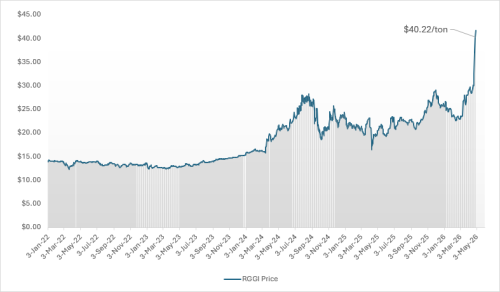
Virginia’s impending return to the Regional Greenhouse Gas Initiative (RGGI) has driven up the price for carbon credits in the multistate cap-and-trade system’s secondary market. The futures price exceeded $41 per ton this morning, far above the roughly $25 per ton that utilities had to pay in the March 2026 auction.
It reflects the widespread expectation that Virginia electricity generators will be needing to buy far more allowances than Virginia will have available to sell, so they will be competing for allowances sold by the other ten states within the compact. High demand and short supply mean higher prices.
The next carbon allowance auction, and the first to include all the Virginia power plants as bidders, will be held in June, just weeks before the revised RGGI regulation takes effect in Virginia. As the General Assembly commanded, the final regulation was rushed through without any public input and has now been signed by Governor Abigail Spanberger (D).
The information page on the Virginia Regulatory Town Hall website includes a three-paragraph economic impact statement that says absolutely nothing about economics or ratepayer impact. It’s a whitewash. The Governor’s Review Memo, dated April 24, is just one word: Approved.
Virginia will have 11.5 million carbon allowances to sell in the final six months (two auctions) of 2026. At the price set in the March auction, that will reap the state treasury about $288 million by the end of the calendar year. But a $40 per ton auction outcome would yield $460 million in six months and points to almost $1 billion in potential annual tax receipts in future years.
Some key points:
First, the regulation just adopted will be obsolete after this year. The other states, while Virginia was away, adopted many changes for the three-year “control period” that begins in January 2027. Virginia will need a new regulation to reflect those.
It would be a travesty if the Spanberger Administration and the Department of Environmental Quality run the same accelerated regulatory railroad job a second time. For the new control period, there should be full regulatory process open to public comment. The legislative mandate to skip all that should only be read as applying to this contract period.
Second, Virginia should recognize it has some leverage as it returns to RGGI and it could negotiate for a larger amount of allowances within the overall total for the 11-state region. In the regulation just adopted, the state projects a shrinking total of allowances for the three years: roughly 22 million in 2027, 21 million in 2028 and 20 million in 2029.
As reported previously on Bacon’s Rebellion, the electricity generators in Virginia that now must buy allowances emitted more than 29 million tons of carbon dioxide in 2025. Much of the money – ratepayer money – they will now spend on carbon taxes will accrue to the other states within RGGI unless Virginia secures more credits. It could also demand more of the “cost containment reserve” allowances divided among the states.
Third, and this is a new point gentle readers, the carbon tax paid by the utilities is not the only way RGGI increases our electricity costs most days. RGGI was costing us money even while Virginia was out of it. Only some of the states within the PJM Interconnection regional electricity market are also part of RGGI, but the RGGI tax they must pay in those states often drives up electricity prices in all of PJM.
It is complicated how this works, but here is a simplified version. For a utility in PJM’s daily energy market, the price it pays for electricity each day or even a given hour within its PJM zone is set by the most expensive generator that PJM has approved to feed the grid. If that most expensive operator is an RGGI-compliant plant, it dictates the marginal price paid to all generators in that zone. And often utilities are buying power from other zones, again paying a higher price because of the carbon tax.
If indeed the carbon auction price of a ton of CO2 reaches the $40 level, that adds about $20 per megawatt hour to the price that generator must demand from PJM. When a solar or wind plant is producing actively, with its low operating cost, the PJM marginal prices it receives (driven up by RGGI paid by a gas or coal plant) are truly a bonanza for its owners. This is another reason they are so in love with RGGI.
If you thought that the fact the sunlight was free meant you paid less for solar power, you were wrong. The PJM kilowatt from the solar plant costs you the same as the PJM kilowatt from the most expensive coal or gas plant. Solar plants are never the only ones producing so they don’t set the marginal price. And the top marginal cost will more likely come from a RGGI paying state now that Virginia is back into the tax scheme.
So, to the possible $1 billion per year Virginia’s electricity generators – and thus its ratepayers – will be paying into the state for carbon credits in 2027 and beyond, add about another $1 billion in electricity costs due to higher PJM marginal and spot pricing on non-RGGI covered power. Again, the math is complicated and the exact numbers elusive, but the basic truth of this is irrefutable.
Increasing the price of electricity is what RGGI was designed to do. Remember, the RGGI carbon tax was less than $6 per ton when Virginia’s Democrats voted to join in 2020, and only $7.60 per ton during Virginia’s first auction in 2021. Just five years later the cost is flirting with $40 per ton. None of this is an accident and none of it surprises the advocates.
They simply never told you the truth.
Leave a Reply
You must be logged in to post a comment.