• Hey, Uber, Over Here! Over Here!

    Dara Khosrowshahi. Photo credit: Fortune

    So, Uber decides to use Washington, D.C., as a test bed for its vision for urban mobility. CEO Dara Khosrowshahi visited Washington Wednesday to publicize company plans to expand its ride-hailing app so customers can access and pay for bike share, car rentals from private car owners, and eventually mass transit.

    And what does Washington do? Mayor Muriel E. Bowser has proposed increasing the gross receipt tax on ride-hailing companies from 1% to 4.75%. The tax revenue would pay for about 10% of Washington’s $178.5 million share of increased funding for Washington Metro. (Virginia and Maryland and providing the balance — without taxing Uber.)

    Interesting economic development strategy Bowser has there: Tax businesses in the growing innovation economy to subsidize enterprises in the stagnant, money-losing old economy.

    Uber’s idea is potentially so transformative that slapping $18 million added tax on the ride-hailing industry may not prove debilitating. (Not for Uber anyway. I’m less sanguine about its weaker competitors.) But one thing we can say for sure: The tax will not accelerate Washington’s evolution toward the transportation future.

    “What we want to make sure is that you’re not taxing one form of shared transportation for another form of shared transportation,” Khowrowshahi said in a public meeting with Bowser, reports the Washington Post. “We’re in this to promote shared transportation in general. We want to make sure that proposals like this are not unconstructive to that goal.”

    City officials, notes the Post, say the ride-hailing services have benefited from Metro’s problems so it’s only fair that they be part of the solution.


    Bacon’s bottom line: Hey, Uber, come look at Virginia — we won’t tax you!

    Your one-stop-transportation-shopping app sounds like a fantastic idea. I can hardly wait until you develop AI that allows people to map multimodal trips integrating everything from walking and biking to gypsy vans and buses to hour-long car rentals. I’m eagerly waiting for a full range of transportation services at varying levels of convenience, comfort and price. If you put a few money-losing public mass-transit enterprises out of business, I won’t have a problem with that. I’d love to put an end to the drain on taxpayers. Likewise, if you force public enterprises to adapt by cutting costs and becoming more responsive to customers, I’m totally cool with that, too!

    I regard Bowser’s logic — Uber is part of Metro’s problem, therefore you should be taxed to help fix it — as wildly illogical. You should be allowed to compete on a level playing field with all other transportation business models. I hope you understand, however, that does include paying your fair share of the cost of maintaining and building the road and highway infrastructure that you rely upon. Who knows, you might end up paying more in taxes that way. But at least you wouldn’t be subsidizing the competition.

    One more thing, Virginia has localities that would love to cooperate with you. Take Virginia Beach. The resort city has plans for development of its waterfront that include a drop-off zone for ride-hailing services. How cool is that? If cities can provide drop-off zones for buses — typically referred to as bus stops — why not drop-off zones for ride-hailing services? That’s something that municipalities can do at next-to-no cost.

    Here in Virginia, we want to accelerate the development of a 21st century model for transportation, not tax it. Use us as a test bed. Please!
  • Put-up-or-Shut-up Time for the Sun Spot Theory

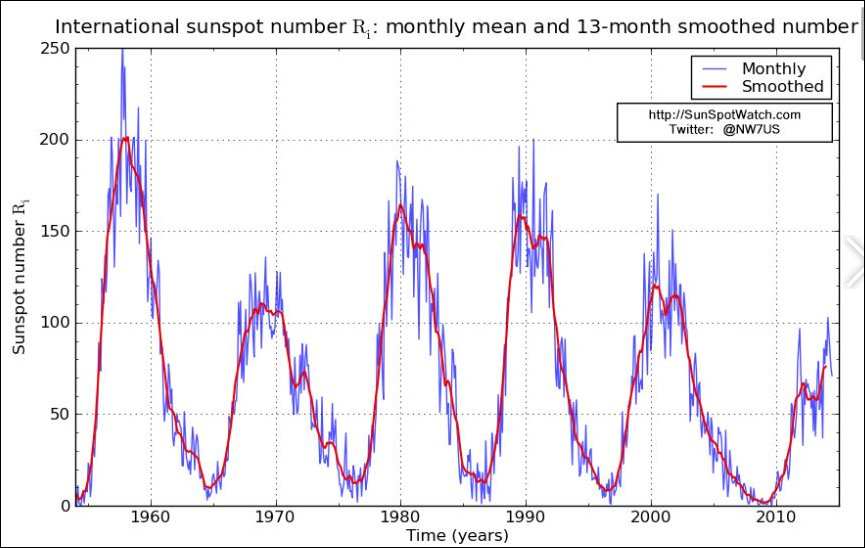
    Recent sun spot cycles. The last time the sunspot cycle was almost as weak as the current one was in the 1970s, a period of declining global temperatures that prompted widespread concerns of a new ice age. Image credit: sunspotwatch.com

    I have frequently expressed skepticism of dire Global Warming scenarios by noting that the increase in global temperatures over the past 20 years fits the lowest range of forecasts made by the climate models. Sorry, folks, I just can’t get exercised about warming-generated calamities, no matter how many after-the-fact justifications are proffered to explain the failure of reality to conform with theory.

    On the other side, the anti-Global Warming crowd has advanced an alternative explanation for climate change. The extreme skeptics suggest that solar activity — sun spots, or the lack of them — have a far greater influence on earth’s climate than the level of CO2 in the atmosphere. According to this theory, solar radiation interacts with the earth’s magnetosphere to block cosmic radiation from penetrating to the atmosphere and seeding cloud formation. Boiling the argument down to its essence, more sun spots predict higher temperatures on earth, fewer sun spots predict lower temperatures. We may have reached put-up-or-shut-up time for that theory as well.

    The skeptics are getting excited now because the incidence of sun spots is crashing. Indeed, sun spots have almost disappeared. The last time the sun exhibited similar characteristics was in the 1600s, the so-called Maunder Minimum which coincided with a decline in global temperatures known to history as the Little Ice Age. If the solar warming rejectionists are correct, “global warming” could disappear in a hurry.

    Writes Robert Zimmerman with the Global Warming Policy Forum:

    If the solar minimum has actually arrived now, this would make this cycle only ten years long, one of the shortest solar cycles on record. More important, it is a weak cycle. In the past,ย allย short cycles were active cycles. This is the first time we have seen a shortย andย weak cycle since scientists began tracking the solar cycle in the 1700s, following the last grand minimum in the 1600s when there were almost no sunspots.

    If the planet is entering a new solar minimum, the theory would predict falling temperatures. Perhaps not immediately — there may be buffering effects that aren’t well understood — but in not too many years.

    Here’s the nice thing about the sun-spot theory: It’s a testable hypothesis. The theory states in no-uncertain terms that solar radiation as measured by sun spots is a key driver of earth’s climate. The theory says that cycles in earth’s temperatures closely match cycles in sun spot activity. We appear to be entering a phase in which sun spots are going dormant. Temperatures should drop — not just for a year or two but in a sustained matter. We should be able to confirm or disprove the sun-spot hypothesis within a few years.

    If the sun-spot hypothesis is confirmed by the data and we see a decisive shift in temperature trends, the theory that posits CO2 as the driving climate variable will be dashed. Conversely, if the sun-spot modelย  is proven incorrect, a lot of moderate Global Warming skeptics (like me) will be more receptive to the CO2 model — although it still has to explain the two-decade-long pause. (“Pause” is not quite the right word. Global temperatures have crept higher. They just haven’t conformed to predictions.)

    Perhaps I’m being naive to think that reality will settle the debate. Reality has a way of being frustratingly complex and ambiguous, and zealots are endlessly creative at devising fallback theories. We didn’t account for the effect of increased particulates in the atmosphere. Or temperatures didn’t rise as expected because the missing heat is lurking undetected deep in the ocean.ย 

    The stakes of this scientific debate are huge. Climate change advocates want to de-carbonize the economy in order to fight what they fear is runaway and calamitous global warming. That means converting motor vehicles to electricity, and it means converting electric power generation to renewable sources. Market forces are pushing the electric power industry toward renewables — especially solar here in Virginia — but not rapidly enough to suit the warmists. The next big debate is whether Virginia should join the Global Greenhouse Gas Initiative a cap-and-trade regime to squeeze out electric-power carbon emissions. Ancillary debates are occurring on how Hampton Roads should deal with the rising sea levels expected to accompany the higher temperatures.

    Here’s another hypothesis: The urgency of combating global warming is a driving force behind the insistence of the social engineers to restructure the economy. If global temperatures cool, that sense of urgency will diminish. Hard-core believers won’t change their minds, but the general public will. Conversely, if temperatures rise in the face of a new sun spot minimum, the warmists will be vindicated.


  • About those Student Loan Default Rates…

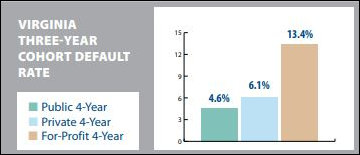
    The distinction of having the highest student-loan default rate of any higher-education institution in Virginia goes to Everest College in Chesapeake. The default rate at the for-profit college (now doing business as Altierus Career College), which prepares students to be dental assistants, HVAC technicians and the like, is 36%, reports WVTF Radio IQ.

    In absolute numbers, non-profit Liberty University took the top spot. A 10% default rate translated into 2,903 students.

    The highest default rates tend to be small, for-profit vocational schools. Although the Radio IQ data doesn’t show it, some public colleges have a fairly high default rate as well. Low-income students are disproportionately likely to drop out of college — whatever the institution — and find themselves unable (or unwillling) to repay their loans.

    Many progressives purport to be concerned about minorities and the high default rate blame for-profit colleges. The Radio IQ article quotes Dianeย Standaert with the Center for Responsible Lending (CRL) as noting that many for-profits are converting into non-profits to avoid state and federal regulations aimed at curbing “abusive practices.”

    Acccording to CRL’s Virginia state profile, for-profit colleges disproportionately harm: low-income families, communities of color, and women.” Undergraduate enrollment at for-profits is 54% low-income, 45.4% African-American, and 60.9% female.ย Students at for-profit institutions in Virginia are less likely to graduate, more likely to take out student loans and graduate more indebted, and are more likely to default on their college debt, according to CRL.

    What this analysis ignores is that there is considerable variability in the default rate for for-profit, private non-profit, and public non-profit institutions. The best for-profit institutions have lower default rates than the worst non-profits. Public institutions such as Norfolk State and Virginia Union University that cater to lower-income African-Americans have default rates comparable to many for-profits. Conversely, the for-profits cater to adult African-Americans — look at their television ads if you doubt me — who didn’t get a chance to attend college immediately after high school but, as adults, would like to advance their career and obtain a better job.

    If mean ol’ fiscal conservatives wanted to shut down for-profit institutions with high default rates on the grounds that they were costing taxpayers, some progressive group would describe the disproportionate impact on upwardly striving African-Americans as racist. But the impetus for shutting down for-profits isn’t coming from the Right. It’s coming from the Left, hostile as always to the idea of someone somewhere making a profit.

    The real problem isn’t whether an institution is for-profit or non-profit, it’s the fact that the federal government hands out student loans indiscriminately. Federal loans are not granted on the basis of a student’s likelihood to repay, whether based on SAT scores, class standing, credit score, years in the workforce or any other relevant factor. Why? Because objective lending criteria might impact minorities more than whites, which would constitute a different type of discrimination and invoke the inevitable cries of racism.

    So, if you think with a leftist mindset, instead of insisting that the federal government establish standards to reduce the number of students defaulting on their debt, which would be racist, you attack for-profit institutions… even thought, by leftist standards, limiting educational opportunities for minorities by this indirect means also could be construed as racist. But if you think with a leftist mindset, that’s OK because you’re suspicious of for-profit enterprises anyway. Furthermore, you control the commanding heights that shape public opinion formulation — the media, academia, the educational bureaucracy — so you have the power to frame the issue the way you want.

    That, folks, is democracy at work in America today.


  • Subsidies for Thee, but Not for Me

    Jamestown Settlement — tax thyself!

    The economy of the Historic Triangle — Williamsburg, Yorktown and Jamestown — depends heavily upon heritage tourism. Visitor spending reached $1.08 billionand employed 11,000 workers in 2012, according to one report. But last year tourism and hospitality officials were complaining that growth had stagnated.

    So, what do you do to boost the region’s No. 1 industry?

    Raise taxes, of course. This year the General Assembly passed a bill backed by Senate Majority Leader Tommy Norment, R-James City County, to impose a 1 percentage point surcharge on the sales tax to raise revenue to be split equally between a new effort to rekindle Historical Triangle tourism and the three Triangle localities of Williamsburg, James City County and York County, reports the Daily Press. Williamsburg would use the funds to roll back the admissions tax and hotel and meals taxes it approved last year.

    Sen. Monty Mason, D-Williamsburg, had opposed the tax all along on the grounds that it impacted poor people the most. After the bill sat on the desk of Governor Ralph Northam for three weeks, he prevailed upon Norment to amend the tax. The revised version would exempt the sales tax on food and add a $2-a-night hotel surcharge to recoup the lost revenue.

    โ€œI think this could be transformational,โ€ Norment said.

    Bacon’s bottom line: I don’t normally agree with Democratic Party politicians, but Mason is absolutely right about this. It’s one thing to tax hotels and restaurants, as Virginia Beach does, to raise funds to pour into marketing, promotion and infrastructure building. Although local residents do pay more for eating out, the tax is largely paid by the industry itself. But levying a sales tax on the general populace to benefit the industry is quite another thing. Such a tax would indeed impact the poor, who spend a disproportionate share of their incomes on food — not eating at restaurants but food purchased at grocery stores.

    The workforce of Williamsburg, York and James City is about 70,000. In other words, five out of six people do not work in the hospitality industry. Undoubtedly some businesses provide goods and services to the sector, thus benefiting indirectly from its presence, but major employers like the College of William & Mary and the Anheuser-Busch brewery do not. The tax would represent a massive subsidy for the tourism sector at the expense of everyone else.

    Don’t get me wrong — I personally love heritage tourism. I love visiting Colonial Williamsburg. But is that really the future that Triangle localities want to build for themselves? William & Mary, one of the highest regarded public universities in the country is located there. The Kingsmill Resort, which caters to affluent retirees, is located there. NASA Langley and Thomas Jefferson National Accelerator are located a few miles down Interstate 64. For $25 million a year, the community can’t come up with any better economic development initiative than promoting tourism?

    As the dominant industry, the tourism sector is converting its political clout into public subsidies in order to perpetuate, even increase, its dominance. While a 1% sales tax surcharge might not seem like a lot, it will have a small dampening effect on economic activity not related to tourism. For example, the surcharge could encourageย affluent retirees to select somewhere else to settle down and spend their money, thus impacting Kingsmill Resort-like development in the future and driving away citizens who pay lots in taxes but demand little in the way of government services.

    I’m all in favor of not damaging your existing industry by refraining from enacting burdensome regulations and taxes. But if you want to nudge your community into the innovation-driven Knowledge Economy, you don’t do it by taxing the new economy to subsidize the old economy.


  • Map of the Day: Changes in Probability of Death

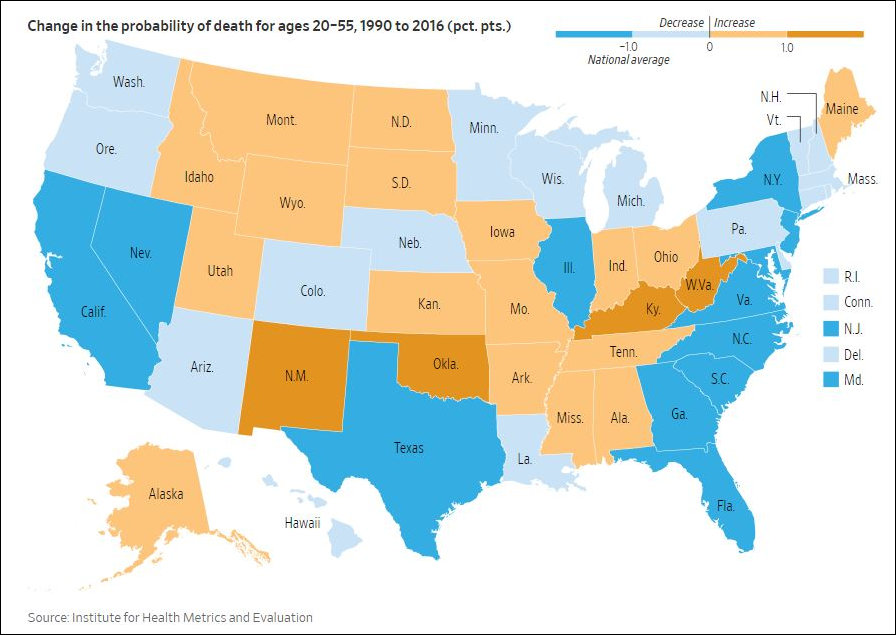
    Map source: Wall Street Journal

    It’s not new news anymore that gains in life expectancy have leveled off in the United States, driven by startling and unexpected declines among young and middle-aged whites. The so-called “deaths of despair,” including drug overdoses, are on the rise. So are liver disease (associated with alcoholism) and suicides. Chronic diseases associated with obesity such as diabetes, heart disease, and stroke are up, too.

    The map above shows changes in the probability of death among 20- to 50-year-olds in the 50 states between 1990 and 2016. There is a remarkable divergence — health for this age group has improved significantly for some states, including Virginia, and gotten worse for others.

    A breakdown by county in Virginia would be revealing. I hypothesize that western Virginia, especially the far Southwest, would show patterns similar to neighboring West Virginia and Kentucky. Although a more granular look at the data might reveal a different pattern, it appears that Central Appalachia is ground zero for deaths of despair.


  • NAEP Results Are In. No Answers to Important Questions.

    Source: National Assessment of Educational Progress

    There is some mildly good news for Virginia from the latest National Assessment of Educational Progress (NAEP) tests, commonly called the Nation’s Report Card. Virginia 4th graders improved their performance in mathematics, while 8th graders made incremental gains in both math and reading.ย Virginia students also maintained a significant edge over their peers nationally in math and reading in both grades.

    “For the first time, 50 percent of Virginia fourth graders achieved at or above the proficient level in mathematics, with 12 percent earning advanced scores,” states the Virginia Department of Education press release. “Students in no other state performed at a statistically higher level.”

    NAEP results are based on representative samples of students in each state. The 2017 NAEP sampling of Virginia students included approximately 2,300 fourth-grade students and 2,200 eighth graders.

    As is their wont, state officials took note of “achievement gaps between white students and their black and Hispanic peers.” The press release elaborates: “The percentage of black eighth graders achieving proficient or advanced math scores increased by eight points, to 20 percent in 2017, compared with 12 percent in 2015. While this represented a significant gain for black students, the improvement did not translate into a statistically significant narrowing of the achievement gap with white students.”

    No mention of Asian students who comprise 8% of Virginia’s population. Why would that be? Perhaps the answer can be seen in the charts atop this page. There we can see that Asian/Pacific Islanders (which in Virginia means Asians because there aren’t many Pacific Islanders here) achieved the top scores. Thus, the “achievement” gap can also be seen as an Asian-white achievement gap, an Asian-black achievement gap, and an Asian-Hispanic achievement gap.

    Why do state officials make whites the standard against which blacks and Hispanics measured? In order to advance the dominant narrative about race, of course. Setting Asians as the standard for comparison would confound the conventional wisdom. Perhaps Virginians would be compelled to ask why Asians out-perform other ethnic groups, including “privileged” whites. We would have to ask ourselves, do Asians attend better schools… or do they tend to out-perform in all schools? Don’t they face discrimination? If not, why not? Why are they disciplined at lower rates than other groups, including whites? Are they less likely to be disruptive in class? Do they study harder?

    Setting Asians as the standard against which others are measured would force us to consider the role of intact families, personal behavior, and cultural norms and expectations rather than view racial/ethnic disparities through the lens of white privilege and minority oppression.

    The focus on the white-black/Hispanic gap also conveniently ignores the English-fluent/English-as-a-second-language gap. For example, according to NAEP data, the score gap between 4th grade whites and Hispanics is 23 points. But the gap between English-fluent and English-as-a-second-language students is 36 points. Given the fact that Hispanics are more likely to not be English fluent, facility with the English language likely explains much of the white-Hispanic gap.

    How much of the gap disappears when you compare whites with English-fluent Hispanics? How much of the broader white-Hispanic gap should be attributed to white privilege and how much should be attributed to the influx of poor, ill-educated immigrants from Mexico and Central America who have an immense amount of catching up to do? That question never gets asked.

    Unfortunately, the searchable NAEP database does not allow us to make that comparison. What a surprise. I guess it never occurred to NAEP officials that such a comparison would be worthwhile. It would be nice if state educators would get over their black/white obsession and begin asking a wider range of questions.


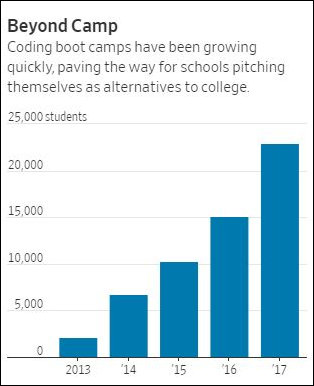
  • Alternatives to Traditional Colleges Are Spreading

    Image source: Wall Street Journal

    Last year Aidan Cary, a bright high school student in Hampton, applied to the University of Virginia and other prestigious universities in the Northeast. But he ended up attending a nearly unknown institution, MissionU, for a very different kind of educational experience.

    At MissionU, based in San Francisco, he is enrolled in a one-year, data-science program. He studies between 40 and 50 hours per week and visits high-tech companies in the Bay area as part of the educational experience. And he pays nothing up front. Instead he will repay MissionU with 15% of his salary for three years once he lands a job paying $50,000 or more.

    As the Wall Street Journal writes, MissionU is part of a broader movement toward an alternate model of higher education:

    A new breed of longer programs such as MissionU has begun to pop up. In California the Holberton School and the โ€œ42โ€ program recently opened, and in Indianapolis the Kenzie Academy has begun its second class. While they remain focused on digital skills, they also add a smattering of general education coursesโ€”in areas like problem solving and teamworkโ€”and market themselves as college alternatives.

    โ€œThe degree is dead. You need experience,โ€ says the website for Praxis, a five-year-old digital school based in South Carolina.

    These new-breed institutions represent a new challenge for traditional four-year institutions of higher education. Unlike private career schools, MissionU, Praxis, and the Kenzie Academy aren’t targeting an adult population seeking workforce degrees and certifications — they’re targeting youngsters like Cary who would have gone straight from high school to college.

    The value proposition is huge: You investย only one year of your life studying before you enter the workforce. The year of intensive study costs as little as $22,500 spread over three years, and only if you make a job paying $50,000 or more. If the program costs you more, it’s only because you’re making more. Plus, the colleges practically guarantee you a job at the end of the line. Cary figures he will come out $250,000 ahead compared to the traditional route.

    And what do students lose compared to the traditional four-year, residential college experience? Well, they’re actually expected to work 40 to 50 hours a week, which may preclude a fair amount of partying and goofing off.

    They also don’t get an accredited degree. But sheepskins are mainly valuable for signalling to the job market that someone is intelligent enough, diligent enough, and conformist enough to endure the four-year degree-earning process. Instead, Cary will earn a skill in great demand that will land him a job in a technology company, most likely in the Bay area. Once he enters the workplace, the sheepskin credential becomes superfluous — from then on, he’ll be judged by his job performance.

    He’ll lose one more thing.ย While alternative colleges can teach a person how to work, they donโ€™t teach their students why they are working, the Journal quotes Gardner Campbell, an English professor at Virginia Commonwealth University as saying. Without that context, he says, graduates of MissionU-like programs run the risk of becoming well-paid drones.

    Ah, poor Mr. Cary will miss the value provided by the vaunted liberal arts curriculum. He can console himself that most graduates forget the vast majority of what they studied within a few years. Also, if Cary’s parents are like many others who find traditional universities to be teaching not the “liberal” arts but the “politically correct” arts, they may be perfectly happy to spare their child a learning experience increasingly resembling an indoctrination camp than an institution encouraging wide-ranging exploration of thought.

    Can these alternative institutions be replicated, or do they cater to a narrow slice of elite students? After all MissionU is highly selective — its acceptance rate is in the single digits, comparable to an Ivy League school. Caryย scored in the top 5% of the country on his SAT and graduated in the top 10% of his high school class.ย 

    As long as critical skills are going begging in the workplace, I see no reason why these “alternative colleges” can’t proliferate. They offer a fantastic value proposition compared to the four-year college. The only real barrier is the brain-dead preference of H.R. offices for the credential of a four-year degree. But I expect that employers’ desperation to hire employees with critical job skills will overcome that prejudice.

    Traditional higher-ed institutions don’t comprehend the degree of animosity they have engendered in the marketplace. First, they have made college nearly unaffordable for the middle class. Second, they have created learning and cultural environments that are ideologically hostile to roughly half the population. Their value proposition has become “Give us your children so we can indoctrinate them with alien values, and by the way, give us all your money.”

    That’s not a viable long-term business model.


  • How Coal Saved the Grid in January

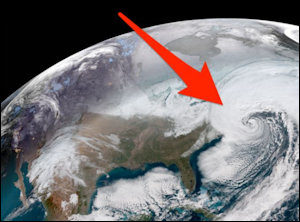
    The 2017-18 Bomb Cyclone

    The twelve days between Dec. 27, 2017, and Jan. 8 this year saw one of the longest and most intense deep freezes ever recorded for the East Coast. Snow, ice and frigid temperatures plunged much of the United States into winter misery for a seemingly endless period.

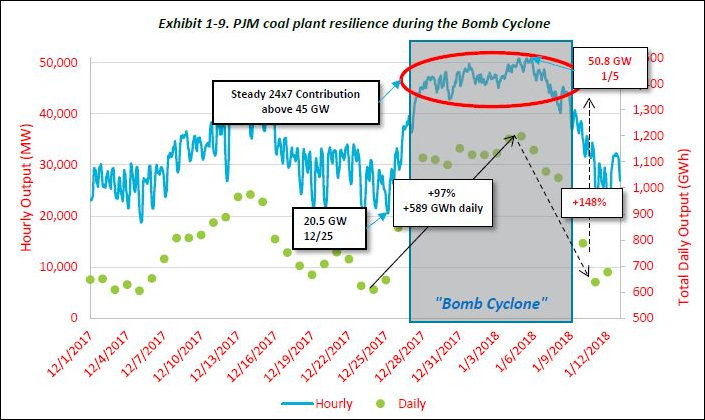
    The so-called “bomb cyclone” also put the East Coast electric grid under intense stress. The period of Jan. 4-6 accounted for three of the top ten winter demand days in the history of PJM Interconnection, the regional transmission organization of which Virginia is a part. Electricity consumption and output surged 21% over average daily loads.

    Were it not for the ability to fire up old coal and oil power plants, many of which are scheduled for phasing out, the regional grid would have been overloaded and the system would have been hit with widespread blackouts, concludes a report, “Reliability, Resilience and Oncoming Wave of Retiring Baseload Units,” issued last month by the National Energy Technology Laboratory.

    The Lab’s analysis of the PJM system found that coal generation surged from 20 gigawatts to 51 gigawatts of supplied capacityย during the bomb cyclone. By contrast, nuclear power, which typically runs all out with little variability throughout the year, provided no surge capacity.

    Natural gas generation averaged about 25 gigawatts, but its surge capacity was limited by pipeline constraints and the necessity of competing with gas as a home-heating fuel during the freeze. As a percentage of total output, gas actually fell. Emphasizes the report: “It was coal, and secondarily fuel oil, fired primarily in fuel switching natural gas units, that provided the electricity crucial for keeping natural gas-fired residential furnace fans operating during the extreme cold of the BC.”

    And renewables? Renewable output declined. That’s what happens when clouds and snow blot out solar output. As it happened, wind power declined as well. “Intermittent generating sources experienced a significant decline nearly inverse to growth in demand,” states the report. “As the storm settled over the Mid-Atlantic area, PJM saw decreased output from solar and wind resources.”


    Coal, the fuel that everyone loves to hate, saved the day. Had the coal capacity not been available, the report stated, “a 9-18 GW shortfall would have developed, depending on assumed imports and generation outages, leading to system collapse.”

    Let that sink in: “Leading to system collapse.”

    Should I repeat that for you?

    The study authors fear for the future. They write:

    The 30 GW of coal that ramped up to meet the surge in PJM load includes the units most likely to retire due to insufficient market support, given those units were not running at baseload levels before the event. As more of these units retire, the ability of the system to respond to extreme events with reliance, let alone economically, deteriorates. To maintain the resilience seen in this event, any retiring units that were dispatched during the event would have to be replaced with other resilient generation sources and their associated infrastructure (e.g. pipelines, transmission).

    Bacon’s bottom line: Let me spell out what this means for energy policy in Virginia. Current regulatory policy is hostile to coal-generated electric power, and could become even more hostile if Virginia joins the Regional Greenhouse Gas Initiative. Powerful environmental and activist groups backed by out-of-state money want to phase out nuclear power by blocking the bid of Dominion Energy Virginia to re-license four nuclear units in the years ahead, and they want to halt the construction of any more gas-fired units. And, although it appears to be too late to do so, they opposed construction of the Atlantic Coast Pipeline and the Mountain Valley Pipeline. In effect, they want to build a grid in which in gains from energy efficiency plus increases in intermittent wind and solar power replace all coal and nuclear and account for any incremental increase in demand growth.

    If we assume advances in the economics of battery storage, a renewables-heavy grid can be made to work just fine under routine circumstances. In theory, massive banks of batteries can store excess solar wind power to shift electric loads to times of the day when the sun isn’t shining and the wind isn’t blowing. Building all those batteries would be expensive, but it could be done. But it’s one thing to store enough electric power to handle daily load shifts. It’s another to build enough batteries to provide power for a 12-day storm system. It can’t be done. And when the electricity runs out, not only do the 40% of households who rely upon electricity to heat their homes start freezing, so do the households that use natural gas because there’s no electricity to run the fans and blowers.

    Massive storm systems like the bomb cyclone and the Polar Vortex of several years ago occur only once every few years. But occur they do. And the energy mix of our electric grid must be built around that reality. Far from increasing resilience — the buzzword of the day — we could be laying the groundwork for self-inflicted disaster.


  • Pushing Forward Virginia’s Solar Future

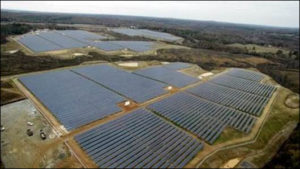
    Dominion solar facility in Buckingham County.

    A couple of years ago, the rap against Dominion Energy Virginia was that it was hostile to solar power. That line of thought is harder to maintain now that Dominion is committed to build at least 5,200 megawatts of solar power — roughly a quarter of its generating capacity — by 2042. Dave Mayfield at the Virginian-Pilot has taken notice:

    After many years as a laggard, Virginia has lately been emerging as a leader in the field.

    Last year, it placed 10th among the states in new solar capacity installed, up from 17th the year before, according to aย report compiled for the Solar Energy Industries Association. North Carolina ranked second, behind California.

    The association projects that Virginiaโ€™s total solar generating capacity will more than triple over the next five years to roughly 2,000 megawatts โ€“ enough to power upwards of 200,000 homes.

    Some industry officials and clean-energy advocates expect even-sharper growth during that time frame, and say the solar expansion almost certainly will accelerate across Virginia in the decades beyond.

    I nearly fell out of my chair when I read this: โ€œI think youโ€™re going to see a lot more discussion about Virginia being a hot state for solar,โ€ said Ivy Main, affiliated with the Sierra Clubโ€™s Virginia chapter who writes the โ€œPower for the People VAโ€ blog. Main has been relentlessly critical of Dominion’s approach to solar over the years.

    So the rap against Dominion has changed. Now the criticism is that, yeah, 5,200 megawatts is pretty good, but 25 years takes too long to reach that goal. And, yeah, Dominion is building more solar, but it’s not opening up the grid fast enough enough to homeowners, small businesses and independent solar producers.

    Regarding the first criticism: I expect Dominion’s enthusiasm for solar will increase in direct proportion to the falling cost of solar generation, smart grid technology, and battery storage. Just as the utility has gone from a minimal commitment to solar two years ago to a large-scale commitment today in response to changing economics and market forces — especially growing demand by data centers and large corporations for renewable energy — this “problem” will take care of itself. The main brake on solar adoption will be Dominion’s comfort level with integrating a huge solar fleet into its transmission and distribution systems while maintaining grid reliability during periods of peak demand.

    The second criticism, opening up solar production to outside competition, is a thornier issue. Many companies would like a piece of Dominion’s electricity market (as well as that of Appalachian Power’s and that of the electric co-ops). These interlopers are nimble and innovative, and, given current price trends, they likely would be able to sell solar for less than the cost of generating electricity from coal, nuclear or even gas — if not now, then five years from now. If competition opened up as critics would like, Virginia’s incumbent utilities stand to lose significant market share.

    But here’s the rub: Electric utilities are monopolies, and they are monopolies for a reason. They have the responsibility for maintaining the integrity and reliability of the electric grid. If the lights go out, the North American Electric Reliability Council, PJM Interconnection, the State Corporation Commission, and millions of customers will look to the likes of Dominion, Appalachian Power, and the electric co-ops to get them back on again. They won’t look to homeowners. They won’t look to the independent solar producers. They won’t look to the Sierra Club. The utilities are the ones with skin in the game.

    Society and the utilities have struck a bargain: In exchange for ensuring the reliability of the system, society will grant them monopoly service territories and regulate them to provide an assured rate of return on their capital (absent incompetence on the utilities’ part). Reneging on that bargain and opening up the system to wide-open competition would undermine the utilities’ revenues and profits, exposing them to potentially massive write-offs. It should surprise no one that the utilities resist such an eventuality.

    Ironically, Dominion led the charge for opening up the utility industry to competition some twenty years ago. The experience was widely judged to be a failure; little competition materialized. Then in recognition of that failure a decade ago, Dominion led the charge to re-regulate the industry in Virginia. We can debate the success or failure of the experience since then, but it does seem apparent that if the industry were deregulated in 2018, there would be plenty of competition on the power-generation side of the business — from merchant producers selling into the wholesale market, from entrepreneurs partnering with big corporations, from intermediaries buying wholesale electricity off the grid and re-selling it to retail customers, and from energy- and eco-conscious homeowners installing their own solar.

    One approach to opening up the market for competition is to demonize the utilities. That’s a favorite trope of the Left, which is hostile to corporate power and profits to begin with. Another approach is to give thought to how to realign the incentives for Dominion, Apco and the electric co-ops to do the kinds of things society wants them to do — generate more renewables, allow more competition, invest in energy efficiency, etc. — and to realign them in such a way as to not trigger massive write-offs for power plants made obsolete by the changes. Virginia can choose an ideological route or it can choose a pragmatic path forward.

    Under any scenario, building and maintaining the electric transmission and distribution remains a “natural monopoly” and would be subject to continued regulation. But deciding how to restructure electricity generation will be really complicated. In an ideal world, all power generators would sell into PJM’s wholesale market and the winners would be bidders who offer the best combination of price and sustainability. But if the incumbent utilities lose market share and revenues, who pays for cleaning up the coal ash ponds of coal-burning power plants?ย Who eats the cost of write-offs from obsolete generating units?ย Who pays to keep aging coal- or nuclear-power plants in reserve for back-up power? What are the implications of Virginia joining the Global Greenhouse Gas Initiative?

    We haven’t begun to answer these questions. Indeed, only a handful of people are even asking them. After the exhaustive debate over the Grid Transformation and Security Act this year, there may be little appetite for any such conversations. But allowing for an appropriate respite from the recently concluded General Assembly session, perhaps we should begin the discussion.


  • Petersburg Backs Away from the Precipice

    Petersburg City Manager Aretha Farrell-Benavides

    The City of Petersburg looks like it has finally dug out of its fiscal hole. City Manager Aretha Ferrell-Benavides presented a $73 million budget to City Council last week that restores funding to schools and public safety even while building up the cash reserve by $950,000.

    Last year the city lurched from crisis to crisis after the discovery in 2016 that it was running a $20 million deficit. After bringing in consultants with the Robert Bobb Group, the city slashed funding across the board, cut salaries, and laid off administrative employees.

    The proposed fiscal 2019 budget is $1.1 million smaller even than last year’s, yet it manages to increase public safety by $3 million and schools by $0.3 million. The city bond rating has been upgraded from junk to bond status, reports the Richmond Times-Dispatch.

    The budget is spartan, no doubt, and many Virginia localities would find it unacceptably austere. One could argue that the budget fails to invest enough into K-12, one of the worst-performing school systems in the state. One could further argue that the budget is still fragile, thus vulnerable to a slowdown in the economy and tax revenues. But there is no nay-saying that Petersburg has survived one of the worst fiscal disasters experienced by a Virginia locality since the Great Depression. Government administration is far more disciplined as as a result, and the city is fiscally stronger than it has been in years.

    Most remarkable of all, Petersburg pulled off this fiscal feat without benefit of government bail-outs or reneging on its debt.ย Kudos to Fredericksburg, to the Robert Bobb Group, to the citizen activists who kept the pressure on, and to the city officials who did what they had to do.

    Bacon’s bottom line: There are two lessons to be learned here. First, Virginia’s system of government worked. The McAuliffe administration didn’t panic. The Secretary of Finance provided some professional assistance but didn’t turn the city’s fiscal plight into a broader political crisis. The Commonwealth made it clear from the beginning that Petersburg’s problem was Petersburg’s to solve. And rather than expend its political capital on blaming others and seeking bail-outs, Petersburg’s political leadership submitted to the discipline imposed by the Robert Bobb group.

    Second, Petersburg’s resurrection serves as an example for other governments to emulate. Illinois, Chicago, and Hartford, Conn., are one recession away from fiscal collapse, and a dozen other states and localities are not far behind. Here in Virginia, we forced poor, economically struggling Petersburg to face the music — and it did. When the inevitable occurs, our congressional delegation must steel itself to the inevitable crocodile tears and special pleading from other jurisdictions and say, “If Petersburg did it, so can you.”


  • Want Proof of the Decline of Western Civilization?

    A white rap artist who goes by the name of Lil Dicky joined a black rap artist, Chris Brown (born in Tappahannock, Va., and best known for slapping around songstress superstar Rihanna) to produce a song, “Freaky Friday.” The conceit of the song and video is that Lil Dicky and Chris Brown find themselves occupying each others bodies, which gives rise to such witticisms as

    I’m in Chris Brown’s body
    I look at my soft dick with delight, it’s my dream dick…
    My dick is trending on Twitter, fuck

    and toward the end of the video when contributing “artist” Kendall Jenner says…

    Huh, I’m Kendall Jenner
    I got a vagina, I’m gonna explore that right now (woo)
    Holy shit, I got a vagina (uh), I’m gonna learn
    I’m gonna understand the inner workings of a woman

    Thenย  there was this, in which Chris Brown (occupying white Lil Dicky’s body) croons the following:

    Wonder if I can say the n-word (wait for real?)
    Wait, can I really say the n-word?
    What up, my nigga? (woo)
    What up, my nigga? Big ups, my nigga
    We up, my nigga, you pussy ass nigga
    Man, fuck y’all niggas, ’cause I’m that nigga
    Nigga, nigga, nigga, I’m that nigga

    Apparently, that’s what passes for art — or maybe it’s humor — in the Millennial generation. We’ve come a long way from Rogers and Hammerstein, baby!ย  Released in March, this foul little ditty soared to number one in the United Kingdom and New Zealand,ย and reached number eight on the US Hot 100. As of today, the YouTube video has received more than 90 million views. The mind-dumbing vulgarity didn’t seem to offend anyone….

    Until the words were sung by members of the Virginia Tech women’s lacrosse team. Someone posted a Snapchat of exuberant young women after a win over Elon University dancing in the aisle of their bus and singing the song. Including Chris Brown’s grotesque nigga-nigga-nigga sequence.

    Social media went ballistic. Charges of racism were hurled. Next thing you know, Coach John Sung was apologizing for the use of the epithet, although he insisted that there was no malice involved. “They had just won,” he said. “Theyโ€™re singing songs. The first couple songs were Disney songsโ€ฆ They were celebrating and they were dancing and they were excited.” (From “Let it Go” to “Freaky Friday” — quite the transition.)

    Then came the crowning blow, the condemnation of their peers. The Virginia Tech Student Government adopted a resolution condemning the use of the racial slur, describing it as “one of many episodes of discrimination and animosity toward marginalized groups that have occurred on the campus of Virginia Tech in recent months.”

    According to the Campus Reform website, the resolution stated:

    Examples of such discriminatory incidents includeโ€ฆ a guest lecture by Dr. Charles Murray, a white-nationalist known for inaccurate theories linking race and intelligence; a Steven Crowder speaking event in which promotional materials contained homophobic language; and the invitation of Charlie Kirk, a controversial right-wing speaker whose rallies have attracted the support of white nationalists and ended in violence such as the February 2nd event at Colorado State University, to speak on campus April 30th.

    Asserting that โ€œsuch discriminatory incidents contribute to members of marginalized communities feeling unsafe on the campus of Virginia Tech,โ€ the resolution goes on to โ€œcompletely and wholeheartedlyโ€ condemn the Womenโ€™s Lacrosse team out of a desire to โ€œstand in solidarity with our fellow students.

    Basically, anyone to the right of Mother Jones is deemed a racist, a homophobe, or a borderline Nazi worthy only of condemnation and exile.ย This is concocted outrage. It is selective indignation. It is bullying. It is totalitarian intimidation. It is all about silencing opposing views and silencing anyone who even has a stray thought resembling an opposing view.

    Look, the song is total trash. It is offensive from start to finish — not least the mindless repetition of “nigga nigga nigga” — and if I were the parent of one of the girls who had learned the lyrics by heart, I’d be mortified that she’d wasted her time listening to such garbage. But in the minds of the Virginia Tech student council members, there’s no problem with Chris Brown using that language. There’s no problem with putting that language on a YouTube video. There’s no problem with 90 million people listening to that language. The problem is that the wrong people used the language. When a bunch of white girls used the N word while singing the song — not in in a way meant to denigrate anyone — they were singled out for condemnation and humiliation.

    I reject the N word, I never use it, I don’t defend anyone using it, and I suppose you could say the lacrosse team girls had it coming for being so vapid as to use it. But the double standards applied here are just appalling. It’s all about the power. It’s all about defining who can say what and who can’t.

    But this bullying will backfire. If you want more Donald Trump, this is how you get more Donald Trump. If you want more Alt-Right, this is how you get more Alt-Right. That may be fine with the far Left because anything that engenders hate and polarizes the nation is fine with them, but it’s not the kind of country I want to live in.

    We have a choice. We can succumb to the narrative of aggrievement or we can build a narrative of achievement. We can surrender to envy, resentment, nihilism, and destruction, or we can embrace hope, collaboration, improvement and uplift. Pick one or the other. That’s what it’s come down to.


  • How UVa Compares to Other Flagship Universities in Out-of-State Enrollment


    There’s a special burden upon state flagship universities to acquit themselves well in the national rankings — the university reflects upon the state as a whole. Thus, the high esteem in which Berkeley, the University of Michigan, and the University of Virginia, among others, are held casts a warm glow upon California, Virginia, and Michigan.

    The ranking methodology for the U.S. News & World-Report “Best Colleges in America” puts a premium on average SAT scores. Enlarging the pool of out-of-state students enables an institution to recruit more high-SAT students. As a bonus, out-of-state students pay higher tuition than in-state students. But filling up the student body with out-of-staters conflicts with the mission of public institutions to serve the population of the state supporting them with taxpayer dollars. What’s a university president to do?

    The Washington Post took at look at the flagship institutions of the 50 states to see what percentage of out-of-state students they admitted. At the bottom, the University of Vermont admitted only 21% of its students from within the state in the fall of 2016. At the opposite extreme, the University of Alaska at Fairbanks admitted 89% in-staters.

    Of course, here at Bacon’s Rebellion, we’re most interested in the University of Virginia. UVa admitted 66% in-state students, an increase of 3 percentage points from the previous year. That was a middle-of-the-pack performance compared to other flagships.

    For purposes of comparison, only 51% of University of Michigan students were native Michiganders. On the other hand, Berkeley managed to maintain its high ranking with 76% in-staters, and the University of North Carolina at Chapel Hill with 83%.

    Conversely, one can look at a flagship’s ability to recruit out-of-state students as a positive. Talent comes from all around the country, all around the globe, and many of the 34% of out-of-staters recruited by UVa end up staying here in Virginia. Looking at the percentage from an economic development perspective, this might be the number we’d like to see grow.

    (Hat tip: Peter Blake)


  • Fear and Loathing in the Era of Weaponized PC

    John Accordino

    I don’t know John Accordino especially well, but we’re more than casual acquaintances. He and I had lunch a couple of times to discuss a partnership between Bacon’s Rebellion and Virginia Commonwealth University’s Center for Urban and Regional Analysis, which he headed at the time. He struck me as friendly and collegial. He was assiduous about consulting his colleagues before committing to an agreement with me. He never gave any sign of temper, prejudice, profanity, or any other off-putting trait.

    So I was startled to read a couple of weeks ago that former Governor L. Douglas Wilder, a professor at theย L. Douglas Wilder School of Government and Public Affairs, had sued Accordino, who by then had become dean of the school.

    L. Douglas Wilder

    Wilder’sย lawsuitย alleges thatย Accordino violatedย university rules when he verbally assaulted and abused Wilderโ€™s administrative assistant, Angelica Bega. He allegedly called her “obscene names, accused her of violating VCU human resources rules, questioned and insulted her intelligence, threatened her employment with VCU, and generally disparated her humanity.”

    Hisย abuse โ€œwas such that others within the department, throughout the building, heard his harangue.โ€ Although Wilder did not personally witness the incident,ย Associate Professor Dr. Kristine Artello allegedly informed him that she heard the event through her closed office door and volunteered to provide a written account of Accordinoโ€™s alleged abuse.ย 

    I suppose it’s possible that Accordino presented one face to the public and an entirely different visage to his subordinates, and I acknowledge that my interactions with him were too limited to reveal the inner nature of the man. Furthermore, I have never met Ms. Bega and have no basis upon which to comment upon her credibility. But given the toxic environment in higher education and the #metoo movement today, I’m not willing yet to start casting stones at Accordino.

    Angelica Bega

    Apparently, VCU President Michael Rao and Provost Gail Hackett had their own issues with the accusations against Accordino, for Wilder sued them, too. He alleged that Hackett did notย fairly process Begaโ€™s complaint. After an unsatisfactory meeting with Hackett and Rao, Wilder then went to VCU’s H.R. department, portraying the incident “as sexual harassment and racial and sexual discrimination.” The university, he charged, failed to protect Bega from Accordino’s abusive behavior. Despite Wilder’s insistent personal appeals, Rao refused to discipline the dean.

    That was then. This Wednesday, VCU removed Accordino as dean of the school of government, striking an agreement to supplement his $220,000 salary with $80,000 in supplemental pay over the next three years. After spending the next year and a half on paid “study-research leave,” he will return to teach as a tenured faculty member in the fall of 2019.

    Gail Hackett

    Meanwhile, Accordino has filed a counter-suit against Wilder, accusing him of defamation and interfering with his VCU contract. He is seeking $150,000 in damages, reports the Richmond Times-Dispatch.

    In the filing, Accordino accuses Hackett and Rao of privately supporting him but acting to remove him anyway out of fear of Wilder. … “Hackett told Accordino that she had no cause to reassign him, but due to her certainty that Wilder would go after Accordino with a vengeance, she strongly encouraged Accordino to ‘step down as dean,’ the countersuit alleges.”

    Hackett allegedly told Accordino that he and VCU “would not win in a fight against Wilder.” Further, she implied that VCU refused to confront Wilder’s “disruptive, disrespectful and bullying behavior” because of “a fear that Wilder would make up unfounded and false claims of racism and discrimination.”

    Bacon’s bottom line: Judging from the T-D‘s coverage, Accordino did not dispute in his counter-suit that an incident occurred. I’m speculating here, but it’s not hard to imagine that Accordino did confront Bega over violating VCU H.R. rules — taking too much time off, perhaps? — and that voices rose and tempers flared. It’s also not hard to imagine that Accordino and Bega had markedly different recollections of what happened. Finally, it’s not hard to imagine that Accordino construed his behavior as a justified chastisement of an employee for failing to follow policy, while Bega felt emotionally abused. Did he throw a temper tantrum? Or was she being a snowflake? At this point the public has no way of knowing.

    We do know that VCU authorities initially sided with Accordino. Was that because his side of the story was so believable? Or because Hackett and Rao sided with him because he was “one of them,” a member of the university’s inner sanctum?

    It also seems clear that Wilder immediately embraced Bega’s version of events, and he went after Accordino like a bulldog. He put the VCU brass in an untenable situation. Wilder wasn’t just any ol’ adjunct professor. He was Virginia’s first black governor, and the school of government was named in his honor. He also had the reputation of never backing away from a fight. In the end, Rao faced a devil’s dilemma. Who could embarrass the institution more — Wilder or Accordino? It wasn’t much of a choice. When heย characterized the incident in his lawsuit as “sexual and racial discrimination,”ย Wilder indicated a willingness to go thermonuclear.ย 

    Wilder has been embroiled in another lawsuit recently. He sued former Democratic legislator Joe Morrissey, notorious forย misconduct allegations arising from his relationship with a 17-year-old employee who is now his wife, for work he had performed for Wilder and the Virginia Slavery Museum. Two of Wilder’s three allegations were thrown out of court after Wilder failed to appear in court in answer to a subpoena from Morrissey’s lawyers.

    This case has all the markings of a controversy in which bystanders pick sides based upon their ideological preconceptions. Before we go that route, let’s try to keep an open mind until we see the evidence.


  • Nukes and Renewal

    Surry Nuclear Power Station

    Should Dominion Energy re-license its four Virginia nuclear power units? The answer depends on your appraisal of solar power, energy efficiency and other alternatives.

    Is there a future for nuclear power in Virginia’s long-term energy outlook?

    Dominion Energy Virginia believes there is. Nuclear power currently contributes about 30% of the company’s electricity sales, and the company plans to continue generating power from its Surry and North Anna nuclear power stations for decades to come. Nuclear power, the company says, is reliable, provides fuel diversity, and does not emit carbon dioxide — a major plus as Virginia aims to reduce greenhouse gas emissions.

    The utility’s 2018 Integrated Resource Plan, which peers 15 years into the future, assumes that the company will renew the licenses to operate the two nuclear-generating units at Surry and the two at North Anna. At the time of the license renewals, the units would be 60 years old. The nukes would continue to operate until they were 80 years old.

    But many people think that renewing the licenses is a bad idea. While Dominion expects that refurbishing the four generating units would cost $3 billion to $4 billion, environmentalists and other skeptics suggest that the actual cost could run significantly higher. It doesn’t make sense to spend billions on nuclear power, they say, when solar energy costs less and is getting cheaper every year. While it is true that solar power is intermittent — it generates electricity only when the sun shines — the advent of low-cost batteries and the spread of electric vehicles, they claim, will make it possible to economically store surplus solar power for when it is needed.

    Expect the debate to heat up when the Nuclear Regulatory Commission (NRC) begins processing Dominion’s re-licensing request for the Surry 1 plant. Dominion has filed notice of its intent to submit an application for a license renewal by the first quarter of 2019 — less than a year away. The review could take up to three years, and construction several years more.

    License renewal for existing nuclear units is distinct from a proposal, also explored in the 2018 Integrated Resource Plan (IRP), to build a new nuclear unit at North Anna known as North Anna 3. Dominion has spent hundreds of millions of dollars in planning and engineering costs to keep that option alive. Estimates of the cost for building the third unit have ranged as high as $19 billion, and the IRP suggests that it would not make economic sense except in the strictest CO2-reduction regulatory scenario that would compel the shutdown of coal-generating capacity. The cost of building a third nuclear unit would be so high and fraught with so much uncertainty that opposition would be formidable no matter what the circumstances.

    The re-licensing proposals are a different story. The up-front capital cost, though considerable, would be in the same ballpark as building new gas- or solar-powered generating capacity. Moreover, fuel costs would be more stable and lower over the long run than for the gas-fired facilities. Although there are no hard figures on what the impact on rate payers would be, no one disputes the fact that re-licensing Surry and North Anna would cost a fraction of building a new generating unit.

    Flagships of the fleet

    The two Surry units became operational in 1972 and 1973, capable of generating a total of 1,600 megawatts of electric power. In the early years the power station had some major operational issues. Inย 1972, two workers were fatally scalded by steam after a routine valve adjustment. And inย 1986, a steam explosion due to internal erosion and over-pressurization injured eight workers, four fatally. But performance has been steady since then. Other than an incident in which a tornado touched down in the switching station, disabling power to the plant’s cooling pumps, Surry has operated largely without incident.

    The two North Anna units went online in 1978 and 1980 with a combined capacity of almost 1,800 megawatts of power. The station has operated without major incident, except in 2011 when an earthquake centered nearby caused light damage and triggered an automatic shut-down of the nuclear operations.

    The four nuclear units have formed the backbone of Dominion’s electric-generation portfolio. In recent years, North Anna has operated with top measures of efficiency and safety, garnering the highest ratings in inspections by the Nuclear Regulatory Commission every year but two. Surry and North Anna are consistently ranked as among “theย lowest-cost producers of nuclear-generated electricity in the nation,” as reported periodically by Platts Nucleonics Week, a nuclear industry newsletter and database, saysย Richard Zuercher, manager-nuclear fleet communications.

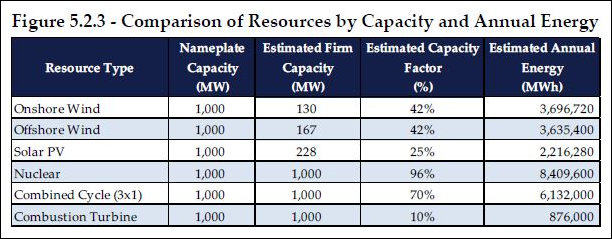
    While the nuclear units account for only 16% of Dominion’s nameplate capacity, they generate more than 30% of its total electricity output. That’s because they operate non-stop, twenty-four hours per day, seven days a week, almost 52 weeks a year, going offline only for planned refueling outages every 18 months or the the rare tornado, earthquake or other mishap. The 2018 IRP, as shown in the table above, assumes a capacity factor for the nukes of 96%, which compares favorably to 70% for combined-cycle gas plants, 42% for off-shore wind (assuming the company manages to build a wind farm off Virginia Beach), and 25% for solar. Thus a nuclear facility with a nameplate capacity of 1,000 megawatts generates 8.4 million megawatt hours annually compared to 6.1 million for natural gas, and 2.2 million megawatts for photovoltaic solar. (more…)


  • Here’s an Idea, Let Maryland Have Amazon

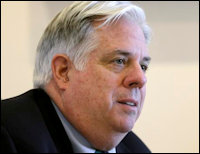
    Virginia’s friend: Maryland Governor Larry Hogan

    Maryland legislators approved Wednesday an $8.5 billion incentive package to lure Amazon’s second headquarters to Montgomery County. Governor Larry Hogan (R), who proposed the plan, is expected to sign the bill.

    I love it! This is the best of all worlds for Virginia. Amazon has estimated that the headquarters will invest $5 billion and employ 50,000. If Amazon puts its second headquarters just across the Potomac River in Montgomery County, Md., Northern Virginia will benefit from many of the positive spillover effects without undermining its tax base to bribe the company into locating there.

    Nonpartisan analysts with Maryland’s General Assembly said the incentives would cost the state $5.6 billion in tax breaks, $2 billion in transportation spending, and $924 million in local tax credits, for a total of $8.5 billion. While a solid majority of Maryland legislators backed the package, a sizable minority objected to the massive subsidies, reports the Washington Post.

    โ€œAmazon is getting the gold mine and weโ€™re getting the shaft,โ€ said Del. Herbert H. McMillan, R-Anne Arundel. He described the package as โ€œcorporate welfare.โ€

    (Virginia has offered an incentive package as well, although nothing that has required approval by our General Assembly. The details remain confidential, despite efforts by anti-Amazon groups to obtain them through Freedom of Information Act requests.)

    Let’s game this out. Let’s assume that Maryland’s bribery package is so generous that it outweighs anything Virginia can cobble together under existing legislation and appropriations. Let’s assume that Amazon builds an 8-million-square-footย  headquarters campus in Montgomery County, invests $5 billion, and hires 50,000 highly compensated workers, as it says it will. Where does that leave Virginia?

    In the cat bird seat.

    Maryland and Montgomery County hired the Sage Policy Group, Inc., to study the economic impact of an Amazon relocation to Montgomery County. The study finds that a full build-out would support more than 101,000 jobs in Maryland, generate nearly $7.7 billion in employee compensation, and boost economic activity by more than $17 billion. (Presumably these are annual figures, although the study’s Key Findings does not say so explicitly.) Writes Sage:

    Complete development of Amazon’s HQ2 will create approximately $112 million in augmented tax revenue at the County level. The bulk of this will flow to Montgomery County through direct income and property tax effects, though indirect and induced activities will also augment local tax revenues as far north within Maryland as Frederick and Baltimore Counties. This tally includes nearly $64 million in property taxes and nearly $34 million in income taxes.

    At the state level, tax receipts will increase by an estimated $190 million over the duration of development, including $84 million in sales tax revenues, $62 million in income tax revenue, and more than $10 million in nontax revenues (e.g., fees, and permits.)

    Here’s what the Sage study overlooks: the costs associated with an added workforce of 101,000 in an era of full employment.

    Unemployment for the Washington metropolitan area was 3.6% in February. That verges on a labor shortage. Indeed, for IT-related jobs, there is a labor shortage. To fill those jobs, Amazon will either (a)ย induce skilled employees from other metros to move to the Washington area, or (b)ย recruit skilled employees from local employers, who in turn will have to induce skilled employees from other metros to move to the Washington area. Those people will have to live somewhere, and they will require state and local government services.

    The increased economic activity resulting from the Amazon headquarters will more than offset the drain from $8.5 billion in subsidies. But will it also offset the cost of building new infrastructure and providing state/local government services, including schools, to the tens of thousands of households moving into Maryland?

    Let’s assume for purposes of illustration that a third of those 101,000 employees joining the Maryland workforce have children, and let’s assume that they have only one child at home on average, and let’s assume that only 75% of those children are of school age. That means we can expect an enrollment increase of 25,000 students in Maryland schools. The average cost per K-12 student in Maryland is about $15,000. Let’s say a 20% of that is overhead and that the variable cost per child is only $12,000. That pencils out to $300 million in added K-12 school expenditures.

    Guess what. The total anticipated increase in state and local tax revenues is…. $300 million. That leaves nothing for public safety, public works, higher education, health care, social services, the environment, or the mandatory bloated bureaucratic overhead. Fiddle with the numbers in my assumptions, if you want, but understand the principle: Sage’s economic impact formula considers only tax benefits, not fiscal costs.

    By contrast, Virginia will enjoy economic benefits from Amazon in Maryland without the tax giveaways.

    The Sage study does not publish an estimate of the economic impact of an Amazon-in-Montgomery-County scenario on Virginia or Washington, D.C. scenario.ย  I suspect there’s a reason why Sage didn’t disclose those numbers — because an embarrassing proportion of the benefits of an Amazon move to Maryland will accrue to the entire metropolitan area.

    “Entrepreneurship related directly or indirectly to e-commerce, cyber-security, big data analysis, and other segments would accelerate,” states the report. As it happens, cyber-security and big data analysis are industry sectors at which Virginia excels. It is inevitable that Amazon will do business with Virginia companies, and it is likely that Amazon or former Amazon employees will seed new enterprises in Virginia.

    No doubt some Amazon employees will live in Virginia and drive across the Potomac. We’ll have to provide schools and other public services to them. Here’s the difference: We won’t have to eviscerate our tax base to do so.