I visited my daughter Sara the other day and was amused to note that delivery services had dropped off two cardboard boxes in front of her house. When I stepped inside, there was a third box, still unopened. Three packages delivered in one day. Wow, thought I. My wife and I might average one delivery per week. Upon my further inquiries, Sara revealed that she also had begun ordering her groceries online and having them delivered to her doorstep as well.
Sara is the mother of a three-month-old infant, so running errands is a serious chore. I understand why she might be willing to pay a modest delivery fee in exchange for greater convenience, especially when she’s juggling baby care with handling the administrative work for her husband’s law practice.
There’s a lesson here for public policy. The rise of e-commerce and home delivery is changing America’s driving habits, especially among younger people less entrenched than carmudgeons like me in their customary way of doing things. Instead of driving to the grocery store and perhaps combining it with one or two other errands, such as depositing a check or picking up a prescription, more and more people are opting for online delivery.
Online-delivery option takes people like Sara off local streets and roads. In the argot of transportation planners, it reduces the number of trips per household. For decades, the propensity for Americans to take an increasing number of trips per day fed the increasing number of cars on the road. According to Federal Highway Administration data, the average number of trips per household increased from 2.3 in 1969 to 3.3 in 2009, and the number of daily vehicle-miles driven per household increased from 34 to 58.1.
Conversely, more e-commerce means there are more delivery trucks roaming around our metropolitan regions and dropping off more packages than ever.
Here’s a big question for public policy wonks: Are we as a nation experiencing a net gain in vehicle miles driven or a net loss as a result of e-commerce? My hunch is that the trend is bringing about a net reduction in driving. While the typical American stops at one or two retail/service locations on average for each trip, I’m surmising that delivery trucks are stringing together long chains of drop-offs, using computer algorithms to plot the shortest, most efficient routes. (This may be true even for grocery store deliveries by refrigerated trucks.)
In sum, I would expect the net result to be positive for society — fewer vehicle miles driven, fewer vehicle emissions, and less congested streets. (But more cardboard boxes in the landfill.)
While positive overall, one might argue, this trend does not help our biggest headache: rush hour congestion caused by people driving back and forth from work. But even here, I expect there will be a modest benefit from home deliveries. Working people typically tack errands onto their commutes home — picking the dry cleaning, stopping at the grocery store, whatever. Insofar as home deliveries displace those rush-hour errands and shift the trips to non-rush hour times of the day, they might alleviate rush hour traffic to a modest degree.
The truisms that have underpinned our transportation planning are shifting under our feet. Smart planners will take into account the impact of e-commerce and home deliveries before investing billions of dollars on new roads, highways and mass transit projects on the assumption that the trends of the past 30 years can be confidently projected into the next 30 years.
Data source: U.S. News & World-Report 2018 Best Colleges
And here they are, the rankings that everybody loves to hate… the U.S. News & World-Report 2018 Best Colleges ranking.
There are numerous other rankings, but the U.S. News publication seems to carry the most clout. I list the rankings here not so much as an objective indicator of the quality of Virginia’s 15 four-year institutions of public education but as a gauge of their relative prestige. Prestige matters because the endless quest for status is one of the primary drivers of college and university priorities and spending.
The aspiration to higher rankings, hence greater prestige, is an endless treadmill. While Virginia’s public institutions strive to climb the ladder, so is every other college and university, both public and private. It’s difficult to rise in the rankings when every other institution in the country is trying to do the same.
Many institutions game the system by applying scarce funds to line items that influence the ranking metrics. Accordingly, it is especially useful to see what U.S. News counts and how institutions might invest resources to improve their scores.
Graduation and retention rates (22.5 percent).U.S. News gives 80% of this measure to the six-year graduation rate and 20% to the first-year retention rate. One can predict that institutions will invest resources to create programs that will influence both of these metrics. Likewise, one can predict that a disproportionate share of resources will be devoted to improving the first-year retention rate.
Undergraduate academic reputation (22.5 percent): U.S. News uses two measures here: academic peer ratings and high school counselor ratings. These are purely subjective, of course. One cannot help but wonder the degree to which the high school counselor ratings are influenced by… previous U.S. News & World-Report rankings. I would hypothesize that institutions intent upon improving their rankings would make efforts to increase visibility among high school counselors. Likewise, I would expect colleges to invest in recruiting star faculty who might bring renown to the institution.
Faculty resources (20 percent): Class size accounts for 40% of this measure. The most points are given to classes with fewer than 20 students, a decreasing number of points are given to classes with 20-29, 30-39, and 40-49, and no points are awarded for classes over 50. I would hypothesize that institutions would respond to this incentive by structuring class sizes to admit the maximum number of students within one of U.S. News‘s brackets. Thus, we would expect to see many more classes enrolling, say, 19 students than 20 students because 19-student classes earn more points under the U.S. News methodology than 20-student classes.
Student selectivity (12.5 percent): Two of the three metrics used in this category are average SAT score and acceptance rate. I would hypothesize that colleges and universities dedicate considerable resources to recruiting high-SAT students, and also that they also dedicate resources to ginning up lots of applications in order to generate the best possible acceptance rate to foster the image of popularity and selectivity. Also, one would expect institutions to dedicate resources to the kinds of assets — newer buildings, cushier dormitories, better food choices — that provide a quick, visceral appeal to high school students visiting campus.
Financial resources (10 percent): U.S. News rewards average spending per student on instruction, research, student services and related educational expenditure. It does not count spending on sports, dorms and hospitals. One would expect universities to adjust their accounting classification of expenses to maximize spending in the favored buckets. Among wealthier institutions, I would predict, there is no practical limit to money spent on student “enrichment” programs such as semesters abroad.
Graduation rate performance (7.5 percent): Adjusting for SAT scores, high school standing, and Pell Grants, U.S. News measures the difference between “expected” and actual graduation rates. If the school’s actual graduation rate is higher than the predicted rate, the college deemed to be enhancing achievement and over-performing. This strikes me as a useful measure, and one that is not easily gamed. I would love to see the data.
Alumni giving rate (5 percent): The percentage of alumni who donate to school is used as an indirect measure of student satisfaction. Of course, this is easily gamed. I would hypothesize that we will see greater resources and creativity expended over time to solicit donations. Even small donations will enhance an institution’s ranking..
Bryan Caplan doesn’t just think outside the box when it comes to higher education. He stomps on the box and mashes it into the ground.
How much of what college students learn in class do they retain later in life?
Remarkably little, says Bryan Caplan, an economics professor at George Mason University. And thereupon lies a tale with massive implications for higher education policy in Virginia and nationally.
Students are subject to “fade out,” the diminishing memory of facts, figures, theories, and languages learned in the classroom that receive no reinforcement in life after school. The fact is, the vast majority of what students learn — whether history, English lit, psychology, calculus, French, or astronomy — is irrelevant to their workplace preoccupations as employees, and it is soon forgotten.
In other words, argues Caplan in his book, “The Case Against Education: Why the Education System Is a Waste of Time,” from a societal perspective the vast majority of college-level schooling represents squandered time and money.
The primary value of earning a college degree is to send a signal to the employment marketplace that the bearer of a sheepskin is intelligent enough, diligent enough, and conformist enough to undergo the multi-year trial of completing the requirements. “For the individual, higher ed helps get you a job and make more money,” said Caplan in an interview with Bacon’s Rebellion. “But for society, the benefits are very overstated.”
Some colleges and universities teach advanced vocational skills such as engineering or law. Students in those fields do learn skills they will apply in their jobs, but Caplan argues that most disciplines teach little that’s relevant in the world outside the ivory tower. A degree in history, for instance, trains the student to become a historian but not much of anything else. By his spitball estimate, 80% of the career-preparation value of a college education comes from signalling, only 20% from content they master.
Reflecting upon my personal experience, I would have to acknowledge that I have forgotten the vast majority of what I learned while earning B.A. and M.A. degrees in history. I recall only the barest of details from my courses in the history of China, Japan, Latin America, the West Indies, Africa, and European overseas expansion. Forty-plus years later, I know more about these topics than the average Joe, but what I’ve forgotten could fill an encyclopedia. Why? Because in my journalism career in Virginia, I never called upon that knowledge and it faded from memory. By contrast, even though I took only a single college course in American government, I retain a storehouse of knowledge about state and local government in Virginia because I call upon it constantly.
I depart from Caplan in my belief that I did learn something of enduring value at the University of Virginia — how to think rigorously and analytically. But then, I must concede, that skill came mainly from two honors courses in historical methodology co-taught by two extraordinary professors and from the experience of writing a senior thesis, not the vast majority of my courses. Most UVa history majors did not take the honors courses and never benefited from the exceptional give-and-take of that particular program.
Caplan would concede that, yes, college students do learn something of enduring value that benefits them later in life, just not much. If the goal is preparing people for the workforce, as so much of the emphasis is today, most Virginians could learn a lot more during four years on the job than they could in four years of college.
“In the real world, most of what you learn is on the job,” Caplan says. “People get good by doing. … Nobody gets good at anything by taking critical thinking classes. They get good by doing.”
Why, then, do millions of Americans collectively spend tens of billions of dollars to attend college? The main reason, Caplan says, is to get a good job. Higher-ed institutions are adept at sorting applicants by intelligence by using such measures as SAT scores and class rankings. But if that were the only value colleges supplied, businesses would select employees on the basis of IQ tests. The ability to complete a four-year program of 40 or so courses also tells employers about a student’s diligence, self-discipline and willingness to conform to institutional demands. Students who fail to complete a college degree — whether because they are not smart enough, are too lazy, or reject institutional norms — are significantly less likely to make good employees.
Caplan makes a prediction fraught with significance for public policy. The State Council of Higher Education for Virginia (SCHEV) has set a goal of making Virginia the “best educated state” in the country by 2030, which means putting the public education system on a trajectory to produce thousands of degrees more than it would have on its previous path. If the supply of Virginians with a college degree exceeds the demand, the workforce won’t become any more productive Caplan suggests. But employers will separate the wheat from the chaff by increasing the educational criteria they require — credential inflation — thus requiring Virginians to devote even more time and expense to obtaining those credentials.
Caplan has another concern about setting arbitrary goals for the number of degrees and workforce credentials. Too many students are ill prepared for higher education as it is. American colleges are already full of students who aren’t capable of college-level work. Many of them are taking remedial classes, re-learning what they should have learned in high school. The fact that Americans have more educational credentials than ever says nothing about the quality of education they are receiving.
“If you could actually get schools to turn out people who can read or write, that would be an accomplishment,” Caplan says. “There are plenty of college graduates whom you’d be shocked by how poor their literacy or numeracy is.”
I asked Caplan if he saw any value in higher education as a consumer good — not just earning a degree but enjoying the residential campus experience, including everything from football games and dormitory bull sessions to ample opportunities to indulge in alcohol, drugs and sex. Instead of giving their kid money to backpack around Europe for a year, are parents paying their kids to enjoy four years of maximum freedom and minimum responsibility before embarking upon a lifetime of toil?
Some parents may be motivated by nostalgia for their own college experience, Caplan conceded, but he doesn’t think it’s an important factor in why they insist their kids get a degree. Most people attend college to advance their prospects in the job market. “Suppose college grads didn’t earn anything extra, how many people would still go? … College would be just for rich kids.”
Caplan sees considerable value in on-the-job training such as internships and apprenticeships — programs in which employees gain knowledge that they apply directly to work. I asked if he subscribed to the idea of “just in time learning” — taking courses and mastering skills as they are needed.
“From the point of view of taxpayers, that makes a lot more sense,” he says. Even then, he’s guarded about the value of acquiring knowledge by taking college courses. Say an aspiring manager wants to learn project management. How can he or she learn the discipline most effectively — by attending lectures and doing homework, or by shadowing someone on the job? Still, taking courses as needed is less wasteful than sending someone to college for four years and “consuming this giant buffet of stuff they’ll never need again.”
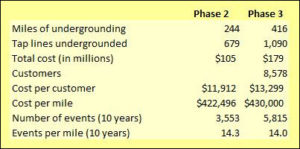
Key metrics for Phase 2 and Phase 3 of Dominion’s Strategic Undergrounding Program
Dominion Energy Virginia has filed for a $73 million rate increase to cover the cost of Phases 2 and 3 of its Strategic Undergrounding Program (SUP). The two phases of the program, designed to limit outages from severe weather events and shorten recovery times, will bury 660 miles of tap lines between them.
The State Corporation Commission (SCC) had permitted a trial of the undergrounding program advocated by Dominion but limited expenditures to $4o million in Phase 2. In the recently approved Grid Transformation and Security Act, however, the General Assembly declared undergrounding to be in the public interest. Now Dominion is filing to recover the full $105 million it has spent on Phase 2 plus another $179 million for Phase 3.
Legally, the law removes the “rebuttable presumption” that the conversion of overhead lines to underground lines will provide local and system-wide benefits, and declares that the costs associated with new underground facilities “are deemed to be reasonably and prudently incurred.” The legislation contains two limits: The cost should not exceed $20,000 per customer, and the average cost per mile should not exceed $750,000 (exclusive of financing costs).
Said Alan W. Bradshaw, director of Dominion’s undergrounding program, in testimony included as part of the filing:
The Company remains firm in its belief that the targeted undergrounding of the most outage prone tap lines will continue to improve the resiliency of the Company’s electric distribution system. The Company believes that a targeted SUP will result in an annual reduction of the total number of outage events and a reduction of repair locations. When outages do occur, it will lead to a reduction in the time required to restore power, particularly as to outages resulting from severe weather events.
According to data provided in the filing, the two undergrounding initiatives would allow Dominion to bury 1,769 tap lines dispersed across the state for a total cost of $284 million. The cost per customer and the cost per mile are well below the limits defined in the legislation.
There are tangible benefits to this investment, but Dominion documents only some of them in the filing. The buried lines accounted for 9,368 outages over the past 10 years — or about $30,3000 per outage avoided. Assuming that a comparable number of outages would have occurred in the future without the undergrounding, how much will the company save in restoration costs? How much outage time will customers save, and what is the economic value of the time saved? Perhaps rate payers will see those numbers in the hearing so they can judge the value of the undergrounding program for themselves.
No sooner had I posted the previous op-ed about the battleground of race and memory, I came across this story in Charlottesville Tomorrow about Freedom and Liberation Day in Charlottesville.
Historians gave a series of presentations at the Jefferson School African American Heritage Center earlier this month highlighting how freed slaves in the Charlottesville area took action after the Civil War to improve their condition in life.
Ex-slaves participated in politics and fought for public education. They agitated for the redistribution of land (which they never got, although many freed slaves managed to purchase land themselves). Perhaps most notably after the end of Reconstruction and the onset of Jim Crow segregation, they picked up and moved north to cities offering greater economic opportunity.
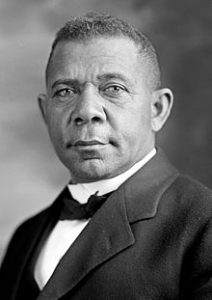
There is a great tradition of self-improvement among African-Americans, epitomized by the great Booker T. Washington who called for black progress through education and entrepreneurship. Washington was eclipsed by W.E.B. Du Bois, who called for political change to end segregation and discrimination. Sadly, the crusade for equal civil rights has morphed into a crusade for equal economic outcomes, and Washington’s philosophy of self-improvement seems a quaint anachronism.
Perhaps it’s time for a Booker T. Washington revival. Given all the discussion about the history of race and racism these days, it would be more helpful and inspiring to celebrate the positive accomplishments of black Americans in the face of adversity than nourishing the narrative of victimhood in the face of abundance.
The University of Virginia and Thomas Jefferson’s Monticello have just wrapped up an international symposium, “Universities, Slavery, Public Memory & the Built Landscape.” The conference, a great success according to the symposium website, provided a forum for “a free-ranging conversation about researching the enslaved past, disseminating findings to a broader public, and breaking down disciplinary boundaries as we collectively work to tell a fuller story about our own pasts.”
According to the Richmond Times-Dispatch, the subject of reparations came up more than once.
Said Ana Lucia Araujo, a Howard University professor of history:
This very city and campus are living examples of how such public battles over public memory can unfold. But where reparations for slavery are increasingly accepted and embraced by governments and other institutions, there is usually a great silence surrounding the idea of financial reparations for slavery.
Symbolic reparations touted by government and universities — renaming buildings, adding memorials and plaques, creating commissions, may not be enough.
Then there was this from Craig Wilder, author of “Ebony and Ivory”:
A lot of the universities have launched reports, but they have launched reports and studies somewhat reluctantly. The question of reparations was, in part, a reflection of how a lot of colleges and universities got to the point of studying their histories … which was often driven by students.
It’s impossible for us to know whether comments about reparations were typical of the sentiments expressed during the conference or cherry-picked by the Times-Dispatch reporter because they were controversial. And one can only conjecture whether the dialogue at the international symposium will reflect the tenor of the upcoming “Teaching Race at UVa” seminar, the purpose of which is to inspire UVa faculty to revise their course syllabi to “present reality of race and racism both locally and nationally.”
My fear, however, is that the sentiments expressed are widely shared by the “subject matter experts” who will be teaching the “Teaching Race at UVa” sessions. If I am correct, the Leftist views espoused at the “Universities, Slavery, Public Memory & the Built Landscape” conference will inform the perspectives propagated by the “Teaching Race at UVa” seminar, which will alter the syllabi of a wide range of courses taught at UVa, which in turn will shape the worldviews of a new generation of students. Leftist thought might be diluted in the process, but the flow of influence will be entirely one way.
The study of slavery, reconstruction, Jim Crow, racial prejudice and desegregation are entirely appropriate subjects for a university to undertake. Indeed, as a former student at UVa and the Johns Hopkins University of slavery, the Atlantic slave trade, and African history, I find myself intrigued by much of the symposium’s subject matter. Furthermore, I agree that it is appropriate to use history as a tool to illuminate contemporary society. We are, after all, products of the past.
What worries me is the narrow range of intellectual perspectives that are considered. The historic focus on past racial injustices is part and parcel of the larger obsession with racial and ethnic disparities today. The underlying assumption is that disparities in income, education and other outcomes are the result of America’s grievously flawed institutions and continued white privilege. The modern academy gives very little attention to the possibility that over the past 50 or so years the modern welfare state, social engineering projects and social justice initiatives have backfired badly, harming those whom the Left purports to help.
The obsessive focus on race represents a form of intellectual doubling down on the bad bet that once Civil Rights were affirmed for all, government then needed to intervene proactively to address equality. African-Americans especially have been the subjects of one botched policy experiment after another. Thus we have witnessed the devastation of intact neighborhoods by urban renewal, the concentration of the poor into housing projects, the undermining of the family structure by the welfare state, the denigration of “bourgeois virtues” that facilitate upward mobility, the assault on disciplined behavior in public schools, the push for lower-income households into home ownership and the subsequent obliteration of wealth after the housing crash, and most recently the credo that everyone is entitled to a college education despite overwhelming evidence that low-income Americans are disproportionately likely to drop out before earning a degree and accumulate debt they can never discharge.
While these policy disasters have afflicted low-income Americans of all races and ethnicities, they have devastated African-Americans most of all. The Left, fixated on race, identity politics, and the sinfulness of America, is unwilling to acknowledge its grotesque failures. Instead, it has adapted to the persistence of poverty and social breakdown among African-Americans (replicated to various degrees among Indians, Hispanics and whites) by finding racism in micro-aggressions and blaming poverty on ever-more-subtle forces of institutional racism.
That’s the problem I have with these academic seminars and symposia. Far from fostering “free-ranging conversations,” they tolerate only a limited spectrum of views. They ignore strains of thought that would threaten their sinful-America paradigm. Instead of embracing a positive approach — how can individuals and communities lift themselves up from poverty — they pursue a divisive, zero-sum game. Reparations in the United States is a non-starter. The idea of collectively punishing one race for the sins of committed by members of that race more than 100 years ago in order to repay the descendants of the victims is intellectually incoherent. Not only does the idea stir great resentment, it distracts us from the proper task at hand — identifying policies that actually work.
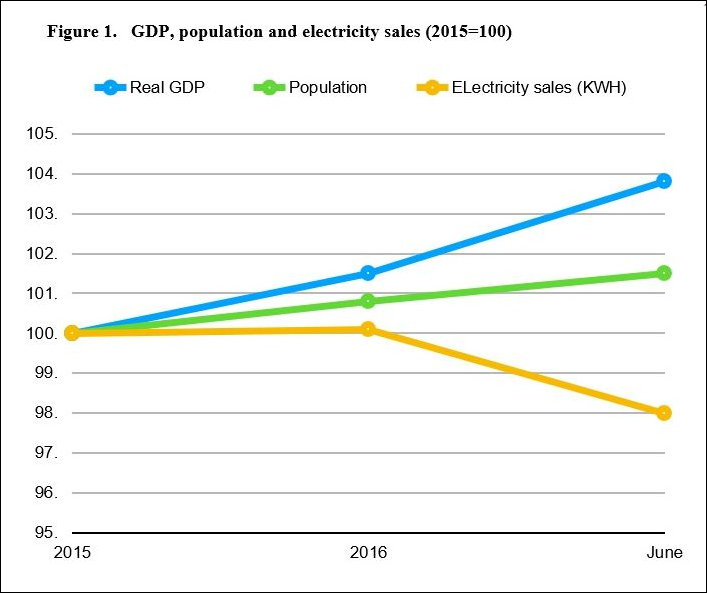
U.S. electricity consumption fell 2.1% in 2017, according to Oilprice.com. As energy-efficiency measures have taken hold, electricity sales have declined seven in the past 10 years. Such numbers do not bode well for electric utilities banking on increased demand growth to justify construction of new power plants. A big question is the extent to which national trends apply to Virginia.
Virginia’s economy differs from the national economy in one important way: The Old Dominion has become a dominant player in the data-center business. Indeed, one could argue that data centers are the biggest economic-development success story in Virginia of the past 10 to 20 years. Data centers consume vast amounts of electricity. And if we want more data centers, which provide a handful of highly paid jobs and loads of tax revenue, we will need to ensure a reliable supply of electricity, preferably renewable.
Dominion Energy Virginia has based the long-range planning in its Integrated Resource Plan (IRP) on an anticipated 1.5% annual growth rate in electricity demand — considerably stronger than demand growth nationally. PJM Interconnection has suggested that Virginia’s growth rate will be slower, but Dominion defends the forecast based on a more aggressive projection in the number of data centers.
The public interest calls for sufficient electricity supplies to accommodate the growing data-center industry and, down the road, a surge in demand from electric vehicles — but not so much as to burden rate payers with excess capacity. Clearly, the trend in electricity demand bears close watching.
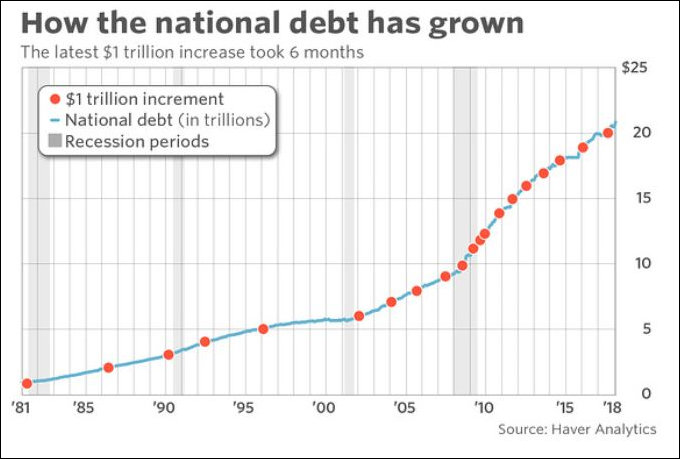
The national debt has passed the $21 trillion mark. It took only six months to get there from $20 trillion. Unlike the last time the U.S. racked up debt this rapidly, the economy is growing, not in a recession. Blame whomever you want — Boomergeddon is coming. It’s just a matter of time.
Microsoft Corp. plans to buy about 60% of the energy production from a massive solar power project in Spotsylvania County to power its data centers in Virginia. The proposed 500-megawatt solar development, called Pleinmont, would include more than 750,000 solar panels on a 3,500-acre site, which, when completed, would be the fifth-largest solar site in the country.
“This is really important to Microsoft, and we think it is really important to Virginia for several reasons,” said Michelle Patron, director of sustainability for Microsoft. “This is going to be the largest corporate purchase of solar power ever in the United States. … We think this puts Virginia on the map for clean energy.”
The Pleinmont solar farm is being planned by Sustainable Power Group LLC, or sPower, which is a joint venture of Arlington-based AES Corp. and Canada-based investment fund AIMCo, according to the Richmond Times-Dispatch.
The project still requires approval by the State Corporation Commission. The commission has scheduled a public hearing in May and is soliciting public comments.
Microsoft has said that it has met its target to power at least 50% of its data centers with clean energy by 2018, and the company wants to achieve 60% clean energy by early 2020, says the Times-Dispatch. In 2016 the company had agreed to buy power from a 20-megawatt solar farm in Fauquier County.
Bacon’s bottom line: In all the excitement over grid modernization and the rollback of the electric rate freeze in recent months, I totally missed this story. But if Virginia is on track to build the fifth-largest solar facility in the country, and if the deal represents the biggest corporate purchase of solar power ever in the U.S., that’s a big deal!
Previous reporting by the Times-Dispatch noted that Pleinmont would sell its electricity into the PJM interstate wholesale power market to companies that want to offset their electricity consumption with power produced by renewable sources of energy.
Does this deal cut Dominion Energy Virginia out of the picture as an electric power generator? Does this represent a new strategic direction for Microsoft and other data-center companies, which are driving the growth in electricity demand in Virginia? In other words, is Dominion’s electric power-generating monopoly being eroded? Five hundred megawatts is a lot of electricity — roughly half the capacity of a new, state-of-the-art natural gas-fired power plant.
Or will Dominion swoop in later, as it has in several other solar deals, acquire the Pleinmont property, and count it towards its commitment to build 5,000 megawatts of solar power, as codified in the recently passed Grid Modernization and Security Act?
One more question: What does this mean for natural gas demand in Virginia?Data centers consume electricity 24/7, but solar power generates power only 12 hours per day (with output varying by the time of year). Where will the electricity come from in off hours? Do deals like this bolster or obviate the need to build any new gas-fired plants?
Figures released this week revealed that sales of the jambon-beurre – the ham and butter baguette sandwich, a classic of French snacking – have been surpassed by sales of American-style burgers.
The study by restaurant consultants Gira Conseil showed that about 1.2 billion ham and butter sandwiches were sold in 2017, while 1.4 billion burgers were eaten over the same period.
I love it! Good thing the French don’t have laws against cultural appropriation!
Appropriate away! I would love to see what the French can do with the hamburger. I’ll bet they take a great thing and make it even better!
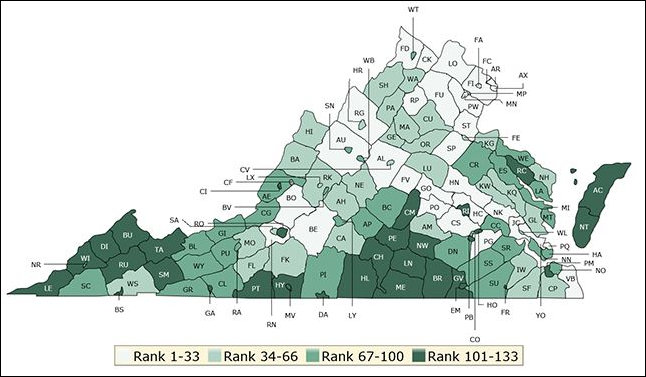
City/county ranking of Virginia health outcomes based on potential years of life lost before age 75. Source: Robert Wood Johnson Foundation
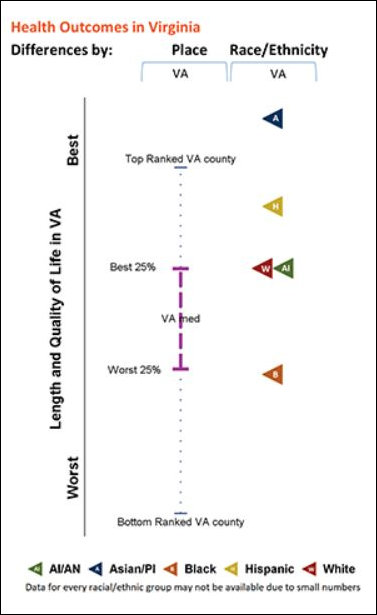
The Robert Wood Johnson Foundation has issued its annual Healthy Community report for the United States. As usual, the information is packaged in such a way as to highlight the health disparities between racial/ethnic groups. But the findings for Virginia, which the state-level report largely overlooks, do not fit the dominant institutional-racism narrative. It turns out that Asians are the healthiest racial/ethnic group by far. It also turns out that, despite lower incomes and education levels, Hispanics are healthier than whites. The only finding that conforms to the narrative is the blacks are the least healthy of any group.
The info-graphic to the right shows differences in health outcomes (potential years of life lost before age 75) by place and by race/ethnicity. The “place” metric compares the differences in health outcomes by city or county. There is a wide disparity (as also seen in the map above) between localities with high incomes and high levels of education and localities with low incomes and education. The worst pockets of unhealth are in far Southwest Virginia, Southside, the Eastern Shore, and older cities. No surprises there.
Far more interesting is the disparity between racial/ethnic groups, which many researchers and commentators persist in defining as a gap between whites on the one hand and blacks and Hispanics on the other — a gap matching the socio-economic divide and consistent with the paradigm of America as a nation afflicted with institutional racism and discrimination.
Yet of all major racial/ethnic groups, Asians are the healthiest. By far. Here in Virginia, according to the study, Asians experienced the lowest level of “premature deaths,” measured by years lost per 100,000 — only 2,600. Hispanics fared next best, with 3,100 years lost, whites with 6,200, and blacks with 8,700.
Another remarkable finding: Whites reported the highest incidence of poor mental health days: 1.6 for Asians, 2.7 for Hispanics, 3.5 for blacks, and 3.8 for whites.
Results conformed to stereotype for poor or fair health, while self-reported “poor health days” showed almost no difference between whites, blacks, and Hispanics. Asians reported the fewest poor health days.
The comparative good health of Hispanics in Virginia is all the more remarkable given that, as the report documents but takes little note of, Hispanics have lower high school graduation rates, have less health insurance, and have a higher rate of teen births than any other group.
Asians and Hispanics do not fit the dominant narrative of the relationship between race and health in the United States. It strikes me that these anomalies are worth exploring. Persuading public health researchers to dig deeper may be a hard thing to do, however. The received wisdom, once established, is a hard thing to dislodge.
How safe are Virginia’s nuclear power plants from terrorists, hackers and natural disasters? Let’s put it this way: Dominion worries about such threats 24/7 so you don’t have to.
In addition to interfering in U.S. elections, Vladimir Putin’s busy cyber-servants have been probing information technology weaknesses in U.S. industry and infrastructure. Sophisticated cyber-attacks have been ongoing since at least March 2016. Perhaps most alarming, the Department of Homeland Security asserted last week, Russian hackers gained access to critical control systems at unidentified nuclear power plants.
“We now have evidence they’re sitting on the machines, connected to industrial control infrastructure, that allow them to effectively turn the power off or effect sabotage, the New York Times quoted Eric Chien, a security technology director at digital-security firm Symantec, as saying. “They have the ability to shut the power off. All that’s missing is some missing political motivation.”
Journalist Ted Koppel highlighted the vulnerability of the U.S. electric grid to attack in his 2016 book, “Lights Out: Cyberattack, a Nation Unprepared, Surviving the Aftermath.” Novelists have imagined the horrifying societal collapse following the collapse of the electric grid. As for nuclear plants, the potential for radioactive contamination makes the threat even more terrifying. Fear-inducing scenarios involve terrorist takeovers, the theft of spent radioactive fuel, and jetliners slamming 9/11 style into nuclear reactors.
The issue of security was top of mind for me when I toured Dominion Energy Virginia’s North Anna Power Station last month. I had the opportunity to pose the kind of questions that members of the public might ask.
I’m not qualified to render judgment on the effectiveness of Dominion’s security efforts, but I can say one thing: Security at the nuclear facility is something the company thinks about around the clock. Utility officials have spent enormous time and effort anticipating and preparing for any scenario you can imagine. Earthquake? Check. Hurricane? Check. Cyber-attack? Check. Armed terrorist attack? Check. Hijacked airplane flying into the nuclear containment dome? Check.
Based on what I learned, I’m not worried about natural disasters or terrorist attacks. The threat of cyber-sabotage continues to unsettle me, but the danger is to the transmission and distribution grid, not to nuclear power plants. Dominion officials assured me — and for a simple reason that I shall explain in due course, I believe them — that their nuclear power plant controls are not vulnerable to a cyber-threat.
If there had never been a Chernobyl or Fukushima, I might not even be asking these questions. As it is, those calamities did occur. We learned that, as thorough as they try to be, nuclear engineers don’t foresee every conceivable contingency. With nation states from Russia and China to Iran and North Korea seeking to penetrate and compromise our infrastructure, we need to keep up our guard. At the same time, we should avoid creating unnecessary alarm. So far, I’ve seen nothing that makes me lose any sleep.
Earthquakes, hurricanes, and aircraft strikes
On August 23 at 1:51:04 p.m., the control room of the North Anna Power Station began to shake, as if it were sitting on a giant vibrating phone, recalls Lee Baron, who worked in the control room then and now runs the company’s simulation center. Lights on the control board began blinking. Alarms emitted shrill beeping noises. Tiles fell from the ceiling. Outside the facility, some electric transformers cracked.
The earthquake, the worst trembler to shake the East Coast in at least a century, exceeded what the power station had been designed for, says Baron, but the facility “shrugged it off.” Following Electric Power Research Institute guidelines, the operators powered down the plant without incident. After minor repairs and two months of intensive inspections, the nuclear station was up and running again.
Media attention focused on the fact that the North Anna station was located on an ancient geologic fault line. The fact that the epicenter of the earthquake was just a few miles away under the town of Mineral led many to conflate the two. But, the two fault lines were unrelated, says Richard Zuercher, manager-nuclear fleet communications for Dominion.
Indeed, as College of William & Mary geologist Chuck Bailey concluded in a 2012 review of maps, photos, and reports, the fault underlying the North Anna Power Station had last been active about 200 million years ago. On the other hand, as the Mineral earthquake demonstrated, the geologic plate upon which the East Coast rests was more active than previously supposed.
Unlike some earthquakes that have a highly localized impact that creates heavy damage, Zuercher says, the Mineral shaker, which registered 5.8 on the Richter scale, diffused its energy and caused light damage over a vast area. The quake was felt as far away as Atlanta and New Brunswick. Virginia does not face a California-like threat of a massive killer quake.
Hurricanes and tornadoes are another theoretical threat. The concern is that wind might pick up a cars or telephone poles and hurl them like projectiles. The nuclear reactors, a third of which are underground, are protected by massive containment domes made of compressed concrete lined by steel plate and reinforced by steel rebar.
The 4 1/2-feet-thick dome wall“is built to take a licking,” says B.E. Standley, the Dominion executive in charge of nuclear power plant safety. “It can survive anything short of an asteroid strike or zombie apocalypse.”(more…)
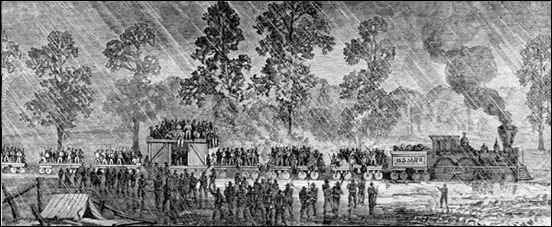
On an abnormally warm early Spring day, I took a 150-mile motorcycle ride from Portsmouth to Stony Creek, Va. That’s where my Great Great Grandpa was captured by federal forces in 1864. He rode with the South Carolina 6th Insurgent Calvary (Aka: the Dixie Raiders), which fought in nearly every major engagement in Virginia from 1862 until the surrender.
Before visiting Stony Creek I had no idea of the importance of the place. I presumed that it was just an outlier to the defense of Petersburg. But from talking to some old timers who live there today, I learned that Stony Creek was a critical logistical hub for the Army of Northern Virginia and a focal point of the lengthy siege of Petersburg, the loss of which precipitated General Lee’s calamitous retreat towards Appomattox and the end of the Civil War.
Stony Creek lies to the west of Interstate 95 between Emporia and Petersburg. During the siege of Petersburg between June 1864 and March 1865 nearly all the supplies to the Confederate defenders — including those from Wilmington, N.C., the only Confederate port not blockaded on the East Coast at the time — came up the Petersburg and Weldon (now CSX Railway) into the Stony Creek depot. Goods were offloaded from the trains and put onto wagons and hauled on plank roads through the back woods and swamps to Petersburg, 25 miles to the north.
During the siege of Petersburg, a largely static affair, a series of engagements were fought over Stony Creek. In June, the Confederates turned back a Yankee cavalry foray, but not until the raiders had torn up 60 miles of railroad track. General Grant ordered another raid in December, which the defenders likewise repulsed. But the attack disrupted the vital supply line, doubling the distance supply wagons had to travel and exacerbating the Army of Northern Virginia’s shortages of ammunition, food, and medical supplies.
By March it was clear that Lee could no longer hold on. After a series of reversals, he evacuated Petersburg. In full retreat, the Army of Northern Virginia would fight only a couple more engagements before being forced to capitulate at Appomattox Court House on April 3rd.
I don’t know exactly where my Great Great Grandpa Randolph Page was captured at Stoney Creek, or where he was imprisoned. Many Confederate Calvary POWs were incarcerated on the Eastern Shore. But one thing is recorded – he was given ten dollars in gold, at discharge and walked on foot back to Landrum, S.C. Upon arriving at his log cabin and farm, he stripped off his lice-infested uniform, burned it, shaved off his hair and scrubbed his body down with lye soap in the creek. Thereafter he returned to the plow and put the war behind him.
Today Stony Creek is a little rural community in sad shape, and hanging by a thread. Cars and trucks whiz by on I-95 and and pay no mind. The BBQ pit and little antique shop, once easily accessible on old I-301, are off the beaten track. The billboard next to the BBQ displays the rust of over 50 years, as worn sign paper and gauze wisp gently in the breeze like curtains to the past.
The town’s history is being forgotten as those who remember get older. But the rail that brought in supplies and ammunition is still there, as are the winding roads where muleskinners ported supplies from the depot to Petersburg. A cannon abandoned in the swamp rests on the main street. The one-room Sappony Baptist church — where Confederate infantrymen fought off a company of Yankees before friendly cavalry ran them off — still stands. The church bears the scars from where a Yankee cannon ball punched through the front wall and a bullet hit the church Bible. Today, the wall’s hole is patched with tin and the church is sided with vinyl.
A wealth of knowledge about the Civil War resides in small communities like Stony Creek, but it is dying. I talked to the locals and encouraged them to print a flyer with a brief history of Stony Creek and a map showing the battlefields and the plank road routes that channeled supplies to Lee’s defenses. Virginians in communities across the state should do likewise, and put up materials on a common statewide History and Tourism website. Tourists could download and print these maps and history as guides or view them on their smart phones.
This would be a great project for the Sons of Confederate Veterans, indeed a project in which all Southern states could participate. Creating a platform for small communities to tell their story of Virginia’s defense and the Confederate cause would lift local spirits and stimulate tourism. History could be brought to life for a new generation, as folks discover the little places, now forgotten, that played significant roles in history.
Stony Creek is a great day trip on a motorcycle or an open convertible on a warm sunny day. I encourage Virginians to visit the place and learn about the history of which we all are apart.
Cliff Page, a sculptor, lives and maintains his studio in Portsmouth.
The biggest obstacle to enacting a state budget is the disagreement between the Senate and the House of Delegates over Medicaid expansion. But even if legislators could resolve their Medicaid differences tomorrow, Finance Secretary Aubrey Layne said earlier today, they still would have to resolve a $400 million gap over other programs.
The second largest funding disagreement revolves around higher education, Layne told members of the State Council of Higher Education for Virginia at a monthly meeting at Christopher Newport University.
According to data SCHEV distributed at the council meeting, the House Appropriations Committee has budgeted $218.8 million in additional dollars for education over the biennial budget between 2018 and 2020, while the Senate Finance Committee has allocated only $94.7 million in new dollars. Most of the gap can be traced to differences in three areas: funding for the Cyber X cyber-security education initiative, faculty pay raises, and financial aid.
Layne voiced no preference for either the House or Senate higher-ed budgets, but did say that Governor Ralph Northam’s two top priorities are funding the Medicaid expansion and setting aside reserves to bolster Virginia’s precarious AAA bond rating.
While the budget outlook for the current fiscal year, 2017-18, is improving, Layne said he is not willing to bridge the funding gap by assuming stronger revenues for 2018-19. Year-to-date personal income tax revenues are up about 6% this year, considerably ahead of the forecast 3.5%. The federal tax cuts appear to be having a stimulative effect on income. December saw a $200 million revenue jump, but he doesn’t know if that reflects a surge in income or a burst of early payments to take advantage of the state-and-local tax deduction before the new tax law eliminates it.
Other signs are favorable — revenue from the sales tax is up, as is the recordation tax on home sales — but Northam wants to dedicate any surplus funds to building up the state’s rainy-day fund.
The Standard & Poor’s rating agency has given Virginia a negative outlook on its AAA bond rating. “They don’t like to see one-time revenues pay for ongoing expenses,” said Layne. Also, he said, “they like to see bigger financial reserves” — 3% to 8% of revenues. The budget introduced by former Governor Terry McAuliffe put an additional $270 million into the reserve for a more than $100 billion two-year budget. The House budget would do less; the Senate budget would do more than the House’s.
Bottom line: However the economy performs for the rest of the fiscal year, there won’t be any loose purse strings to paper over the differences between the House and Senate versions of the budget.
In other remarks, Layne opined on his philosophical approach to the budget. A big concept in the private sector is “fiduciary responsibility,” said Layne, who had been president of Virginia Beach-based Great Atlantic Management before joining the McAuliffe administration four years ago as secretary of transportation. If he violated the highest standards of care for a client, he could get sued or fired. He applies the concept of fiduciary to his job working for state government. His duty is to the citizens of Virginia.
Virginia citizens are paying federal taxes to pay for the Medicaid expansion enabled by the Affordable Care Act. To live up to his fiduciary responsibility and get that money back, Layne supports expanding Medicaid as allowed by the law. One argument he’s heard against expansion is that the federal government can’t afford the program, it’s going bankrupt. To the contrary, said Layne, the federal share of Medicaid expansion is paid by taxes enacted by the Affordable Care Act. It’s not deficit spending. A second argument he’s heard is that the feds can’t be trusted not to renege on its payments. But that possibility is covered by a codicil in the budget that says if the feds back out, the state can back out of the Medicaid expansion, too.
Layne suggested that there is a serious mismatch between Virginia’s tax base and its spending priorities.
Drawing upon his experience as transportation secretary, he noted that the Commonwealth collects roughly $2.5 billion a year in revenue for transportation. Of that sum, only 20% or so pays for new construction; the rest goes to maintenance and operations. The reliance upon the gasoline tax has eroded the transportation revenue stream. As cars get better gas mileage — and as electric vehicles phase out the internal combustion engines — gasoline consumption and revenues decline. In theory, Virginia could switch to a Vehicle Miles Traveled tax, a true user fee. But that creates privacy concerns. To raise revenue, the state has resorted instead to increasing tolls. Nobody likes tolls, but they are a user fee, and they do expose the true costs of transportation.
Once upon a time, transportation funding did not compete with General Fund priorities. said Layne. Now transportation gets a share of the state sales tax, which puts pressure on priorities like education and health care, both of which are funded through General Fund revenues like the sales and income taxes.
What’s the answer? Update the tax structure, which is based upon an 20th-century industrial economy, to one that is based upon a 21st-century knowledge economy. Internet sales are not taxed — although that may change, depending upon an upcoming U.S. Supreme Court ruling. Services are not taxed. Perhaps they should be.
At a broader level, Layne said that Virginia needs to adopt a rigorous approach to formulating the state budget. What kind of services do we need? What money do we need to fund those services? And where does that money come from? “That’s the kind of analysis that not just us, but the country, will have to go through.”
Wow, ever since winning federal recognition as an Indian tribe, the Pamunkey Indians are on a tear. Last week I highlighted PamunkeyNet, a proposal to bring broadband Internet service to rural counties in the Chesapeake Bay region. Now, we find out that the Pamunkeys are thinking bigger… way bigger.
According to Daily Press, the Pamunkey Indian Tribe is looking for land to build what it envisions as a $700 million gaming center that features shows, a spa and a hotel. The project would employ some 4,000 full-time workers and would have a $200 million payroll. Not bad when you consider that the Pamunkeys number only 380 members!
It’s hard to know what to make of all this activity. Since securing their federal recognition, the Pamunkeys have been conducting negotiations with investor groups that specialize in helping Indian tribes launch similar ventures. The value proposition of Indian tribes is their ability to access federal funds and their exemption from many state and local restrictions.
I’ll be the first to admit to an anti-Pamunkey bias, dating back to 1675 and the original Bacon’s Rebellion. Nathaniel Bacon led a movement comprised mainly of poor farmers and white and black former indentured servants against the corrupt regime of Governor Sir William Berkeley. The Pamunkeys sided with Berkeley. The frontier was notorious for tit-for-tat raids and retaliations between English settlers and Indian tribes, and it is fashionable among historians now to accuse Bacon’s forces of making indiscriminate attacks on innocent Indians, including the Pamunkey. Bah! Politically correct thinking infects everything! I reject it. Cross Nathaniel Bacon for whatever reason, and you’re on my black list.
I bear modern-day Pamunkeys no ill will for the deeds of their misguided ancestors. But I find myself astonished by the sudden good fortune about to be showered upon a handful of tribesmen by virtue of their ancient lineage. Whether they succeed in building a casino or not, it seems they have hit the proverbial jackpot.
Judging by the Daily Press article, the Pamunkey tribe has an enlightened attitude. It is using its privileged status to help the broader community by expanding senior housing, rural broadband services, and job creation.
“We don’t live in teepees; we’re just your neighbors,” said Chief Robert Gray. “We’ve got jobs in Richmond, Mechanicsville, Williamsburg. We’re retirees, kids … right now we can use HUD (U.S. Housing and Urban Development) funds, the Indian Health Service. But wouldn’t it be great if we paid for our own health care — more self-sufficiency, more self government.”
The Pamunkeys sound like good neighbors. And I respect the fact that they have managed to maintain a distinct identity for hundreds of years. But in the irony of ironies, they are adopting a strategy that’s become as American as mom and apple pie — working the leviathan state for privileges and favors. They’re joining the ranks of the rent seekers. What a shame.
The year: 2075. The American colonies on the Moon are getting restless under Washington’s tyrannical rule….
This second edition of “Dust Mites” has a snazzy new cover, includes helpful lunar maps, and is 5,000 words tighter than the original. The sequel, “Trogs,” is scheduled for publication this summer.
Advertisement
Advertisement
Advertisement
Advertisement
About
Bacon’s Rebellion is Virginia’s leading politically non-aligned portal for news, opinions and analysis about state, regional and local public policy. Read more about us here.
Fund the Rebellion
Shake up the status quo! Your contributions will be used to pay for faster download speeds and grow readership. Make a one-time donation by credit card or contribute a small sum monthly.
Can’t wait until tomorrow
For your Bacon’s Rebellion fix?
Enter your email address to receive immediate notifications of new posts by email.
SUBSCRIBE
Search Bacon’s Rebellion
Categories
Archives
The Jefferson Council
Protecting Thomas Jefferson’s Legacy at the University of Virginia
Forgot Your Password?
Shoot me an email and I’ll generate a new password for you.

 I visited my daughter Sara the other day and was amused to note that delivery services had dropped off two cardboard boxes in front of her house. When I stepped inside, there was a third box, still unopened. Three packages delivered in one day. Wow, thought I. My wife and I might average one delivery per week. Upon my further inquiries, Sara revealed that she also had begun ordering her groceries online and having them delivered to her doorstep as well.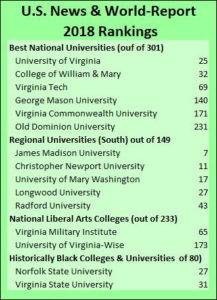




 The info-graphic to the right shows differences in health outcomes (potential years of life lost before age 75) by place and by race/ethnicity. The “place” metric compares the differences in health outcomes by city or county. There is a wide disparity (as also seen in the map above) between localities with high incomes and high levels of education and localities with low incomes and education. The worst pockets of unhealth are in far Southwest Virginia, Southside, the Eastern Shore, and older cities. No surprises there.