
My sentiments exactly. — JAB
My sentiments exactly. — JAB
By Steve Haner

Dominion Energy Virginia has run additional projections on its future energy demand and how to meet it, and the answer keeps coming back that Virginians will need more – not less – natural gas-fired electricity in the next 15 years. The supplemental data was filed with the State Corporation Commission Friday and added to the case file.
Just before the State Corporation Commission received Dominion Energy Virginia’s new integrated resource plan back in October, it issued an order for the company to provide more information. Some opponents of the utility’s plans to add to its natural gas generation expected the additional data to bolster their case it could be done without gas.
Yet gas power continues to turn up in the company’s model runs (we all know how environmental activists trust models) even when Dominion removes the growth in its demand coming from the explosion of data centers in its region. More gas turns up even when the model is set to fully comply with the anti-gas Virginia Clean Economy Act and even when the model is told to comply with the Environmental Protection Agency’s new power plant emission rules. Dominion wrote:
The results of the modeling sensitivity analysis show that even with updated capacity pricing and removing the data center load growth:
There is still an incremental capacity need.
The model does not choose to retire any existing generation.
Renewable and dispatchable generation is needed to meet demand in all sensitivities.

by Todd Truitt
Northern Virginia school districts have settled on their latest attempt to avoid greater transparency: asking the Virginia legislature to “delay” the implementation of the new school accountability system by an additional year, claiming the new system’s 3-year development and implementation period is “rushed.”
The effect of this request would be to push the full implementation until fall 2026, after a new governor and legislature will have taken office. One of the districts’ legislative directors publicly “suggested that an all-out battle to overturn the new rules was less likely to win support in the General Assembly [this legislative session] than an effort to delay them.”
The districts likely hope to replicate the 2015 precedent of the repeal of an A-F accountability system by then-Governor Terry McAuliffe prior to its implementation following its 2013 enactment under his predecessor, Governor Bob McDonnell. (For clarification, the new system uses descriptive summative labels as advocated by civil rights organizations.)
When reached for comment, Virginia Secretary of Education Aimee Guidera said: “The new accountability system is about seeing every child, meeting every child where they are, and getting every child and school what they need to be successful.” She also pointed to the state’s recently released data showing what school scores would have been if the new system had been in place. Guidera contrasted such information vs. the old system’s under-identification of schools needing help, lack of practical data for the general community, and resulting negative impact on the civil rights of Virginia communities, parents and students.

I inserted an incorrect link to register for Willfred Reilly’s December 5 speech at the University of Virginia. Here is the correct link.
++++ sponsored content ++++
by James A. Bacon
In 1995 James W. Loewen wrote a provocatively titled volume, Lies My Teacher Told Me, which proffered leftist interpretations of topics that allegedly had been sanitized from American history books. Two decades later, Wilfred Reilly has put his own spin on Loewen’s book title and American history in Lies My Liberal Teacher Told Me.
Reilly could have just as well have called the book Lies My Leftist College Professor Told Me, for every one of the narrative myths he debunks originated in academe and flourish there today. Here is a sampling:
Lie #1: Brutal “True” Slavery Was Virtually Unique to America and the West;
Lie #3: Native Americans Were Peaceful People Who Spent All Day in Dancing;
Lie #6: European Colonialism Was — Empirically — a No-Good, Terrible, Very Bad Thing;
#10: Bonus Lie: The Continuing Oppression Narrative.
For anyone fed up with the woke mind virus, Reilly’s books — which include Taboo: 10 Facts You Can’t Talk About, and Hate Crime Hoax: How the Left Is Selling a Fake Race War — are a joy to read.
I expect his speech, hosted by The Jefferson Council and the Young Americans for Freedom December 5, 7:00 p.m. to 9:00 p.m. at the University of Virginia, to be equally entertaining. The title: “Narrative vs Reality – from UVA to the USA and Beyond.” (To register click here.)

by James A. Bacon
Governor Glenn Youngkin is rightly concerned about the housing shortage in Virginia, which drives up living costs and throttles economic growth. Yesterday he announced a plan to spend $75 million over five years to catalyze investment of $750 million and build 5,000 units to accommodate a growing workforce. But he acknowledges that massive regulatory reform is needed to bring supply in line with demand.
“With record employer relocations and expansions in the Commonwealth, over $85 billion in capital investment, nearly 250,000 jobs created, and a reversal of recent trends on net-out migration, it is clear that Virginia is growing and we need to make sure the supply of housing can meet our surging demand,” Youngkin said in Executive Order No. 24 issued yesterday.
Resumption of Virginia’s economic growth is very good news indeed. As the executive order notes, “Virginia now ranks among the top ten states for overall job growth, with 250,000 more jobs filled today and more than $85 billion in new capital commitments from employers relocating or expanding operations in the Commonwealth.” In a reversal of recent trends, it adds, more people are moving into Virginia than moving out.
In the Governor’s own analysis, however, Virginia needs to build 550,000 units to match existing demand, plus an additional 30,000 units per year to match the state’s growth. The Workforce Housing Investment Program will create only 1,000 units per year.

Hopeful news in a time of gloom: forty-six state attorneys general across the United States have banded together in a bipartisan coalition to defeat a common hated enemy: illegal robocall operators.
Attorney General Jason Miyares, a Republican, and his fellow AGs have called on the Federal Communications Commission (FCC) to close a loophole in the Robocall Mitigation Database that allows bad guys to exploit access to the U.S. telephone network.
“When was the last time anyone was thankful for a robocall?” Attorney General Jason Miyares says in a press release issued today. “Not only are robocalls annoying, they can also rack up billions of dollars through scams targeting the most vulnerable.”
Let’s not mince words: robocallers are vermin. They must be exterminated. The AGs are doing God’s work.
by Kerry Daugherty

For years Virginia Beach had struggled with April’s annual “Beach College Weekend” which drew thousands of kids from historically black colleges and universities to the Beach. Unfortunately, the event also drew local dirtbags and gangs. As a result, the weekend became a crime convention and instead of making money, businesses locked up.
Along came Pharrell Williams.
Determined to rescue his hometown, Pharrell worked with city officials to turn the problem weekend into a festival. In 2019 SITW was a roaring success. In fact, there were fewer weekend crimes than usual, despite tens of thousands of festival goers.
I was there on Saturday night and even though my musical tastes are more Luke Bryan than Pusha T, I loved it. Portsmouth’s Missy Elliott put on a show and Pharrell and Timbaland were terrific. On Sunday morning I rode my bike back to the festival for Pharrell’s beach worship service and inspired gospel music.
It’s been a catastrophe ever since. First the covid lockdowns stupidly put an end to outdoor concerts (thank you Ralph Northam, worst governor ever) and then the shooting death of Donovon Lynch – Pharrell’s cousin – by a police officer, led to a bitter battle between the superstar and the city.
by James A. Bacon
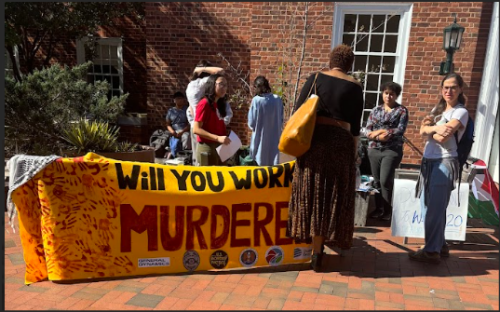
More than 60 employers showed up to the University of Virginia’s 2024 job fair on Oct. 23 to offer job and internship opportunities to UVA students. They were greeted civilly by most — but not by everyone. The Dissenters, a militant pro-Palestinian student organization, targeted companies deemed complicit with Israel.
The Dissenters set up a table outside Newcomb Hall. “Will You Work for Murderers?” proclaimed a banner as activists handed out literature and talked to passers-by.
Activists have the right to free speech like everyone else. What they don’t have a right to do is disrupt the activity of students looking for employment opportunities. Dissenters submitted fake resumes and promised a $20 reward to students who could waste the attention of corporate recruiters for the greatest length of time.
by Dick Hall-Sizemore
FROM THE SOAPBOX

A New York Times news analysis outlines the sad condition of government and politics in the modern United States.
Over the last two years, the Republican-led House of Representatives was essentially dysfunctional. A Speaker was ousted and a long, bitter fight ensued before a replacement Speaker could be elected. Along the way, the country narrowly escaped defaulting on its debt payments and skirted government shutdowns over disagreements on the budget. On those critical issues, both Speakers had to turn to Democrats for the necessary votes. Hardly anything of substance was accomplished as Republicans fought with each other for most of the two years. Several Republican members publicly decried the dysfunction and chaos and predicted that the party would pay a political price.
In the end, they did not pay a political price. It seems that the American people have returned enough Republicans to the House for the party to again have a slim majority. Rep. Patrick McHenry, Republican of North Carolina, and chairman of the House Financial Services committee and interim Speaker, had this observation on the prospect that his party would retain control of the House: It’s “proof that the American people don’t pay attention to the details of our politics.” He then corrected himself and said, “It’s probably less about paying attention and more about not caring.”
by James A. Bacon
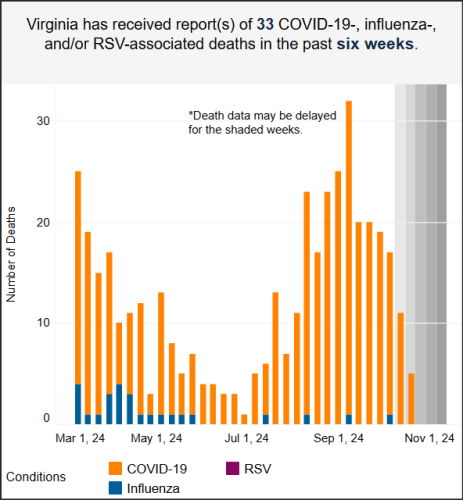
In the previous post I criticized Virginia’s response in 2020 and 2021 to the COVID epidemic, particularly the shutdowns that ignored the impact on jobs and the economy, foregone medical procedures, K-12 schooling, mental health and addiction. Let me emphasize: that’s not to say that COVID was not a huge public-health issue then… or that it doesn’t continue to be one.
The Virginia Department of Health (VDH) has revamped the COVID-tracking features on its website, lumping in COVID with influenza and RSV under the heading of “respiratory diseases.” COVID is much diminished as a public health threat from its peak, but according to VDH still far exceeds influenza as a cause of mortality. Here’s a look at the past eight months:
by James A. Bacon

Opioid deaths in Virginia have declined markedly since the end of the COVID epidemic, reports Virginia Public Media (VPM). The fatalities, many of which were attributable to fentanyl overdoses, peaked at 2,229 in 2021 and have fallen to a predicted 1,552 this year — down 30%.
That number is still frightfully high, of course. It exceeds the 907 automobile deaths, 520 homicides, 54 workplace fatalities, and 38 child-abuse fatalities all combined in 2023.
What accounts for the drop, even as the flow of fentanyl across the U.S. border with Mexico continues unimpeded? VPM cites Gov. Glenn Youngkin’s Right Help, Right Now initiative which invests in education, prevention, recovery and treatment efforts. The article also describes at considerable length the increasing availability of naloxone, a medicine that quickly reverses an opioid overdose.
Those measures have been very helpful, I’m sure. But the account overlooks the obvious: the overdoses peaked during the height of the COVID epidemic, and the numbers began declining as the epidemic receded. Could there be a connection there?
Hold on… hold on… I’m thinking…

by James A. Bacon
Once again the University of Virginia Board of Visitors is conducting the ritual of pretending to be involved in setting rates for tuition, fees, room and board, this time for the 2025-26 fiscal year. The board’s Finance Committee met earlier this month for an hour and forty-five minutes to hear presentations by UVA staff. Other than an introduction by Finance Chair Robert M. Blue, the minutes record no comments or questions by any board member.
Blue framed the purpose of the meeting as, in the phrasing of the minutes, “educating and orienting committee members to some key issues that align with actions on the agenda in December.”
He then turned over the meeting to Chief Operating Officer J.J. Davis to provide “some useful historical context to set the stage for upcoming actions, and to help committee members make decisions from an informed perspective.”
Gaining an “informed perspective” did not extend to allowing committee members to ask substantive questions about UVA’s cost structure or high-tuition/high-aid financial model. Several board members appointed by Governor Glenn Youngkin have pushed for cuts to the university’s administrative staff but have been unable to open up the issue in the finance committee, much less in the full board. Finance Chair Blue and Rector Robert Hardie (who functions as chair of the full board) are both holdovers from the Northam administration. With President Jim Ryan, they control the agenda. Divisions among Youngkin appointees and don’t-rock-the-boat guidance from the Governor’s Office have stymied any action by reformers.
by James A. Bacon

The United States has spent trillions of dollars on poverty programs, yet hard-core inter-generational poverty and its attendant social ills remain endemic. Federal and state benefits are not lavish, and they are contingent to some degree upon recipients finding work, or at least looking for work. But anti-poverty programs are doing a terrible job of lifting people out of poverty. While individual programs might make sense, the system of programs is dysfunctional. Ameliorating poverty will require addressing the system.
That’s my takeaway from a recent report by the Joint Legislative Audit and Review Commission (JLARC), “Virginia’s Self-Sufficiency Programs and the Availability and Affordability of Childcare.”
A mother and child living in the Richmond area and “on welfare” can reap about $1,900 a month ($22,800 a year) in benefits, as seen in this JLARC graphic:
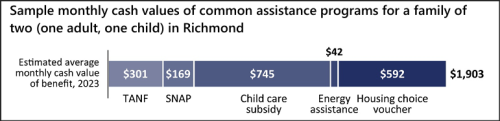
I cannot imagine trying to support a child on $22,800 a year, which is only a tad above Federal Poverty Level of $20,400. It must be noted, however, that JLARC’s list does not include Medicaid (average spending per enrollee in Virginia of $7,000) or the Earned Income Tax Credit (worth up to $4,000 for a family with one child). Nor does it take into account private charity such as food banks or the vast underground economy, estimated at more than $1 trillion, in which many people (including the poor) take money under the table.
The year: 2075. The American colonies on the Moon are getting restless under Washington’s tyrannical rule….
This second edition of “Dust Mites” has a snazzy new cover, includes helpful lunar maps, and is 5,000 words tighter than the original. The sequel, “Trogs,” is scheduled for publication this summer.
Bacon’s Rebellion is Virginia’s leading politically non-aligned portal for news, opinions and analysis about state, regional and local public policy. Read more about us here.
Shake up the status quo! Your contributions will be used to pay for faster download speeds and grow readership. Make a one-time donation by credit card or contribute a small sum monthly.
Enter your email address to receive immediate notifications of new posts by email.
SUBSCRIBE
Protecting Thomas Jefferson’s Legacy at the University of Virginia

Shoot me an email and I’ll generate a new password for you.
