
by Steve Haner

Dominion Energy Virginia’s ongoing program to place selected neighborhood service lines underground, spreading the bill for the upgrades onto all its 2.7 million customers, will cost another $3.8 billion if the General Assembly blesses its extension for another ten years.
Of that, about $1.6 billion is the cost of the construction work and $2.2 billion (58 percent) will be to pay interest to the lenders or profit to the stockholders who put up the working capital. Those numbers are from an analysis provided to a curious legislator by the State Corporation Commission’s staff in a letter earlier this week.
Almost a third of the money will come from the utility’s commercial and industrial customers (yes, including the scapegoated data centers), the SCC reported. But the upgrades being financed will benefit few if any business customers. An earlier report on Bacon’s Rebellion extrapolating data from an SCC case file had some similar cost projections.
When it is the business customers subsidizing electricity for homeowners, nobody in the legislature squawks at all. Politicians only feign outrage if homeowners think they are subsidizing businesses. And none of them dares admit how much profit their favorite political donor is making from all this. (If half the financing is equity, not debt, more than a billion dollars in profit is a pretty good payoff for $20 million in campaign donations. And this is hardly the only 2026 bill enriching the utility.)
Another little tidbit that can be gleaned from the letter. The legislation puts a cap of $900,000 per mile on the underground work, but that is only the construction cost. Add interest or profit payments over time, and the cost is really more than $2 million per mile. Let’s all watch the final discussions of the bill and count the number of times “affordability” is invoked.
The Senate version of the bill, Senate Bill 253 (here is the language as it now reads), will be up in the House Labor and Commerce Committee this afternoon. It passed the Senate 39-0. A similar if not identical bill cleared that committee and passed the House 66-31, so the outcome is not really in doubt. There won’t be testimony and might not be any debate.
It is the bill that also includes the provision allowing Dominion to ask – ask – the SCC about transferring all its energy capacity purchases and some of its transmission costs onto the scapegoat, er, the large data centers. Should the SCC grant that and rejigger traditional allocations between the customer classes, everybody but the data centers would see a decrease for about seven years.
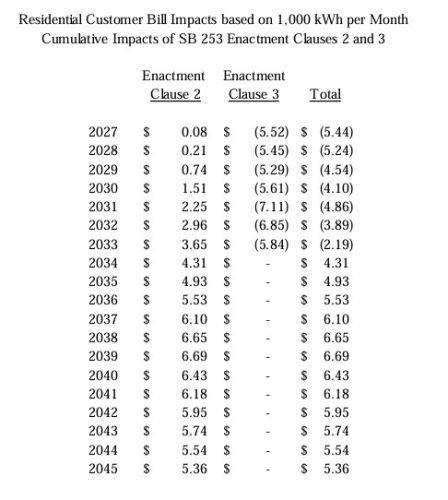
The increased costs from the undergrounding program are a sure thing but the potential savings from changing the cost allocation rules are speculative. Do not bet money you need on the SCC approving that. But in the letter sent to Delegate Lee Ware (R-Powhatan), the SCC put the two outcomes in one table to see the net impact. That table is reproduced below.
Neither the undergrounding payments nor the petition to the SCC on cost allocations were part of the original bill discussed back in 2025. Both show up as enactment clauses, with enactment clause 2 being the residential tap line reauthorization and enactment clause 3 being the potential change to what data centers must pay.
Looking forward several years, by the mid-2030s the cost of paying for the underground lines exceeds the savings from altering the cost allocation formula. But again, that changed cost allocation formula may never come to pass. Customers may face only the continuing bill to pay for underground lines for a few of their lucky fellow customers.
That expense must be approved. The SCC is handcuffed. When first authorized about ten years ago, the General Assembly included some of its favorite “magic words” to dictate a specific outcome, as the SCC letter reminds Ware. The phrase in question in the law reads (emphasis added):
Answer: It should first be noted that §56-585.1 A 6 (“Subsection A 6”) of the Code of Virginia, as revised by the 2018 Acts of Assembly, provides that the replacement of 5 certain overhead distribution tap lines with underground facilities is deemed to provide local and system-wide benefits and to be cost beneficial.
Which of course means ten more years of this, at an estimated cost of $3.8 billion (with $2.2 billion of that interest to lenders or profit to stockholders), is “in the public interest” by legislative fiat.
Hat tip: Clean Virginia (don’t you love the strange bedfellows of the legislative process?)
Leave a Reply
You must be logged in to post a comment.