
by Steve Haner
The regional electricity marketplace that serves Virginia, PJM Interconnection, was shocked (pardon the pun) by last year’s high price auction to secure future excess generation capacity, needed for days of tight supply. In response, several changes were made to the process to lower the price faced by the member utilities and their customers.
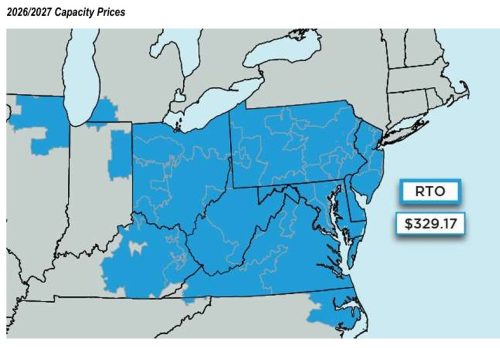
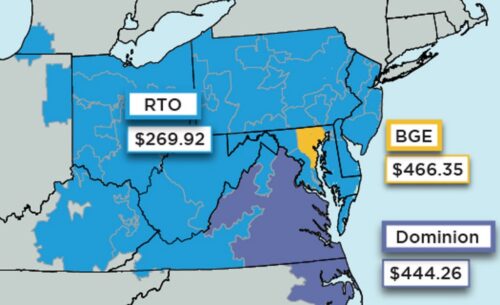
It didn’t make much difference. For the PJM region, the bid price for future firm generation capacity has settled at $329.17. Last year, the price was set at $269.92 for most of the PJM territory. The new price is an improvement for the Dominion Energy Zone, which reached $444.26 in the 2024 auction, and for the Baltimore Gas and Electric Zone, which hit $466.35. For that price, the generator promises to make available one megawatt of generation for the entire day.
The prices from the summer 2024 auction are now being paid by the PJM load serving entities, including Virginians. The auction looks forward by a year, and the new $329.17 price will apply for contracts starting in July 2026. Just two years ago, that price was less than $30 per megawatt day. Compared to last year, the pressure on Dominion’s part of Virginia dropped but utilities in Pennsylvania, New Jersey and other parts of PJM are looking at even higher costs, including those in Western Virginia outside Dominion Zone.
One of the reforms imposed after the 2024 auction was to set an artificial cap on the price. The auction that started last week went right up to that pre-agreed maximum price of $329.17. Without the cap, it likely would have been higher. Does that indicate the rules interfered with finding the correct price?
The underlying supply and demand mismatch that is driving this should concern all energy customers in the PJM region. This is yet another sign that PJM is losing too much of its dispatchable coal and gas generation, although another of the reforms applied was to keep open several plants that were otherwise going to close. Even with that extra supply, prices stayed high. Like the price cap, there is an economics message in that, too.
Utilities and other load serving entities within PJM are required to either make or buy all the power they need with a comfortable reserve margin built in. The last-ditch method to meet that regulation are these firm capacity contracts with generation entities – often not owned by any utility – willing to guarantee availability when called. Until last year the extra cost it imposed on the utilities was negligible. Not now.
The PJM news release on the auction can be read in detail here. One key sentence:
Wholesale capacity accounts for a relatively small portion of retail electricity bills; PJM would expect the cap price to translate to a year-over-year increase of 1.5–5% in some customers’ bills, depending on how load serving entities and states pass on wholesale costs to consumers. Given that prices decreased in two zones, it is possible that consumers in some areas could see a drop in retail rates.
And another one that jumps out:
The cleared resource mix includes: 45% natural gas, 21% nuclear, 22% coal, 4% hydro, 3% wind and 1% solar.
The idea that a hydro plant on a running river or below a lake is a reliable place to turn for a sudden boost of extra electrons makes sense. But obviously the strongest demand was for natural gas, nuclear and coal, and wind and solar drew little interest as reliability backups. All the politics and media hype in the world cannot change that.
In response to the added expense on its operation, Dominion Energy Virginia last year first asked the regulatory State Corporation Commission for permission to tack on another $145 million in charges to customers.
It backed off that approach but now has an application pending with the SCC to transfer the cost of its capacity contracts out of its base rates and couple it with the fuel charge, instead. Unexpected expenses in base rates, which change only rarely, put financial pressure on the company. Fuel costs are adjusted annually and don’t squeeze profits.
How it is collected really doesn’t matter to consumers. It all gets passed on one way or another.
Leave a Reply
You must be logged in to post a comment.