

Northern Virginia’s business community rises from its slumber to address challenges of the AI revolution.
by James A. Bacon
Like the legendary Rip Van Winkle who fell asleep for 20 years and woke up to a whole new world, Northern Virginia’s business community has emerged from its lengthy snooze to realize that it needs to reinvent its regional economy. The result is a new “NOVA Roadmap” that seeks to free the region from its dependence upon federal employment and contracting.
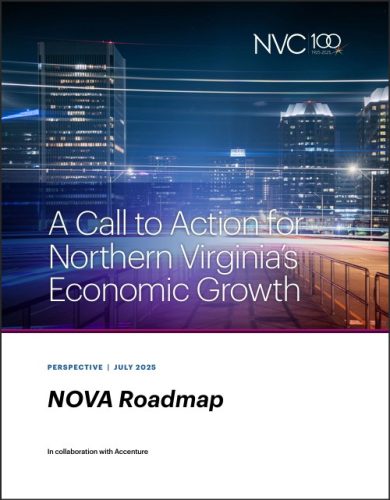
The Fairfax Chamber of Commerce plan seeks to hitch Northern Virginia’s economy to emerging, fast-growth technology sectors by building data centers and other digital infrastructure and creating a new curriculum for developing critical skills needed in the emerging economy.
“’Wait and see’ is not an option,” said Fairfax Chamber CEO Julie Coons when introducing the plan Monday. “Urgent and coordinated action is essential. Recent federal workforce losses could cost Virginia billions in GDP and tax revenue if we fail to act.” (See the Richmond Times-Dispatch account here.)
Northern Virginia was the dynamo that drove economic growth in Virginia for nearly a half century. But the growth machine, dependent upon surging federal spending, has been sputtering for years now. Population and job growth in the Northern Virginia MSA (Metropolitan Statistical Area) have slowed to the point where they have been overtaken by metropolitan Richmond metro, which no one would call a boom town.
NoVa has been choking growth from years past– unaffordable housing, horrendous traffic congestion, and sky-high childcare costs. But those challenges are hardly unique. Silicon Valley is even more unaffordable. A bigger challenge is a corporate culture geared to winning federal contracts, which is antithetical to the pace of innovation and speed to market prevailing in the private sector. NoVa has yet to produce a tech giant capable of competing and surviving in global marketplaces. The region’s one-time superstar, AOL, is long gone. The companies threatening to disrupt the military procurement system upon which the Northern Virginia economy subsists — companies like Palantir — are from outside the region.
The Fairfax Chamber embarked upon its Roadmap last year with concerns about affordable housing and childcare, reports the RTD. But the Trump administration’s downsizing of the federal workforce — the state has lost an estimated 11,000 federal jobs with another 10,500 potentially at risk in coming months — sparked a focus on future jobs.
Frankly, the rethinking is way overdue. There was a time when the Fairfax Chamber and Northern Virginia Technology Council played leading roles in thinking about, and advocating for, state and local policies to promote technology development. I’m not sure how they lost their way, but they’ve been somnambulant for years. We’ve heard little from them. Trump trauma, it appears, has given them a strong whiff of smelling salts.
There is some original thinking in the white paper, which was conducted in collaboration with the Accenture consulting firm, but also some very conventional, business-as-usual thinking. Hopefully, it will prompt the kind of serious introspection the region desperately needs.
The underlying premise of the report is sound: Northern Virginia’s economy is too dependent upon the federal government.
Federal jobs are critical to the region’s competitive advantage and currently account for approximately 15 percent of the region’s job market. Virginia is the largest recipient of federal contracts in the country, which in 2025 amounted to $109 billion and over 441,000 jobs directly dependent upon federal contracts.
As Federal workforce and contractor losses increase, Virginia’s unemployment rate is expected to rise to its highest level since 2021. A 10 percent reduction in the Federal workforce could create $6 billion in total state GDP loss…
The solution: “We call on regional leaders to come together to transform economic development strategies to create growth and drive diversification. … For Northern Virginia to finally shed its dependence on federal dollars and thrive as future-focused industries reshape global markets, we must build an economy that competes by design, not by default.” (Highlight in the original text.)
The paper sets four “bold goals.” I’m not sure how bold they are, but what it’s worth, here they are:
- Develop a new economy and prepare the workforce and digital infrastructure to support it.
- Cultivate affordability for the workforce, creating “equitable access” to affordable housing and childcare that’s grounded in “inclusive participation.”
- Attract sustained investment.
- Rebrand the region as the destination of choice for future-focused industries.
Let’s discuss the first three in turn. (Rebranding the region would be a purely cosmetic move of little value.)
Develop a new economy. The paper identifies emerging high-growth technology sectors — AI, quantum computing, space, biotech, semiconductors, and robotics/autonomous systems. Fine. But guess what. Every other economic development initiative in the country, if not the world, has identified these sectors.
Virginia has been touting the Wallops Island space port for decades, but California, Texas, and Florida have blasted so far ahead of Virginia that Wallops barely registers on the radar. If Texas is the North Star, Virginia is one of the bitty little stars in the Pleiades.
Likewise, NoVa has targeted biotech for years with only modest success. Today’s announcement that AstraZeneca plans to invest billions of dollars to locate the world’s largest pharmaceutical plant in Virginia could be a game-changer, but it’s not clear where in the state that investment will be located.
Virginia has been touting cybersecurity as a growth sector since the McAuliffe administration, if not longer. After all, the military and intelligence communities are huge customers for IT security. But where is the industry innovation occurring? Where are the corporate leaders located? Where are billions of dollars in market capitalization being minted? Not in Virginia.
Picking winners is a fool’s errand. History shows that world-competitive tech clusters tend to start with superstar entrepreneurial success stories — which are inherently impossible to predict — and the supporting infrastructure, business ecosystem and human resources must arise around it. You need the superstar innovator first. All a region can do is to create an environment that is as hospitable as possible to new enterprises.
More than anything, NoVa needs entrepreneurs. As it happens, the timing is propitious. Trumpian cutbacks to federal employment and contracting will liberate resources from the stodgy, innovation-resistant public sector. Perhaps frustrated innovators, now driven by necessity, will start working on that business idea that they had been sitting on. Perhaps a few will catch fire.
A workforce to support the new economy. This section of the report contains what, to me, is the most interesting thinking. Northern Virginia’s workforce, as skilled as it is, will need to “reskill” to support the emerging tech sectors.
“Curricula need to change,” the report says. “The nature of skill-building programs should evolve, too. Flexibility is key. Bootcamps, modular courses, and industry-recognized certifications offer workers rapid, flexible, upskilling options so they can quickly transition into new roles.”
Whether Virginia’s existing institutions are up to the task is an open question. I’d like to see more analysis on that subject.
Modernize the digital infrastructure. Northern Virginia has the world’s largest cluster of data centers, and more than 70% of the world’s Internet traffic is routed through them. Data centers — the rise of which the regional futurists of 20 years ago never predicted as a growth industry, incidentally — gave rise in turn to cloud computing, and AI will reside on the cloud.
“This infrastructure advantage makes Virginia a launchpad for scaling the $1 trillion national AI buildout,” the white paper says.
Data centers are energy hogs, however. To continue dominating the data-center industry will require expanding the capacity to deliver electricity.
Attracting more data centers to the region means addressing energy supply challenges and grid bottlenecks, and solving problems related to land availability, regulations, and cost. In addition, modernizing the digital infrastructure requires expanding fiber optic networks across rural and suburban areas and investing in transportation infrastructure to support future-focused industries.
All very true. But here’s the hitch:
To sustain its leadership position in the AI economic boom, Northern Virginia must strengthen the power grid, scale renewables and battery storage, and adopt on-site small modular reactors (SMRs).
Take note of what the report is not saying. It is not saying that Virginia needs to build more gas-fired power plants. The authors buy into the progressive renewable-energy agenda. Indeed, the report says explicitly that SMRs will require “multi-stakeholder collaboration, a combination of federal and private funding, and alignment with the Virginia Clean Economy Act.”
In case you haven’t been reading Steve Haner’s columns on the Rebellion, let me remind you: The VCEA calls for a net-zero energy grid by 2045 in Dominion Energy territory and by 2050 in the rest of Virginia. Not only does that mean no new gas plants, it requires phasing out existing gas-fired generators.
Maybe small nukes will provide a more stable electric-generation base. Or maybe they’ll prove to be another broken tech dream. Planning your region’s economic resurgence on SMRs is a gamble.
Affordable workforce. The white paper sets the goal of making Northern Virginia “an affordable place to live, work, and raise a family.”
First, tackle housing affordability through comprehensive zoning reform. “The production of more dense, multifamily housing is needed. In conjunction, streamlining building permitting processes and reducing regulatory barriers can speed the time it takes to build homes and increase the inventory of attractive, affordable housing of all types.”
Second, make childcare affordable. The cost of infant care in NoVa is $14,277 annually, or about $1,190 monthly per child, the study says. Addressing that cost is essential. The paper recommends “collective action” such as state-local matching grants, public-private partnerships, and fast-tracking childcare permitting in workforce zones. “The business sector should offer employer-sponsored childcare as a talent retention and return-to-work strategy.”
OK, as far as it goes. Observe, however, that the Chamber seems wedded to the current expensive, over-regulated childcare model locked in place by state legislation. Also, the white paper ducks the issue of addressing transportation gridlock in the region. Maybe the authors were smart enough to know there’s not enough money on the planet to expand the highway network or rescue the region’s disastrous commuter rail system.
Attract sustained investment. Virginia businesses deal with a patchwork of local tax structures, including inconsistent rules around Business, Professional and Occupational License (BPOL) taxes, machine and tools taxes, and local filing requirements. The tax code, the study asserts, is a deterrent to economic growth. The region also needs to modernize how government interacts with business bottlenecks like licensing, procurement and regulatory compliance.
Going forward, attracting and retaining high-growth businesses and bringing new, sustainable tax revenue to the region requires a deliberate shift in mindset to prioritize ease of doing business, streamlined regulation, and entrepreneurial dynamism.
Excellent advice. The problem here is that NoVa’s elected representatives advocate the opposite. Governor Glenn Youngkin vetoed dozens of bills that would have saddled business with more obligations and regulations — many sponsored by Northern Virginia’s own General Assembly representatives. The next Democratic governor might sign those bills.
Senate Majority Leader Scott Surovell, D-Fairfax, joined with Fairfax County Board Chairman Jeff McKay in a public statement blaming Trump and Youngkin for the jump in Fairfax County’s unemployment rate, reports the RTD. What do these braniacs propose as an alternative? Regional tourism, the dearth of convention space, and the need for new sources of local tax revenue, they say, are missing from the mix.
Do these guys want NoVa to be more like Silicon Valley or Las Vegas?
The good news is that Northern Virginia’s civic leaders have awoken from a decade-long slumber. The bad news is the region’s electorate and elected officials are fixated on “social justice,” which can be achieved only by more government programs, higher taxes, and more onerous obligations on business.
Good luck, guys. I’m rooting for you. But you’ve got your work cut out for you.
Leave a Reply
You must be logged in to post a comment.