• ARE YOU AWAKE CARGOSQUID?

    In case you missed it, today CNN reports:

    โ€œAn oil spill off Louisiana was designated a spill of “national significance” Thursday, meaning assets can be drawn from other states and areas to combat it, Homeland Security Secretary Janet Napolitano said.

    โ€œThe U.S. military may be called on to assist authorities scrambling to mitigate the potential environmental disaster posed by the spill as it expands toward the Gulf Coast, the Coast Guard said.

    โ€œIn addition, another controlled burn of the oil slick may be conducted, Coast Guard Chief Petty Officer Erik Swanson said.

    โ€œOfficials said late Wednesday the estimated amount of oil spewing into the Gulf from three underwater leaks after last week’s oil rig explosion has increased to as much as 5,000 barrels, or 210,000 gallons, a day — five times more than what was initially believed.โ€

    And you said โ€œno oil is leakingโ€?

    Tobacco does not cause cancer either.

    DDT does not harm the environment.

    The world is flat.

    The climate is not changing.

    OK if it is, humans have no role in that change.

    And they need not take action to protect against negative impacts.

    Oh yes, be sure to tell your friends that it is intelligent to continue to rely on Autonomobiles for Mobility and Access.

    And all the while, the Dow is up by 125 or so because after all cleaning up oil spills is a plus for the GDP.

    Sleep well.

    EMR


  • Making Stone Soup on Roads

    The policies of Gov. Robert F. McDonnell have more than a few contradictions.
    A key one is his stubborn refusal to raise taxes while
    he also deals with a state highway system that badly needs upgrading. Yet, it so short of money that funds for maintenance are routinely raided from construction funds.

    Trying to reconcile this is Sean T. Connaughton, the former chairman of the Prince William County Board of Supervisors, a former head of the U.S. Maritime Administration and now McDonnell’s Secretary
    of Transportation.

    Connaughton sat down with me last week for an interview that focused on how he expects to make stone soup for the state’s transportation sector with the state running a $4.4 billion budget deficit.
    The former Coast Guard and Navy officer insists that he can be done. Money isn’t exactly the main problem, Connaughton told me. Of its $3.8 billion transportation budget, the state still puts about $1 billion a year into infrastructure. “But right now we have money for construction that isn’t moving through the pipeline. So we’re trying to understand why,” he says.
    To find out, the McDonnell administration has launched a series of audits of the Virginia Department of Transportation. Besides that, Connaughton says he wants to find out why state and federal transportation planning often runs at cross ends and why it takes so
    long to get an improvement completed.

    One example is the plan for so-called “hot lanes” on Interstate 395 and 95 south of Washington which offer motorists expedited rush-hour access for extra fees. Conaughton complains that he was hearing about the project eight years ago when he was chairman of the Prince William board “and we still haven’t gotten to a comprehensive agreement.”
    Another question mark involves federal money for higher-speed rail. Politicians and the state’s business elite had big plans to get a big chunk of the $8.5 billion offered for passenger rail by President Barack Obama’s American Recovery and Reconstruction Act. They dreamt of
    fast passenger trains that would whisk them from downtown Richmond to
    Washington in 90 minutes.

    But this year, Virginia got a paltry $75 million while North Carolina got $545 million. One reason is that North Carolina has been working on higher speed rail much longer than the Old Dominion and has a more sophisticated program. And even though the two states have a
    compact for cooperation on the issue, “they have never met about it,”
    says Connaughton who planned to visit Raleigh to get things moving.
    What’s more, Connaughton is a big fan of the Virginia Public Private Transportation Act which some claim leads the states in its sophistication. Public-private funding lets the state have its cake and eat it, too, by letting the private sector shoulder the financial burden
    for new roads since the state has no available funds and is unwilling to
    raise money through taxes.

    McDonnell is fast-tracking a plan to build a public-private superhighway along U.S. 460 from Petersburg to Hampton Roads that would be completely private.”We believe with will have a (program) that will move this project forward that will not require any state or federal
    financial involvement. They are consulting lawyers right now. We would have essentially a true private toll road,” Connaughton says.
    Another scheme to get around revenue woes would be putting toll booths on the southern approaches to Interstates 85 and 95. There’s one big caveat, Connaughton acknowledges. Funds raised from those tollbooths can be used only for maintenance on those federal interstates. But doing so would take the maintenance burden off the state and could speed safety improvements in accident-prone areas of the interstates.

    Will Connaughton’s schemes work? He is known for out-of-the-box solutions.
    As chairman of the Prince William board, he pushed the county to start building and maintaining its own roads rather than having to deal with the state.
    But relying on public-private partnerships doesn’t always work. The Pocahontas Parkway near Richmond was such a deal but demand for the toll road was so weak that the state came close to losing its pristine AAA bond rating, forcing the state to scramble for a new
    deal.
    There’s only so far Virginia can go without actually paying for its transportation needs.
    Peter Galuszka

  • Just When You Thought Drilling Was Safe


    Drill Baby, Drill” advocates who include President Barack Obama along with Virginia Gov. Bob McDonnell have been telling us that modern offshore oil technology is so modern that deaths and devastating spills are the problems of yesteryear.

    Think twice.
    This Tuesday a powerful blast ripped apart and then sank the Deepwater Horizon platform about 50 miles off Louisiana in the Gulf of Mexico. The floating platform which was in mile-deep water burned for two days before sinking. Eleven workers are still missing and presumed dead.
    Environmentalists fear that as much as 336,000 gallons of crude oil could be oozing from the wreck every day. Salvage teams are scrambling to see if the wreck of the platform has blocked the wellhead which would make fixing the problem a lot more difficult.
    Despite what the politicians and oil lobbyists would have you believe, there have been similar disasters in recent years. One that comes to mind is the Piper Alpha rig off Scotland in the North Sea. Located in 474 feet of water, the rig exploded in July, 1988, killing 167. That one is vivid because I was working in the Soviet Union and some of my friends who were working for British newspapers and wire services covered the disaster.
    McDonnell and Obama want to lease a block 50 miles off of Virginia’s Eastern Shore for exploration. So far there’s scant evidence of much oil but some of natural gas reserves.
    McDonnell wants to make Virginia “the energy capital of the East Coast.”
    He might want to also provide some state economic development grant money for funeral homes in Cape Charles, just in case.
    Peter Galuszka

  • The Ugly Ain’t Over, Part III

    Consumers account for roughly 70% of the U.S. economy, and their spending is the driving force behind economic growth. Over the past three business cycles, consumers increased their buying power through borrowing: running up credit cards, purchasing automobiles and houses on easier credit terms, and tapping their home equity. This trend was particularly pronounced during the Bush II expansion, a period in which incomes stagnated but consumers, buoyed by the rising value of their houses, borrowed more than ever.

    In the United States, consumer debt grew from about 60% of GDP in 1990 to 96% of GDP by 2008, according to a McKinsey Global Institute report. A simple arithmetical calculation suggests that debt accumulation added an average of roughly 1.4% per year to economic growth over that period.

    (For those generation war-mongers who would flagellate U.S. Baby Boomers for throwing prudence, frugality and thrift to the winds, it is worth noting that the leveraging of consumer debt was widespread throughout the U.S., Canada, Europe and South Korea as well. The debt accumulation coincided with a period of low and declining interest rates that reduced the cost of borrowing. McKinsey did not address why interest rates were so low, but the trend clearly seems connected to the โ€œglobal capital glutโ€ noted by Federal Reserve Chairman Ben Bernanke in a Sept. 11, 2009, speech to the German Bundesbank in Berlin.)

    Not only will the U.S. economy lose the propellant of consumers getting into hock up to their eyeballs and spending with wild abandon, consumers will actually cut back their borrowing. In economist-speak, they will โ€œde-leverage.โ€ Although consumers have increased their saving in the past year or two (no mean accomplishment when joblessness and underemployment approach 18% of the workforce), they still have a lot of de-leveraging to go.

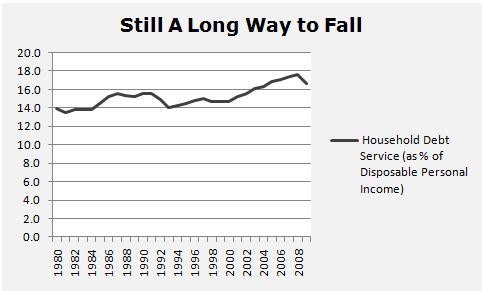
    The chart to the left, based on Federal Reserve Board data, shows that service on mortgages, credit cards and other forms of household debt peaked at 17.5% of after-tax income in the third quarter of 2007 before falling to 16.4% two years later. That implies that consumers have accomplished only one-third of the de-leveraging needed to get back to the 14.0% indebtedness experienced as recently as 1993. (Click on image to view details.)

    Economists debate whether the โ€œnew frugalityโ€ represents a fundamental shift in American values, or if consumers are just making a virtue of necessity as financial institutions curb their lending for their own reasons. Evidence suggests that a little of both is occurring. Boomers have awakened to the fact that they will retire soon and that they have done too little to prepare for life after the paycheck. Although some Boomers will put their faith in God or the U.S. government, others are trying to spend less and save more.

    Similarly, there is evidence that the U.S. population generally has come to see the pitfalls in a life dedicated to the accumulation of material possessions and status symbols. As part of the nationโ€™s greening consciousness, people are increasingly aware that buying more โ€œstuffโ€ sends economic and environmental ripple effects across the globe, from the decimation of rain forests to the emission of greenhouse gases. In a parallel trend, market research tells us that people are more likely to say that the most important priorities in life are friends and family rather than earning more money or being famous. It is unknowable how long this cultural shift will last, but when reinforced by badly burned financial institutions imposing stricter lending standards, itโ€™s a good bet that consumer spending will remain depressed for years.

    By simply not borrowing more, consumers will slow economic growth by 1.4% per year compared to the U.S.’s historic performance since 1990. If newly frugal consumers continue de-leveraging to levels of indebtedness prevailing 20 years ago, the unwinding could steal an additional 1.0% of annual economic growth over the next 20. Absent a new source of dynamism, a potential combined loss of 2.4% in the annual economic growth rate suggests that economic performance could be sickly for the next two decades.

    So, how does this quick analysis inform our understanding of the debacle, known as Boomergeddon, to come? First, slow consumer growth must be viewed in the context of the massive overhang of bad commercial and residential real estate debt (see “The Ugly Ain’t Over Yet, Not by a Longshot” and “The Ugly Ain’t Over, Part II“), which will ravage bank balance sheets and crimp lending. If economic growth is slower and of shorter duration than projected by the Obama administration, deficits will be considerably higher than the $9 trillion between 2010 and 2020 also forecast by the Obama administration.

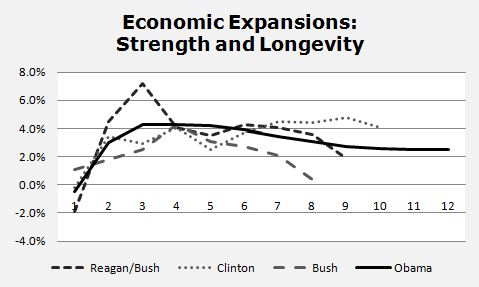
    On the surface, the Team Obama’s 10-year budget forecast seems fairly cautious. This year, 2010, will resume economic growth at a tepid rate, but the expansion will gain momentum over the next few years and then settle into a slow-but-steady mode for the rest of the decade. However, a comparison with previous business cycles shows that the O Team is predicating its optimistic budget forecast on the strongest, longest economic cycle of the past 40 years. (Click on image to view details.)

    First, compare the Obama forecast for the first four years of the business cycle: Under an Obama presidency, the U.S. will outperform the first four years of the Clinton and Bush II business cycles, lagging only the turbo-charged expansion of the Reagan years. Moving into the middle years of the business cycle, Obama expects U.S. economic performance to trail Reagan and Clinton, but only by a modest margin. Then, in the final stages of the expansion, Obama expects the economy to keep to going — the Energizer Bunny of the economic world. While the Bush II’s business cycle lasted only eight years, Reagan/Bush’s nine and Clinton’s ten, Obama projects economic growth into the indefinite future in a state of never-ending bliss.

    Needless to say, not everyone expects to see such a strong business cycle. Some, like U.S. Chamber of Commerce President Tom Donohue, have warned of a double-dip recession brought on by a wave of new taxes, regulations and mandates. One need not heed Donohue, however, to think that the current economic expansion will be weak — for reasons that predate Obama’s elevation to the presidency and have nothing to do with his political agenda. Let me emphasize: Republicans could win control of Congress this fall, Obama could lose re-election in 2012, a new team could enact a new economic policy, and the political pyrotechnics would not change the underlying economic trends. Obama’s sin is not in creating our current economic dilemma but in failing to acknowledge the effect it will have on the economy, deficits and the national debt over the decade ahead.

    Boomergeddon is coming, baby. Deficits are gaining momentum, with entitlements and interest payments on the debt spinning out of control. Within a few years, the chain reaction will be unstoppable.


  • Take That, Big Bird!

    Gov. Bob McDonnell could make good this week on aims of the Republican-dominated House of Delegates to slash state funding for public television and radio.
    To be sure, a number of revenue-starved states have cut funding to their public television radio stations by at least $23 million this fiscal year, according to the Association of Public Television Stations.
    McDonnell’s plan would phase out $2.2 million for public broadcasting of the $8.2 million now planned in the proposed 2010-2012 budget.The ultimate goal would be to cut state funding altogether for public tv and radio. A final decision could come as early as Wednesday as the General Assembly gathers to consider final tweaks to a $77.7 billion budget over two years.
    True, the conservative governor has made it plain that times are tough and lots of things face cuts that were heretofore considered off limits.
    But when one considers McDonnell’s spawning ground of Regent University and his mentor televangelist Pat Robertson, the move seems a little too curious.
    Public radio can provide excellent coverage unmatched by commercial networks. Their global stretch is impressive. The depth is real. One example is NPR’s coverage of the 9/11 events which I find still haunting to this day.
    NPR, however, is thought by some on the right wing to have a “liberal” bent since it deals with issues often left alone by outlets such as “fair and balanced” Fox News. These include the problems of the poor and outcast, a tough look at the private sector, especially banking in the light of the 2008 crash, detailed probes of civilian deaths at the hands of U.S. troops in Iraq and Afghanistan and issues relating to gas and lesbians whom many right-wing and/or “Christian”stations demonize.
    For an example of the suspicion, look no further than the neo-Neanderthal editorial pages of the Richmond Times-Dispatch which slammed NPR for labeling as “anti-union”Massey Energy. The Richmond-based coal firm has been called to task repeatedly for safety and environmental concerns. A Massey mine was the scene of the worst mine fatalities in 40 years last week. However, if the RTD knew anything about West Virginia, where the disaster took place, it would know that union struggles are every bit a part of coal mining as methane gas. Among Massey’s notoriety is its efforts to quash union organizing, thus eliminating another layer of potential review that might have saved 29 lives April 5.
    Naturally, canning Virginia funding for public broadcasting is going to be in the gun sights of the conservative House of Delegates, which also sees NPR as a dangerous threat to their version of the truth.
    Cutting the funding wouldn’t kill public broadcasting in Virginia, but it would hurt. By some accounts if the House’s original version of the cuts happened, the Community Ideas Station based in Richmond which serves other markets in Charlottesville, the Southside and Northern Neck, would lose 17 percent of its budget. Public TV and radio execs say services would most definitely be affected. The DC area might be shielded since stations such as WETA and WAMU are bigger deals with greater access to money.
    To be sure, the Corporation for Public Broadcasting would continue to fund the stations, which would also get money from their now-ongoing seasonal fund drives. Some members of the state Senate have said they’d try to push the effort back.
    But at a time when Mainstream Media is cutting back dramatically on reporting and commercial radio dials are dotted with the dogmatic likes of Glenn Beck and Rush Limbaugh and his ditto heads, thoughtful Virginians stand to lose with McDonnell and the House’s action.
    Peter Galuszka
    Author’s note: I had to revise the figures which I took from an inaccurate Richmond Times-Dispatch story. I confirmed them with State Budget Director Dan Timberlake. I apologize. PG

  • Exactly What High Taxes?

    Once again we head for the parallel universe!
    The Tea Party Express Tour, starring Sarah Palin, is heading for downtown Richmond tonight. From 6:30 to 8 p.m., the “Taxed Enough Already” crowd will sling their bile at Big Government, Liberals and Big Taxes. They will flap their rattlesnake “Don’t Tread on Me” flags and call for an end to Barack Obama “socialism” and the huge taxes he is bringing.
    Meanwhile, back on the home front, your faithful blogger of Gooze Views is quietly awaiting for his federal income tax return, despite the fact that 2009 was not exactly one of his greatest years, income-wise. We managed to pay our mortgages on time and balance other debt. But it was pretty bad. One wonders why, if all the hysteria is to be believed, why I wasn’t hung out to dry, tax-wise.
    It turns out that a lot of Americans are wondering the same thing. According to a study by the Center on Budget and Policy Priorities, Americans have actually been paying less income tax, in fact, dramatically less.
    The average federal income tax rate for a median-income family of four (which pretty much defines us) reached its peak of about 12 percent during the worst stagflation years in the late 1970s. It dropped under the Reagan Revolution to about 8.5 percent before plateauing at that level as Reagan’s Big Government spending, mostly for defense, finally caught up with the taxpayers. Then, under Democrat Bill Clinton, it really tumbled to about 5.5 percent. George W. Bush say an uptick before his tax cuts kicked in to the 4 to 5 percent level.
    Tax credits of $800 for married joint filers under Obama’s American Recovery and Reinvestment Act and other cuts will make the average American family pay about 4.6 percent in 2009. That’s about the lowest rate since 1955, according to the Center.
    To be sure, payroll taxes are up and it is uncertain how much taxes will spike as more deficit spending bills come due. I am sure My Dear Baconaughts will have a field day pushing this particular idea, especially the Big Bacon Himself who believes his new Boomergeddon religion.
    Whatever. I can’t predict the future as well as some of you all can. But I due wonder what the Teabaggers and Sarah Palin are doing out there wailing about excessive taxes when the rates are the lowest they have been since 1955, if you believe the Center.
    Are we in a parallel universe? What was that big light in the sky over Iowa and Wisconsin and the big boom anyway? Maybe aliens have something to do with it.
    Peter Galuszka

  • Virginia’s Most Bankrupt City?

    Here’s a “top ranking” list you don’t want to be on: Business Insider‘s list of “America’s Most Bankrupt Cities.” Unfortunately, the fair city of Norfolk appears there with a $26 million deficit.

    I have not been following developments through the Virginian-Pilot, but the Business Insider‘s description is pretty scary:

    City Manager Regina Williams has whittled down a deficit of up to $46 million (including $10 million in current-year shortfall) in a few months. But the rest of the way is an uphill fight. City departments have dismissed her request for 20% budget reductions. Schools are asking for a $6 million budget increase. Someone’s getting disappointed in the April 20 proposal.

    The consolation is that Norfolk’s per capita budget deficit is only $110. Things could be worse… like they are in Harrisburg, Pa., where the per capita deficit is $1,500!

    Beware, Virginia, you are not exempt from Boomergeddon. Borrowing $650 million from the VRS to balance the budget? Naughty, naughty.


  • Richmond’s Gong Show


    One wonders after nearly three months in office, just what is going on in the head of Gov. Bob McDonnell.

    After about a decade of steadily building a reputation for reason and fair-mindedness, suddenly Virginia is the Butt of All Jokes. We’ve made Jon Stewart’s “Daily Show” on the Comedy Channel, Gail Collins in the op ed of The New York Times, the lede story on AOL news and on and on.
    The latest bit of mindlessness is McDonnell’s resurrecting April Confederate History Month after his two Democratic predecessors quietly laid it to rest much to the thanks of the African-American community. Not only did McDonnell issue a small but very loud decree reinstating the month-long memorial, he somehow (hard to believe) completely left out any recollection of slavery.
    To his credit, McDonnell issued a public apology and retracted his initial forgetfulness and ponied up that slavery was (ahem) a bad thing. But the damage had been done. What was he thinking when he made the original proclamation?
    As Rasheed N.C. Wyatt, president of the Newport News chapter of the NAACP said: “Although the Governor has issued an apology after the fire storm of public pressure, he still misses the point. Inserting language to a proclamation which is already offensive simply demonstrates how out of touch he is with the African-American community.”
    The new Gong Show in Richmond is gaining a lot of bad press and ridicule.
    Exhibit A is our Attorney General Ken Cuccinelli whose proclamation that public universities had no legal basis to ban discrimination against gays and lesbians provided fodder for Jon Stewart. He had a field day displaying “the Cooch’s” photos and then reminding the national television audience of the famous “Virginia Is For Lovers” tourism slogan.
    Cuccinelli has also won attention for his suits against the federal EPA on global warming and for his threat to sue on new mileage standards for cars. Before this, McDonnell won a lot of coast-to-coast disgust and/or bemusement for his early 1980s master’s thesis which said that women needed to stay at home and that gays and fornicators deserved no state protection.
    All of this makes Virginia look like it did look a few decades ago — a bunch of Rednecks and would-be Southern patricians still living in their mythology and wanting the rest of us to embrace it.
    Homage to the Confederacy is simply too dangerous a mine field to tread. After Richmond fell in April, 1865 and after reconstruction, there was a New Reconstruction around about the 1890s. That’s when Jim Crow laws, unheard of before, suddenly became “the Southern way of doing things — the way things always were.” Richmond became the destination for thousands of white former Confederate soldiers, who, finally free of Northern occupation garrisons, started the moonlight and magnolia romance that was in large part mythology.
    Monument Avenue in the former Confederate Capital remains a kid of kitschy leftover. What other city would have Paris-style streets commemorating Robert E. Lee and his horse Traveler or Stonewall Jackson and his horse Old Sorrel?
    Don’t get me wrong, I have always been a student of the conflict and believe that there are things to admire in people like Lee and Jackson, who, strangely, broke state law and educated blacks when he lived in Lexington.
    I also remember that for a college project, I wrote an amateur history of the federal occupation of a small North Carolina coastal town. My primary source was the diary of a Union naval officer who took part in the occupation which was designed to keep British arms and ammunition from moving up Tar Heel rivers and into Southern hands. The diary stood in complete opposition to what the old families of that Southern town believed. Their relatives, according to the naval officer, welcomed the hated Yankees with open arms when their gunboats steamed into town.
    But I stray from the point. One has to wonder when McDonnell will figure out his job. It’s not as if the liberal national media is just waiting to pounce while watching over him with a microscope.
    McDonnell and sidekick the “Cooch” are doing a fine job of making themselves easy targets.
    Peter Galuszka

  • The Tragedy of Coal

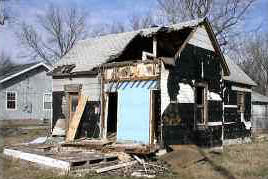
    The massive underground coal mine blast that killed at least 25 miners on the afternoon of April 5 in Naoma, W.Va. brought back some doleful memories.

    Exactly one year ago, I was in Naoma cruising up and down the Coal River Valley working on a story for Richmond’s Style Weekly on Richmond-based Massey Energy Co.’s mountaintop removal practices in which entire mountains in the Central Appalachians are lopped off like a bottle cap to get a rich coal seams. The millions of tons of waste are stuffed in streams and massive sludge ponds filled with billions of gallons of toxic waste sit here and there contained by often fragile earthen dams.
    Now, Massey is the locus of great grief. The miners were working in an especially gassy part of Upper Big Branch Mine went the explosion set off. Some were torn apart by the blast; others suffocated. Hope is fading for another four who may or may not have made it to underground safe rooms equipped to keep them alive for about 96 hours.
    The Massey disaster points out, once again, some very ugly things about the firm and coal mining in general. Coal supplies more than half of our electricity in this country, but it is dirty and dangerous. It is a major contributor to global warming and although safety records are much better than they used to be, mining is still an exceptionally hazardous way to make a living.
    Massey used to be synonymous with a fairly philanthropic family in Richmond that gave to cancer centers and education. True, they were staunchly anti-union but they didn’t have Massey’s Bad Boy image of today. The family sold its interests off first to St. Joe’s Minerals and then to Los Angeles engineering giant Fluor which spun off Massey in the late 1990s.
    The new face of Massey is that of a dark-haired, jowled man named Don Blankenship who is a latter day tycoon. He has stirred controversy by giving millions to elections of legislators and judges, especially in West Virginia where some of Massey’s most profitable operations are. A stickler for the bottom line, he is known to check faxed production reports from his mines every two hours. He’s now drawing fame because in a court case, evidence was produced that he wrote a memo that in his mines, production comes first.
    Blankenship is an in-your-face type. He’s called Al Gore a “greeniac” and once came close to punching out an ABC reporter who confronted him at a Massey facility in Kentucky. Massey was responsible for one of the biggest environmental fines ever when a sludge lake dam burst. Even at the Upper Big Branch Mine, regulators cited it for 50 “unwarrantable” violations last year even though Massey’s Website brags that it’s 2009 safety record was better than the industry average.
    A few personal notes:
    • I spent part of my childhood in north central West Virginia where coal was a big part of life. Back in the early to mid 1960s, strip laws were a joke in the Mountain State and it was common to wake up one morning to find the property next to you blown apart and hauled away. I used to play on the remains which had poisonous yellow lakes from rain leaching from coal. We used to collect the bones of the dead animals.
    • On occasion, some of the fathers of my grade school classmates died in deep mines.
    • When I was away at high school in the DC area on Nov. 20, 1968, a Consol mine blew up in Mannington, in Marion County, a county north of where my family lived. It killed 78 miners. It was not far from where the Monongah mine blew up on Dec. 6, 1907, killing 361.
    • I used to have to take West Virginia history and learn how to spell the state flower, the rhododendron. But our state-sanctioned history books never talked much about the dangers of coal on the War of Blair Mountain in the 1920s that involved the U.S. Army using fighter planes to bomb and strafe striking miners.
    • In 2002, I was five miles in a mountain at Red Ash, Va. on a story for Virginia Business magazine. It was a Massey mine and they actually let me in. It was “low coal” and we had to maneuver in seams no more than 40 inches tall. I remember feeling intensely claustrophobic but in time, a strange sense of calm came over me.
    • Last year, at Coal River, a man in a pickup truck took offense that I was photographing a school next to some giant Massey coal silos. He followed me around the twisting mountain roads for a while.
    So, the current disaster once again spotlights coal’s dangers. A number of people commenting on this blog (who life in coal-free places like the Washington suburbs) say it is an essential part of our energy mix. Well, I guess if you don’t actually live near the coal, you don’t really understand it.
    Peter Galuszka
    N.B. The photo is of the Monongah disaster in 1907.

  • The Ugly Ain’t Over (Part II)

    The United States, and Virginia along with it, is entering a new era of budgetary constraints. The economic expansion we’re now entering will be weaker and frailer than in previous business cycles, with lamentable consequences for the productive, tax-paying economy of businesses and workers — and for the government that feeds off them.

    Two weeks ago (See “The Ugly Ain’t Over, Not by a Longshot“), I made the point that the economy faces a wave of bad commercial real estate loans that will result in another round of crippling write-offs for commercial banks. But the magnitude of that problem is modest compared to the coming second wave of defaults in the residential mortgage business. Even that’s not the end of it. On top of real estate loans going bad, we soon will need to worry about the precarious state of the junk bond market.

    While the Obama administration has supported the residential real estate sector with more than $1 trillion in TARP funds, Fannie Mae/Freddie Mac mortgage purchases, FHA mortgage underwriting and Federal Reserve purchases of mortgage-backed securities, it is not clear that housing prices have hit bottom. The housing sector has ridden out the wave of defaults on sub-prime loans and some โ€œAlt-Aโ€ loans (lesser credit quality than prime loans but better than sub-primes), but it is bracing for a tsunami of bad Option ARM (Adjustable Rate Mortgage) loans. (See the T2 Partners presentation for details.)

    During the peak of the housing bubble, financiers kept mortgages flowing by relying upon Option ARMs, which enticed buyers through ultra-low teaser rates and the ability to defer payments by adding to the mortgage balance. Typically, these loans reset after five years, at which point the payments can jump by 60% or more. Roughly $750 billion of these mortgages were written, and they are coming due. As Option ARM homeowners go into default, they will dump more houses into a sagging market, which will exert more downward pressure on housing prices. In a downward spiral, more homeowners will find themselves underwater, owing more on their mortgages than their houses are worth. If they walk away from the loans in large numbers, they will put even more pressure on housing prices and the financial institutions left holding the bag.

    Indeed, there is little sign that the foreclosure crisis is abating. Monthly year-to-year comparisons between 2009 and 2010 show that mortgage foreclosures were still increasing. Realtytrac Inc. reported more than 308,000 default notices, scheduled auctions and bank repossessions in February, a six percent increase over the previous February. The silver lining was that, for the moment at least, the rate of increase was slowing.

    Similarly discouraging is a recent report by Neil Barofsky, special inspector general for the Troubled Asset Relief Program (TARP), who concluded that the Obama administration’s $75 billion Home Affordable Modification Program (HAMP), which aimed at reducing the number of foreclosures by subsidizing the restructuring of troubled mortgages, was having little effect. Writes Barofsky in a recent report:

    Absent a thorough review of HAMP and its goals, the program risks helping few [homeowners], and for the rest, merely spreading out the foreclosure crisis over the course of several years, at significant taxpayer expense and even at the expense of those borrowers who continued to struggle to make modified, but still unaffordable, mortgage payments for months before succumbing to foreclosure anyway.

    Throughout the 2000s bacchanalia of borrowing, the non-finance business sector was restrained about taking on debt — thank goodness, or business bankruptcies would be far more widespread and unemployment even worse than it is now. But there were pockets of excess in residential and commercial real estate, and in the private equity sector. The growth of private-equity financial companies, which structure debt-heavy buyouts, led to a surge in highly leveraged acquisitions during the 2000s.

    According to a recent McKinsey Global Institute study, companies acquired through such buyouts were 2.7 times as leveraged on average as publicly listed corporations. The use of leverage is a wonderful thing for investors if the companies prosper and pay off their debt — big fortunes can be made in a hurry. But if the economy stalls and companies have difficulty paying off their loans, investors and debt-holders can take a beating. By McKinseyโ€™s estimate, roughly $434 billion of such loans in the U.S. are scheduled to come due between 2010 and 2014.

    Add it all up, and the U.S. could experience another $1 trillion or more of write-offs over the next three or four years — and thatโ€™s just from the problems we know about. Banks, which have barely recovered from the sub-prime loan fiasco, will endure more rounds of massive write-offs. To avoid the prospect of more Wall Street-style bailouts, regulators are requiring banks to set aside more loan-loss reserves and strengthen their balance-sheet leverage, which leaves them no choice but to restrain lending. That they are doing by tightening their lending standards. No more sub-prime mortgages. No more liarโ€™s loans. Lower lending limits on home equity loans. Fewer credit cards issued. More collateral demanded of small businesses.

    Predictably, the politicians will rail at the banks for taking bailout money only to turn around and curtail their loan volume, but banks cannot simultaneously bullet-proof their balance sheets and ramp up lending. It is a financial impossibility that only a grand-standing congressman could fail to grasp.

    The chart above shows the contraction in lending by which the banking industry shared its pain with consumers and small business in the past two years. Large, publicly traded corporations have alternatives to bank loans: They can issue stock and sell bonds. But small businesses, the job-creating locomotive of the U.S. economy, depend heavily upon banks. Obama’s plan to pump up small business lending by $30 billion may help, but it can’t make up for the $110 billion decline in bank lending to business last year alone. If the banks can’t lend, small businesses can’t hire, and the economy can’t grow.

    No, the ugly ain’t over. And the politicians in Washington, D.C., and Richmond had better adjust their plans to that economic reality.


  • “Wallops, We Have a Problem”


    Gov. Bob McDonnell may be dancing for joy, if not perhaps for feeling a little upstaged, by President Barack Obama’s reversal of a stand against drilling for oil offshore of Virginia.

    Exploration could begin in 2012 for a Delaware-sized area of 2.9 million acres about 50 miles off of Cape Charles. The plan is for seismographic studies of possible reserves of oil and natural gas that so far have eluded the oil patch and who, surprisingly, did not dance the McDonnell jig when they heard Obama’s news.
    Of course, Obama is playing politics. By feigning to the GOP, he is trying to get their support for some new version of global warming legislation that very well could see the controversial cap and trade market system dumped. McDonnell gets to crow about Virginia as the “Energy Capital of the East Coast” — whatever that is supposed to mean.
    But there are very real concerns about drilling off of Virginia and they all don’t have to with some limp-wristed tree or whale-hugger. They very well could force Virginia (and maybe McDonnell) into some hard choices about what kind of economic development the state really wants.
    One of the key industry that would be negatively impacted is Virginia’s fledgling space sector. NASA, the Navy and Air Force use the Wallops Flight Facility on the Eastern shore industry for basic science and military research. Plans are to develop Wallops into a commercial space port that could serve as an alternate to Cape Kennedy or Edwards Air Force Base.
    McDonnell out to know this because his party is pushing the space industry hard. Fellow Republican Terry Kilgore pushed legislation in this General Assembly to change insurance requirements at Wallops Island to make it easier for commercial launches.
    NASA Is not happy with the idea of oil rigs popping up off the coast. “That area is right in the middle of our launch range,” a Wallops spokesman was quoted as say in a Newport News Daily Press article.
    The Navy is another issue. The Norfolk-based Atlantic Fleet uses a part of the offshore area for live-fire exercises since it is close to home. Joe Bouchard, former commanding office of the Norfolk Naval Station, has testified that drilling “would have a serious negative impact on U.S.national security” and that the economic benefits appear exaggerated.
    Reaction a little further up the coast (the Obama drill zone stops off Delaware) is likewise sour. New Jersey politicians are skittish because an oil spill could hurt the state’s fishing industry famous for scallops not to mention beach resorts.
    Let’s just say there is significant oil off the coast and the Old Dominion becomes an “Energy Capital” as McDonnell says. Well, that’s no piece of cake because you are talking about putting in piers, pipelines, transfer units, oil liter transshipment barges and perhaps new refineries around the Chesapeake Bay which is already largely dead thanks to pollution. The state still has a sizable watermen’s industry for crabs and fish which would be highly sensitive to the new industrial activity. Oysters are only beginning to make a comeback after decades of abuse. How would they fare in a new oily world?
    But the big unanswered question is “Where is the oil industry?” Part of my work involves tracking it and believe me, if there’s oil, they are not exactly shy. I recently dealt with Chevron which has been busy developing on of the world’s Top 10 fields in Kazakhstan and is expanding both its work and its pipelines there at a cost of billions.
    They and other firms are very active in ultra-deep water in the Gulf of Mexico and Alaska remains a huge interest. So why are they willing to pump in billions after billions in water more than a mile deep when the Continental Shelf off Virginia is relatively shallow and would present much less cost.
    Could it be that there’s isn’t all that much oil there? If there were, wouldn’t Big Oil have nabbed it already. Meanwhile, Virginia had better think about what it might be giving up to follow one ambitious governor’s dream.
    Peter Galuszka

  • Drill, Baby, Drill!

    This is the last thing I ever expected: “Obama to allow oil drilling off Virginia.” Gov. Bob McDonnell must be in heaven right now. Ditto for Virginia Beach Mayor William Sessons.

    I share the environmentalists’ concerns about the potential for oil pollution on Virginia’s coastline, and I am hopeful that strict safeguards will be put into place to prevent oil spills. But oil is just a sideshow. The real fossil fuel wealth off the coast is natural gas. As I understand it, production of natural gas would nicely complement the production of wind power off the coast. Because wind power is inherently intermittent, Dominion Virginia Power would have to maintain a back-up capacity to kick in when the winds die down. The most practical fuel for such back-up power would be natural gas.

    (I presume that Obama’s plan would permit natural gas drilling as well, although the MSNBC story does not address the point.)

    Obama’s decision to open up energy production off the Virginia coast also jump-starts Sessons’ goal of making Virginia Beach the energy production capital of the East Coast. The idea once sounded far fetched. No longer.


  • SORTING WHEAT FROM CHAFF

    SORTING WHEAT FROM CHAFF CONCERNING THE SUSTAINABLE FUTURE SKETCH

    EMR will move on from THE SKETCH soon but several key points were raised by Larry, Groveton and others in comments following ONE MORE NOTE ON SKETCH COMMENTS that may be lost without special attention. This is the last post from which EMR will NOT delete comments intended to belittle, confuse, embarrass and waste time. That will make multiple posts on a single topic required less often.

    Larry said:

    โ€œwell – at least you looked.โ€

    More than that Larry, EMR appreciated the lead to the Melissa Data Carrier Route site.

    โ€œwhile the data is not quite a granular as you might prefer, I think it does get past the zip code dilemma and I find it interesting that someone has melded/fused income and wealth data to end up with a geographical distribution.โ€

    There is one reason they did this:

    A lot of advertisers are willing to buy the information and for them, it is โ€˜accurate enough.โ€™ They are not concerned with the need to achieve a Balance of economic, social and physical activity โ€“ in fact they sell more stuff if there is no Balance within and no Critical Mass of settlement pattern components.

    And sell they do. Since signing on to the site EMR has received two personal Emails and a newsletter from Melissa employees. EMR put a tracer on the registration and it will be interesting to see who they sell the information to. All this advertising frenzy will end when citizens wake up and advertising is phased out because it is no longer effective in convincing citizens they need to consume. (More on that soon.)

    Larry went on to say:

    โ€œso maybe not academic nor implementation …โ€

    Glad that is now straight!!

    โ€œI dunno.. but it sure looks like data that could form a better basis for looking more closely at actual settlement pattern attributes.โ€

    The big issue is, as EMR noted before, WHO WILL PAY for the data and analysis that is needed. More on that below.

    โ€œI wonder what would be the things that would need to be looked at in particular?

    Same things, just looked at within a Comprehensive Conceptual Framework โ€“ and through the right end of the telescope.

    Later Larry said:

    โ€œHere’s a gift for you EMR:

    ” CNT has updated our Housing + Transportation Affordability website to now cover over 330 metros in the U.S. with expanded and improved data. And our analysis shows that only two in five American communitiesโ€”or 39 percentโ€”are affordable for typical households when their transportation costs are considered along with housing costs.”

    โ€œhttp://www.cnt.org/news/2010/03/23/expanded-h-t-index-most-comprehensive-snapshot-of-neighborhood-affordability/

    โ€œThe Housing + Transportation Affordability Index is an innovative tool that measures the true affordability of housing based on its location.

    โ€œhttp://htaindex.cnt.org/โ€

    This REALLY IS a gift! EMR had not checked in with Center for Neighborhood Technology (CNT) for a long time. EMR worked with some of their colleagues on โ€œBlueprint for a Better Region.โ€

    CNT, their colleagues in other Institutions such as STPP and the funders behind CNT, STPP, et. al. were (are) the driving forces behind Location Efficient Mortgages.

    Recall that a Location Efficient Mortgage criteria could have avoided the meltdown at Fannie and Freddie.

    The idea of location efficiency is what the expanded H + T Index is intended to support. Take a look at those maps! Almost all the affordable places are inside R=20. The ones that are outside R=20, based on a quick review, are also the places with high foreclosure rates for โ€˜cheapโ€™ houses.

    SO!!! The Index is not โ€˜perfectโ€™ but those places are reselling. It is the WSH, WL that are bringing down the economy.

    The reason that the H + T is not perfect is that CNT had to rely on the same coarse data granularity that was the topic of earlier discussions. Even the foundations (Institutions) that fund CNT cannot afford to capture and aggregate data at that scale. It will take every Agency working together to do that job. At the present, governance practitioners see no reason to rock the boat. They get paid every two weeks and / or enjoy contributions.

    So, while H + T is great and CNT gets the big picture, the data is open to spurious, mean-spirited, and misleading comments by the advocates of Business-As-Usual.

    In a comment on the BACK TO THE FUTURE? post by Peter G., Groveton said:

    โ€œInterestingly, I am in Bad Homburg Germany today (outside Frankfurt). Looking for examples of EMR’s functional human settlement patterns. I see some of what EMR describes – dooryard, cluster, alpha community, clear edge, etc.โ€

    Groveton:

    When you read Chapter 34 of TRILO-G you will learn that Fahmah had the same observation. Once one has a handle on the Vocabulary, it is easy to see the physical ramifications.

    Groveton went on to say:

    โ€œHowever, I see some of what Jim Bacon worries about too – sky high taxes, lots of restrictions, nanny statism.โ€

    There is a much finer grained governance structure in Germany. Also, the governance structure is much more closely aligned to the settlement pattern. So the Agencies responsible for many of the Services and controls are much closer to those governed (no million population โ€˜municipalitiesโ€™). If that were not the case, there would be much more carping than you heard.

    โ€œHard to say whether the relative calm of relatively functional human settlement patterns is worth the loss in personal freedom.โ€

    Actually it is not that hard.

    The โ€˜personal freedomโ€™ part of the equation is an illusion. That is because those who are enjoying the โ€˜freedomโ€™ are not paying the full cost and the vast majority are not enjoying very much of anything.

    In a recent comment TMT almost put his finger on the issue. He said โ€œtoo many people lose.โ€ The problem is that too many citizens THINK they are losing.

    The vast majority of the citizens, especially those at the top of the Ziggurat, have been convinced by pandering politicians and those who profit from Business-As-Usual that they DESERVE Big Rock Candy Mountain. Larry said something like: โ€œThose who have IT do not want less of IT.โ€

    Well, it is quite simple:

    Five percent of the population cannot continue to consume 25 percent of the resources.

    It has been suggested that over the past 30 years a third of the total global natural resource base has been consumed (wasted). That may be a stretch but over the past 140 years it is clear that far more than half have disappeared. Even in the nation-state where those fortunate 5 percent live (the US of A) there is a widening Wealth Gap. Only 0.5 percent are really enjoying themselves.

    In a global society with high literacy, instant communications and weapons of mass destruction, market economies and democratic governance processes cannot survive with the current trajectory.

    The citizens of India and China what their share and so do those in Southeast Asia, the Middle East and Africa. There is not just that there not enough oil (cheap energy and cheap feed stocks), there is not enough water, top soil, marine and mineral resources, etc. to support anything like the current US of A consumption rates and settlement patterns for 6.5 Billion humans.

    As Amitai E. says: There must be a balance of private rights and community responsibilities.

    To do that with democratic processes and a market economies, the prices must be adjusted to reflect the true total costs determined by democratic processes.

    In addition, the illusion of being able to live โ€˜the way we have beenโ€™ must be replaced by a realistic understanding of the real alternatives.

    EMR


  • Back to the Future?

    Is it March Madness or the start of one of the ugliest periods in Virginia’s history?
    The Old Dominion is fast getting a reputation for the kind of politics of disenfranchisement, stubborn states’ rights-ism and glib constitutional arguments designed to attack the “enemy” a stone’s throw on the other side of the Potomac River that many thought had died out years ago.
    Within two months of taking office, Republican Atty. Gen Kenneth Cuccinelli filed a lawsuit against the Environmental Protection Agency for doing its job and identifying new pollutants (in this case, carbon dioxide).
    Then you had “the Cooch” taking it upon himself while not bothering to inform his fellow Republican, Gov. Bob McDonnell, to declare as invalid any prohibitions by state colleges of discrimination against homosexuals.
    Next, after President Barack Obama’s huge achievement (those are the word’s of London’s Economist magazine, not mine) of getting health reform passed, you had the Cooch, this time with McDonnell by his side, suing the federal government.
    One top of this you have some very ugly incidents. After some yah-hoo Tea Party types in Southside erroneously posted the address of the brother of Democratic Congressman Tom Perrillo, the poor man had the natural gas tube to his grill cut on his screen-in porch. In short order, Eric Cantor, the House Minority Whip from Henrico County, claimed that someone fired a bullet in a Richmond office. City police, who, unfortunately, have a lot of experience with firearm forensics, said that the bullet was fired randomly.
    Pushing this all along are such bigots as Glenn Beck egging on polyglot Tea Baggers and Macho Alaska Girl Sarah Palin coming on with such class acts as posting Web pictures of Democratic politicians with grass hairs around them and saying it is time to “reload” in fighting the creeping socialism of Obama. And this woman wants to be a national leader?
    What is strange is that all this is happening during the administration of America’s first African-American president. There was plenty to bellyache about during the presidency of George “W” Bush but protests never got so personal or venomous.
    As far as the “Cooch” goes, you have to give the man credit — he campaigned on exactly what he has turned out to be. Instead of working on its reputation as a reasonable, progressive state that’s a good place to raise and education family and do business, the Old Dominion is instead being the tip of the reactionary spear. And Richmond, once again, is becoming the capital of a new kind of Confederacy for a slipshod of states’ rights, self-appointed armed militia and zealots out to disenfranchise minorities although this time it is those with a different sexual orientation, rather than blacks.
    All the anti-Washington lawsuiting brings back bad memories of Massive Resistance and other dark periods when Virginia led the way to hatred and bigotry. For a good understanding, look at a piece in Style Weekly written by a former Virginian-Pilot colleague of mine, Margaret Edds. Her commentary reminds us of some rather ugly periods of our history, such as one in 1924 when the General Assembly passed the Racial Integrity Act which made it a felony to marry someone with even a trace, or one-sixteenth, of non-Caucasian blood.
    Or, consider another act by those descendants of Thomas Jefferson in state government.In the 1920s, they pushed policies for the state-sanctioned sterilization of people with low IQs, in a campaign so ruthless that it attracted the interest of none other than Adolf Hitler. Or, how the state officially harassed African-American lawyers in the 1950s who tried to get Virginia to go along with federal civil rights rules and Supreme Court decisions.
    The new attitude is that we can pick and choose which federal laws we like –thinking that got us into the Civil War.
    But is that what Virginians really want? Or have they been high-jacked by right-wing radicals?
    There is evidence that the latter is true. The State Air Pollution Control Board, the citizen body that protects state air quality and works to enforce federal laws of the 1960s and 1970s, has distanced itself from Cuccinelli’s EP lawsuit. It seems that the “Cooch” didn’t bother informing them of the suit before he filed it. What’s more, there isn’t much evidence suggesting that any state college administration formally requested an attorney general’s opinion on the gay rights matter. It seems that the “Cooch” pounced a couple of days after a bill to grant such protection was tabled in a state Senate committee.
    All of this is coming from a fractured GOP (see a Style Weekly story I did). It isn’t evident just how the Republican Party will react from these sudden wing nut plays. One would think that they might retreat and retrench in a more intelligent way. But that might not happen until people realize that something had to be done with health care and after some of these goofy states’ rights challenges get deep-sixed in a higher court. My fear is that reason won’t prevail until blood is spilled.
    Peter Galuszka

  • ONE MORE NOTE ON SKETCH COMMENTS

    It is nearly inconceivable to EMR why otherwise intelligent humans continue to intentionally confuse themselves about the basics of human settlement patterns.

    In comments on TWO NOTES ON SKETCH COMMENTS

    Groveton says โ€œfacts are stubborn things.โ€

    Facts ARE stubborn things and the facts Groveton presents appear to be correct.

    However, as applied these fact are IRRELEVANT. With respect to human settlement patterns and other complex systems, a Comprehensive Conceptual Framework and a robust Vocabulary are essential to understand and apply facts.

    MUNICIPAL BORDERS ARE IRRELEVANT AND PROFOUNDLY CONFUSING IF ONE IS TRYING TO UNDERSTAND HUMAN SETTLEMENT PATTERNS as the comments on TWO NOTES ON SKETCH COMMENTS document very clearly.

    EMR has found that only a Comprehensive Conceptual Framework based on the organic structure which reflects the actual economic, social and physical activities of humans โ€“ and not arbitrary lines that reflected profoundly different conditions 250 years ago โ€“ is useful.

    The serious consideration of human settlement patterns does not require use of the New Urban Region Conceptual Framework (NURCF). A scholar can develop a new framework if they invest the effort. But those concerned with achieving a sustainable trajectory for civilization should not delude themselves that they can make any progress without Comprehensive Conceptual framework.

    In addition to the NURCF, the only other framework widely referred to in current discussions is the much more simplistic โ€œTransectโ€ developed by proponents of New Urbanism. New Urbanism is a well articulated design philosophy championed by founders and members of The Congress of New Urbanism and is only tangentially related to the work of SYNERGY/Planning.

    As luck would have it, Groveton lives within a few miles of a place โ€“ Greater Reston โ€“ that has examples of most of the human settlement patterns components โ€“ Unit, Dooryard, Cluster, Neighborhood, Village and Community โ€“ that are the foundation of the NURCF. The developers, managers and many residents of Reston use the NURCF Vocabulary for all the components except โ€œDooryardโ€ which is often neglected. The same is true for Burke Centre where the largest component is of Village scale. The Dooryard turns out to be very important both historically and in contemporary social and physical interactions. Dooryard was added to the Vocabulary after Burke Center and Fair Lakes were planned, designed and developed.

    Greater Reston is still a Beta Community but, as is the case with The Woodlands, TX, Peachtree City, GA, Irvine, CA, Columbia, MD and other Planned New Communities (PNCs), if one understands what they are looking at they can understand the rudiments of the NURCF and thus of human settlement pattern functions. When one tries to apply these understandings to whole NURs โ€“ especially very large Urban agglomerations such as New York NUR, Paris NUR, Berlin NUR or even Stockholm NUR or Toronto NUR it is difficult without a firm foundation and an understanding of the scale of components. Groveton has traveled the world and says he has not seen the light, yet.

    Those who have read EMRs columns and posts to this blog should have no trouble applying the concepts outlined in GETTING TO A SUSTAINABLE FUTURE โ€“ A SKETCH or in TWO NOTES ON SKETCH COMMENTS.

    For those who want to catch up, a reading of STARK CONTRAST including a review of the Mid-Atlantic (Washington-Baltimore NUR to Central Carolina NUR) map that accompanies that essay and โ€˜readingโ€™ the PowerPoint โ€œNew Urban Region Conceptual Frameworkโ€ (both contained in PART FOURTEEN of TRILO-G) will answer every question and clarify every misunderstanding raised in the comments on TWO NOTES ON SKETCH COMMENTS.

    EMR has stated that he does not have time to go back and repeat what he has already written, however, he will add a few notes from memory which should erase any lingering questions.

    Reston and The Woodlands are the closest places to those who commented on the post so EMR will refer to them. (NB. The Woodlands follows the component Vocabulary of Columbia, MD โ€“ when The Woodlands was laid out the primary planning consultant, the firm for which EMR was VP for Planning and Design, was headquartered in Columbia. Community and Village are similar to Reston but โ€œneighborhoodโ€ is applied to Cluster scale components and there are no Neighborhood scale components. This was also done in Franklin Farm, VA for โ€˜salesโ€™ purposes over EMRโ€™s objections.

    The overall density of Reston is 13 persons per acre EXCLUDING the 1,100 acres + / – in the office / commercial area and EXCLUDING the Town Center. Cluster density ranges from 6 to 70 persons per acres. Over half the residential Clusters in Reston have over 30 persons per acre.

    At the Neighborhood scale density ranges from 10 to 50 persons per acre. That includes the Common OpenSpace WITHIN Neighborhoods.

    The Village Center Neighborhood of Lake Anne Village has the highest density and the greatest mix of uses.

    As Joel Garreau pointed out in Edge City, NO ONE thinks Reston (or The Woodlands) are โ€˜high densityโ€™ yet that is the base number for STARK CONTRAST based on development between 1960 and 2000. With the end of cheap oil, the base density might have to be doubled to support more extensive use of shared-vehicle systems. This fact was pointed out in SKETCH. Even at twice the density at the Cluster scale, few would find the density โ€˜high.โ€™ See READ IT NOW review of Green Metropolis. This increase in density would mean a one third reduction in the amount of land needed for Urban fabric even if the OpenSpace area remained the same. This is also noted in SKETCH.

    Reston Town Center which is outside the 13 persons per acre (PRC) zoning (TNT Please Note) has Clusters that exceed 100 persons per acre. If the Town Center had a METRO station platform under Market Street and all the vacant land were built out at the current FARs within half a mile of the platform, Reston Town Center would be a prototype Village-scale station area and would have residential densities in the 80 to 130 person ranges and COULD achieve a relative Balance of J / H / S / R / A.

    The requirement for a sustainable trajectory — the objective of SKETCH — is sustainable NURs made up of Balanced (Alpha) Communities. That means inside the Clear Edge agglomerations of Alpha Communites that look a lot like Reston plus some that look like North Arlington, South Arlington and Federal (Monumental) Core.

    Accurate is in โ€˜the businessโ€ so he can translate all this to The Woodlands. By the way, while in the Woodlands, check out the same-house, same-builder data for houses in The Woodlands vs ones in scattered โ€œsubdivisionsโ€ west, north and east of the Centroid of the Houston NUR.

    Back to Groveton, EMR has noted over and over that Fairfax County includes all or part of 11 Beta Communities. The comment on payment to Fairfax County is meaningless.

    Net and Gross densities can be confusing. OpenSpace is often credited both within a component and to the next highest component for any given area of Urban fabric. Making this allocation clear is one of the is one benefits using the New Urban Region Conceptual Framework.

    So that there is no confusion:

    As clearly stated in STARK CONTRAST, The five persons per acre density is the GROSS density INSIDE Clear Edge around the Core of the NUR. It is assumed that there is 50 percent OpenSpace (water and land) inside the Clear Edge in the STARK CONTRAST calculations. That leaves 50 percent of the area in Urban fabric with a gross density of 10 persons per area AT THE COMMUNITY SCALE. (See note above concerning the impact of increased density.) Within any Alpha Community there would be from 30 to 50 percent OpenSpace made up of Community, Village, Neighborhood and Cluster scale serving land. All of the Planned New Communities (PNCs) listed above have around 40 percent OpenSpace within the communities.

    Finally, Larry:

    EMR understands the enormous scope of the education process necessary to erase generations of Myths. You may have heard of PROPERTY DYNAMICS? Any additional suggestions you have will be welcome.

    But first to get the web site done.

    EMR