• Don’t Follow Virginia’s Antiquated Example

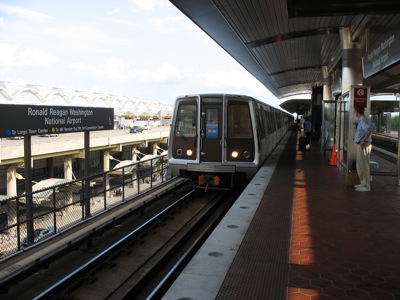
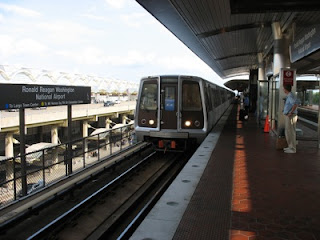
    The growing national battle over union labor has popped up regarding plans to continue with the Dulles rail project, including building an underground station at the international airport in the Virginia suburbs of Washington.

    Conservatives, including editorial writers at the Washington Examiner, are aghast that a resolution passed by the Metropolitan Washington Airports Authority issued a โ€œproject labor agreementโ€ that contractors and subcontractors involved in the $3.5 billion Phase 2 of the Dulles rail project will have to meet union rules and working conditions, although the specifics arenโ€™t clear. Opponents criticize former Democratic Gov. Timothy Kaine for giving up state authority for the project to the MWAA a few years ago.

    Claiming that the labor agreement is a โ€œslap in the face of all working Virginiansโ€ in the right-to-work state, as the Examiner put it, critics also claim that requiring unionized workers will add up to 20 percent more to the projectโ€™s costs. Since only about 4 percent of construction workers in the Old Dominion are unionized, many union workers from out of Virginia will be flocking to the project, they say.

    The outcry is the latest in a wave of union-bashing that has swept the United States after the Republicansโ€™ big win in the midterm elections. Public unions were singled out by conservative Republicans in Wisconsinโ€™s brutal recent budget battle and in other states. The trickle-down is smearing all union workers.

    A broader view is needed here. One reason Virginia is a right-to-work state is that years ago its business elite wanted to keep pay for manufacturing workers low so theyโ€™d have a better chance of stealing jobs from companies in states where unions are strong and wages and benefits are better. The history is an unsavory Southern one in which those in power beat down weaker folk for economic and political gain.

    The fact is that unions bring on better wages and have forced companies and state legislatures to provide better benefits and safer working conditions. The choice for the MWAA is clear. Who do you want to follow? The antiquated ways and so-called โ€œcultureโ€ of the failed Southern past or something a bit more modern? Itโ€™s time to move on from โ€œBeggar Thy Neighbor.โ€

    Peter Galuszka

  • Immigration, Education and Income Disparity

    Let us explore another aspect of the old class warfare theme invoked so often by my esteemed liberal counterpart on this blog: the increasing disparity of incomes between rich and poor.

    Many possible causes have been invoked, mostly entailing the rapacity of the rich. One cause that gets relatively little attention is immigration. Because a large majority of immigrants into the United States are poor and ill-educated, they compete for, and drive down the wages of, lower level jobs for immigrants and native-born Americans alike. That much stands to reason. But the contribution to income disparity is more pervasive than that.

    I draw from a recent policy brief, “The Future of Immigrant Children,” published by the Brookings Institution, a think tank that is, not, incidentally, funded by the “radical right-wing Koch Brothers.” The report dwells on a very real problem: the low level of educational achievement of Hispanic immigrants and its impact on their upward mobility and living standards.

    As authors Ron Haskins and Marta Tienda explain, federal immigration legislation in 1965 changed the criteria for gaining admission to the United States from a quota system that favored European immigrants to one that gave priority to family reunification. The volume of immigrants surged, and newcomers’ countries of origin shifted from Europe to Asia and Latin America. Since 1990, the U.S. has admitted roughly 1 million immigrants per year, and another 500,000 have entered illegally.

    For a variety of reasons, Latinos significantly under-perform Asians and whites in standardized test scores. They also are more likely to drop out of high school and less likely to attend college. Because education is a necessary credential for achieving upward income mobility in a knowledge-based economy, the income prospects of Latinos are stunted. Write the authors:

    Latin American immigrants arrive in the United States with a strong work ethic and strong family values. But by the second generation, their work rates decline, their wage progress appears to slow, and both their nonmarital birth rates and their divorce rates rise. These social and economic trends bode ill for immigrant parents, their children, and the nation. Finding ways to boost achievement and help more Latinos complete high school and attend college or other postsecondary training should be high on the nation’s policy agenda.

    This reinforces my long-held contention that much (not all, but much) of the increasing income disparity in the United States has sociological causes. When the ranks of the lower-income brackets are continually replenished by immigrants (whether legal or illegal), and when second-generation Latinos fail to thrive in school, suffer a diminished work ethic, and develop the social pathologies of divorce, illegitimacy and female-headed households, all other things being equal, income disparities will worsen.

    Nearly one quarter of all schoolchildren in the U.S. are immigrants or the children of immigrants, Brookings says, and the majority of those are Latino. Of course, many of them will turn out to be successful, upwardly mobile contributors to American society. But on average, the flood of poor, ill-educated immigrants effectively depresses average incomes, especially for Americans in the lower income brackets.


  • Why Can’t Poor Virginia Kids Get Dental Service?

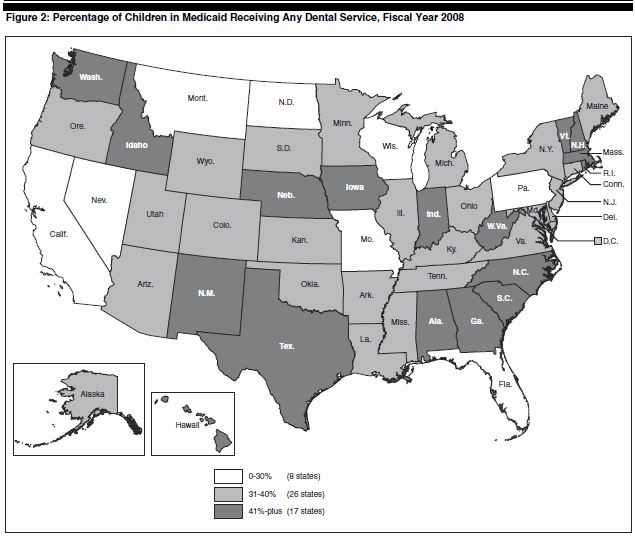
    Virginia falls in the middle tier of states for the percentage of children in Medicaid receiving dental service — somewhere between 31% and 40% — according to a recent study published by the Government Accountability Office. (Click on map for more legible image.)

    The GAO estimated that 6.5 million children nationally had untreated tooth decay, and that rates of dental disease among children in Medicaid have not improved over time.

    A big problem is the low participation rate of dentists in Medicaid and CHIP (the Child Health Insurance Program). Among those who do participate, many place limits on the number of Medicaid patients they will treat. Who would have figured? One solution would be to pay health care professionals enough so they don’t lose money for treating Medicaid patients. Of course, that would be expensive.

    Another might be to expand the number of “mid-level” practitioners, or dental therapists, who can provide routine dental services like teeth cleaning and cavity filling, as they do in the U.K., Canada, Australia and New Zealand. But the use of dental therapists has been highly limited in the United States, according to the GAO: There is one program in Minnesota and another for Alaska Natives. In Minnesota, people can earn an M.A. degree in “dental therapy”, which is a much easier-to-surmount occupational barrier than earning a four-year Dental school degree.

    Seven states (Virginia not among them) do allow dental hygienists and primary care physicians to provide certain dental services without the on-site supervision of a dentist. But these are limited mainly to preventive services.

    The GAO report does not explicitly say so, but it appears that the American Dental Association (ADA) and its state counterparts keep a tight lid on who can practice dentistry and when — using their influence over state government licensing and higher educational programs to limit competition. Responding to the crying need to expand coverage, the ADA response has developed the position of “community health coordinator” to provide “oral health education” as well as limited preventive services. As of last summer, the program had enrolled 27 students in a pilot program. The ADA plans to train an additional 18 by September 2012. Woo hoo! That’ll really help close the gap for millions of poor kids!

    What’s been going on in Virginia? I found this summary by the Children’s Dental Health Project.

    In 1997, concerned about low utilization of dental services in Medicaid, the General Assembly ordered a study. The Department of Medical Assistive Services then convened a Dental Advisory Committee. Then in 2000, a coalition called Virginians for Improved Access to Dental Care formed. Legislative proposals were submitted in 2004. And actual programs were rolled out in 2006 — 10 years later.

    The Virginia solution? The state Medicaid department contracted administration of the dental program through a vendor, Dora Dental, inc., which offered a number of administrative and billing improvements, and the state increased dental fees by 28%. An additional 190 dentists were credentialed to provide Medicaid and CHIP services. Children’s utilization of dental services increased from 29% to 36% by 2006.

    That is still a pitiful number. I see no reason why dental hygienists or dental therapists should be banned from working independently to clean teeth, take x-rays, fill cavities and provide other basic services that they already do routinely in dentists’ offices. Dentists predictably will trot out the old “quality of care” argument. In other words, it is preferable to let two-thirds of Virginia’s poor kids go without dental care of any kind than run the risk that a handful might receive improper care. Such would be the logic of a craft union, er, profession, determined to protect its turf.


  • Rail-to-Dulles: More FUBAR than Ever

    Back when Tim Kaine was governor, he handed control over the Rail-to-Dulles heavy rail project to the Metropolitan Washington Airports Authority over the objections of those who thought that a multi-state authority might not represents the interests of Virginians.

    Well, it turns out that “not represent the interests of” was an under-statement. “Trample on” the interests of Virginians would be more like it. No, make that “run the interests of Virginians through the wood chipper.”

    Last week the MWAA board resolved, contrary to Virginia’s long-held Right to Work law, to require any contractor winning the bid for Phase 2 of the Rail-to-Dulles project to have a labor agreement. As a Washington Examiner editorial notes, because unions represent only a tiny percentage of Virginia construction workers, most employees hired for the job will be union members from other states. Moreover, union wage rates and the lessening of competition to union-shop contractors likely will add between $350 million and $750 million to the bid.

    Where will the money come for all this boodle? Let’s put it this way: It won’t come from Maryland or Washington, D.C., taxpayers, who won’t share any of the burden of funding the MWAA’s decisions. Most likely, the funds will come from drivers on the Dulles Toll Road, who have already been socked with pay for most of Phase 1. Or, who knows, maybe Virginia taxpayers generally may have to pony up.

    Speaking of paying for the Rail-to-Dulles project, I have received interesting correspondence from Gary Woodward with Hurley’s Auto Audio in Tysons Corner. Tysons “landowners” are paying for a modest portion of extending Metro to their neck of the woods by means of a special tax district. But, according to Woodward, many landowners are just passing the cost on to their tenants. Writes Woodward:

    “Most tenants who lease property in tysons have what is called a triple net lease. This lease is a lease in which all expenses (insurance, upkeep, management, and TAXES) are paid by the tenants. This puts the tenants who were railroaded into paying the tax (without input to the Tysons landowners) without representation. In fact we are paying the tax to develop ourselves out of a small business location. Paying for our own poison.”

    Wow, this project just goes from bad to worse. This looks like an issue custom-made for Jamie Radtke, the former Tea Party chair running for the Republican nomination. It won’t work to George Allen’s favor the same way, as he championed the Rt. 288 project in Chesterfield/Henrico Counties long ago… although, I must say, the scale and abuse of that boondoggle pales in comparison to the Rail-to-Dulles fiasco, which, like everything in Northern Virginia, is bigger and more grandiose than anything in Richmond.

    Watch out, Tim Kaine, you’d better get your talking points in order!

    Update: After pondering this post, I do wonder if the Examiner got the whole story. Uncle Sam is helping to pay for Phase 1. Are the Phase 1 contractors required to use union-contract labor as a condition of the Davis-Bacon Act? (No, I’m not related to that Bacon.) If any federal money is being used for Phase 2, could it be that the MWAA had no choice but to comply? Does anyone know the answer?

    Second update: It appears that the Examiner got the story exactly right. Read an extended (if adversarial) commentary in “The Truth about Project Labor Agreements” website. The MWAA’s action is extraordinary. I think this issue will prove to be highly damaging to Tim Kaine in his (anticipated) campaign for U.S. Senate.

    Third update: I must correct an error that appeared in the original post. (I have deleted the offending passage from the post because, once corrected, it is no longer germane.) Drawing from the Examiner editorial (third paragraph, last sentence), I stated that the decision by the MWAA board to build a modified underground Metro station would add $330 million to Phase 2 of the Rail-to-Dulles project. That was incorrect. It would actually reduce the cost by $330 compared to the most recent financing plan, although the alternative selected would be roughly $330 more expensive than a cheaper, above-ground option that also had been considered.


  • Tax Rates vs. Taxes Paid — a Primer for Homer Simpson

    Commentary on this blog shows persistent confusion about the share of federal personal income taxes paid by “the rich.” Pundits of a lefty persuasion focus on the tax rate, which is low by historical standards, and thereby assume that the taxes paid by the rich is likewise low. The left-hand bar on this chart shows what share of taxes the 1.4 million households with the highest income (the top 1%) paid. (This chart comes from the Mercatus Center.)

    The Top 1% took home 24% of all U.S. income, a share that has been increasing steadily over the past three decades. They also paid 38% of all federal personal income taxes. That share, too, has been increasing steadily over the past three decades.

    To some, like President Obama, that tax take is not progressive enough. Citing the low rate of taxation on “millionaires and billionaires,” Obama proposed last week to reduce tax loopholes for “the rich” and raise the top tax bracket on households making more than $250,000.

    Here’s the problem: As Mercatus points out, the super-rich (the 400 highest-income taxpayers in the U.S.) pay a lower effective rate because most of their income is capital gains, which is taxed at a higher rate than wages, salaries and other forms of compensation. Raising the tax rate on wages and salaries will not touch the capital gains tax rate.

    Why not raise the rate on capital gains? If your goal is to beat your chest in a ritual display of liberal wrath and indignation, be my guest. Just don’t expect the super rich to actually increase the amount of taxes they pay. Capital gains are the ultimate discretionary tax — people pay them only when they incur a taxable event — the sale of stock or other asset. If rich people object to paying the tax, they just hold onto their asset without ever selling it. This is “d’oh” economics. Even Homer Simpson could figure it out.

    How do we move toward a more egalitarian society? Not by increasing taxes and punishing the rich. It would be far more effective to reduce taxes and other disincentives to save, allowing middle-class households to accumulate more wealth-generating assets. For the poor, create an economic climate that encourages job creation. But the United States is still hooked on Mass OverConsumption, doing everything possible to stimulate consumption, short-term economic growth and short-term tax revenues, heedless of the impact on the long-term health of the economy.


  • The Wonk Salon: April 19, 2011

    Why ACOs Are Doomed to Fail
    Heritage Foundation
    Accountable Care Organizations are the latest big-government “silver bullet” for bringing health care costs under control. They will only make matters worse.

    How to Make Health-Insurance Exchanges Work
    The Manhattan Institute
    Critics expect Obamacare-mandated health insurance exchanges to get bogged down in politics and bureaucracy. Here is how to make an exchange work in New York state.


  • Surprise! Virginia Hosed by Federal Highway Funding Formula


    Federal fuel taxes (18.3 cents per gallon) paid into the federal highway trust fund are returned to the states according to mathematical formulae that have become increasingly outdated, contends Ronald D. Utt with the Heritage Foundation in a new report. The methodology creates winners and losers.

    “The shortchanged states are typically those with above-average population growth whose transportation needs exceed those of the slower-growing states, which often receive shares greater than what they pay in,” he writes. The 28 donor states, he suggests, should “work together to seek an end to the inequities embodied in current law.”

    Virginia, as it happens, is a donor state. According to Utt’s calculations, Virginia’s “return ratio” in 2009 was 0.895, which means it received 89.5 cents back for every dollar paid into the federal trust fund. That represents a deterioration from its long-term return ratio of 96.1 cents per dollar over the 1956-2009 period.


  • Chart of the Day: State Tax Revenue Losses

    The obvious point of this chart published by the Center on Budget and Policy Priorities (โ€œTop Three State Tax Charts”) is that state tax revenues suffered deeper, more prolonged losses during the 2007-09 economic slump than in previous recessions. While the Center provided no breakdown by state, it is hardly a stretch to suggest that Virginia followed the national pattern.

    Now, take a closer look. State tax revenues recovered rapidly during the 1981-82 downturn but have dropped deeper and/or taken longer to recover in each succeeding recession.

    Anyone want to lay odds on what the next recession will do to state tax revenue?


  • U.S. Firms Send Jobs Overseas

    Among journalists, there’s a tried and true expression: good stories just keep getting better.

    And that’s the case this morning with a Wall Street Journal story reporting that big, global U.S. corporations (the ones Republicans want to hand tax breaks to) have been hiring overseas while cutting U.S. workers. Firms such as General Electric, Caterpillar, Microsoft and Wal-Mart were among the firms that cut American workers by 2.9 million in the past decade while adding 2.4 million overseas.

    In the previous decade, the reverse was true — 4.4 million jobs added in the U.s. and 2.7 million created abroad.

    If you recall, yesterday I posted an item that as S&P was considering downgrading the U.S. government’s credit rating because of deficit fears, the IRS was reporting that something like 40 percent of Americans paid no income tax. The super rich got huge tax breaks. My point was if you are truly concerned about government spending, one needs to look at revenue coming in as well as cuts.

    The very same people who want to cut taxes, especially for the Citation jet crowd, are the same ones who want to give big corporations big tax and trade breaks. Incredibly, the New York Times reported that GE paid no income taxes in 2010, after taking advantage of tax breaks galore, including many overseas, although it apparently did pay some tax estimates.

    Acording to today’s Journal story, GE had 158,000 workers in the U.S. and 152,000 overseas in 2001. Last year, the situation was different — 133,000 in the U.S. and 154,000 overseas.

    I understand that as the world’s economies become increasingly global, corporations have to put their people where the most active markets are. That’s just as Groovy as Groveton, save for one point. Why do conservatives constantly make them out to be the Poor Nellies who have to suffer from U.S. government intrusion, regulations and taxes?

    If one looks at this with his or her budget deficit blinders on (meaning that nothng else is important these days), one sees no joy for the budget or the deficit. If companies employ fewer workers, they won’t be generating wealth and taxes (of course plenty don’t pay taxes anyway). Corporation won’t be paying as much in taxes, either (of course, GE apparently doesn’t pay taxes anyway.) ANy wealth generated will probably be in Kuala Lumpur.

    So at the end of the day, you have to wonder why all the attention is on cuts. Look at Paul Ryan’s shamefully ridiculous budget proposal that would chop up Medicare and give it over the the managed care companies whose track record in keeping Amerians healthy is less than spectacular. That, however, is a topic for another day.

    So, to you Baconauts and Boomergeddons, I say, in the words of the Great Santini, “Haroog, Harooga!

    Peter Galuszka

  • Please Help Me Understand

    Interesting news today for the Baconauts and Boomergeddons. The stock market has tanked because Standard & Poor’s Rating Services has cut its outlook on the U.S. to negative, saying it was worried about government deficits and debt. On the same day, the wire services are noting word from the IRS that “Super Rich See Federal Taxes Drop Dramatically.”

    Huh? Isn’t this confusing! We are saddled with a deficit so big that S&P is threatening the U.S. government’s triple-A rating (to be fair, as Jim Bacon more or less predicted). If progress isn’t made on a frugal budget that addresses the longer term financial issues by 2013, we’ll be in the soup, says S&P.

    One way to help solve the problems is to have more tax money coming in. I mean, do I have that right? If I make more money, my checking account is bigger and it’s easier to pay my bills. Bacon, Groveton and the rest — please tell me if I am understanding this simple concept correctly.

    But forty-five percent of all households will pay no federal income tax at all. Of the 400 taxpayers reporting the highest adjusted gross incomes, the average tax rate was 17 percent in 2007, down from 26 percent in 1992. The year 2007 is the latest for which the IRS has data. The upper tax bracket is supposed to be 35 percent — a fact bemoaned by many Republicans and others in the silk-stocking set. Why the difference? Deductions galore, from real estate, tuition and other credits, help people who make more than $340 million very, very much.

    Once again, with so little money going in from the wealthy, why the big push to keep Bush era tax cuts that benefit them? I guess it is because some people accuse Barack Obama is a “socialist” despite no evidence. If anything, one might criticize Obama to not do more to make the super rich pay their fair share. But, I forgot, he may not even be an American citizen, not if you believe Arizona legislators, who in an extreme insult, are requiring Obama to “prove” he is a U.S. citizen if he wants to campaign in the Copper State.

    That’s off topic. What’s on topic is this basic contradiction. If Americans, especially the super rich, are so burdened with taxes and they shouldn’t be required to redistribute their wealth, why then, do they pay so little in taxes? And if you have such a serious financial crisis that S&P is making dangerous noises, shouldn’t you increase the top line?

    Groveton. Bacon. Please help. Thank you.

    Peter Galuszka

  • What Are Virginia’s Priorities?

    State and local governments across the country all fund the same categories of public services: schools, Medicaid, social services, roads, corrections, etc. It says a lot about the priorities of a state’s legislators and electorate about which programs they fund the most generously (or, in our case, the most parsimoniously).

    In its 2011 edition of “Virginia Compared to the Other States,” the Joint Legislative and Audit Review Commission (JLARC) publishes a number of state rankings. Here is how Virginia fared:

    • Medicaid expenditures per capita total (FY 2008): $691, or 47th highest in the country.
    • Welfare expenditures as a percentage of total state expenditures (2009): 18.8%, or 43rd highest
    • Road expenditures (FY 2008): $633, 42nd
    • State and local taxes as a percentage of personal income (FY 2008): 9.5%, or 40th highest.
    • Pre-K state and local funding per pupil (2007-2008): $4,849, 38th
    • Schoolteacher average salary (2007-2008): $46,680, 29th
    • In-State tuition at public institutions (2010-2011): $8,814, or 14th

    Do lower Medicaid and welfare expenditures reflect hate-the-poor attitudes on the part of Republicans and Byrd conservatives? Or could they reflect the state’s low unemployment rate (39th) and poverty rate (42nd)?

    Put another way, could there be a connection between (a) lower state expenditures on social “welfare” programs and (b) lower taxes? Further, could there be a connection between (b) lower taxes and (c) lower unemployment and poverty?


  • Factoid of the Day: Virginia’s 10-Year Spending Growth


    Virginians pride themselves (or flagellate themselves, depending upon their perspective) for being one of the most parsimonious of states when it comes to state government spending. According to data published by the Joint Legislative Audit and Review Commission, however, we were far from frugal in the decade of the 2000s.

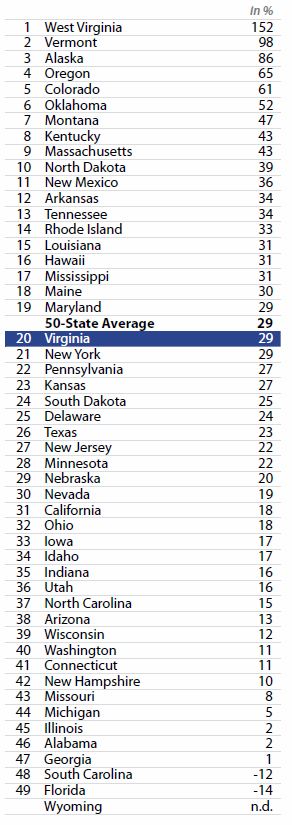
    Virginia’s growth in state spending between FY 2000 and FY 2009 matched the average of all 50 states combined: 29%, adjusted for inflation and population growth. Nineteen states saw a faster rate of government spending while 29 saw a slower rate of growth. (The rate for one could not be determined.)

    Click on table for more legible image.


  • Factoid of the Day: Inflation in College Tuition

    Hat tip to Ray Hyde for the following chart:
    Inflation in college tuition costs separated from the general Consumer Price Index in the early-mid 1980s and began accelerating in the early 1990s. It would be interesting to know what new legislation, new regulation, or economic/demographic trends accounted for the breakaway. My operating hypothesis is that the super-inflation can be attributed somehow to government policy. Does anyone have any thoughts?


  • The Wonk Salon: April 14-15, 2011

    Innovative Work Roles for Teachers
    Center for American Progress
    This study advocates alternatives for school staffing that make use of teachers’ outside-the-classroom talents. A program at West Springfield High School in Fairfax County is highlighted.

    Nonprofit Hospitals More Likely to Sustain Unprofitable Services in Small Town America
    National Bureau of Economic Research
    For-profit hospitals in rural areas are quicker to cut unprofitable medical services; non-profit hospitals support them longer.

    A New Way of Looking at the Bay
    The Virginia News Letter
    The Chesapeake Bay is more than a set of natural processes — it is socio-economic system, which is far more complex.


  • Selling Virginians for Cheap

    Danville in Southside Virginia has been especially hard hit by changing global markets. Once a major textile, tobacco and furniture town, the city has seen its economy decimated as those sectors have taken hits. Moving cut and sew plants to cheaper labor overseas helped shutter such local textile names as Dan River Mills and Tultex, hiking the local unemployment rate.

    So, it was with great joy that then-Gov. Tim Kaine announced in 2006 that Swedwood, a unit of Swedish furniture giant IKEA would build a $281 million facility with 930,000 square feet to build stylish and affordable furniture for IKEA stores in the U.S., including the D.C. area. State and local officials kicked in $12 million in incentives for the factory that would eventually employ 330 workers. The trade press trumpeted Swedwood’s plans for a “cost-effective, lean production flow.”

    And that’s when Virginia’s notoriety for treating its workers shabbily kicked in.

    Although IKEA has a good reputation for employee relations and allows unions in Sweden, not so in little Danville. Workers at the plant complain that promised raises don’t materialize and that they often learn on Friday evening that they must work a weekend overtime shift or face penalties, according to a report in The Los Angeles Times. One worker, Kylette Duncan, told the Times she had to cancel medical appointments for her sick husband because of Swedwood’s chaotic work schedules.

    The International Association of Machinists and Aerospace Workers says it has enough interest at Swedwood to try to organize the factory but the firm won’t let them on the grounds. After all, this is Virginia where the “right to work” anti-union concept is a cherished idea. The firm hired labor-busting law firm Jackson Lewis of Richmond to help blunt organizing efforts.

    According to the Times, the story has been all over the media in Sweden but has gotten little attention in the U.S. Small wonder since the unions have faced a bashing, especially from budget-cutting Republicans in states such as Wisconsin.

    On oddity is that the official who pushed landing Swedwood is no Republican at all, but former Gov. Tim Kaine who has been head of the national Democratic Party and is running for the U.S. Senate.

    But then, when it comes to selling Virginia’s cheap labor, it really doesn’t matter which party one belongs to.

    Peter Galuszka