• Is the Tax-Free Muni a Financial Dinosaur?

    Have tax-free municipal bonds outlived their usefulness? I would argue that they have.

    The tax exemption for municipal bonds has been around since 1913, when the federal income tax was established. Its purpose was to comply with the current thinking in constitutional law, which prohibited the federal government from taxing state or municipal financial instruments.

    However, the legal doctrine of “intergovernmental tax immunity” was steadily undermined over subsequent decades. In 1988, the Supreme Court declared it in 1988 to be “thoroughly repudiated.” The original premise for tax-free munis may have disappeared, but the vested interests benefiting from the exemption were so powerful that they defeated any effort to repeal the exemption.

    Now a new paper by the Center for American Progress, “Bring Back BABs,”argues that tax-free munis are an inefficient way for the federal government to help state and local governments raise money for capital expenditures. Authors Jordan Eizenga and Seth Hanlon categorize the tax exemption for municipal bonds as a โ€œtax expenditureโ€ representing a claim against federal government revenue. That implicit expenditure will amount to $230.4 billion over the 2012-2016 period. Moreover, the tax exemption is economically inefficient. An estimated 10 percent to 20 percent of the subsidy is captured by bond buyers in higher tax brackets at a cost to U.S. taxpayers of more than $6 billion per year.

    The authors’ preferred alternative is Build America Bonds, in which the federal government directly subsidizes state and local governments by paying a portion of the interest payments on the bonds. BABs were enacted in 2009 as part of the Obama administration’s recession-fighting strategy, but Congress let the program die at the end of 2010 on the grounds that the program was costing billions of dollars.

    Bacon’s bottom line: I say, end the municipal bond tax exemption and spike the BABs bonds. Let state and local governments pay the same price as everyone else for capital.

    Eizinga and Hanlon are right: the tax-free bond status is a hidden subsidy. People don’t notice it because it doesn’t represent a spending line item in the federal budget. Taxes not collected are difficult to measure, so the federal government’s commitment of resources is more or less invisible. If Americans want to achieve transparency in government spending, we need to get all such implicit spending commitments out in the open where people can see them and prioritize them. So, BABs are probably a better way to subsidize state-local governments than municipal bonds are.

    What the authors fail to do is make a case that state-local governments should enjoy a privileged access to financial markets. Without question, some bond-backed projects are worthwhile. But how many useless projects have been financed with munis that never would have seen the light of day without the tax exemption? All issuers of debt should compete on a level playing field.


  • About Obama’s Rich People…

    (As published in today’s Washington Times).

    I have a vision of hell. There are no pitchfork-wielding demons flitting about, no lava pools vomiting pitch, no goateed Lucifer polishing his horns. The devil is dressed in a button-down shirt and gray suit. He is a GS-12 official for the Internal Revenue Service (IRS) and his minions are tax preparers. When we meet our final reward, the punishment for our crimes is to undergo eternal audit.

    I speak of this not because I personally have had a lamentable encounter with the tax system, but because my 81-year-old mother has. She reads the Wall Street Journal, studies Barronโ€™s and passes the day with CNBC flickering in the background, yet she finds the tax code incomprehensible. So she pays roughly $900 a year for tax professionals to file her taxes for her. Two years ago, her certified public accountant made a mistake that would have cost her more than $800. This year, H&R Block made a careless error that would have cost her nearly $2,000.

    The tax system that shuttles citizens between the IRS, the Virginia Department of Taxation and the tax preparers is so convoluted that my mother at one point was reduced to tears as she tried to get the mess straightened out. In a meeting with one sympathetic state tax official, she broke down. โ€œDonโ€™t feel badly, he told her. โ€œI have people in here crying all the time.โ€

    Thatโ€™s what lovers of the leviathan state donโ€™t get. The tax system doesnโ€™t just take our money – it subjects us to endless torment.

    According to a 2010 report by the National Taxpayer Advocate, an IRS ombudsman, taxpayers and businesses spend about 6.1 million hours a year on their taxes at a cost of $163 billion. That doesnโ€™t include the economic cost of tax-avoidance behavior, in which taxpayers shift assets into less productive endeavors or take into account the dread, frustration and anger of the beleaguered citizen. The cost in anti-anxiety medications alone must be prohibitive.

    President Obama wants to increase the tax on โ€œthe rich,โ€ as if it were some monolithic class of oligarchs. But many of the so-called rich are just like Toots (yeah, I call my 81-year-old mother Toots) who was required to report a capital gain when Wyeth Pharmaceuticals was acquired by Pfizer in a stock-and-cash transaction last fall. If her holdings had been somewhat larger, she would have punched through the $250,000-a-year barrier that Mr. Obama lumps in with the โ€œmillionaires and billionairesโ€ who can โ€œafford to pay a little more.โ€

    Actually, Toots can ill afford to pay even โ€œa littleโ€ more because Federal Reserve policy, implemented with the full support of the Obama administration, has driven down the interest yield on her conservatively invested portfolio – all for the noble purpose of rebuilding the financial strength of the nationโ€™s banks. Thus, Wall Street financiers, who actually are rich, pay themselves big bonuses for profits they did little to earn, while the elderly suffer a deteriorating standard of living.

    More to the point, my motherโ€™s capital โ€œgainโ€ was largely bogus. One thousand dollars of her original investment grew over 34 years to $7,400, seemingly a handsome profit. But thanks to inflation, $1,000 in 1976 dollars is worth about $3,800 today. In other words, slightly more than half of the โ€œcapital gainโ€ was illusory, attributable to inflation. Adding insult to injury, that phantom gain pushed Toots into an income bracket that requires her to pay more for her pills this year under Medicare Part D and to pay a bigger contribution for Medicare Part B.

    Toots doesnโ€™t blame the government for the mistakes made by her tax preparers – not directly. But she canโ€™t help but wonder if the exploding complexity of the tax code might have had something to do with them. Tax preparers are inundated during tax season with people trying to beat the April 15 filing deadline, she says, and their jobs get only more complicated with each passing year.

    I often wonder why she experiences so many more of such torments than I do. Most likely, she says, itโ€™s because I work for a living and donโ€™t have the time to double-check behind everyone. If I paid more attention to my taxes, she insists, Iโ€™d be plucking out my eyeballs in frustration as well. I have to agree, I probably would.

    (Image credit: Washington Times)


  • Cuccinelli Strikes Again

    In two actions destined to set blood to boiling and jugular veins to bulging on the left, Attorney Ken Cuccinelli is once again resisting the overreach of the imperial, I mean, federal government.

    First, the Cooch has asked the U.S. Office of Surface Mining to back off its aggressive regulation of surface mining. The agency has expanded its regulatory role at the expense of the states, he asserts, even though Congress gave states primary responsibility when it passed the Surface Mining Control and Reclamation Act. The AG warned that he would litigate if the agency persists in overstepping its role.

    Second, Cuccinelli has joined the state of South Carolina in protesting a National Labor Relations Board complaint against the Boeing Company as an assault on Right to Work. Boeing had the audacity to build a non-union facility in South Carolina to manufacture its new Dreamliner planes. Rather than organize the South Carolina workers, the International Association of Machinists and Aerospace Workers went to the NLRB. Lafe Solomon, NLRB’s acting counsel, obligingly declared that Boeing’s move represented an unlawful “retaliation” against the union for previous strikes and blocked the company from opening its plant.

    If Solomon’s complaint is allowed to stand, it could give unions effective veto power over any company with union operations from setting up non-union operations in any right-to-work state, not just South Carolina. Cuccinelli sent a letter to the NLRB describing the complaint as โ€œan assault upon the constitutional right of free speech, and the ability of our states to create jobs and recruit industry.โ€ Solomon’s action, he added, seeks to destroy citizensโ€™ freedom from compulsion to join unions.

    While Cuccinelli is fighting to uphold the right to work, he ought to take a look at the recent decision by the Metropolitan Washington Airports Authority to require union labor for the second phase of the Rail-to-Dulles heavy rail project. That’s a little closer to home than Boeing and South Carolina.


  • The Wonk Salon: April 29, 2011

    The Benefits of Electric Power Competition
    National Center for Policy Analysis
    States that have fostered electric-power competition have seen more capital investment, more adaptability to shifts in demand and fuel costs, greater innovation in services offered, and greater use of renewable fuels. Last time I checked, Virginia was re-regulating the electric power industry!


  • Catastrophe Investing with Bob Pugh

    What if I’m right — what if Boomergeddon comes true and the U.S. government goes into default? How do you protect yourself? How do you preserve your wealth while all those about you are losing theirs?

    Even scarier, what if there’s a Japan-sized earthquake…. in California? What if a cyber-terrorist knocks out the electric grid? What if China collapses into civil war and disrupts global supply chains?

    Bob Pugh, the Insightful Investor, and I have all the answers! (Well, mostly Bob has the answers. I mainly dream up terrifying scenarios.) Listen to a podcast of Bob and me discussing catastrophe investing on his Internet radio show.

    Bob, who lives and works in Northern Virginia, has been producing his once-a-week radio show for a half a year now, and he’s built his audience up to 50,000 listeners per month. Chalk up another victory for new media!


  • Hospice Care and Hospital Stays in Virginia

    The publishers of the Dartmouth Atlas have seized upon an important insight: The cost of health care varies widely from region to region across the country, and higher costs are not always associated with superior outcomes. In its most recent report, the Dartmouth Institute plumbs one of the more vexing problems facing health care policymakers: the outlandish cost of caring for patients during the last few months of their lives.

    In “Trends and Variation in End-of-Life Care for Medicare Beneficiaries with Severe Chronic Illness,” the authors suggest that thanks to the spread of the hospice movement, fewer Medicare patients across the country are dying in hospitals and they are spending fewer days in hospitals in the last six months of their lives. Hospice care is beneficial to the patients and their families, and it eases the fiscal stress on the Medicare system.

    However, the intensity of medical care rose for those Americans who did wind up in hospitals. Increases were particularly sharp in two measures: the amount of physician labor per patient and in the number of patients who saw 10 or more physicians.

    The broad trends are interesting in themselves, but it is crucial to delve into the details for actionable insight. As the authors point out:

    Widespread regional variation persists in measures of end-of-life care. In 2007, the percentage of deaths in hospital varied by a factor of almost four across hospital referral regions, and the average number of hospice days per patient in the last six months of life varied by a factor of more than six.

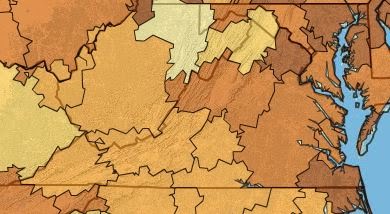
    So, how do we stack up in Virginia? First let’s look at the national map that shows the percentage of chronically ill patents who were treated by 10 or more physicians during the last six months of life:


    A quick glimpse shows that Virginia Medicare patients tend to use health care services somewhat more intensively than in other parts of the country. But there is variation within Virginia, too, as seen below. The two largest metro areas, Northern Virginia and Hampton Roads, are the most resource intensive, followed by the Richmond and Charlottesville hospital service areas, and lower rates in the less populated areas.
    The percentage of Virginians dying in hospitals likewise is higher than the national norm.

    Yet another map shows the variation in the average number of days spent in hospice care during the last six months of life. (Click on the map below to view a more legible image.) You’ll see that outside of Northern Virginia, hospice care has not made great inroads in Virginia compared to other parts of the country — although in another map, not shown here, Dartmouth shows that hospice care is clearly on the rise, though from a low base, in hospital service areas in the western part of the state.
    What are the barriers to hospice care in Virginia? Legal restrictions? Cultural resistance? Disinterest on the part of the medical community? The Dartmouth Atlas doesn’t answer those questions. But the project has done its job if it stimulates Virginians to do so.


  • The Wonk Salon: April 28, 2011

    For-Profits in Higher Ed: Delivering What Society Asks For
    American Enterprise Institute
    Don’t blame for-profit higher ed for low graduation rates and high student debt. Private colleges are doing what the federal government incentivizes them to do: Expand access and damn the consequences.

    Immigrant Children and the Path to Educational Success
    Urban Institute
    The discussion about education reform needs to take into account the special circumstances of young immigrant children, who comprise a growth percentage of the school population.

    Legalize Undocumented Workers, Don’t Deport Them
    Center for American Progress
    An Arizona-style “papers please” policy would devastate California’s economy but legalizing undocumented immigrants would energize it. The same logic (or illogic) holds true for Virginia.


  • Wytheville Community Makes the Cut (but Where are the Other Community Colleges?)

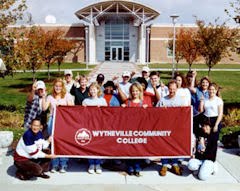
    Drawing upon on data relating to student success, the Aspen Institute has published a list of 120 community colleges across the nation that are eligible to compete for the Aspen Prize for Community College Excellence. Only one community college in Virginia made the cut. And it is (drum roll)….

    Wytheville Community College!

    That doesn’t say much about Virginia’s community college system as a whole. With a population of 7,750,000, Virginia is home to one out of 40 Americans. Proportional representation in the list of top community colleges suggests that we would have at least three represented.

    What, exactly, is being measured? Let me quote the Aspen Insitute:

    We looked at … graduation rates, retention rates, and the total number of degrees/certificates awarded relative to total enrollment, taking into account part-time students as well as full-time students. Using these measures, equal weight was given to overall performance, improvement, and performance by minority students. The selection process measured outcomes with a comprehensive set of data points that took into account the varied missions and populations served by community colleges.

    OK, there’s a touch-feely element to all of this. Aspen is not measuring the number of grads who go on to start their own IT start-ups, work for Wall Street or become millionaires. But it’s worth taking a look at the methodology, deciding if it measures something worthwhile and, if it does, ask why Virginia community colleges aren’t meeting Aspen’s standard of excellence.

    But don’t let that take anything away from Wytheville Community. Good going, guys!


  • Are Alligators Coming for the “Cooch?”

    It came as a shock for Laurie Duncan.

    This past Saturday, she was with her husband and 13-year-old daughter fishing on the Pasquotank River near South Mills, N.C. about five miles south of the Virginia border. There, amidst the marsh grass and cypress roots was a large, seven-foot-long alligator sunning itself. After a few pregnant moments, the gator slipped silently into the murky water.

    State wildlife officials say that as the climate warms, gators are heading north.

    I’m no gator expert, but I have spent a lot of time in Eastern N.C. over the past 50 plus years. My understanding had been that the northernmost breeding population of the American alligator was in the East Lake area a little west of Maneto, N.C. in a vast swamp known mostly by loggers and Air Force and Navy pilots who roar past in jet fighters, dropping practice bombs on several ranges. They are common in southeastern N.C. where some lie waiting for scraps from tourists visiting the USS north Carolina, a World War II battleship moored at Wilmington.

    So, what’s next? Gators in D.C.’s reflecting pool?

    I personally hope one shows up in Jim Bacon’s bird bath. Why? The lead Boomergeddon is a major denier of global warming. He’s in tune with Kenneth “The Cooch’s” efforts to harrass a poor former University of Virginia scientist who came up with the “Hockey stick” approach to dating warming on tree rings. The deniers, you see, say it has nothing to do with human activity.

    It is probably caused by gators on the moon.

    Peter Galuszka

  • Can’t Have all Three

    Few writers on economics are able to say more in about 700 words than James Surowiecki of The New Yorker. He’s done it again in the current issue,

    spelling out in clear and simple terms the choices the U.S. faces with health care.

    Perhaps not too oddly, he’s in sympathy with some of the points brought up by the budget-bashing Baconauts and Boomergeddons, not to mention the Big Bacon himself. “Multitrillion-dollar piles of debt have a way of making people nervous . . .” he writes. Yet he takes the worry a little farther by noting that Washington doesn’t have a spending problem per se but a health-care problem. Medicare, Medicaid and tax subsidies for employers who provide insurance are rising faster than just about any other expense.

    How come and who gets what?

    He says insurance companies are not the real driver of costs (I have often said they are). He says health care providers are, namely hospitals, MRI tests, drugs and doctor’s exams. The fee for service system, not to mention CYA for malpractice, means that lots of uneeded tests are ordered, leading to complaints about waste and inefficiency you see here on this blog

    How to go about it? Surowiecki tears apart the proposal of Congressman Paul Ryan, the darling of the New Right, to go to vouchers for Medicare. All that is a shell game that would mean tax payers pay less and seniors pay more out of their own pockets. If you buy into the Boomergeddons who have made fright about future debts a religion, Granny and Grandpa are going to have a lot less extra pocket change to bear the increased cost to them that vouchers would bring. Since many readers of this blog are a a few years ago from Granny and Grandpa, wake up! They are talking about us! So, a camp believes that seniors should be protected.

    How to reduce waste? ObamaCare has something called the Independent Payment Advisory Board that would try to rein in Medicare spending. But the IPAB seems like another all-powerful Washington agency answerable to no one (ya-da, ya-da, ya-da) and even some Democrats are prepared to get rid of it along with the usual Republicans.

    So where does that leave us? The nut of the dilemma, he says, is that we all like our doctors and want good care. We don’t like how expensive medicine has become.

    “The ideal system, for most voters, would guarantee all seniors reasonable health care, stop the debt from getting out of control, and keep paying health-care providers as before. The problem is that you can only do two of those things at once.”

    Therein lies the rub.

    Peter Galuszka


  • The Wonk Salon: April 27, 2011

    Cutting Corporate Taxes Can Increase Tax Progressivity
    Urban Institute
    Cut corporate tax rates and jack up rates on dividends and capital gains – reduce incentives for corporate tax avoidance and recapture the revenue from payouts to stockholders.

    Infrastructure Bank Means More Power to Washington
    Heritage Foundation
    President Obama’s idea for an “infrastructure bank” would concentrate transportation decision-making authority in Washington, D.C.

    The Right Way to Reform Public Pensions
    Center for Retirement Research
    Hybrid public pension plans are in. They should be constructed so that the Defined Benefit and Defined Contribution portions of a plan are “stacked,” not “parallel.”

    Improve Schools by Improving School Principals
    National Governors Association
    Next to teachers, principals are the most important school-based influence on student learning. School systems should overhaul how they prepare, license and evaluate principals.

    Rewarding Better Teachers by Rewarding Better Evaluation Systems
    Brookings Institution
    Prod local school systems into adopting new teacher-performance metrics by financially rewarding those with the most reliable evaluation systems.


  • The Revolt against Higher Ed Picks up Steam

    Malcolm Harris has published a piece, “Bad Education,” in N+1 magazine, which is “must reading” for anyone obsessing like I do about the higher education bubble. He draws eerie parallels between the Fannie Mae/Freddie Mac-fueled expansion of the housing bubble and the Sallie Mae-fueled expansion of the student loan bubble that should leave you feeling very, very nervous.

    Some excerpts:

    If tuition has increased astronomically and the portion of money spent on instruction and student services has fallen, if the … market value of a degree has dipped and most students can no longer afford to enjoy college as a period of intellectual adventure, then at least one more thing is clear: higher education, for-profit or not, has increasingly become a scam. …

    Today, student debt is a exceptionally punishing kind to have. Not only is it inescapable through bankruptcy, but student loans have no expiration date and collectors can garnish wages, social security payments, and even unemployment benefits. When a borrower defaults and the guaranty agency collects from the federal government, the agency gets a cut of whatever itโ€™s able to recover from then on (even though they have already been compensated for the losses), giving agencies a financial incentive to dog former students to the grave. …

    In addition to the billions colleges have spent on advertising, sports programs, campus aesthetics, and marketable luxuries, theyโ€™ve benefited from a public discourse that depicts higher education as an unmitigated social good. Since the Baby Boomers gave birth, the college degree has seemed a panacea for social ills, a metaphor for a special kind of deserved success. We still tell fairy tales about escapes from the ghetto to the classroom or the short path from graduation to lifelong satisfaction, not to mention Americaโ€™s collective college success story: The G.I. Bill. But these narratives are not inspiring true-life models, theyโ€™re advertising copy, and they come complete with loan forms.

    University administrators build their empires and faculty members enjoy their tenure at the expense of America’s new indentured class: the students.


  • A Real Mexican Hero

    This has nothing to do with Bacon’s Rebellion, but I was so moved by the story, I had to bring attention to it.

    When drug dealers ordered 77-year-old rancher Alejo Garza Tamez to vacate his farmhouse so they could expand their drug routes into the United States, he dismissed his workers and fortified his house. Two truckloads of trafficantes arrived early the next morning, firing shots into the air. Tamez began shooting back. As told by the New York Post, he killed four and wounded two before they finally took him out.

    How many Americans would have the courage to stand up to the drug lords like that?

    For the background we’re not getting in most U.S. media, read “Speaking Frankly: Voices from the Borderlands,” a James A. Baker III Institute report on the metastasis of Mexican drug running into a pandemic of kidnapping, theft and extortion. The lawlessness is so bad in some cities that the middle class is emptying out. By one estimate, 40,000 extortions occur daily in Juarez. As of September 2010, some 10,000 businesses had been shuttered or burned out. When the middle class flees, civil society vanishes.

    Broad swaths of Mexican territory are reverting to a state of anarchy. The border means nothing to the drug cartels. Law-abiding Mexicans and Americans are all in this together. Alejo Garza Tamez should be a hero to us all.

    ——————————————————

    Learn the facts about drug abuse problems so you will be in a better position to help a friend or a loved one hooked on drugs get much-needed addiction treatment.


  • Virginia Pension Funding on the Edge of Acceptable

    The gap between state obligations for employee retirement benefits and the money set aside to pay for them grew to at least $1.26 trillion in fiscal 2009 โ€” a 26% increase in one year, according to this Pew Center for the States analysis. Pension plans accounted for $660 billion of the gap, health care and other benefits for another $604 billion. The states collectively contributed only $73 billion in 2009 toward their plans, far short of the $115 billion urged by actuaries.

    And that may be a conservative projection. The Pew estimate is based on the statesโ€™ own actuarial assumptions. Most states assume that their funds will earn a compounded rate of 8% annually in future years but many observers believe that figure is too optimistic.

    The Government Accountability Office advises states to reach at least an 80% funding level. By that measure, Virginiaโ€™s funding of its public employee pensions is barely adequate, at 80% on the nose. The state’s unfunded liability amounts to $13.8 billion. By purposes of comparison, the General Fund budget this year is about $15.5 billion.

    By Pew’s count, 31 states are doing worse — but 18 states are doing better. (Click on map for more legible image.) Not exactly consistent with our AAA bond rating, is it?


  • The Wonk Salon: April 26, 2011

    Expanded Measures of School Performance
    Rand Corporation
    Uncle Sam should encourage, but not mandate, the states to expand measures of school performance beyond those instituted by No Child Left Behind.

    Coordinate Schooling with Social Services
    Center for American Progress
    Congress should ensure that social services like primary health and dental care are coordinated with teaching children, especially poor children, in schools.

    Driving Down the Cost of Solar Energy through Collaborative Purchasing
    World Resources Institute
    Industry fragmentation makes solar energy more expensive. Governments should join with industry in purchasing collaboratives to begin standardizing the business.